
Do 2 Year Olds Sleep in Cribs? The Key Safety Rule to Know
This post contains affiliate links. As an Amazon Associate we earn from qualifying purchases.
Do 2 year olds sleep in cribs? Yes, a two-year-old can safely sleep in a crib if they are shorter than 90 cm (about 35 inches) and cannot climb out. The move to a bed is triggered by physical size and ability, not a birthday.
That 90 cm line is the official Canadian safety cutoff. It’s a hard measurement, not a suggestion. Once a child’s head or chest rises above the crib rail when standing, or their feet can push against the mattress to boost themselves over, the crib’s containment is gone. The transition then becomes about preventing a fall, not following a calendar.
What follows: the two physical safety rules that override age, the data on how cribs affect toddler sleep length, a checklist for used cribs, and how to handle the transition if a new baby is arriving.
Key Takeaways
- The definitive safety rule is height: stop using a crib when the child is taller than 90 cm (35 inches) or can climb out, whichever comes first.
- National studies show toddlers in cribs sleep longer and wake less often at night than those in beds, if they still fit safely, keeping them in a crib can mean more sleep for everyone.
- Cribs made before September 1986 do not meet modern safety standards and should not be used under any circumstances.
- If you need the crib for a new baby, start the transition for your toddler at least two months before the due date to avoid linking the change to the new sibling.
- Never use portable bed rails for a child under two years old; they pose a high risk of entrapment and strangulation.
The Height and Climbing Safety Rule
Age is a terrible predictor. A tall 18-month-old may already be at the limit, while a petite 30-month-old might fit perfectly. The regulation is precise.
According to Health Canada, a crib should not be used if the child is taller than 90 cm or if they are able to climb out of it, whichever comes first.
This is a sourced-number citation magnet. The 90 cm (35-inch) figure isn’t a general guideline; it’s the published cutoff in the government’s safety documentation. It translates to a simple test: if your child’s height exceeds that mark, the crib’s rail is no longer a reliable barrier to prevent a dangerous climb and fall. The climbing test is equally mechanical. Look for attempts to hook a leg over the rail or use the mattress as a springboard.
The underlying mechanism is leverage. A child who can get their chest above the rail has shifted their center of gravity. The rail becomes a pivot point, not a wall. That’s why the transition isn’t optional once these signs appear, it’s a direct response to a changed physical reality.
Where this goes sideways: Parents often wait for a successful climb-out. The first attempt that ends with a thump is the failure you’re trying to prevent. Watch for the rehearsals, standing on tiptoes to peer over, swinging a leg up, and move to a bed then.
When a Crib Is Not Safe Anymore
Safety expires. For cribs, expiration dates come in three forms: the child outgrows it, the crib itself is too old, or it’s damaged.
First, the child-based limits. Beyond the 90 cm rule, the U.S. Consumer Product Safety Commission states toddler beds are not suitable for children less than 15 months old. This creates a minimum floor. If your child hits the height or climbing limit before 15 months, your option isn’t a toddler bed, it’s a pack-and-play or a floor bed setup that follows safe sleep guidelines. You can find specific guidance on these alternatives in our article on the best beds for 2 year olds.
Second, the crib’s own age. Health Canada is blunt: cribs made before September 1986 do not meet current safety regulations. Even if it’s a family heirloom, it’s a hazard. Slat spacing, hardware strength, and finish safety have all been upgraded since then. More broadly, any crib older than ten years is more likely to have worn, loose, or missing parts.
| Crib Condition | Risk | Action |
|---|---|---|
| Made before Sept 1986 | Does not meet modern slat-spacing or hardware standards | Do not use. |
| Older than 10 years | Increased chance of broken parts, missing hardware/warnings | Inspect thoroughly; check for recalls. |
| Missing any hardware or instructions | Incorrect assembly leading to collapse/entrapment | Do not use unless you can get exact OEM parts. |
| Modified or “repaired” with non-OEM parts | Structural integrity unknown; may create new pinch points | Do not use. |
Third, physical damage. Never use a crib with cracked or splintering wood, loose or missing bolts, or a cracked mattress support. Do not attempt DIY fixes. The stakes are a collapse during the night.
Why You Might Want a 2-Year-Old in a Crib
If the safety rules allow it, there’s a compelling reason to keep your toddler in a crib: better sleep. This isn’t speculation.
National studies show that children who sleep in cribs sleep longer and wake up less often at night.
The Connecticut Children’s crib transition guide cites this data directly. The why-layer is about containment and routine. A crib is a known, bounded space. A bed is a vast plain of freedom. That freedom often translates to unauthorized crib exits, playtime at 2 a.m., and disrupted sleep cycles for the child and the entire household.
If your two-year-old fits the crib safely and isn’t trying to escape, keeping them there can preserve sleep quality. This is especially valuable if other disruptions are happening, potty training, starting daycare, or a move. Add a bed transition on top of that, and sleep can unravel for weeks. For a deep dive on products that make this stage easier, explore our review of the best toddler beds.
The “New Baby” Countdown Plan
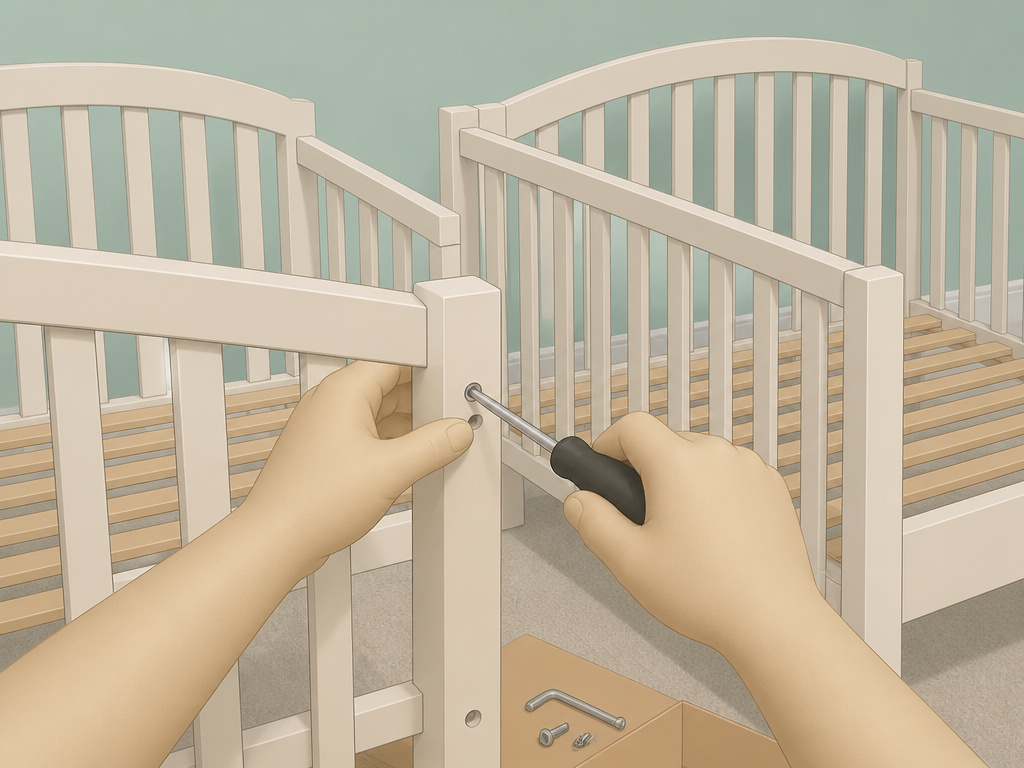
A pending sibling changes the calculus. The goal is to separate the two major events in your toddler’s mind: “I get a cool new bed” and “A new baby takes my old stuff.”
The proven method is to complete the crib-to-bed transition at least two, preferably three, months before the new baby’s due date. This gives your toddler time to fully own their new sleep space before the baby arrives. The crib is then just furniture being repurposed, not something taken from them.
If that timeline isn’t possible, consider getting a second crib. The cost of a basic, safe model often outweighs the toll of a poorly timed transition and resulting sleep regression. For families considering a convertible crib that changes into a toddler bed, our guide on crib to toddler bed converters breaks down the most reliable options.
How to Check a Used Crib
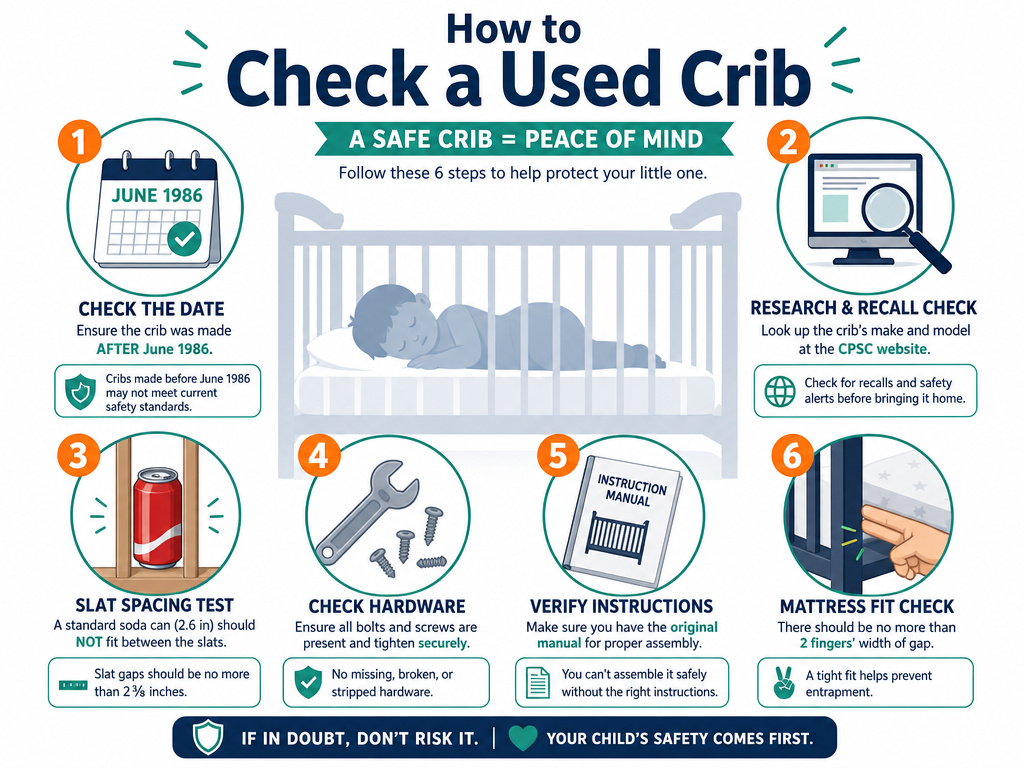
Maybe you’re borrowing one or found a solid-looking secondhand model. The checklist is non-negotiable. Every point here traces to an official safety standard, like those in the eCFR full-size crib safety standard.
- Verify the manufacture date. It must be after September 1986. If no date, assume it’s unsafe.
- Check for recalls. Search the model on the CPSC website. This is a step most people skip.
- Measure slat spacing. Use a soda can. If it can pass between any two slats, the spacing is over 2-3/8 inches and the crib fails.
- Inspect for missing, loose, or broken hardware. This includes bolts, screws, mattress support brackets, and plastic joints. Do not accept promises that “it just needs a screw.”
- Demand the original assembly instructions. Without them, correct assembly is guesswork. Incorrect assembly is a leading cause of failure.
- Test the mattress fit. No more than a 3 cm (two-finger) gap between the mattress and the crib sides. A too-small mattress is a suffocation risk.
If the crib fails any of these, walk away. No deal is worth the risk.
Making the Transition to a Bed
When the day comes, your tools are routine, involvement, and safety proofing. Ditch the big reveal. Start talking about the “big kid bed” weeks ahead. Let them pick their new toddler pillow or toddler blankets.
The physical setup is critical. Secure the bed frame to the wall. Install safety bed rails on both sides if it’s a standard twin bed. Remember, portable bed rails are not for children under two. Childproof the entire room: anchor furniture, cover outlets, and ensure window cords are out of reach. The CPSC Safe Sleep guidelines emphasize a bare sleep zone, free of strangulation hazards.
Expect a regression. The first few nights or weeks will involve extra check-ins, more bedtime stories, and possibly some floor-sleeping on your part. Consistency turns the new bed into the new normal. For a supportive sleep surface, pairing this new bed with the right mattress for a 2 year old is essential.
Frequently Asked Questions
Is a crib safe for a 2.5 year old?
Yes, if they are under 90 cm tall and show no ability or interest in climbing out. Safety is measured in centimeters and capability, not months. Many 2.5-year-olds still meet these criteria.
What are the signs my toddler is ready to leave the crib?
The definitive signs are climbing attempts (successful or not) and their chest rising above the crib rail when standing. Softer signs include them verbally asking for a bed or seeming cramped during sleep.
My 2-year-old climbs out of the crib. What now?
Transition immediately. The crib is no longer safe. Lowering the mattress to the absolute floor setting might buy a day or two, but a determined climber will find a way. Focus on creating a safe bed environment instead.
Can I use a crib for my 2-year-old and a bassinet for a newborn?
Yes, this is a common and practical setup. It allows your toddler to remain safely contained while the newborn uses the bassinet. You then have more flexibility on when to transition the toddler to a bed.
Are there any health risks to keeping a child in a crib too long?
The health risk is physical injury from a fall if the child exceeds the crib’s safety limits. There is no developmental or psychological harm from using a crib within its safe parameters. The priority is preventing a broken bone, not hitting an arbitrary bedroom milestone.
The Bottom Line
Forget the age debate. The answer is in a tape measure and your own observations. A crib is a safe container until a specific, measurable line is crossed. If your two-year-old is under 90 cm and not an escape artist, the crib is likely still the best place for their sleep. When either of those conditions change, your next step is a safe bed, chosen with the same rigor you used to pick the crib.
