
How to Transition Toddler from Crib to Bed: A Smooth Guide
This post contains affiliate links. As an Amazon Associate we earn from qualifying purchases.
Transition your toddler from a crib to a bed by matching three things: a concrete readiness sign (like reaching 35 inches tall), a bed that meets the federal ASTM F1821 safety standard, and a phased plan that starts with naps. Rushing this move before the child can understand basic boundaries is the single biggest cause of repeated nighttime escapes and broken sleep routines.
The federal standard isn’t just paperwork. It dictates the exact guardrail height and mattress fit that stops a sleeping toddler from rolling into a gap and getting stuck. A bed that claims compliance but has a wobbly rail or a too-small mattress fails the test on night one.
What follows: the two physical measurements that trump age, the one safety certification you must verify, and a four-phase transition plan that uses the old crib as a backup instead of a battle line.
Key Takeaways
- Move a child when the crib rail is at or below their nipple line, typically around 35 inches tall, not at an arbitrary age.
- Any toddler bed must comply with the ASTM F1821 safety standard, which mandates guardrails and specific mattress dimensions to prevent entrapment.
- Start the transition at naptime and keep the crib assembled in the room as a fallback option for the first few nights.
- Never introduce a pillow before age two, and always use a small, firm one when you do.
- A convertible crib with a toddler rail kit is often safer and more familiar than a standalone toddler bed.
The 35-Inch Rule and Other Real Readiness Signs
Most advice says to move a child between 18 months and 3 years. That window is so wide it’s useless. Age is a poor indicator. Your child is ready when their body can defeat the crib’s containment.
The clearest signal is height. When the top rail of the lowered crib mattress is at or below the child’s nipple line, they can leverage their torso over it. For most toddlers, this happens around 35 inches tall. A pediatrician from University Hospitals states this directly: if the child can put a leg over the top rail, the crib is no longer safe for containment.
Common mistake: Transitioning because you’re expecting a new baby and want the crib. This often backfires. The older child sees the move as a displacement, not a promotion, and regresses. If you must move them, do it at least 2–3 months before the newborn arrives.
Other signs cluster around cognition and coordination. Can the child understand and follow a simple instruction like “stay in your bed”? Do they walk confidently and get in and out of a chair without falling? Those skills matter more than a birthday. A 28-month-old who climbs like a monkey is more ready than a placid 3-year-old who has never tried.
Toddler Bed Safety: The Non-Negotiables
This is where online guides get vague. They say “get a safe bed.” The U.S. Consumer Product Safety Commission (CPSC) and ASTM International are not vague. Their combined rules form a checklist you can physically verify.
The governing law is 16 CFR § 1217.2, which mandates that all toddler beds sold in the U.S. Must comply with the ASTM F1821 consumer safety specification. This isn’t a suggestion. It’s a federal requirement for manufacturers.
A toddler bed shall comply with all applicable provisions of ASTM F1821-19ε1, Standard Consumer Safety Specification for Toddler Beds, approved June 1, 2019. You may inspect a copy at the Division of the Secretariat, U.S. Consumer Product Safety Commission.
. Electronic Code of Federal Regulations
What does F1821 actually require? It’s a detailed engineering standard focused on preventing entrapment, falls, and injuries from normal use. For you, the parent, three requirements are critical:
- Guardrails: The bed must have guardrails on both sides. The standard specifies their minimum height and mandates that the gap between the guardrail and the mattress must be less than 3.5 inches to prevent a child’s body from slipping through while their head remains trapped.
- Mattress Fit: The bed must be designed for a standard crib mattress (51⅝ x 27¼ inches). There must be no gap larger than 1 inch between the mattress and the bed frame anywhere around the perimeter.
- Structural Integrity: The bed must withstand a specific weight and stress test without breaking, tipping, or developing sharp edges.
When you shop, look for a label or mention of “ASTM F1821” or “CPSC 16 CFR § 1217.2” compliance. If it’s not stated, assume it’s not compliant. This is the bare minimum for a toddler bed.
| Safety Feature | ASTM F1821 Requirement | What Happens If It’s Missing |
|---|---|---|
| Guardrail Gap | Less than 3.5 inches between rail and mattress. | Child’s torso can slip through, leading to head entrapment and strangulation risk within minutes. |
| Mattress Fit | Max 1-inch gap around entire mattress perimeter. | Limbs can become wedged between mattress and frame, causing injury during sleep movements. |
| Corner Posts | Must not extend more than ⅛ inch above the end panel. | Loose clothing or cords can snag, posing a strangulation hazard. |
Your Three Main Paths: Convertible Crib, Toddler Bed, or Mattress on Floor
You have three viable options, each with a different cost, effort, and psychological profile for your child. The right choice depends on your crib, your budget, and your toddler’s temperament.
1. The Convertible Crib Path
This is often the smoothest transition. You take your existing crib and use a manufacturer’s conversion kit to remove one side and attach a toddler safety rail. The footprint, the mattress, and the familiar look remain. Brands like Babyletto specialize in these systems. For example, converting a Babyletto crib typically requires a specific toddler rail kit, some models include it, others sell it separately.
Where this goes sideways: Assuming any rail fits any crib. Conversion kits are model-specific. Using a generic or mismatched rail can create dangerous gaps that violate the ASTM standard. Always use the kit designed for your exact crib model.
This path is ideal if you have a modern convertible crib. It leverages familiarity and is explicitly endorsed in the CPSC toddler bed business guidance as a compliant toddler bed when the proper kit is installed.
2. The Standalone Toddler Bed Path
This is a dedicated, small-scale bed that uses a crib mattress. It’s a good choice if your crib isn’t convertible or you want to free up the crib for another child. The key is verifying it meets the ASTM F1821 standard. Look for beds with fixed, integrated guardrails, not removable ones that can be incorrectly installed.
When choosing a toddler bed, prioritize solid construction over theme-based designs. A wobbly character bed is a safety hazard, no matter how much your child loves the character.
3. The Mattress-on-the-Floor Path
Also called a Montessori-style floor bed, this option bypasses the frame entirely. You simply place the crib mattress directly on the floor in a child-proofed room. It eliminates fall risk entirely and grants the child independence.
The trade-off is that the room must be absolutely safe: anchored furniture, covered outlets, gates at the door, and no small objects. It also forgoes the defined sleeping space a frame provides, which some children need. It’s a minimalist, effective option mentioned by pediatric resources like the St. Louis Children’s Hospital guide for parents seeking an alternative.
| Option | Best For | Primary Safety Check |
|---|---|---|
| Convertible Crib | Families with a modern crib; toddlers sensitive to change. | Verify manufacturer’s toddler rail kit is installed per instructions, leaving no hazardous gaps. |
| Standalone Toddler Bed | Freeing up the crib; rooms where the crib footprint doesn’t fit. | Look for permanent label stating compliance with ASTM F1821 or 16 CFR § 1217.2. |
| Mattress on Floor | Child-proofed rooms; parents embracing Montessori principles. | The entire room is the “crib.” Must be 100% safe for unsupervised roaming. |
The Toolkit: What You Actually Need to Buy
 You don’t need much. Over-buying creates clutter and overwhelms the child. Focus on these essentials.
- The Bed: Either a compliant toddler bed or the correct conversion kit for your convertible cribs. This is your only mandatory purchase.
- A Mattress: If you’re using a standalone bed, you’ll need a crib-sized mattress. You can reuse your existing one if it’s in good condition. For a twin bed conversion later, you’d need a twin mattress for toddler use.
- Safety Rails: If your chosen bed doesn’t have integrated, permanent guardrails, you must add toddler bed rails. These are not optional. Ensure they clamp securely to the bed frame and leave no gap wider than 3.5 inches against the mattress.
- Bedding: Use fitted crib sheets. Do not add loose blankets, pillows, or stuffed animals for children under 12 months, and hold off on a pillow until at least age two. When you do introduce one, choose a toddler pillow that is small and firm.
Skip the themed bedding sets for now. The goal is a calm, simple sleep space. A favorite toddler blanket can be introduced once the child is consistently staying in bed.
Step-by-Step Transition Plan That Works
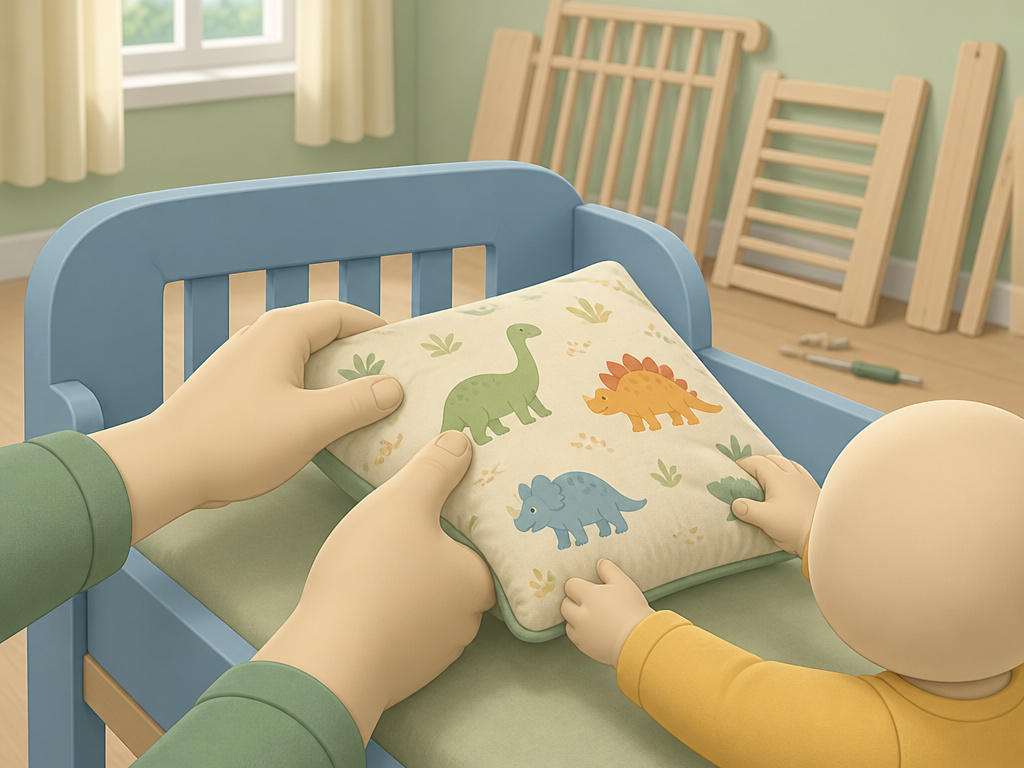 A successful transition is a campaign, not a single battle. Rushing leads to weeks of escape artistry at 2 a.m. This four-phase plan stretches the process over 1-2 weeks.
Phase 1: Prep Work (3-4 Days Before)
Involve your child. Talk about the “big kid bed.” Let them pick out new sheets. Assemble the bed together during the day and let them play on it. Read books about the transition. The goal is excitement, not surprise.
Phase 2: Nap Time Launch
Start with naptime, not bedtime. The stakes are lower, and daylight makes the new environment less intimidating. Do your normal nap routine, but in the new bed. If they get up, calmly return them. If they utterly refuse, let them nap in the crib. No drama.
Phase 3: First Bednights (The Crib Stays)
For the first 2-3 nights, keep the crib fully assembled in the room. Start bedtime in the big bed. If they get out repeatedly after calm redirection, use the crib for that night. Say, “It looks like your body needs the crib tonight. We’ll try the big bed again tomorrow.” This removes the power struggle and uses the crib as a tool, not a punishment.
Phase 4: Crib Removal & Consolidation
Once they’re sleeping through the night in the new bed for 3-5 consecutive nights, disassemble the crib. Move it out of the room. This is the final, concrete step that confirms the new reality.
Easy to miss: The check-back promise. After tucking them in, say, “I’ll come check on you in five minutes.” Then actually do it. This builds trust and often keeps them in bed waiting for you. Gradually extend the time between checks.
Troubleshooting the Inevitable Bedtime Escapes
They will get out. It’s a given. Your response determines whether it’s a three-night phase or a three-month war.
First, child-proof the room. Assume they will get out. Anchor dressers, cover outlets, use a gate at the door. Make the room a safe pod.
When they emerge, use the boring return method. Do not talk, scold, or cuddle. Say, “It’s time to sleep,” lead them back, tuck them in, and leave. Be a monotone robot. Any reaction, positive or negative, is a reward.
If escapes are constant, sit silently in a chair across the room. Don’t make eye contact or speak. Every time they get up, place them back. Your silent presence removes the fun of the game. Move the chair closer to the door each night until you’re out.
Frequently Asked Questions
What age is best to transition from crib to bed?
There’s no best age. The best indicator is size and development. Most children transition between 18 months and 3 years, but watch for the physical signs: when the crib rail is at or below their nipple line (around 35 inches tall) or when they attempt to climb out.
Can I use my crib mattress for a toddler bed?
Yes. A standard crib mattress (51⅝ x 27¼ inches) is the exact mattress specified for a compliant toddler bed. This is a key part of the ASTM F1821 safety specification. Reusing it provides familiarity and saves money.
Are bed rails safe for toddlers?
Properly installed bed rails that meet current safety standards are essential, not optional. They must be designed for the specific bed, attach securely, and leave no gap wider than 3.5 inches between the rail and the mattress. Always follow the manufacturer’s instructions for your bed rails for kids.
What if my toddler is scared of the new bed?
Go slower. Spend more time in Phase 1 (prep work). Let them nap with you in the big bed first. Use a night light. Keep the crib in the room longer as a security blanket. Fear means they’re not ready, pause the transition for a few weeks and try again.
Is a toddler bed or a twin bed better?
For the initial transition, a toddler bed (or converted crib) is almost always better. It’s smaller, cozier, and uses the familiar crib mattress, which feels secure. Moving straight to a vast twin bed can be intimidating. You can move to a twin mattress for a child later, often around age 4 or 5.
The Bottom Line
Forget the calendar. Measure your child. If the crib rail hits at or below the nipple line, start planning the move. Your non-negotiable is a bed that complies with the CFR toddler bed safety rule (16 CFR § 1217.2). Whether you choose a convertible crib to bed, a standalone bed, or a mattress on the floor, guard that 3.5-inch gap between rail and mattress like it’s the only rule in the book.
Start at naptime. Keep the crib as a backup, not a threat. When they get out, and they will, lead them back without a word. The transition isn’t a test of your toddler’s obedience. It’s a test of your patience. Pass it quietly, and everyone sleeps.
