
Are Sleep Sacks Safe for Babies Who Can Walk? Safety Guide
This post contains affiliate links. As an Amazon Associate we earn from qualifying purchases.
Yes, sleep sacks are safe for babies who can walk, but only if the sack is correctly sized, sleeveless, and certified to safety standards like NEN-EN 16781:2024. The European standard explicitly applies to children up to 24 months, which includes many walking toddlers. The real hazard shift isn’t mobility—it’s fit. A sack that’s too large or has loose neck/arm openings becomes a tripping and entanglement risk the moment a child stands in the crib.
That last clause—fit over mobility—is the pivot. A walking baby in a snug, certified sack is fine. A newly mobile toddler in an oversized, untested sack is climbing toward a fall. Safety hinges on three specs you can measure tonight: the sack’s length, the neck opening circumference, and the presence of a recognized safety certification label.
What follows is the breakdown of those three specs, the official age and size limits most parents haven’t seen, the one recall that proves why standards matter, and a step-by-step transition plan for moving from sacks to the first real toddler blankets.
Key Takeaways
- European safety standard NEN-EN 16781:2024 covers sleep sacks for children up to 24 months old, providing a clear safety framework for walking toddlers.
- The neck and arm openings are the critical failure points for walkers—they must be snug enough to prevent the child’s head from slipping through, which is a strangulation hazard if they trip.
- Weighted sleep sacks are not safe at any age, according to the Public Health Agency of Canada, and should be avoided.
- Transition from a sleep sack to a blanket is based on size, not age; stop using the sack when your child reaches the manufacturer’s maximum height/weight limit or can reliably remove it themselves.
- Always check for a CPSC sleep sack recall history; products like the Zigjoy feet sack were recalled for violating mandatory flammability standards, a hidden risk for mobile children.
What the Safety Standards Actually Say About Age
The most common advice you’ll find is “use a sleep sack until age 2.” That’s a simplification of a specific engineering rule. The European standard NEN-EN 16781:2024 Ontw. (and its Austrian counterpart ÖNORM EN 16781:2024) explicitly states it is “applicable to products for use by children up to the age of 24 months.”
This document specifies requirements for the safety of children’s sleep bags… It is applicable to products for use by children up to the age of 24 months.
This standard is the most current, detailed set of safety requirements for sleep sacks. It covers design, construction, and testing to prevent risks like overheating, entanglement, and suffocation. The 24-month cutoff isn’t arbitrary; it’s the point at which the defined risks and testing protocols for a “sleep bag” are deemed appropriate.
But the standard also lists important exclusions. It does not apply to products “for use by children who have the ability to climb out of a cot.” This is the clause that matters for your walker. If your toddler can climb over the crib rail, the sleep sack safety paradigm changes. The sack isn’t the primary risk—the fall is.
| Standard / Guideline | Age/Size Scope | Key Relevance for Walking Babies |
|---|---|---|
| NEN-EN 16781:2024 | Up to 24 months | Provides safety benchmarks for fit, construction, and thermal properties. The go-to standard for manufacturers. |
| AAP Safe Sleep Guidelines | Up to 1 year+ | Recommends wearable blankets over loose bedding. Does not set an upper age limit, focusing on the safety of the sleep environment itself. |
| CFR Part 1615 (US Flammability) | Sizes 0-6X | Defines an “infant garment” for sleepwear. For walkers in larger sizes, this mandatory standard for flame resistance becomes critical. |
The takeaway is that a sleep sack certified to EN 16781 is engineered for safety within the crib for a child up to two. Once climbing begins, you’re managing a different set of hazards.
When a Sleep Sack Becomes a Risk (and How to Know)
A sleep sack doesn’t suddenly become dangerous when your baby takes their first step. The risk evolves. For a non-mobile infant, the main concerns are overheating, face-covering, and hip position. For a walking, pulling-up, climbing toddler, the hazards are tripping, entanglement, and using the sack as a climbing aid.
The neck and arm openings are the new failure points. If the neck hole is too large, a toddler who stumbles while standing in the crib could slip down through the opening. The armholes can catch on crib rail posts or hardware.
Where this goes sideways: An oversized sleep sack on a standing toddler. If the foot of the sack extends well past their toes, it acts like a loose skirt they can step on. The resulting trip and fall inside the crib can lead to impact injuries against the rails.
How do you know if the fit is wrong? Use this three-point check: 1. Length: With your child standing, the sack should not pool on the floor. It should end at or just below the ankles. 2. Neck Opening: You should not be able to fit more than two fingers between the neckline and your child’s collarbone. 3. Arm Openings: They should be snug around the arm, without gaping fabric that could catch.
The ISPID sleeping sack factsheet notes that “the opening for the arms and head should not be too large to ensure that the baby cannot slip out of the sack.” This warning is for infants, but its importance multiplies for mobile toddlers.
If the sack fails any of these checks, it’s time to size down or transition out. Continuing to use it “just for another month” is how minor falls happen.
The Hidden Standard: Flammability and the Recall You Need to Know About
Most parents think of suffocation or entanglement. Almost none think of fire. But for a walking toddler, flammability is a real concern. A child who can stand is closer to night lights, power cords, or other potential ignition sources in their room than a stationary infant.
In the US, children’s sleepwear in sizes 0 through 6X must meet the mandatory children’s sleepwear flammability standard (CFR Part 1615). This includes many sleep sacks. The standard requires the fabric to be flame-resistant or to be tight-fitting enough to not easily ignite.
This isn’t a theoretical rule. In November 2025, the Consumer Product Safety Commission announced a CPSC sleep sack recall for approximately 700 Zigjoy one-piece sleep sacks with feet. The reason? They violated this mandatory flammability standard, posing a burn hazard.
Common mistake: Assuming “100% cotton” means safe. The recalled Zigjoy sacks were labeled 100% cotton but failed the federal flame-resistance test. Material alone doesn’t guarantee safety; certification does.
The recall is a concrete example of why checking for compliance matters, especially for a mobile child. A walking toddler is more active, generating more friction, and their environment changes. When you shop, look for a label indicating compliance with CFR Part 1615 or the similar Canadian standard. If you see no mention of flammability standards, that’s a red flag.
Sleep Sack vs. Blanket: The Safety Comparison for Toddlers
Once your child is walking and nearing the top of the sleep sack size chart, you face a choice: find a bigger sack or introduce a blanket. This isn’t an aesthetic choice; it’s a safety trade-off with clear parameters.
A well-fitted sleep sack is a controlled environment. It stays put, cannot be kicked off, and presents a known, tested risk profile. A blanket is a loose object. It can be kicked into a pile, wadded up, or thrown over the head. For a child under one, the blanket is the clear loser. For a walking toddler over one, the equation changes.
The American Academy of Pediatrics recommendations state that loose bedding can be introduced after 12 months, but they emphasize the crib should remain bare for the first year. The transition, therefore, is about toddler readiness, not a birthday.
| Safety Factor | Sleep Sack (Correctly Sized) | Small, Lightweight Blanket |
|---|---|---|
| Suffocation Risk | Very Low (wearable, no loose fabric) | Low, but present (can be pulled over face) |
| Overheating Risk | Controlled (TOG rating indicates warmth) | Variable (child may bundle or kick off) |
| Tripping Hazard | High if too long | None |
| Climbing Aid | Possible (if used for leverage) | No |
| Ease of Use | Simple for parent, secure for child | Child learns to self-regulate |
The ISPID epidemiology working group report found sleeping sacks may reduce SIDS risk by 20-30%, partly by delaying when a baby can turn prone. This protective effect is most significant for younger infants. For a robust, walking toddler, the primary benefit of a sack shifts from SIDS prevention to maintaining a safe, predictable sleep covering.
So, which is safer? For a toddler who cannot climb out and is in a properly fitted sack, the sack is safer. For a toddler who is at the sack’s size limit or is a determined climber, a small, breathable blanket for toddler sleep in a child-safe bed (like a toddler floor bed) becomes the safer path.
The Safe Transition Checklist: From Sack to Blanket
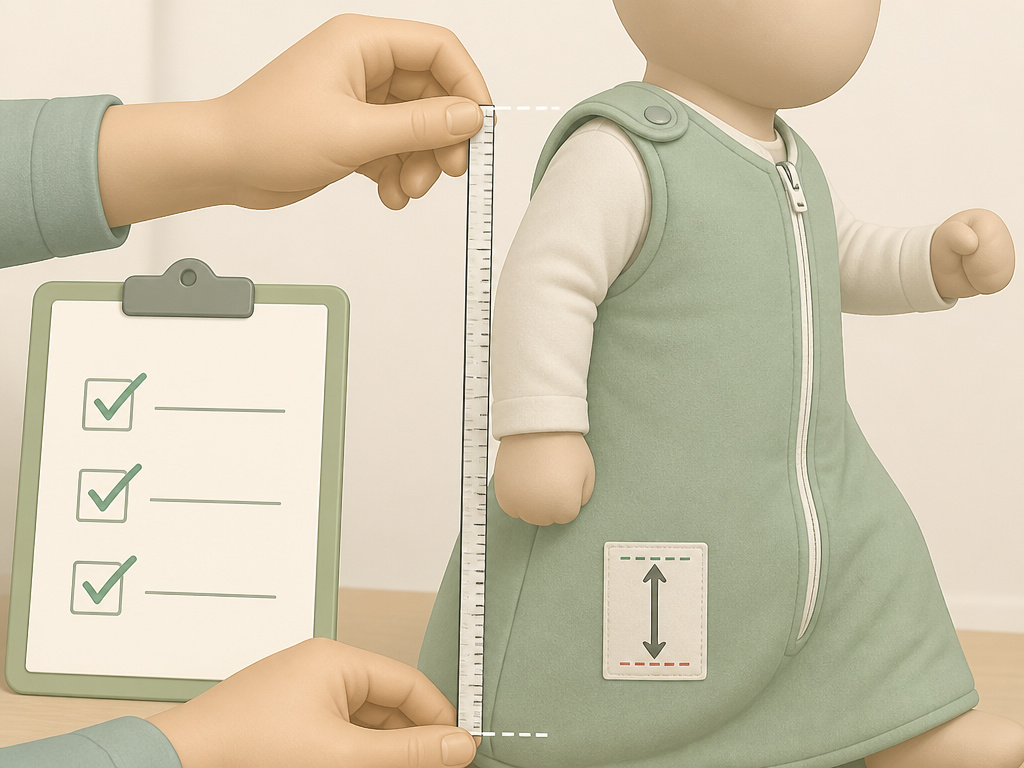
Transitioning isn’t a single event. It’s a process you manage over weeks. Don’t cold-turkey swap the sack for a duvet. Follow this sequence to build safe habits.
Phase 1: The Assessment (1-2 Weeks)
- Confirm your child meets the minimums: At least 12 months old, able to walk steadily, and shows no signs of trying to climb the crib in their sack.
- Measure the sleep sack. If it’s at its maximum length or weight limit per the label, the decision is made for you.
- Rule out weighted options. Remember, weighted sleep sacks are not safe according to Canadian health authorities.
Phase 2: The Introduction (1 Week)
- Start naps with a blanket. Choose a small, breathable, safe toddler blanket like a muslin receiving blanket. Place it across their lap during your pre-nap routine.
- Keep the sleep sack for nighttime. This maintains routine and security.
- Watch closely. Can they pull the blanket off their face if it shifts? Do they immediately throw it? Their reaction guides your pace.
Phase 3: The Switch (1-2 Weeks)
- Once naps are consistently safe with the blanket, try one night. Keep the room temperature slightly warmer to compensate for the missing sack.
- The one step nobody skips: Dress them in warm, fitted pajamas. The blanket is a supplement, not the primary warmth layer.
- If they sleep soundly, you’re done. If they’re unsettled, revert to the sack for a few more nights and try again.
When to pause the transition: If your child gets sick, is mastering a new skill like climbing, or you’re traveling. Stability is key. You can also consider this transition the right time to move from a crib to a Montessori floor bed, which eliminates the fall risk from climbing altogether and makes using a blanket more practical.
Frequently Asked Questions
What is the maximum age for a sleep sack?
There is no universal maximum age. The European safety standard NEN-EN 16781:2024 applies to products up to 24 months. Many children outgrow the largest available sizes (often around 36 months or 40 inches tall) before they are developmentally ready to stop using one. The limit is size, not age.
Can a walking toddler trip in a sleep sack?
Yes, if the sleep sack is too long. When standing, the fabric should not extend past their feet and pool on the mattress. An overlong sack acts like a hobble skirt and is a serious tripping hazard inside the crib. Always size for height, not age.
Are sleep sacks with feet safe for walkers?
Not necessarily. The recent Zigjoy feet sack hazard recall shows that footed sacks must still comply with flammability standards. Furthermore, a footed sack removes the tactile feedback of the crib mattress underfoot, which some experts argue is important for balance and spatial awareness for a standing child. A footless sack is generally the safer choice.
How do I know if the neck hole is too big?
Perform the two-finger test. With your child wearing the sack, try to slide more than two fingers between the neckline and their collarbone. If you can, the opening is too large and poses a potential entanglement or slipping-down risk for a mobile toddler.
What should my toddler wear under a sleep sack?
Stick with fitted, season-appropriate pajamas. Avoid loose tops, dresses, or pants with long, dangling drawstrings. The goal is a smooth, layered system where nothing can bunch up, twist, or cover the face. For a child transitioning to a blanket, warm footed pajamas or a wearable blanket under the blanket itself is a good strategy.
Before You Go
The safety of a sleep sack for a walking baby comes down to a fit check and a label check. Measure the length tonight. Find the certification tag. If it passes, you have a safe, warm container for sleep. If it fails, you have a clear trigger to move to the next stage: a small blanket in a secure bed.
The goal isn’t to use a sleep sack forever. It’s to use the right sleep aid for each developmental stage. For a new walker, that’s often a snug, certified sack. For a climbing, independent toddler, that’s a first blanket in a crib or a floor bed. The timeline is set by your child’s size and skills, not the calendar. Watch them, measure the gear, and you’ll know exactly when to make the switch.
