
Safety Guide: Are Weighted Sleep Sacks Safe for Newborns?
This post contains affiliate links. As an Amazon Associate we earn from qualifying purchases.
No, weighted sleep sacks are not safe for newborns. The U.S. Consumer Product Safety Commission (CPSC), the American Academy of Pediatrics (AAP), the CDC, and the NIH all explicitly warn against using any weighted swaddles, blankets, or sleep sacks for infants. These products pose documented risks of chest compression, suffocation, and reduced oxygen levels, with at least one reported infant death linked to their use.
That official, unified warning from every major U.S. Health and safety body is not a suggestion. It is a directive based on the physiology of an infant’s developing rib cage and the mechanics of sleep. When a regulatory body like the CPSC issues a statement urging retailers to consider stopping sales, the risk calculation has moved past theory.
What follows is a breakdown of the specific warnings, the weight amounts in popular products like Nested Bean and Dreamland Baby, the physical dangers named by pediatricians, and the safe, proven alternatives that don’t gamble with a newborn’s airway.
Key Takeaways
- Every major U.S. Health authority. CPSC, AAP, CDC, NIH, states weighted infant sleep products are not safe.
- A 1 to 1.5-pound weighted sleep sack can represent over 10% of a newborn’s body weight, compressing their flexible rib cage.
- A clinical trial to assess safety was terminated early due to “external controversy,” meaning no overnight safety data exists.
- The Bubpods Sleep Sack was recalled in Australia for posing a “compression or suffocation risk,” a documented case of regulatory action.
- Safe sleep relies on a firm, flat surface with only a fitted sheet and an appropriate, non-weighted sleep sack or wearable blanket.
The Official Stance from U.S. Health Regulators
The guidance is not ambiguous. In April 2024, the U.S. Consumer Product Safety Commission issued a clear, public statement: “Don’t use weighted blankets or weighted swaddles” for your babies. This CPSC safety warning on weighted swaddles aligns with identical warnings from the National Institutes of Health and the Centers for Disease Control and Prevention.
The AAP has been equally direct. In its updated safe sleep guidelines, it advises against “weighted swaddles, weighted clothing or weighted objects on or near the baby,” calling them unsafe. The academy has taken the extraordinary step of opposing the development of a voluntary safety standard for these products, arguing that any standard would “send an incorrect message to families that the products are safe.”
The CPSC, NIH, CDC, and AAP have all warned the public not to use weighted swaddles and blankets. The CPSC has stated it is aware of reports of fatalities and has asked retailers to consider stopping sales.
This unified front is rare. It signals that the risk is considered fundamental, not a flaw in one brand’s design. The core issue is the application of weight to an infant’s torso during sleep, a scenario regulators and doctors say should not exist.
What’s Actually in a Weighted Sleep Sack?
To understand the warning, you need to know what these products contain. The weight isn’t just fabric.
- Nested Bean products for infants under one year use about 1 to 2 ounces of weighted beads, typically concentrated in a central pouch on the chest.
- Dreamland Baby weighted swaddles and sacks contain between 0.8 and 1.5 pounds of plastic beads, distributed across the torso, plus the weight of the fabric itself.
These numbers matter when placed on a newborn. A 7-pound baby wearing a 1-pound Dreamland sack is carrying over 14% of its body weight on its chest. For a 10-pound infant, it’s still 10%. Manufacturers often cite this 10% ratio as a safety benchmark borrowed from adult weighted blankets. The problem is that an adult’s rigid rib cage and robust respiratory system are nothing like an infant’s.
| Brand | Weight Type | Approximate Weight | Placement |
|---|---|---|---|
| Nested Bean | Small beads | 1–2 oz (28–57g) | Central chest pouch |
| Dreamland Baby | Plastic beads | 0.8–1.5 lbs (0.36–0.68kg) | Distributed across torso |
| Bubpods (Recalled) | Weighted patch | Not specified | Cloud-shaped patch on front |
These specs come from company disclosures and recall notices. The Bubpods Sleep Sack, subject to an Australian product safety recall notice, was pulled because its weighted patch could “restrict an infant’s chest and abdominal movement which increases the risk of suffocation.” This is a real-world example of the hazard in action.
The Three Physical Risks Doctors Name
Pediatricians and safe sleep experts point to three interconnected dangers that make weighted sleepwear uniquely hazardous for infants.
1. Chest Compression and Restricted Breathing. An infant’s rib cage is pliable, more cartilage than bone. Dr. Rachel Moon, chair of the AAP’s SIDS task force, explains it doesn’t take much pressure to compress it. This compression can physically obstruct the ability to take a full breath and make the heart work harder. It’s a direct mechanical load on a developing system.
2. Reduced Oxygen Saturation (SpO2). This is where limited research offers a concerning signal. A small industry-commissioned study, cited by the AAP, placed incremental weights on infants’ chests. It found that as the chest load increased, pulse rate increased and blood oxygen saturation generally decreased. While average oxygen levels stayed above 95%, the downward trend was clear. The researchers themselves noted the potential for oxygen to “decline into unsafe levels” during longer sleep periods. The study was stopped after two minutes per test.
3. Impaired Movement and Self-Rescue. Safe sleep relies on an infant’s ability to move, especially to reposition their head if their airway becomes blocked. A weighted product can limit this mobility. More critically, if a baby wearing one rolls onto their stomach, a known risk factor for suffocation, the extra weight can make it impossible to roll back. The ACC recall notice explicitly states this hazard: weighted products “can also limit an infant’s movements. For example, if an infant rolled onto its stomach it may not be able to roll back over.”
Where this goes sideways: Assuming a short, supervised nap is a safe test. The AAP states there is no evidence evaluating the safety of these products “in an unmonitored setting” for a full night’s sleep. A two-minute lab test does not equal eight hours in a crib.
Why “No Safety Standard” Is the Problem
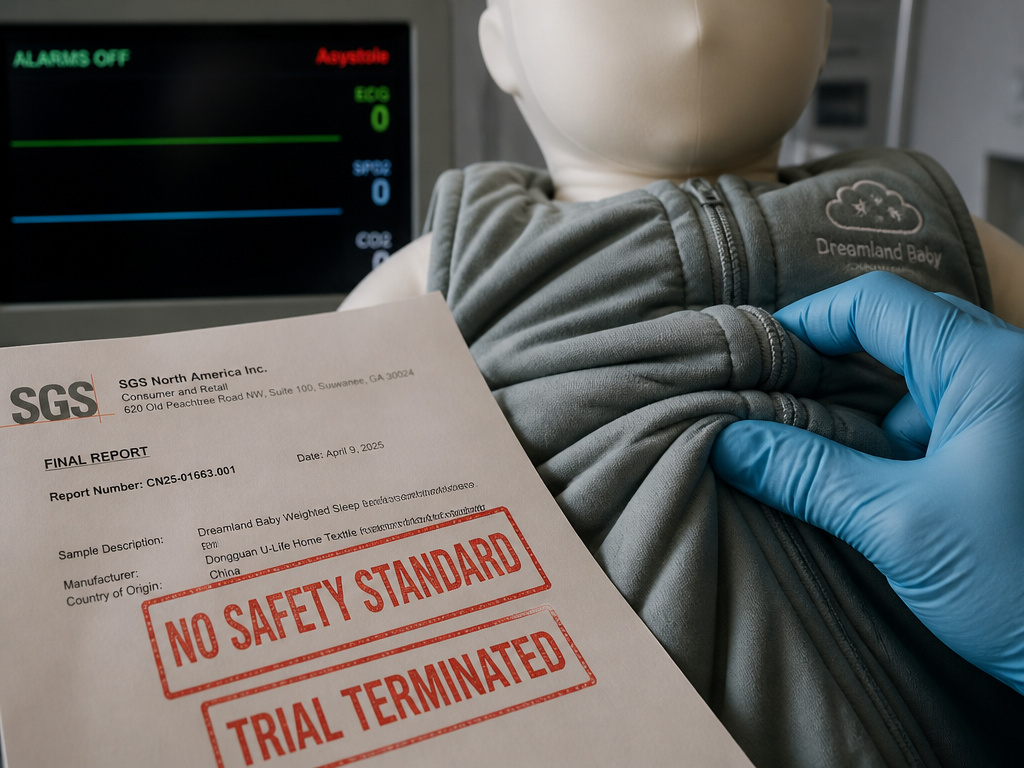
A common point of confusion is the lack of a federal safety standard for weighted infant sleep products. Some interpret this as a gray area. Regulators and pediatricians see it as the heart of the problem.
The AAP has actively opposed the creation of a voluntary safety standard through ASTM International. Their position, detailed in an AAP news article on product recall, is that establishing a standard for an inherently unsafe product category legitimizes it. It gives parents a false sense of security, much like what happened with inclined sleepers before they were linked to over 100 infant deaths.
Furthermore, a key effort to gather objective data failed. A clinical trial on weighted blanket safety registered with the National Institutes of Health aimed to assess the safety of weighted wearable blankets in healthy infants during sleep. It was terminated in 2024 before any overnight studies began, citing “external controversy” and concerns raised by the CPSC and AAP. The result: we have no rigorous, independent, overnight safety data. The companies are selling on theory, not proven safety.
| Aspect | Weighted Sleep Sack Claim | The Evidence Gap |
|---|---|---|
| Overnight Safety | “Safe for all-night sleep.” | No peer-reviewed studies exist for unmonitored overnight use. A key NIH-registered trial was terminated with no data collected. |
| Oxygen Levels | “Maintains healthy oxygen levels.” | A short industry study showed a trend of decreasing oxygen saturation as weight increased. |
| Movement & Arousal | “Does not impair movement or arousal.” | Recall notices and incident reports cite restricted movement and inability to roll back. Physiology suggests added weight requires more effort to arouse. |
This evidence gap is why the regulatory stance is one of prevention. As Dr. Michael Goodstein of the AAP told NBC News, “You should prove safety before you put a product out there. You shouldn’t be proving it after kids die.”
Safe and Effective Alternatives to Weighted Sacks
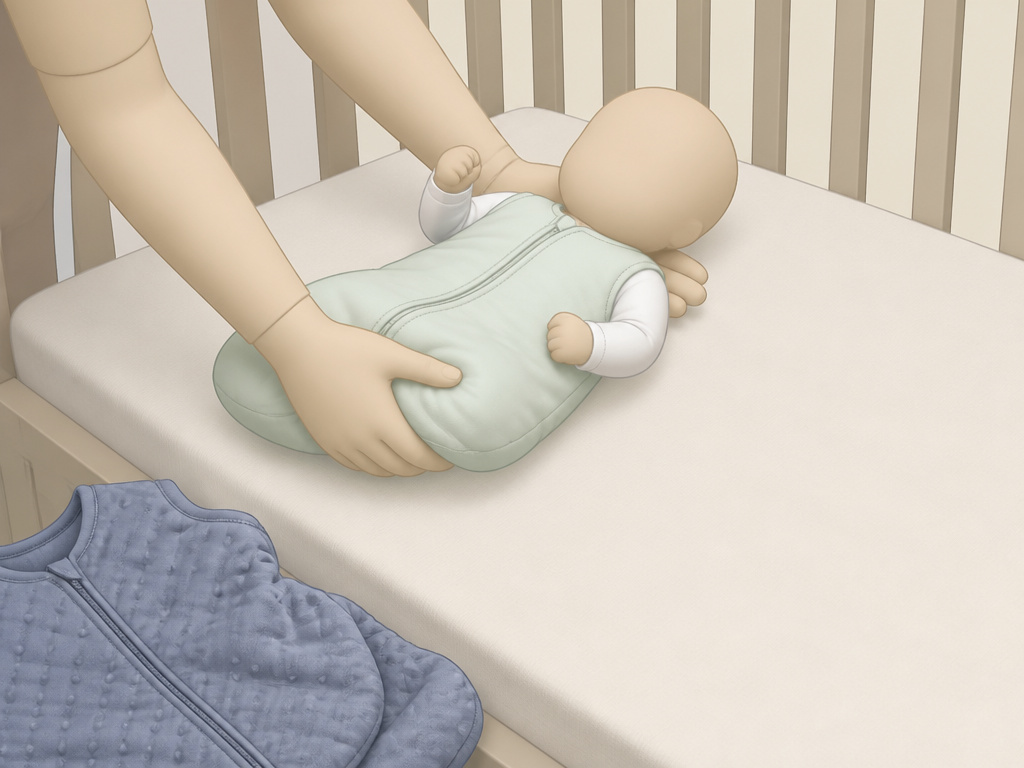
You don’t need weight to help a newborn sleep safely. The tools that work are boring, simple, and backed by decades of evidence that they reduce the risk of SIDS and suffocation.
A Firm, Flat, Bare Sleep Surface. This is non-negotiable. The crib, bassinet, or play yard should have a firm mattress covered only by a fitted sheet. No pillows, blankets, stuffed animals, or crib bumpers.
A Well-Fitted, Non-Weighted Sleep Sack or Wearable Blanket. This is the safe replacement for a loose blanket. A good wearable blanket keeps a baby warm without any risk of covering their face. It allows full range of motion for the arms and legs. Look for one that is the right size for your baby’s weight to prevent them from sliding down inside.
A Tight Swaddle (For Newborns Not Yet Rolling). For young infants who still have the startle reflex, a snug swaddle blanket can provide the comforting pressure they crave, without added weight. The key is it must be tight around the arms to prevent loosening, but loose around the hips and legs. You must stop swaddling as soon as your baby shows signs of attempting to roll, usually around 2-3 months.
Other Proven Sleep Supports. A pacifier at nap and bedtime is associated with a reduced risk of SIDS. A white noise machine can mask disruptive household sounds. A consistent, calming bedtime routine helps signal that sleep is coming. These are the elements of a safe sleep environment, not added pounds on the chest.
When selecting safe blankets for newborns for use during supervised awake time, or when building your essential newborn bedding items, prioritize breathable, natural fabrics and avoid anything with sewn-in weights or heavy embellishments.
Frequently Asked Questions
What do pediatricians say about weighted sleep sacks?
The American Academy of Pediatrics says they are “not safe and not recommended.” The AAP’s task force on SIDS warns that weight on a baby’s chest can compress the flexible rib cage, restrict breathing, and impair the infant’s ability to arouse themselves if their oxygen drops. They have opposed the creation of any safety standard for these products.
Have any weighted sleep sacks been recalled?
Yes. The Bubpods Sleep Sack was recalled in Australia in January 2023. The Australian Competition and Consumer Commission stated the product’s weighted patch posed a “compression or suffocation risk” and could limit an infant’s movement, preventing them from rolling back over if they rolled onto their stomach.
Are there any safe weighted products for babies?
No major U.S. Health or safety organization endorses any weighted product for infant sleep. This includes weighted swaddles, sleep sacks, blankets, or wearable blankets. The consistent advice is to avoid them entirely for babies under 1 year of age. For older children, like toddlers, the conversation is different, but for infants, the rule is clear.
What about the 10% body weight rule companies mention?
The 10% rule is borrowed from adult weighted blankets and has not been proven safe for infants. An adult’s physiology is completely different. A newborn’s respiratory system is immature, and their rib cage is highly flexible. Applying even 10% of their body weight as a constant load during sleep is a risk regulators are not willing to take.
What should I do if I already own a weighted sleep sack?
Stop using it immediately for sleep. You can repurpose it for supervised, awake cuddle time on the floor if you wish, but it does not belong in the crib, bassinet, or any sleep space. Transition to a certified, non-weighted wearable blanket or a properly sized infant blanket for playtime.
Before You Go
The question isn’t just about product design. It’s about a fundamental principle of infant safety: we don’t add barriers to a baby’s breathing. The CPSC, AAP, CDC, and NIH have drawn a bright line. Weighted sleep sacks fall on the wrong side of it.
The data isn’t there. The official warnings are. The recalled product is a concrete example. When you’re choosing crib bedding or a soft baby blanket, the safest path is the one that has been proven over time, a firm, flat, bare mattress and a simple, well-fitting sleep sack. That’s how you build a safe sleep space where little dreamers can truly rest.
