
What Is a Lovey Baby Blanket? Key Safety Tips & Recall Info
This post contains affiliate links. As an Amazon Associate we earn from qualifying purchases.
A lovey baby blanket is a small, soft comfort object, often a blanket with an attached plush animal head, designed for a baby to hold and self-soothe. The key distinction is size, it’s small enough for little hands, not large enough to cover the body, and its role as a transitional object for emotional security. The American Academy of Pediatrics says it’s not safe for sleep until at least 12 months due to suffocation risk, but it can be introduced during supervised awake time as early as 4-6 months.
The 12-month rule marks the line where a baby’s motor skills and the object’s physical risks finally separate. Before that, a loose blanket of any size in a crib is a documented hazard.The lovey’s job is to be a comfort tool, not a sleep prop, for the first year.
What follows is the breakdown every cautious parent needs: the two federal recalls that changed how these products are made, the one design feature that eliminates a major hazard, and the step-by-step method for introducing a lovey that actually sticks.
Key Takeaways
- A lovey is not safe for unsupervised sleep until your baby is at least 12 months old. Before that, use it only during supervised cuddles, play, or car rides.
- Check for recalls. In 2024, 450,000 Little Sleepies Sleepyhead Loveys were recalled because the care label could detach and pose a choking hazard.
- Prioritize hardware-free designs. Look for loveys like the Leaps + Legends model that use soft loop knots instead of plastic clips or metal snaps, which are common failure points.
- Introduce the lovey during calm, happy moments while you’re holding your baby. Let it absorb your scent first to build a positive association.
- A lovey is different from a swaddle or receiving blanket. It’s a dedicated emotional-comfort object, not a wrapping or burping cloth.
What Exactly Is a Lovey (And What It Is Not)
A lovey is a specific category. It’s a small blanket, typically around 12 to 16 inches square, often with a soft plush animal head sewn to one corner. This hybrid design gives a baby two textures to explore, the silky or minky blanket and the fuzzy toy head, and a easy-to-grasp anchor point. Its sole purpose is emotional regulation.
A lovey baby blanket is a transitional object, a term from child psychology for an item that helps a child cope with separation from a parent. It is intentionally small, lightweight, and made of breathable fabric to minimize any physical risk while maximizing tactile comfort for self-soothing.
This is not a swaddle. A swaddle is a large, stretchy blanket meant to wrap snugly around a newborn to mimic the womb and curb the startle reflex. It’s a sleep aid, not a comfort object, and it becomes unsafe once a baby shows signs of rolling. A lovey is also not a standard receiving blanket, which is a larger, multi-purpose cloth for burping, wiping, or a lightweight cover. The lovey’s job is psychological. It’s the first possession a baby chooses for comfort, not utility.
The classic image is Linus from Peanuts with his blue security blanket. That’s the cultural reference point. Modern loveys have evolved from that simple square into more complex, safety-focused designs, but the core function is identical.
When Can a Baby Safely Sleep with a Lovey?
The official answer is clear: not before 12 months of age. This guideline comes directly from the American Academy of Pediatrics’ safe sleep recommendations, which state nothing should be in a crib besides a fitted sheet and the baby for the first year. This includes pillows, loose blankets, stuffed animals, and loveys.
The mechanism is suffocation risk. A young infant lacks the head control and motor strength to reliably move an object away from their face if it covers their nose and mouth. A lovey, while small, is still a soft object that can be pushed into the airway during sleep. By 12 months, most babies can roll over, sit up, and push things away with purpose.
But you can start much earlier. The edge case that most guides gloss over is supervised awake time. You can introduce a lovey as early as 4 to 6 months during cuddles, floor play, or stroller rides. This is the window where you build the positive association without any sleep risk. Hold the lovey between you and your baby during feeding. Tuck it next to them during tummy time. Let it become a symbol of comfort and connection while you’re right there watching.
Where this goes sideways: Putting the lovey in the crib “just for naptime” with a 7-month-old. The risk isn’t worth the convenience. If you want to use it as a sleep cue, place it in the crib during the bedtime routine and remove it the moment the baby is asleep.
This staged approach, supervised bonding first, crib access later, respects the safety rules while leveraging the lovey’s emotional benefit. It turns the 12-month mark into a graduation, not a sudden introduction.
Key Safety Features to Look For
Safety consists of a checklist of physical design elements that prevent specific, documented failures. Two government recalls define what to avoid.
In October 2023, the CPSC announced a recall of approximately 450,000 Little Sleepies Sleepyhead Loveys and Bandana Bibs. The reason? The care instruction label could detach, posing a choking hazard. Two reports of detached labels were filed. In July 2019, about 700 Swaddle Bee Loviebee security blankets were recalled because the metal snaps could detach, also posing a choking hazard.
These documented hazards are the reason you inspect every inch of a lovey before buying.
| Feature to Check | Why It Matters | Red Flag / Failure Mode |
|---|---|---|
| Attached Labels & Tags | Must be permanently stitched, not glued or tacked. | A loose label is a direct choking hazard, as seen in the CPSC recall of Sleepyhead loveys. |
| Hardware (Snaps, Clips, Eyes) | Should be avoided entirely. | Plastic eyes can pop off; metal snaps can detach, as in the Swaddle Bee blanket recall alert. |
| Seams & Stitching | Must be tight and robust, with no loose threads. | A ripped seam can release stuffing or create a loop for tiny fingers. |
| Fabric Breathability | Should be natural, lightweight fibers like cotton or muslin. | Polyester minky or thick plush can trap heat and increase overheating risk. |
| Overall Size | Should be small, under ~16″ square. | A blanket too large can be pulled over the face more easily. |
The modern solution is the hardware-free design. Brands like Leaps + Legends make loveys that attach to pacifiers or strollers with a soft loop knot instead of a plastic clip. No metal, no plastic, no sewn-on parts. This eliminates the most common recall category outright. When you’re evaluating personalized baby blankets or luxury baby blankets, apply this same checklist. Embellishments are risk points.
How to Introduce a Lovey (The Method That Works)
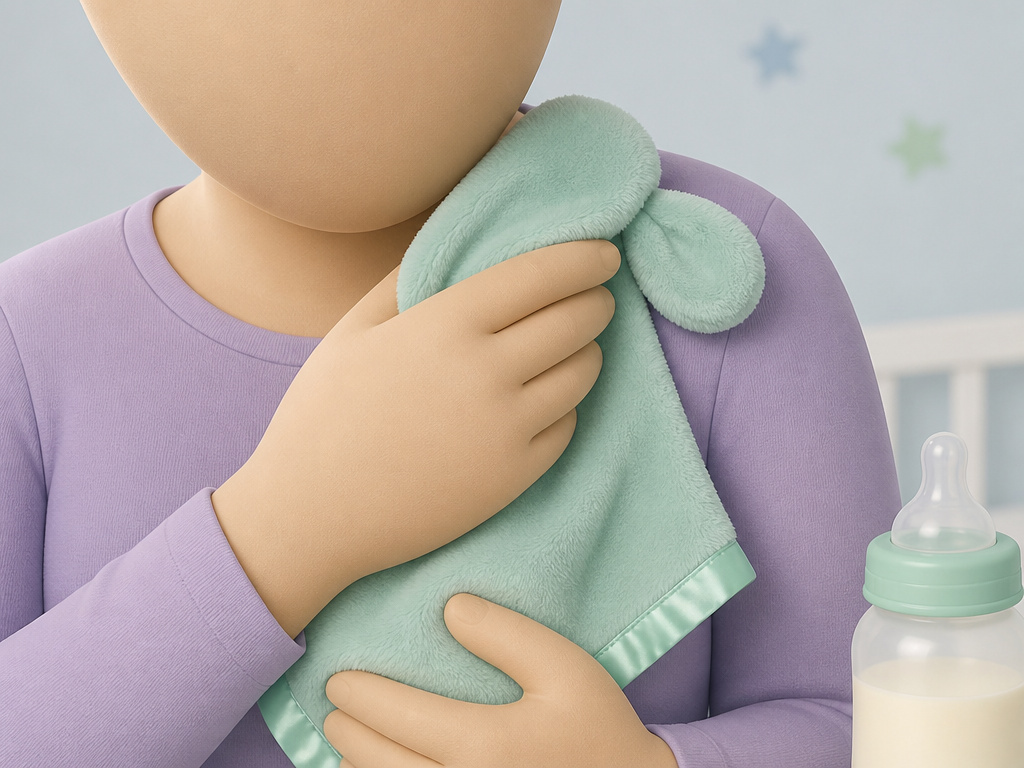
Introducing a lovey is a conditioning process. The goal is to make the object smell and feel like comfort itself.Rushing this leads to rejection.
Start during a calm, happy period of the day. Never introduce it when the baby is already upset, you’ll create a negative association. Hold the lovey between you and your baby during a feeding or snuggle session. Let it rest on your chest so it absorbs your scent for a night or two before giving it to them. Your smell is the primary comfort signal.
Here is the sequence that builds a real attachment: 1. Scent Transfer First. Sleep with the lovey or keep it in your shirt for a day. This imbues it with your familiar smell, the ultimate baby comfort. 2. Supervised Interaction. Offer it during quiet play or cuddles while you’re fully present. Let them mouth it, hold it, drop it. 3. Incorporate into Routine. Make it part of the pre-sleep ritual outside the crib. Use it during the last story or song, then remove it before placing baby down. 4. Crib Access After 12 Months. Once the pediatrician gives the all-clear, place it in the crib. It’s now a familiar friend, not a strange new object.
What if your baby shows zero interest? That’s common before 8 or 9 months. Don’t force it. Leave it nearby during happy times. Some babies are tactile, others are visual. A lovey might not be their chosen comfort object, and that’s fine. The best infant blankets or muslin blankets might serve as a security item in a different form.
Lovey vs. Other Baby Blankets
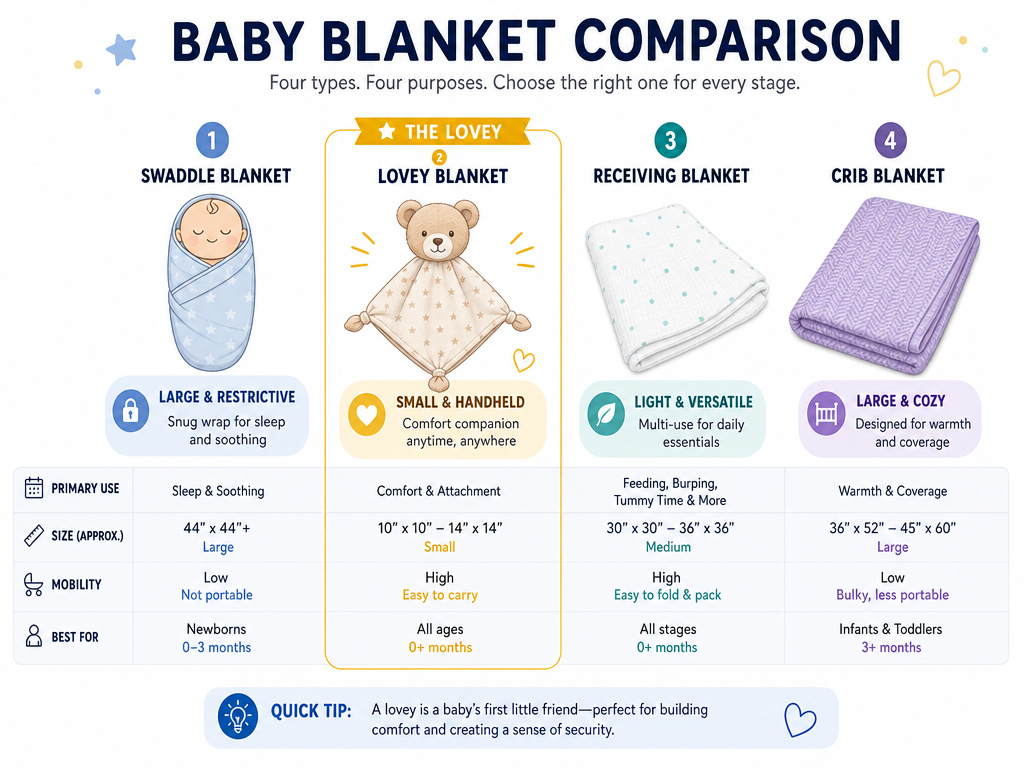
Parents get confused because the word “blanket” is used for everything. A lovey has a distinct job description compared to other staples in the nursery drawer.
| Blanket Type | Primary Purpose | Safe Use Timeline | Key Difference from a Lovey |
|---|---|---|---|
| Lovey | Emotional self-soothing, transitional object. | Supervised awake time: 4-6 mo+. Crib: 12+ mo. | Small, handheld comfort focus. |
| Swaddle Blanket | Wrapping newborn to suppress startle reflex. | Birth until signs of rolling (usually 2-4 mo). | Large, restrictive, for sleep only. |
| Receiving Blanket | Multi-purpose: burping, wiping, light cover. | Birth+, but not in crib unsupervised. | Utility cloth, not a dedicated love object. |
| Crib Blanket | Warmth in the toddler bed. | Not before 12 months in crib; later for bedding. | Large, for covering the body, not holding. |
You might use a receiving blanket for a diaper change and a lovey for the car seat. They are tools for different tasks. A common mistake is using a large, beautiful organic baby blanket as a lovey substitute. The size makes it unsafe for crib access at the same age, and it may be too bulky for a baby to maneuver comfortably.
Choosing the Right Lovey for Your Baby
With the safety rules established, your choice comes down to material, sensory detail, and washability. You need more than one identical copy, losing the only one is a family crisis.
First, buy two or three of the exact same lovey. Rotate them in use so they wear evenly and smell the same. This is non-negotiable for sanity. When looking at a selection of the best baby blankets for gifting, consider a lovey duo pack.
The material dictates feel and care. Organic cotton or bamboo blends are breathable, cool, and gentle on eczema-prone skin. Polyester minky is ultra-soft but can be less breathable. Must be machine washable and dryable. Loveys get dirty.
Consider sensory elements for older babies: * Different textures (satin edges, crinkly fabric inserts, bumpy stitching). * Minimal, embroidered facial features instead of plastic eyes. * A lightweight, floppy structure that’s easy to grip.
For a newborn, the simplest option is often best. A small, plain muslin square knotted in the middle can serve as a first lovey without any extras. As they grow, you can upgrade to a more traditional animal-head style. Brands like Bunnies by the Bay or Angel Dear are popular for their consistent quality and wide availability, making finding replacements easier. Skip anything with ribbons, loose strings, or decorative buttons.
Frequently Asked Questions
Can a 6-month-old have a lovey in the crib?
No. A 6-month-old should not have any soft objects, including a lovey, in the crib for sleep. The safe sleep guideline from the AAP is firm on this: nothing in the crib but the baby until at least 12 months. You can, however, let the 6-month-old interact with the lovey during fully supervised awake time.
How many loveys should I buy?
Buy at least two identical loveys. This lets you wash one while the other is in use, and it provides a backup if one gets lost. For a lovey that becomes a deep attachment, having three is not excessive. Rotate them regularly so they wear and smell the same.
What if my baby doesn’t take to a lovey?
That’s perfectly normal. Not all children form an attachment to a transitional object. Don’t push it. Continue offering it during calm moments, but respect their preference. Other comfort rituals, like a specific song or rocking pattern, may be more important to them. The lovey is a tool, not a requirement.
Are loveys a choking hazard?
They can be if poorly made. The primary risks are detachable parts: plastic eyes, sewn-on noses, loose labels, or hardware like snaps. This is why checking for recalls and choosing hardware-free designs is critical. A well-made lovey from a reputable brand, with all features securely attached, presents a very low choking risk during supervised use.
Can a lovey help with sleep training?
Yes, but only as a sleep cue, not a sleep prop, before 12 months. You can incorporate the lovey into the pre-sleep routine (e.g., cuddling with it during the last book). Then remove it when you place the baby in the crib. After 12 months, it can remain in the crib as a familiar comfort object that helps with self-soothing during night wakings.
What’s the difference between a lovey and a security blanket?
They are essentially the same thing. “Lovey” is the modern term often used for the blanket-plus-plush-animal style. “Security blanket” is the older, more general term popularized by the Peanuts comic strip. Both refer to a comfort object a child uses for emotional regulation.
Before You Go
A lovey is more than a cute blanket. It’s a first step toward emotional independence, a tool for comfort you can’t always provide. The rules exist because its benefits are real, and so are the risks if chosen carelessly.
Start with safety. Check the CPSC recall database. Feel every seam. Choose hardware-free. Then, introduce it slowly, with patience, during the happy moments. Let it become a friend. By the first birthday, that small, soft object might just be the thing that makes the crib feel a little less lonely and the world a little more secure.
