
Is Sleep Training Bad for Babies? The Research & Realities
This post contains affiliate links. As an Amazon Associate we earn from qualifying purchases.
Sleep training is not inherently “bad” for babies, but its appropriateness hinges on age, method, and individual child factors. For infants over six months, evidence from long-term studies shows no measurable harm to emotional health or attachment by age six. For infants under six months, behavioral sleep interventions show no benefit and carry documented risks, including potential disruption to breastfeeding and an increased SIDS risk when sleep is artificially prolonged.
The core of the debate concerns matching a specific tool to a specific developmental stage and a specific family’s needs. A method that might help a nine-month-old learn to fall asleep independently could be actively counterproductive, and potentially risky, for a three-month-old whose nervous system is still wiring itself to the world.
What follows is a breakdown of the evidence, separated by age. You’ll see the numbers from the largest long-term study, the physiological reasons age matters, and the documented risks that most parenting blogs gloss over. By the end, you’ll be able to read any claim about sleep training and know which half of the first year it applies to.
Key Takeaways
- Age is the non-negotiable line. Behavioral sleep interventions before six months show no benefit for mothers or infants and are linked to increased risks, including feeding problems and SIDS.
- Long-term data finds no harm. The most robust follow-up study, tracking children to age six, found no differences in emotional health, stress, or parent-child attachment between sleep-trained kids and controls.
- “Works” means different things. Sleep training effectively reduces infant signaling (crying for a parent), but objective measures show it doesn’t significantly increase total infant sleep time.
- Method choice changes the stakes. “Camping out” (gradual withdrawal) shows similar effectiveness to “cry-it-out” but with less reported parental stress and no sleep deterioration at follow-up in some studies.
- Your comfort level matters. Parental inconsistency, starting and stopping, is more stressful for a child than either consistently responding or consistently following a chosen plan.
What the Research Actually Says About Safety and Effectiveness
The American Academy of Sleep Medicine (AASM) practice parameters rate unmodified extinction (full cry-it-out) and graduated extinction as effective therapies for bedtime problems in infants and young children, classifying them as Standard and Guideline recommendations, respectively.
This clinical endorsement is based on observable, short-term behavioral change. The goal is to reduce unwanted sleep associations, and the data shows these methods do that. But “effective therapy” in a medical guideline doesn’t translate to “universally good idea.” The nuance is in the details most summaries miss.
First, define “works.” Most studies rely on parent-reported sleep diaries. If a baby learns not to cry out when they wake, parents sleep more soundly and report the problem as solved. However, the few studies using objective measures like actigraphy (movement monitors) tell a different story. They find sleep training has little, if any, effect on a baby’s own total sleep time. The baby may still wake just as often; they just stop signaling for help.
Second, look at the long arc. The most cited long-term study followed 225 children to age six. It found that by age two, sleep problems had largely resolved in both the sleep-trained group and the control group. By age six, there were no differences in emotional health, conduct, stress levels, or parent-child closeness. The intervention group’s mothers had experienced less depression in the short term, a real benefit, but the children themselves were indistinguishable a half-decade later.
The takeaway is mechanical, not moral. Sleep training is a tool that alters a behavior (signaling) within a specific developmental window. It doesn’t create long-term damage, but it also doesn’t create long-term super-sleepers. The child’s inherent biology and development catch up.
The Critical Age Divide: Under 6 Months vs. Over
The six-month mark is a biological pivot point grounded in developmental neurology and physiology. Treating the two halves of the first year the same is where much of the danger and confusion lies.
For Infants Under Six Months
The brain’s circadian system, which regulates sleep-wake cycles, is only beginning to organize. The longest continuous sleep episode naturally emerges around six months. Trying to force longer, consolidated sleep before this wiring is complete is like trying to potty-train a newborn. The hardware isn’t there.
A systematic review concluded that behavioral sleep interventions in the first six months of life do not improve outcomes for mothers or infants. The review identified significant risks, including increased problem crying, premature cessation of breastfeeding, and worsened maternal anxiety. Furthermore, encouraging a baby under six months to sleep longer than is developmentally normal is associated with an increased risk of SIDS.
Where this goes sideways: Separating feeding from sleep for a young infant. Night feeds are crucial for maintaining milk supply. A sleep training program that pushes a 4-month-old to drop night feeds can undermine breastfeeding within a week, leading to supply issues and weight-gain concerns.
The sleep environment matters as much as routine at this age. A safe, comfortable space is foundational. This is where investing in a breathable crib mattress and appropriate crib sheets can support safer sleep without trying to hack an immature nervous system.
For Infants Over Six Months
After six months, the circadian rhythm is more established, and many babies are capable of self-soothing, re-settling after a brief arousal without crying for a parent. This is when behavioral interventions become a matter of parental choice rather than developmental contraindication.
The AASM practice parameters apply here. Methods like graduated extinction (checking at intervals) or bedtime fading (adjusting bedtime later) can help an infant who has the capacity to self-settle but has developed a strong habit of relying on a parent to fall asleep. The key is that the baby is developmentally ready to learn this skill.
| Developmental Factor | Under 6 Months | Over 6 Months |
|---|---|---|
| Circadian Rhythm | Still organizing; longest sleep ~6 hours emerges around 6 months | Established; capable of longer nocturnal sleep cycles |
| Primary Sleep Risk | SIDS risk increased with artificially prolonged sleep | Behavioral habit formation; night wakings often habit, not hunger |
| Feeding Relationship | Night feeds critical for nutrition and milk supply | Nutritional night feeds often not essential; may be comfort |
| Appropriate Intervention | Safe sleep environment, responsive feeding, routine | Behavioral methods (extinction, fading) are an option |
Breaking Down the Common Sleep Training Methods
Not all sleep training is “cry-it-out.” The spectrum runs from highly parent-involved to completely parent-absent. Understanding the mechanism of each explains why outcomes and stress levels can differ.
Extinction Methods (Unmodified & Graduated)
These methods work on the principle of removing the reinforcement (parental attention) for the undesired behavior (crying at bedtime). Unmodified extinction is the classic “cry-it-out”: put baby down awake and do not re-enter until morning. Graduated extinction involves checking at progressively longer intervals (5, 10, 15 minutes).
Common mistake: Inconsistent checking during graduated extinction. Popping in unpredictably can actually reinforce crying more effectively, turning the process into a frustrating game for the baby. If you choose this method, use a timer and stick to the schedule.
The PubMed systematic review on early interventions notes that these methods are effective for reducing signaling. However, one study found parents sometimes had to repeat the process two to five times in a baby’s first year, and over 40% reported it did not reduce the number of night wakings they were aware of.
Gentler Alternatives (Camping Out & Bedtime Fading)
“Camping out” involves the parent sitting in a chair next to the crib as the baby falls asleep, gradually moving the chair farther away over successive nights until they’re outside the room. Bedtime fading temporarily sets bedtime later to match the child’s natural sleep onset, then slowly makes it earlier.
These methods rely on stimulus control and reducing anxiety. They often take longer but can feel more sustainable for parents who are uncomfortable with prolonged crying. Research indicates camping out may be linked to less stress and less depression in mothers compared to extinction methods.
The Chair You Never Actually Leave
Some babies are highly sensitive to presence. For them, the “camping out” method can backfire if the parent’s eventual exit feels like a new abandonment. They learn to fall asleep with you there, then panic when the condition changes. In these cases, a quicker, clearer transition, even if it involves more initial protest, can sometimes be less confusing. It’s counterintuitive, but true.
The Cortisol Question: Does Crying Cause Harmful Stress?
The fear that sleep training floods a baby’s brain with damaging stress hormones is a primary concern for many parents. The science here is specific and often misrepresented.
A well-known 2012 study measured cortisol levels in 25 infants and their mothers during a sleep training intervention in a lab. On the first two nights, babies cried and their cortisol levels remained elevated from pre-bedtime to post-sleep. The mothers’ cortisol levels also remained high.
On the third night, the babies stopped crying. Their cortisol levels returned to normal baseline patterns. The mothers’ cortisol levels, however, dropped significantly. The baby’s physiological stress response adapted once the new expectation was learned; the parent’s stress directly tracked the baby’s audible distress.
The part nobody mentions: The study’s sample was tiny, and the intervention was intense (a five-day inpatient program). It doesn’t prove that sleep training is stress-free, but it does show that the cortisol response is not a permanent, escalating state. It extinguishes along with the crying behavior, at least in this controlled setting.
The bigger stressor may be inconsistency. Starting a method, feeling overwhelmed, rescuing the baby, then trying again tomorrow creates unpredictable reinforcement, which is more anxiety-producing for a child than a predictable pattern, even if that pattern involves initial crying.
Real Outcomes: What Long-Term Studies Actually Measure

The promise of sleep training is often framed as teaching a lifelong skill. The long-term data reframes that promise. Sleep training doesn’t create a different kind of sleeper; it resolves a specific behavioral hurdle within a developmental window.
The landmark Australian study had 328 families. Nurses offered sleep training advice (controlled crying or camping out) to the intervention group at an 8-month well-child visit. The control group received standard care. At the two- and four-month follow-ups, mothers in the intervention group reported less depression.
The researchers followed up when the children were six years old. They assessed: – Emotional and behavioral problems – Sleep habits – Child-parent relationship (closeness, conflict) – Parental mental health and stress – Child cortisol levels
The result: no significant differences on any measure. The 9% of sleep-trained children who still had sleep problems at age six was statistically identical to the 7% in the control group. The study’s conclusion is blunt: using these methods had no long-term harmful or beneficial effects on the children.
This is the “so what” for the long-term harm debate. The evidence for lasting damage isn’t just thin; it’s absent in the best-designed follow-up we have. The evidence for lasting benefit is equally absent. The impact is in the short-term, parental mental health column.
Making a Decision That Fits Your Family
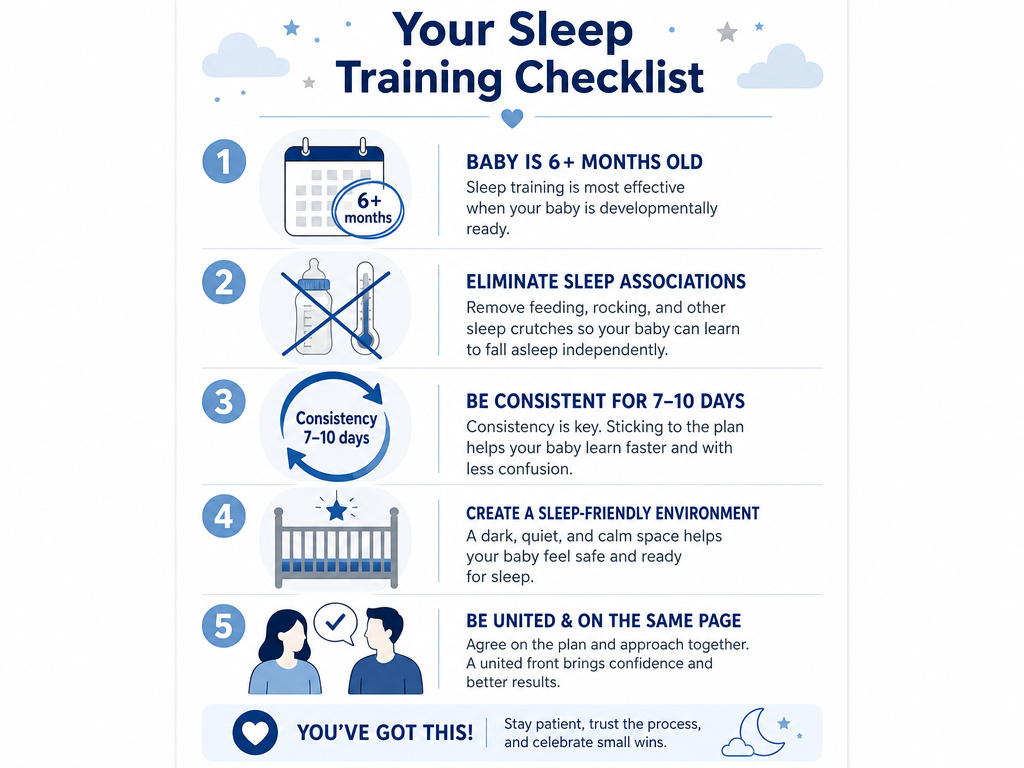
This process involves aligning a strategy with your child’s age, your family’s tolerance for crying, and your own mental health. A decision made from desperation at 3 a.m. Is different from one considered at 3 p.m.
Your checklist before starting anything:
- Confirm age. If your baby is under six months, shift your goal. Focus on establishing a safe sleep environment with a certified crib mattress and mastering drowsy-but-awake puts when possible, not on eliminating night feeds.
- Rule out other problems. Is there an ear infection? A leap in development? A need for a larger baby mattress? Teething? Sleep training during illness or major disruption is setting everyone up for failure.
- Choose a method you can stick with for 7-10 days. Your consistency is the most important variable. If the thought of “cry-it-out” makes you nauseous, you will not be consistent. Pick camping out or bedtime fading.
- Prepare the sleep space. Ensure the room is dark, cool, and safe. A comfortable baby blanket (for older infants) or a secure swaddle blanket (for younger ones) can be part of the soothing routine, not a sleep crutch.
- Talk with your partner. Get on the same page. Who will handle the checks? What is the exact plan? Write it down.
When to stop or change course:
- Your baby is under six months and you’re pushing for longer sleep stretches.
- Your mental health is deteriorating, not improving.
- The method is clearly not working after a full, consistent week (not just 3 hard nights).
- Your instinct is screaming that something else is wrong. Listen to it.
For some families, the right choice is never to formally sleep train. It’s to ride out the wakeful phases with coffee, shifts, and the knowledge that it’s temporary. For others, a clear plan is the lifeline that restores sanity. Both are valid, evidence-supported paths. The data doesn’t pick a winner; it just clarifies the stakes.
Frequently Asked Questions
Does sleep training cause attachment disorders?
No long-term study has found a link between behavioral sleep interventions and insecure attachment. The Australian follow-up to age six specifically measured parent-child closeness and attachment and found no difference between groups. Attachment is built through thousands of daily responsive interactions, not determined by what happens at bedtime alone.
Can you sleep train a newborn?
You should not attempt behavioral sleep training with a newborn. Their nutritional needs require round-the-clock feeding, and their nervous system is incapable of the self-regulation these methods require. Focus on safe sleep practices, feeding on demand, and learning your baby’s sleepy cues instead of a schedule.
What is the most gentle sleep training method?
“Camping out” (the chair method) and “bedtime fading” are generally considered the most gradual, parent-present approaches. They avoid outright ignoring the child’s cries. The PRISMA scoping review on infant sleep interventions notes these gentler alternatives may be linked to less stress for mothers.
How long does it take for sleep training to work?
With consistent application, many babies show significant reduction in crying within 3-5 nights for extinction methods. Gentler methods like camping out can take 7-14 nights. However, “working” means the baby falls asleep with less protest. It does not guarantee they will stop waking overnight; they may just stop signaling for you when they do.
Will sleep training make my baby sleep through the night?
Probably not, especially in the long term. The objective studies show sleep-trained babies do not sleep more total hours than non-sleep-trained babies. They learn to fall asleep independently at the start of the night and may resettle without crying, but developmental regressions, teething, and illness will still cause wakeful periods throughout infancy and toddlerhood.
Before You Go
The question “is sleep training bad” forces a binary moral judgment onto a complex tool. The evidence clears the fog: for babies over six months, it’s a neutral tool that can provide short-term parental relief without long-term child harm. For babies under six months, it’s a tool misapplied, carrying real risks without proven benefit.
Your decision is a logistical choice about how your family gets through a season of life. Whether you choose to sleep train or not, the foundation is the same: a safe sleep space, a responsive relationship during waking hours, and the understanding that this phase, like all others, is temporary.Your child’s sleep will mature because their brain develops, not solely because of any training you did or didn’t do. The goal is a healthy child and a functional family. Sometimes the data shows that different paths can lead to the same place.
