
Is a Swing Safe for Newborn Sleep? Official Stance & Hazards
This post contains affiliate links. As an Amazon Associate we earn from qualifying purchases.
No, it is not safe for a newborn to sleep in a swing. The American Academy of Pediatrics (AAP) and the Consumer Product Safety Commission (CPSC) state that the only safe sleep environment is a firm, flat, non-inclined surface like a crib, bassinet, or play yard. Infant swings are designed for supervised, awake entertainment and pose a documented suffocation risk, especially for babies under four months old.
That distinction between “for use” and “for sleep” is written into federal law. The mandatory safety standard for swings, incorporated in the Code of Federal Regulations, explicitly states it does not cover products intended to provide sleeping accommodations. A swing is certified to keep a seated infant from falling out while it moves. It is not certified to keep a sleeping infant breathing.
What follows is the breakdown of why the risk is mechanical, not just advisory. We’ll cover the specific recall that forced the issue, the biomechanics of an infant’s airway in a semi-reclined seat, and the one scenario where a swing’s design is legally required to meet a different standard. By the end, you’ll be able to read any product’s manual and know whether its warnings are about liability or a documented death pattern.
Key Takeaways
- The AAP safe sleep guidelines permit only firm, flat surfaces for sleep; any incline over 10 degrees is considered unsafe.
- A 2024 recall of over 2 million Fisher-Price Snuga swings linked five infant deaths to swing sleep, with most involving unrestrained infants and added bedding.
- Infants under four months lack the head and neck control to prevent their chin from resting on their chest in a semi-reclined seat, which can silently block their airway.
- The ASTM F2088 safety specification for swings legally excludes them from being classified as sleep products, meaning they are not tested for sleep safety.
- If a swing has a “cradle” or stationary flat mode, it must also comply with the bassinet standard (ASTM F2194) when not swinging, creating a rare hybrid product.
The Short, Official Answer
The answer from every medical and regulatory body is unanimous and non-negotiable. The AAP infant sleep environment guidelines are clear: infants must sleep on their back on a firm, flat surface in a crib, bassinet, or approved play yard. The 2022 AAP policy report states that products with inclines of more than 10 degrees are unsafe for infant sleep.
This isn’t a suggestion. It’s the conclusion drawn from fatality data. The CPSC swing recall notice from October 2024 is a concrete example. It details five reported deaths between 2012 and 2022 involving infants aged one to three months in the Fisher-Price Snuga Swing. The cause was suffocation.
The mandatory federal swing safety standard (16 CFR Part 1223) incorporates ASTM F2088-24, which opens with this scope: “This specification does not cover products in the rest (non-rocking) position that are intended to provide sleeping accommodations for the occupant.” A swing, by its governing standard, is not a sleep product.
The law treats swings and beds as separate categories with separate safety tests. A swing passes if it doesn’t tip over and its harness holds. A bed passes if it provides a flat, firm surface with breathable sides. Conflating the two is where the danger lies.
Why a Swing Is a Different Kind of Danger
Parents often think, “It’s a seat with straps, how bad can it be?” The danger isn’t from falling out. It’s from positional asphyxia – a baby’s body position itself cuts off their air supply, and they can’t cry or move to fix it.
For newborns and young infants, head control is minimal. In a semi-reclined swing seat, gravity pulls the heavy head forward. The chin can rest on the chest, kinking the trachea like a bent straw. This can happen even with the harness fastened. An adult watching might see a peacefully sleeping baby who is actually struggling to breathe.
The technical policy report notes that infants younger than four months in sitting devices are at “increased risk for upper airway obstruction and oxygen desaturation.” This risk is silent and doesn’t require a product malfunction.
Where this goes sideways: Adding blankets or a head support pillow to a swing. In the recalled Fisher-Price cases, most deaths involved added bedding. A pillow or loose blanket near a baby who can’t lift their head is a direct suffocation hazard. The swing’s own headrest became part of the problem, prompting the recall to advise parents to cut it off.
The 2024 Recall & What It Proves
In October 2024, the CPSC and Fisher-Price announced a recall of more than 2 million Snuga Infant Swings. This wasn’t for a broken part. It was for a fatal design flaw when the product was used in a way parents commonly used it: for sleep.
| Recall Fact | Detail | Why It Matters |
|---|---|---|
| Product | Fisher-Price Snuga Infant Swing (21 model variations) | Shows the risk spans an entire product line, not a single bad unit. |
| Incident Period | 2012 – 2022 | The hazard persisted for a decade before regulatory action. |
| Reported Deaths | 5 infants (1–3 months old) | Confirms the risk is real and documented with fatalities. |
| Primary Hazard | Suffocation | Deaths occurred when infants were unrestrained, and bedding/headrests were present. |
| Official Stance | “Infant swings are not safe for sleep.” | The recall is an enforcement of the existing AAP and CPSC position. |
The recall notice is a primary source document that moves the conversation from theory to documented tragedy. It states the swings are “not safe for sleep.” The remedy wasn’t a repair kit. It was instructions to remove the headrest and body support insert and a directive to stop using the swing for sleep.
This action followed the 2022 Safe Sleep for Babies Act, which Congress enacted to ban inclined sleepers. The regulatory environment now treats inclined, contained sleep spaces as inherently hazardous. A swing is the next logical product in that category.
Cradle Swings & The “Flat Mode” Loophole
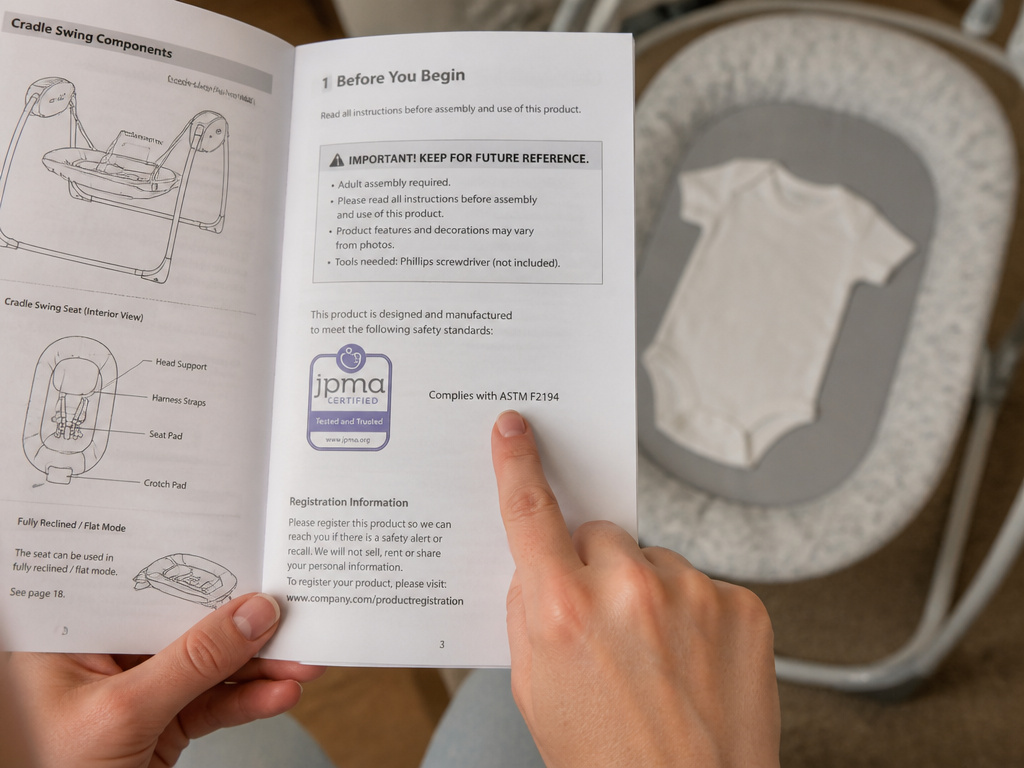
Here’s where it gets technically nuanced, and most parents get confused. Some swings market a “cradle swing” or “flat recline” mode. The seat lies flat and may not swing. This seems like a bassinet. Isn’t that safe?
The law has a specific clause for this. The ASTM International standard (F2088-24) that governs swings was revised in 2024 with a key addition. It now requires that cradle swings, when in their stationary, flat mode, must also comply with the separate bassinet standard, ASTM F2194.
Common mistake: Assuming a “flat” swing seat is automatically a safe sleep surface. It must be certified to the bassinet standard (look for a JPMA certification seal) to be considered one. Most are not.
This creates a hybrid product. In swing mode, it’s governed by swing rules (not for sleep). In stationary, flat bassinet mode, it should be governed by bassinet rules (potentially for sleep). However, you must verify the certification. The product manual must explicitly state it meets ASTM F2194 for use in that mode. If it doesn’t, that flat mode is just a feature, not a certified safe sleep space.
| Product Type | Governing Safety Standard | Intended Use | Safe for Unsupervised Sleep? |
|---|---|---|---|
| Traditional Infant Swing | ASTM F2088 | Supervised, awake soothing | No |
| Bassinet | ASTM F2194 / 16 CFR Part 1218 | Sleep | Yes |
| Cradle Swing (Swinging) | ASTM F2088 | Supervised, awake soothing | No |
| Cradle Swing (Stationary Flat Mode) | ASTM F2088 AND ASTM F2194 | Sleep (Only if certified to F2194) | Maybe (Check Certification) |
The takeaway is simple. Never assume. Check the manual and the product labels for the specific certification that applies to the mode you want to use. A true safe bassinet or bedside sleeper will have that certification as its primary feature.
What To Do If Your Baby Falls Asleep in the Swing
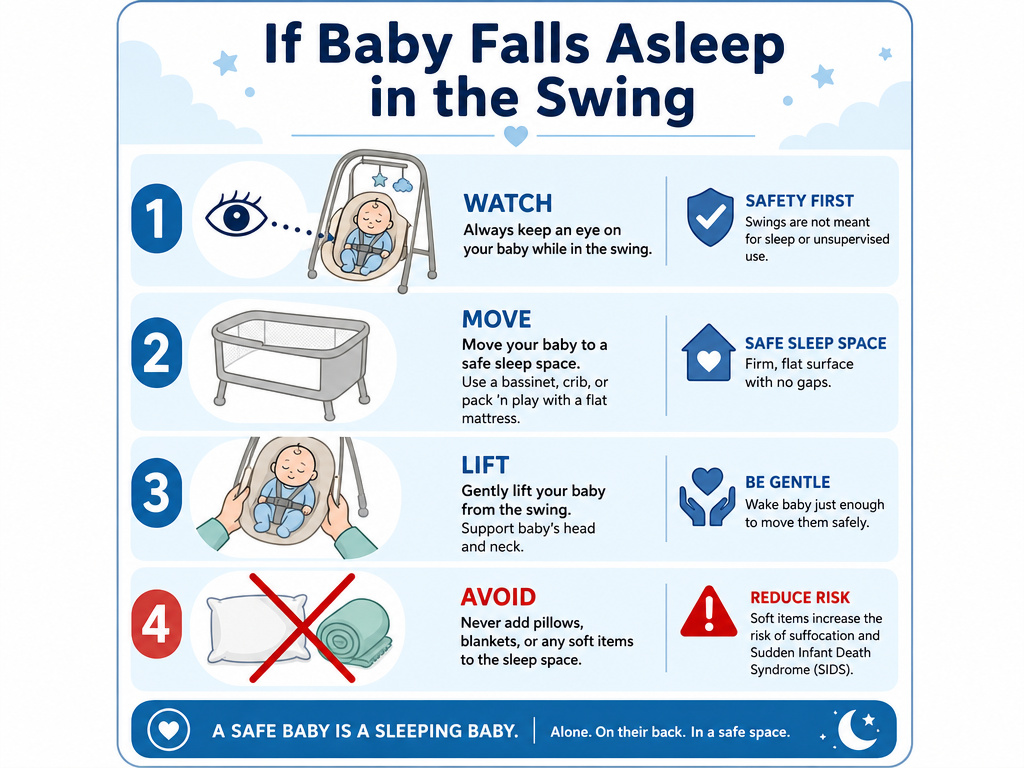
It happens. The motion is soothing, and your newborn drifts off. The protocol here is straightforward and non-negotiable.
- Supervise Closely. Do not leave the room. Do not get distracted by your phone. Keep the baby in your line of sight.
- Prepare the Real Sleep Space. While supervising, make sure the crib for newborn or bedside bassinet is ready: a firm, flat crib mattress with a fitted sheet, no other items.
- Transfer Promptly. As soon as is practical—without risking waking them unnecessarily—gently unbuckle the harness and move them to their safe sleep surface. It is safer to risk waking them than to let them sleep in the swing.
- Never Add Props. Do not try to “make it safer” by rolling up blankets on the side. Do not use the swing’s headrest or a pillow. These increase the risk of suffocation.
The part nobody mentions: The transfer is easier when they are in a deep sleep cycle. Watch for limp limbs and steady breathing. Slide one hand under the head/neck and the other under the bottom, lift smoothly, and place them directly on their back in the bassinet. Practice makes it less disruptive.
Safe & Certified Alternatives for Newborn Sleep
If a swing is off the table for sleep, what actually works? The list is short, specific, and certified.
- Crib: The gold standard. A full-size crib with a firm, flat baby mattress that meets federal safety standards. It’s the most durable long-term option.
- Bassinet or Portable Sleeper: Designed for the first 4-6 months. Look for products certified to the bassinet standard (ASTM F2194). This includes many co-sleeper bassinet models that attach to the adult bed for easy access.
- Play Yard with a Bassinet Level: Many pack ‘n plays include a removable, firm bassinet insert that is certified for sleep. Ensure you are using the certified insert, not the lower, padded “napper” attachment, which is often inclined and not for sleep.
- Bedside Sleeper: A specific product category that attaches securely to the adult bed with a drop-down side. A true bedside sleeper bassinet will be certified to both bedside sleeper and bassinet standards.
The through-line for all these is a flat, firm surface and a certification label from the Juvenile Products Manufacturers Association (JPMA) or a direct reference to ASTM F2194/CFR Part 1218 in the manual. This is what separates a marketed “sleeper” from a regulated safe infant bed.
Frequently Asked Questions
Can a newborn sleep in a swing under supervision?
No. Supervision does not prevent positional asphyxia. A baby whose airway is blocked by their own chin may not struggle or make noise. You can be looking right at them and not know they are in distress. Safe sleep requires the right environment, not just a watchful eye.
What about swings that fully recline flat?
Fully reclined seat is not the same as a certified flat sleep surface. The materials, stability, and breathability of the sides are tested under different standards. Unless the product manual states it meets the bassinet standard (ASTM F2194) for that flat mode, it is not approved for sleep.
Are there any swings approved for overnight sleep?
As of 2024, there are no infant swings marketed or certified in the United States for overnight, unsupervised sleep. The consumer product safety recall and the codified safety requirements have made this distinction legally clear. Any product intended for infant sleep must comply with bassinet or crib standards, not swing standards.
My baby only sleeps in the swing. What can I do?
This is a common and exhausting challenge. The goal is to transition to a safe sleep surface. Start by using the swing for calming while awake, then transfer to a bassinet for sleep. Try replicating the motion manually (rocking the bassinet) or using white noise. Consistency is key. For persistent issues, consult your pediatrician to rule out medical causes like reflux, but never use the swing as a sleep solution.
How do I know if my bassinet is truly safe?
Check for a JPMA certification seal on the product or its packaging. In the manual, look for a statement that it “conforms to ASTM F2194” or “meets the requirements of 16 CFR Part 1218.” These are the markers of a safe co-sleeping product designed and tested for sleep.
Before You Go
The data is unambiguous. The American Academy of Pediatrics recommendations permit only firm, flat surfaces for infant sleep. The reported swing-related fatalities provide the tragic consequence of ignoring that rule. The mandatory infant swing rules are written to keep swings in the category of supervised seating, not sleep equipment.
Your safest path is to choose a product designed for the job from the start: a certified crib, bassinet, or play yard. The peace of mind that comes from a firm crib mattress in a regulated baby bed is worth far more than the temporary convenience of a swing. Use the swing for smiles while the sun is up. Use the flat, certified surface for sleep when their eyes close.
