
How to Make Infant Sleep Through the Night: A Gentle Guide
This post contains affiliate links. As an Amazon Associate we earn from qualifying purchases.
To make an infant sleep through the night, build a three-part foundation: a certified-safe sleep space, a predictable daytime rhythm of feeds and naps, and a consistent, calm response to night wakings. “Sleeping through” for a baby under six months means a single 5 to 8 hour stretch, not twelve hours. The goal isn’t to eliminate all wakings but to consolidate the longest sleep block into the parents’ night.
That 5 to 8 hour definition changes everything. It reframes success from an impossible marathon to a manageable milestone. New parents hear “sleeping through the night” and picture an unbroken twelve hours. Their three-month-old isn’t broken; the expectation is.
What follows is a practical walkthrough of the three phases you control, safety, daytime rhythm, and night response, and the one variable you don’t: your baby’s unique neurology. This separates the foundational must-dos from the optional gentle techniques, so you can stop chasing one-size-fits-all solutions.
Key Takeaways
- “Sleeping through the night” for infants under six months is clinically defined as a 5 to 8 hour stretch, not a full twelve hours.
- Any sleep training method is secondary to the non-negotiable safe sleep ABCs: Alone, on their Back, in a firm, empty Crib or bassinet.
- Daytime feeding consistency and managing nap length have a greater impact on night sleep than any bedtime ritual.
- Your response to a night waking, quick-feed versus pause-and-listen, is the single biggest lever you have before four months old.
- Products marketed for sleep, like positioners or home monitors, have no proven benefit for reducing SIDS risk and can create a false sense of security.
The 3-Phase Sleep Foundation (Safety First, Daytime Rhythm, Nighttime Response)
You cannot build a sleep habit on an unsafe base. The first phase isn’t about routines; it’s about physiology. A baby’s ability to sleep deeply is wired to their physical security.
Place your baby to sleep on their back for every sleep, naps and night, until they are 1 year old. This single step is associated with a dramatic reduction in the risk of SIDS. Once a baby can roll from back to stomach independently, you do not need to reposition them, but the sleep surface must remain firm and free of loose bedding.
The American Academy of Pediatrics recommendations form the non-negotiable core. This means a firm, flat mattress in a certified crib, bassinet, or play yard. Inclined sleepers, pillows, soft bumpers, and loose blankets are out. For the first six months, the safest place for that crib is right next to your bed. Room-sharing cuts the risk of sleep-related death by as much as 50%.
The Consumer Product Safety Commission (CPSC) rule from June 2021 made this law: any product marketed for infant sleep must meet the same federal safety standards as a crib. If a “baby nest” or “lounger” doesn’t have that certification, it’s not a safe sleep space. Your first purchase should be a certified infant mattress that fits snugly in your chosen safe sleep spaces.
Phase two is daytime rhythm. Sleep at night is directly fueled by what happens during the day. A newborn’s stomach is tiny. They need to eat every 2-3 hours around the clock to grow. Trying to stretch night feeds before they’ve doubled their birth weight is a fight against biology. Focus on full, consistent daytime feeds. A well-fed baby is more likely to take longer stretches when their circadian rhythm starts to mature after 8 weeks.
Phase three is your nighttime response. This is where gentle shaping begins. When your baby stirs at night, pause. Listen. Is it a fussy sleep noise or a hungry cry? Giving them a minute to self-settle (after the newborn phase) can help them connect sleep cycles. If they need to eat, keep it dark, quiet, and boring. Feed, burp, and place them back down awake-ish. You’re teaching the difference between night for sleeping and day for playing.
What Does “Sleeping Through the Night” Actually Mean?
The phrase sets parents up for failure. In infant sleep research, “sleeping through the night” is defined as a continuous sleep period of 5 to 8 hours. It does not mean from 7 p.m. To 7 a.m.
| Age Range | Typical Longest Sleep Stretch | Realistic Parent Goal |
|---|---|---|
| 0-8 weeks | 2-4 hours | Survival. Feed on demand, sleep in shifts. |
| 2-4 months | 4-6 hours | One longer core block (e.g., 12 a.m. – 5 a.m.). |
| 4-6 months | 6-8 hours | Block aligns with parent bedtime (e.g., 8 p.m. – 3 a.m.). |
| 6-12 months | 8-12 hours | May drop night feed; block extends toward morning. |
This table isn’t a promise. It’s a map of neurological maturation. The stretch gets longer as the brain learns to regulate sleep cycles and as the stomach can hold more calories. Your job is to create the conditions for that stretch to happen, not to force it before their system is ready.
Where this goes sideways: Comparing your baby’s sleep to a friend’s six-week-old who “sleeps 10 hours.” That baby is likely in a deep growth-spurt sleep cycle or is being fed formula that takes longer to digest, it’s not a parenting victory or failure. Biology drives the schedule for the first three months.
The milestone to watch for is when that longest block naturally starts to land during your own sleeping hours. That’s the sign their circadian rhythm is syncing with the dark. You can then gently nudge the timing earlier by adjusting the last feed of the day.
The Daytime Engine: Feed, Play, Sleep
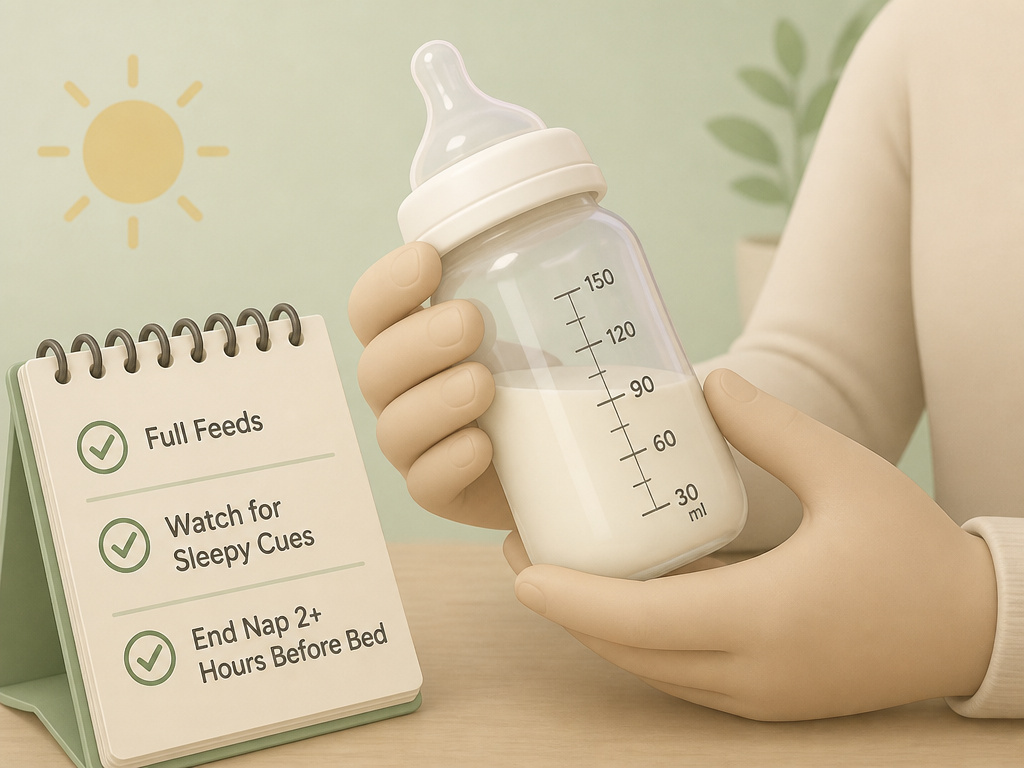 Night sleep is built in the daylight. A predictable, repeating cycle of feeding, active awake time, and napping sets a metabolic rhythm that tells the brain when to be alert and when to rest.
Full feeds are the cornerstone. A baby who snacks all day will wake to snack all night. Ensure daytime feeds are substantive. For breastfed babies, offer both sides. For bottle-fed babies, watch for signs of fullness rather than pushing every last milliliter. A well-established feeding routine directly reduces the need for calories overnight.
Awake windows matter more than a clock schedule. A newborn can only handle 45-60 minutes of awake time before becoming overtired. An overtired baby produces cortisol, a stress hormone that makes falling asleep and staying asleep harder. Watch for sleepy cues: rubbing eyes, staring into space, turning away from stimulation.
| Baby’s Age | Typical Awake Window | Sleepy Cues Often Missed |
|---|---|---|
| Newborn | 45-60 min | Stilling, looking away, fluttering eyelids |
| 2-3 months | 60-90 min | Red eyebrows, fussiness that escalates quickly |
| 4-6 months | 1.5-2.5 hours | Clumsiness, decreased engagement, yawning |
Nap length dictates night sleep quality. Long, late-afternoon naps can sabotage bedtime. It’s a balance: you want them well-rested, not over-rested. If the last nap ends too close to bedtime, they won’t have built up enough sleep pressure. A general rule: try to have the final nap end at least 2 hours before you want them down for the night. If they crash for a 5 p.m. Marathon nap, expect a 10 p.m. Party.
The Bedtime Routine: Signal, Not Solution
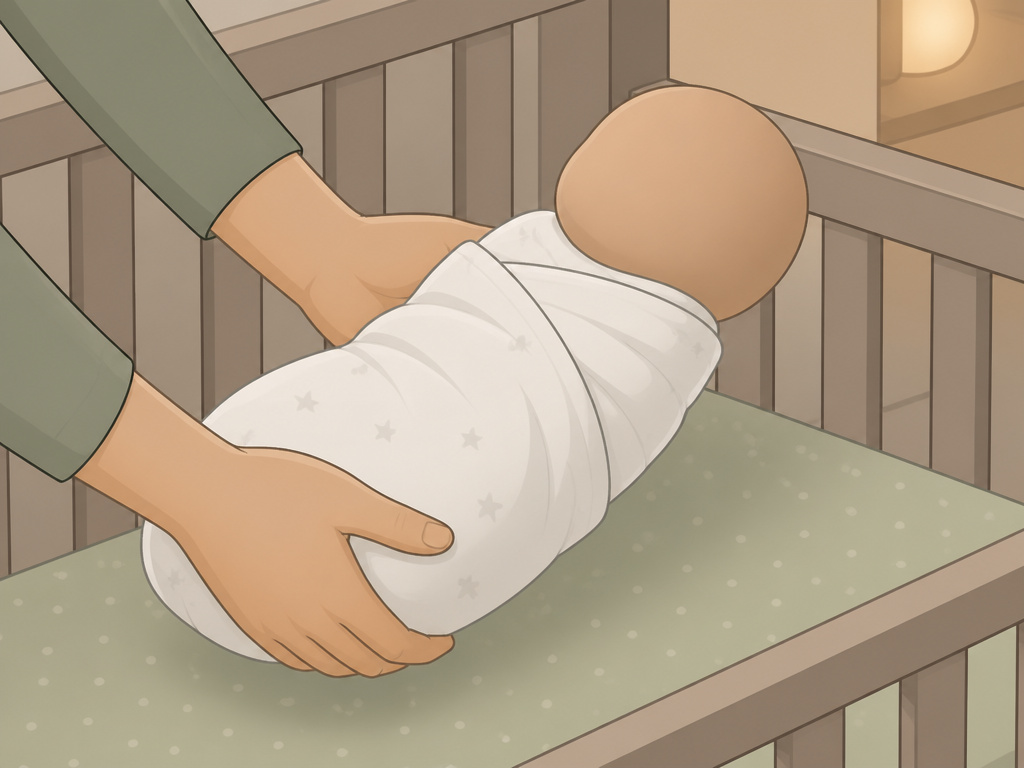 A bedtime routine is a consistent series of calming steps that signals the transition from day to night. It’s a cue, not a magic spell. The power is in predictability, not in the specific songs or books.
Start simple, even with a newborn. A five-minute sequence is enough: dim lights, change into pajamas, feed, perhaps a short song or gentle rock, then into the crib drowsy but awake. The “drowsy but awake” part is the goal, it lets them practice falling asleep in their sleep space without your arms as a prop. It won’t work every time early on, but the practice pays off around 3-4 months.
Your choice of sleepwear and swaddle blankets is part of the safety signal. A proper swaddle or sleep sack keeps them warm without the risk of a loose blanket. Stop swaddling as soon as they show signs of rolling, usually around 8 weeks. Transition to a wearable blankets for baby sleep sack.
Common mistake: Creating a 45-minute elaborate routine that requires perfect silence. You want your baby to be able to fall asleep amid normal household sounds. A white noise machine is fine to mask sudden noises, but don’t condition them to require absolute quiet.
The routine also helps you. It forces a wind-down period for both of you, creating a psychological boundary between the hectic day and the hopefully quieter night.
Navigating Night Wakings: The Feed vs. Settle Decision
This is the crux. The baby wakes. What do you do? Your decision tree depends on their age, weight, and the type of cry.
For newborns (0-3 months), respond promptly. Night wakings are almost always for feeding. Your goal is to meet the need efficiently. Keep the lights off or very dim. Use a soft voice. Change the diaper only if it’s soiled. Feed, burp, and place them back down. This isn’t the time to worry about creating “bad habits.” Security and nutrition are the priorities.
For infants (3-6 months), introduce a pause. Wait 2-5 minutes before going in. Often, they will fuss between sleep cycles and put themselves back to sleep. If the crying escalates, go in. Check for a genuine need, are they stuck in a corner, is the diaper leaky, are they truly hungry? If it’s a feed, keep it business-like. This is where using a bedside bassinets makes the quick check and return much easier.
The gradual wean for older infants (6+ months). If your pediatrician confirms they no longer need nighttime calories, you can start to reduce the amount of milk in the bottle or minutes on the breast during night feeds. Alternatively, you can increase the time you wait before responding by a few minutes each night, allowing them more opportunity to self-settle. Consistency is everything. Changing your response night-to-night confuses them and prolongs the process.
Products, Gadgets, and the False Promise of Easy Sleep
The baby sleep industry is built on parental desperation. Be skeptical.
Sound and movement machines can be useful tools. Continuous white noise can mask disruptive household sounds. The evidence for heartbeat or womb sounds is anecdotal. Avoid devices that keep the crib in constant motion. They can prevent a baby from learning to self-soothe and create a dependency that’s hard to break.
Home breathing monitors (wearable or under-mattress) are a contentious category. The official Mayo Clinic baby sleep guide and other major health bodies state there is no evidence they prevent SIDS. They can generate false alarms, causing immense anxiety, and may provide a dangerous false sense of security that leads parents to overlook the proven safe sleep practices.
Weighted sleep sacks or swaddles are not recommended for safe sleep. The added weight can make it harder for a baby to arouse themselves, which is a protective mechanism against SIDS. Stick with standard, lightweight, well-fitting sleep sacks.
Your money is better spent on a high-quality, breathable mattress for crib and several basic cotton swaddles than on a high-tech gadget promising sleep. The foundation is simple, even if executing it is hard.
When to Pause and When to Seek Help
You can do everything “right” and still have a baby who wakes frequently. Some babies are just more sensitive, have reflux, or are slower to mature neurologically. Your mental health is part of the equation.
Pause the plan if:
- Your baby is sick, teething, or going through a documented growth spurt.
- You are so sleep-deprived you cannot function safely. Survival mode is a legitimate strategy, do whatever gets you the most sleep in a safe manner for a few days.
- It’s causing significant tension between you and your partner. The goal is better rest for the family, not a trophy for sleep training.
Seek help from your pediatrician if:
- Your baby is not gaining weight appropriately.
- They seem to be in pain when lying flat (could indicate reflux).
- Their breathing sounds noisy or labored during sleep.
- You have persistent concerns about their sleep patterns or development.
A pediatrician can rule out medical issues like tongue ties, allergies, or sleep apnea. They can also give you the green light to try more structured sleep training methods if you choose to go that route after six months.
Frequently Asked Questions
How soon can I start sleep training?
Formal, cry-based sleep training is not recommended before 4-6 months of age. Before that, you are “sleep shaping” by establishing good habits, a safe sleep environment, a predictable routine, and differentiating day from night. The foundation you build in the first four months makes any future training easier and faster.
Is it okay to feed my baby to sleep?
For young newborns, yes, it’s biologically normal and often the only way they’ll nod off. The issue is the dependency that can form after 3-4 months. If they only know how to fall asleep while sucking, they’ll need that same condition every time they wake between cycles. The goal is to gradually separate feeding from the moment of falling asleep by putting them down drowsy but awake.
What if my baby only sleeps while being held?
This is common, especially in the first 8-12 weeks. It’s called the “fourth trimester.” The transition from the womb is huge. Use safe alternatives like a certified wearable baby carrier during the day for naps. For night, persist with placing them in their cribs and bassinets after they fall asleep, even if they wake 10 minutes later. The repeated exposure helps them adjust. For some parents, a shift-sleep system where one partner is “on duty” holding the baby while the other gets a solid block of sleep is the only workable short-term solution.
Do I need to wake my newborn to feed at night?
Yes, if your pediatrician has instructed you to do so, typically until they regain their birth weight and are gaining steadily. After that, you can let them wake you. A healthy, growing baby will not sleep through their need for calories.
Are pacifiers safe for sleep?
Yes, and according to some studies, offering a pacifier at nap and bedtime may have a protective effect against SIDS. If you are breastfeeding, wait until nursing is well-established (usually 3-4 weeks) to introduce one to avoid nipple confusion. Don’t reinsert it if it falls out after they’re asleep.
The Bottom Line
Infant sleep is a developmental process, not a behavior to be fixed. Your role is the gardener, not the engineer, you prepare the soil, provide consistent care, and then wait for growth to happen on its own timeline. The single most effective thing you can do is master the safe sleep basics and then respond to your baby’s cues with calm consistency. The nights are long, but the phase is short. Trust that a solid, safe foundation of routine and response will eventually yield longer stretches of sleep for everyone.
