
How to Establish a Newborn Sleep Routine and Room Sharing
This post contains affiliate links. As an Amazon Associate we earn from qualifying purchases.
To set a newborn sleep routine, anchor it in safety: place your baby on their back on a firm mattress in your room for the first six to twelve months. Then, layer on a simple, consistent 20-minute bedtime sequence, like a warm bath, gentle massage, quiet feeding, and cuddle, to signal that night is for sleeping. The routine supports safety; safety enables sleep.
That six-month room-sharing rule is a documented risk reducer, cited in government guidelines from Australia to the CDC. Your baby’s sleep environment is a physical setup that either supports safe breathing or introduces hidden hazards.
What follows is the breakdown: the three non-negotiable safety specs that come before any routine, the four-step evening sequence that actually works on a newborn brain, and how to adapt when your baby hits the first major sleep milestone of rolling over.
Key Takeaways
- Room-share for at least six months, ideally until twelve months. This practice, backed by the CDC and NSW Health, significantly reduces SUDI risk.
- Every sleep starts on the back on a firm, flat surface. Soft bedding, pillows, and inclined sleepers are banned from the sleep area.
- A newborn bedtime routine is a sensory signal, not a strict schedule. Keep it short (15-20 minutes), consistent, and calm, think bath, massage, feed, cuddle.
- Stop swaddling the moment your baby shows signs of rolling. Transition directly to a wearable blanket for safe arms-free sleep.
- Watch the clock, not the calendar. Preterm babies have different sleep needs, and any medical condition overrides standard advice, always consult your pediatrician.
The Non-Negotiables: Safe Sleep First
Your baby’s routine cannot exist without a safe sleep environment. This is not a separate topic. The foundation determines whether the routine leads to rest or to risk.
Place the baby on their back for all sleep times. Use a firm, flat sleep surface, such as a mattress in a safety-approved crib covered by a fitted sheet. Keep soft bedding out of the sleep area. These are not best practices. They are the baseline.
The most critical element is location. Your newborn must sleep in the same room as you, on a separate surface, for a minimum of six months. The CDC safe sleep guidelines and the NSW Health safe sleep practices both stress this. The risk of Sudden Unexpected Death in Infancy (SUDI) is highest in the first three months, and room-sharing allows for monitoring and quicker response to any breathing difficulties.
The surface itself is the second spec. A firm, flat crib mattress is mandatory. Soft mattresses, memory foam toppers, or inclined sleep pods can cause an infant’s airway to become obstructed. The mattress must be tight-fitting, with no gaps, and covered only by a snug, fitted crib sheet. This rule extends to a bedside bassinet, the mattress must be equally firm.
| Sleep Environment Element | Safe Choice | Risk If Compromised |
|---|---|---|
| Sleep Position | On the back, for every nap and night sleep. | Highest risk factor for SUDI; side-sleeping is unstable and can lead to rolling onto the stomach. |
| Sleep Surface | Firm, flat, safety-approved crib or bassinet mattress. | Airway obstruction; re-breathing of carbon dioxide if the face presses into soft material. |
| Bedding | Only a fitted sheet. No blankets, pillows, bumpers, or stuffed toys. | Entrapment, suffocation, and overheating. Loose bedding is implicated in infant asphyxiation cases. |
| Room Temperature | 68–72°F (20–22°C), with baby dressed in one more layer than an adult. | Overheating is a known SUDI risk factor. A sweaty neck or chest is a sign to remove a layer. |
The short version: Safety is the routine. The bassinet next to your bed, the bare mattress, the baby on their back, that’s the setup. Everything else is built on top of it.
Building Your Bedtime Sequence
A newborn routine is about consistent sensory cues to teach night from day.A short, predictable sequence tells a baby’s developing brain that the long sleep is coming.
Aim for 15 to 20 minutes. Longer than that, and an overtired, overstimulated newborn will fight sleep. The sequence should be calm, low-light, and involve minimal talking.
Here is a proven four-step framework. Start it around the same time each evening, but be flexible by 30 minutes based on your baby’s last nap and hunger cues.
- The Warm Bath (5 minutes). Warm water is a powerful physiological cue for sleep. It raises the body’s core temperature slightly, and the subsequent cooldown triggers the natural dip in temperature that promotes drowsiness. Skip soap every night to avoid drying skin; a water-only bath is perfect.
- Gentle Massage & Lotion (5 minutes). In a warm room, use a fragrance-free lotion for a gentle massage. Focus on the legs and back. This touch is calming and provides proprioceptive input that helps regulate the nervous system. A clinical trial on sleep routines specifically included massage as a key element of a feasible neonatal bedtime ritual.
- Quiet Feeding & Diaper Change (7-8 minutes). Feed your baby in a dim, quiet room. This is often a “cluster feed” for newborns. After feeding, do a final diaper change in low light. The goal is a full, dry baby ready for sleep.
- Final Cuddle & Into Bed (2-3 minutes). Swaddle your newborn (if they are not rolling yet) or place them in a sleep sack. Hold them upright for a brief burp or cuddle, then place them in their bassinet while they are drowsy but still awake.
Where this goes sideways: Starting the routine when the baby is already crying from hunger or exhaustion. You miss the sleep window. Begin 20 minutes before you see the first eye-rub or yawn.
This sequence does not produce a baby who sleeps through the night. That is not the goal. It produces a baby who begins to understand the rhythm of the day and connects these calming steps with the safety of their sleep space.
Day vs. Night: Teaching the Rhythm
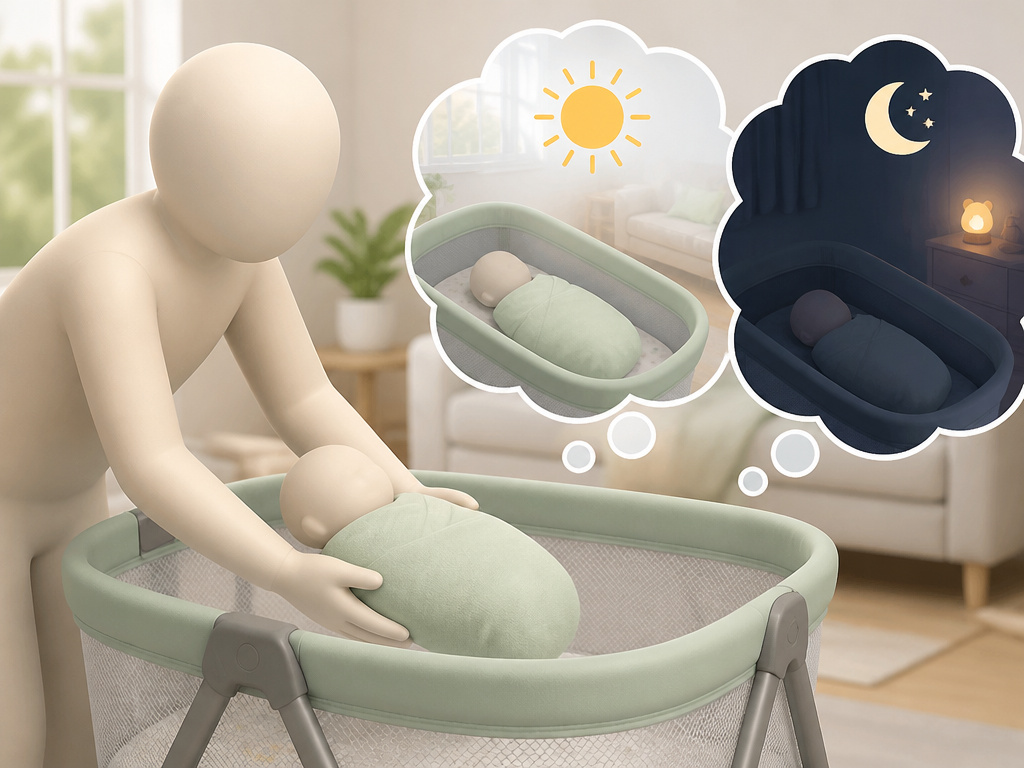 Newborns are born without a circadian rhythm. Your job is to provide the contrast. Daytime sleep should happen in a brighter, noisier environment. Nighttime sleep is dark and quiet.
During the day, open the curtains. Run the dishwasher. Talk in a normal voice. When your baby naps, let them do so in a portable bassinet in the living room, not in a pitch-black nursery. This helps cement that daylight hours are for activity.
At night, the rules flip. Use dim lights or a nightlight. Speak in whispers or not at all. If a diaper change is needed, do it quickly and with minimal interaction. The message is simple: night is boring. Night is for sleeping.
This contrast is especially important in the first six weeks. It is the scaffolding upon which a more predictable schedule will later be built.
Navigating the Two Biggest Transitions
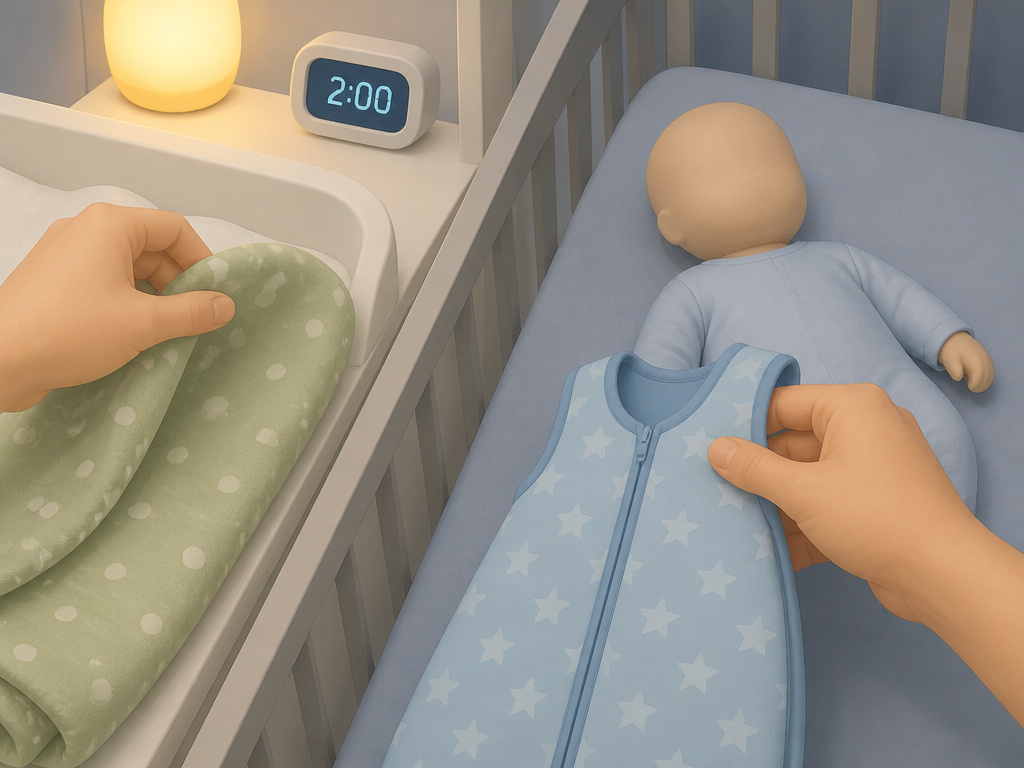 Two events will disrupt your early routine: the end of the swaddle and the move to their own room. Plan for them.
The Swaddle to Sleep Sack Shift
Swaddling is a brilliant tool for the first weeks. It mimics the womb and prevents the Moro reflex from startling a baby awake. But it becomes dangerous once a baby can roll.
Common mistake: Continuing to swaddle after a baby shows rolling signs. If a swaddled baby rolls onto their stomach, they cannot use their arms to push up or turn their head, creating an immediate entrapment and suffocation risk.
The transition is non-negotiable. The moment you see your baby attempting to roll, even during tummy time, switch to a wearable blanket. These sleeveless sacks keep babies warm without restricting arm movement. It may mean a few rougher nights as they adjust, but safety is not flexible.
The Room-Sharing Countdown
The six-month mark is a minimum, not a deadline. The official clinical policy directive from NSW Health states room-sharing is ideal for the first six to twelve months. If you and your baby are sleeping well, there is no rush to move them out.
When you do transition, make it gradual. Start with naps in the nursery so the space becomes familiar. Use the exact same safe crib mattress and sleep sacks they are used to. Keep the bedtime routine identical, only the location changes.
When Your Newborn Isn’t “Typical”
The averages are a guide, not a law. Two key groups need adjusted expectations.
Premature Babies: A baby born early will have sleep needs aligned with their adjusted age, not their birth date. They may sleep more overall but in even shorter, more frequent bursts. Their nervous system is less mature, so they may be more sensitive to overstimulation. Keep routines even shorter and more gentle. Always follow the guidance of your neonatologist or pediatrician.
Babies with Medical Needs. Certain conditions, like severe reflux, may require a doctor to recommend a specific sleep position or incline. This is the only exception to the “back to sleep” rule. The advice of your healthcare provider overrides any general guideline.
Frequently Asked Questions
How long should a newborn bedtime routine be?
Keep it between 15 and 20 minutes. Newborns have very short windows between sleepy and overtired. A long, drawn-out routine will push them past the point of easy settling. The sequence is about cues, not ceremony.
Can I use a pacifier as part of the routine?
Yes, offering a pacifier at sleep time is supported by research and can be protective. However, if you are breastfeeding, wait until nursing is well-established, usually around three to four weeks, to avoid nipple confusion. Never reinsert a pacifier after the baby falls asleep.
What if my baby only falls asleep while being held?
This is extremely common in the first month. The goal is to gradually move toward putting them down “drowsy but awake.” Start by holding them until they are in a deep sleep (limp limbs, regular breathing), then place them down. Over weeks, try putting them down progressively earlier in the sleep cycle. Consistency with the rest of the bedtime routine will help.
Is it safe to use a sound machine?
Yes, a constant, low-volume white noise or pink noise machine is safe and can be very helpful. It masks disruptive household sounds and creates a consistent auditory cue for sleep. Place it at least 6 feet from the baby’s head and keep the volume no louder than 50 decibels (about the level of a quiet shower).
When should I drop the dream feed?
The “dream feed”, a late-night feeding you initiate before you go to bed, is a parental tool, not a baby need. You can drop it whenever you feel your baby is gaining weight well and you no longer need it for your own sleep stretch. Most parents phase it out between two and four months, as nighttime sleep stretches naturally lengthen.
Before You Go
A newborn sleep routine is a short list. A safe place in your room. A firm mattress with a tight sheet. A back for sleeping. A few calm steps each night to say the day is done.
The goal is not perfect, unbroken sleep. Not yet. The goal is safety, rhythm, and a foundation of trust. The rest, the longer stretches, the predictable naps, builds on that foundation in the months to come. Start with the bassinet next to your bed and the gentle massage after the bath. The rest follows.
