
The Process of How to Make Baby Bed Bumpers Under the US Ban
This post contains affiliate links. As an Amazon Associate we earn from qualifying purchases.
You cannot legally make or use traditional baby bed bumpers in the United States. The Safe Sleep for Babies Act of 2021 made them a banned hazardous product as of November 12, 2022. This federal law covers any padded material intended to cover crib sides, including DIY versions, regardless of manufacture date. The ban exists because bumpers are linked to infant suffocation and strangulation.
That date is the line where a common nursery item became illegal to sell, distribute, or import. The Consumer Product Safety Commission (CPSC) enforces this.Your intention to craft something soft and protective runs directly into a public health mandate built on incident data.
What follows is a breakdown of the law, the mechanical reasons for the ban pulled from the CPSC’s own testing, and the specific, safe alternatives you can actually use. We’ll cover the legal definition, the documented failure modes, and how to set up a crib that meets modern safety standards without a bumper.
Key Takeaways
- The federal ban on crib bumpers took effect November 12, 2022, and applies to all bumpers, including handmade ones.
- The legal definition includes any padded material covering crib sides to prevent bumps or limb entrapment; only non-padded mesh liners are exempt.
- CPSC testing found even “breathable” bumpers can provide a climbing aid, increasing fall risk for mobile infants.
- The primary hazards are suffocation (for infants under 8 months) and strangulation (from loose ties or entrapment).
- Safe, legal alternatives include using a firm, snug-fitting mattress at the lowest setting and considering a certified non-padded mesh liner.
The Short Answer: You Can’t and Shouldn’t
The search for “how to make baby bed bumpers” often comes from a good place. You want to protect your child from bumps or keep limbs safely inside the crib. The problem is that the solution you’re considering has been proven deadly. Federal law now treats it the same way it treats lead-painted toys.
The U.S. Code crib bumper ban (15 U.S. Code § 2057e) is explicit. It states that crib bumpers, regardless of their date of manufacture, are a banned hazardous product. This is a prohibition. The CPSC’s official crib bumper regulation codifies this, making the sale, distribution, or importation of these products illegal.
Before you start: Using or making a bumper creates two immediate, specific risks. First, an infant under 8 months can press their face against the padded surface and suffocate, as they lack the neck strength to turn away. Second, the ties can loosen, creating a loop for strangulation, or a mobile infant can use the bumper as a step to climb and fall from the crib.
Why does a homemade version not get a pass? The law defines the hazard by the product’s intended function and construction, not its origin. If you sew a padded panel to line the crib sides, you have manufactured a banned product. The legal risk is one thing. The physical risk to your child is the real reason to stop.
What Exactly Is Banned? The Legal Definition
The law casts a wide net. Knowing the precise definition shows why many well-intentioned DIY projects fall under the ban.
According to 16 CFR Part 1309, a crib bumper is: 1. Any material intended to cover the sides of a crib to prevent injury from impacts or to prevent access to openings (like slats) to avoid limb entrapment. 2. This includes padded crib bumpers, supported/unsupported vinyl bumper guards, and vertical crib slat covers. 3. This does not include non-padded mesh crib liners.
The key is padding. The moment you add batting, foam, or any filling to a fabric panel meant for the crib sides, you’ve created a banned product. This also covers “vertical slat covers,” which are individual padded tubes meant to wrap around each crib slat. They are included in the ban.
The CPSC’s definition is intentionally broad to close loopholes. “Breathable” became a marketing term for thinner bumpers, but the agency’s testing concluded the term has no quantifiable safety meaning. Thickness alone doesn’t prevent suffocation; firmness does.
Here is what the ban encompasses versus what it allows:
| Banned Product | Description | Why It’s Included |
|---|---|---|
| Traditional Padded Bumper | Fabric panel with polyester filling, attached with ties or ribbons. | Creates a soft, compressible surface that can conform to an infant’s face. |
| Vertical Slat Cover | Individual padded tube that zips or ties around each crib slat. | Still presents a padded surface and can detach, creating an entanglement hazard. |
| Vinyl Bumper Guard | A thinner, often supported vinyl sheet meant to cover slats. | Can create a non-breathable barrier and poses entrapment risks. |
| Allowed Product | Description | Why It’s Exempt |
| Non-Padded Mesh Crib Liner | A panel made of taut, non-expandable mesh fabric, secured safely. | It is not padded, allowing air to pass through freely, preventing suffocation. |
The Mechanics of the Hazard: What the Testing Shows
The ban was created from incident analysis and specific product testing commissioned by the CPSC. The CPSC staff statement on testing from Boise State University provides the physical “why.”
The research identified two distinct hazard periods linked to infant development:
- Suffocation/Entrapment (2–8 months): Infants in this range lack the motor strength to extricate themselves if they roll or wiggle against a bumper. The report notes that in incidents where a sleep positioner was also involved, infants often became trapped between the positioner and the bumper, with their face pressed into the bumper material.
- Strangulation/Climb-out (8–17 months): Older, mobile infants can use the bumper as a foothold. The study developed a test to measure “height gain” – how much a bumper could elevate a child. It found that a combination of the bumper’s firmness, tension, and attachment mechanism (like hook-and-loop) directly impacts this risk.
The testing also revealed a critical flaw in previous thinking. An old voluntary standard, ASTM F1917-12, focused on maximum thickness. The Boise State report proved that a bumper could pass a thickness test but still be soft enough to conform to a face. Their recommendation was that all bumpers needed firmness testing, not just thick ones.
Where this goes sideways: Using a bumper to “fix” a broken crib slat. The report documented incidents where parents used a bumper to cover a broken or gaping slat, which then led to a strangulation from the bumper’s ties. The bumper introduced a new hazard while attempting to address an existing one.
Safe and Legal Alternatives to Crib Bumpers
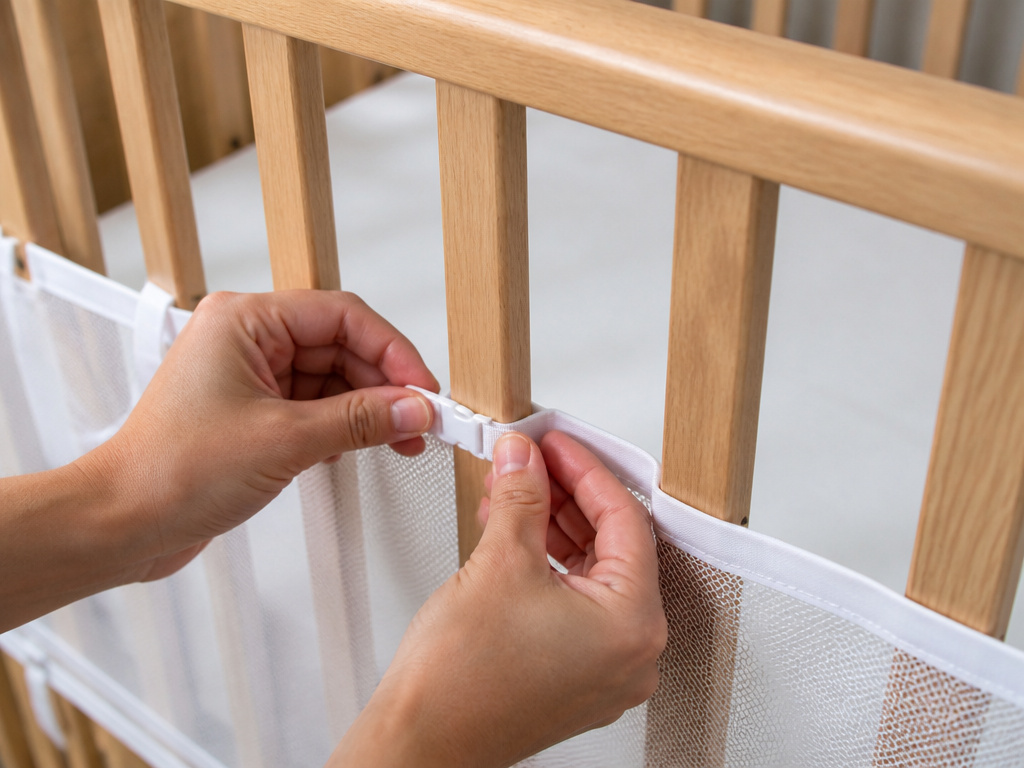
Your crib doesn’t need a bumper. A safe sleep environment is bare and firm. Here are the steps to achieve that, along with the one product category that remains a legal option if you’re concerned about limbs.
- Use a Firm, Snug-Fitting Mattress: This is the single most important step. The mattress must be firm and fit the crib with no gaps wider than two fingers between the mattress and the crib frame. This prevents limbs from getting trapped in a gap.
- Set the Mattress to the Lowest Level: As soon as your child can sit up, lower the mattress to its deepest setting. By the time they can pull to stand, the mattress should already be at the bottom. This minimizes the height they can climb from.
- Dress the Baby, Not the Crib: Use a wearable sleep sack instead of loose blankets. This keeps your baby warm without any fabric that could cover their face.
- Consider a Certified Non-Padded Mesh Liner: If the sight of limbs through slats causes anxiety, this is the only legal product. It must be non-padded, made of taut mesh, and secured according to the manufacturer’s instructions without creating loose fabric or gaps.
I won’t recommend a mesh liner as a default. A bare crib is safest. But if you choose one, your due diligence is non-negotiable: verify it is explicitly marketed as “non-padded” and look for reviews that confirm it stays taut. A sagging mesh liner is its own entrapment risk.
When your child outgrows the crib, the transition to a toddler bed or a Montessori floor bed eliminates the slat concern entirely. Many parents find that a convertible crib to bed offers a seamless, long-term solution.
Addressing Common Concerns and Myths
“But my parents used bumpers, and I was fine.”
This is survivor bias. The data aggregates outcomes across the population, and the statistics show a clear, preventable risk. Safety standards evolve with evidence. We don’t use lead paint or drop-side cribs anymore, either.
“I’ll just make one with breathable mesh fabric.”
If it’s truly non-padded and taut, you are essentially replicating the one allowed product category. However, without standardized testing, you cannot guarantee the fabric’s strength, durability, or safe attachment method. A commercial product that meets the exemption has been evaluated for these risks.
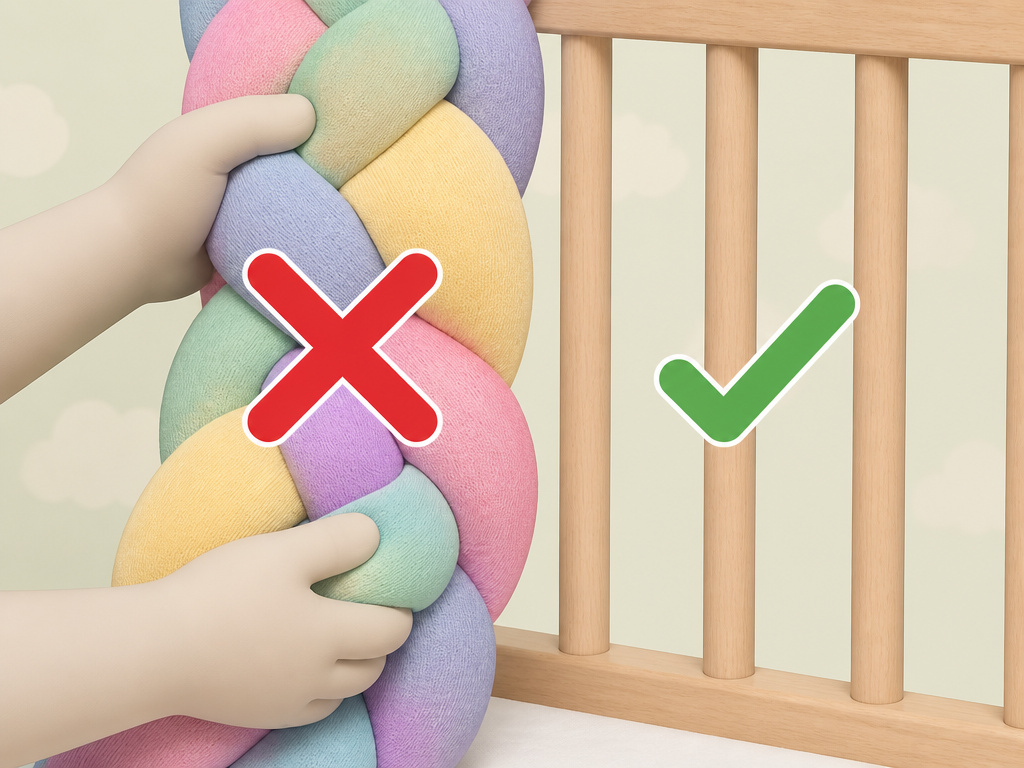
“What about those cute bumper alternatives like braided bumpers or woven wall hangings?”
Anything added to the crib sides that is not a certified, non-padded mesh liner introduces an unknown risk. Braided bumpers were specifically listed in the CPSC test samples (like S08) and present entanglement and climbing hazards. Decor should stay on the walls, not on the crib.
“My baby keeps hitting their head on the slats. Isn’t a minor bump safer than suffocation?”
A brief cry from a bump is a normal, minor event. It does not cause brain injury. The ability to feel the hard slat is what teaches a mobile infant to adjust their position. Padding that hazard removes the feedback and introduces a far graver, silent danger.
What to Do With an Existing Bumper
You might have a bumper from an older child, a hand-me-down, or a gifted nursery set. The law is clear: its manufacture date doesn’t matter.
- Remove it immediately. Take it out of the crib and out of the sleep environment.
- Do not donate it or sell it. Passing it on violates the ban on distribution and puts another child at risk.
- Destroy and discard it. Cut the ties and the fabric so it cannot be used as intended, then dispose of it.
Treat it like any other banned hazardous product. Its only safe place is in the trash. Replace it with a safe toddler blanket for use outside the crib during playtime, if needed.
Frequently Asked Questions
Are mesh crib bumpers safe?
Only non-padded mesh crib liners are exempt from the federal ban and can be considered safe if used correctly. They must be pulled taut and secured without creating gaps. “Mesh bumpers” that contain any padding or batting are banned and unsafe.
Why are crib bumpers illegal?
Crib bumpers are illegal because they are linked to infant deaths from suffocation and strangulation. The Consumer Product Safety Commission guidance details these risks, leading to the 2022 federal ban under the Safe Sleep for Babies Act.
What can I use instead of a crib bumper?
Use a firm, snug-fitting crib mattress at the lowest setting. For limb concerns, the only legal product is a certified non-padded mesh crib liner. For older children transitioning, consider bed rails on a toddler bed.
Is it safe to put a blanket over crib rails?
No. Loose blankets, including those draped over rails, pose a suffocation risk and can be pulled into the crib. Use a wearable sleep sack for warmth and keep all loose bedding, pillows, and soft toys out of the crib until at least age one.
Can I use pool noodles as crib bumpers?
No. This is a dangerous DIY hack. Pool noodles are not designed for cribs, can compress and conform to a baby’s face, and present a serious suffocation hazard. They also create a perfect step for climbing. This violates the same safety principles as padded bumpers.
When was the crib bumper ban passed?
The Safe Sleep for Babies Act was signed into law on May 16, 2022. The ban on crib bumpers became effective 180 days later, on November 12, 2022. This is the date all bumpers, regardless of when they were made, became illegal.
Before You Go
The desire to make something soft for your child’s bed is instinctual. The evidence, however, has rendered that instinct obsolete for cribs. The federal law isn’t bureaucratic overreach; it’s a direct response to a measurable, fatal hazard.
The safe path is simpler than any sewing project. A firm mattress, a fitted sheet, and a sleep sack. That’s the complete checklist. If the crib slats worry you, a verified non-padded mesh liner is the single sanctioned option, but a bare crib is the gold standard.
Focus your DIY energy elsewhere—on a quilt for floor time, a mobile for the ceiling, or decorating the nursery walls. The crib itself is one place where simplicity is the standard that keeps your child safe. When it’s time to move on, you can explore the world of floor beds or cot beds with confidence, knowing the sleep space is built for safety, not decoration.
