
Back or Stomach: The Correct Infant Sleep Position Explained
This post contains affiliate links. As an Amazon Associate we earn from qualifying purchases.
Infants must sleep on their back, the supine position, for every single sleep, nap or night, until they are at least one year old. Stomach (prone) and side sleeping are not safe and significantly increase the risk of Sudden Infant Death Syndrome (SIDS) and other sleep-related infant deaths. This recommendation from the American Academy of Pediatrics (AAP), supported by the CDC and global health bodies, is based on decades of evidence showing back sleeping can reduce the SIDS rate by over 50 percent.
The stakes in that first sentence concern a documented, physiological chain reaction that starts the second an infant is placed prone. The back sleep position on a firm, flat surface is a non-negotiable guardrail against a set of risks that peak between two and four months of age.
What follows breaks down the hard science behind the “back is best” rule, tackles the persistent choking fear head-on with clinical data, and walks you through building a sleep environment that supports this position safely. By the end, you’ll know exactly why the rule exists, how to apply it with any caregiver, and what to do if your baby starts rolling over on their own.
Key Takeaways
- Place your baby on their back for every sleep until their first birthday. Stomach and side positions are unsafe.
- The risk of SIDS for an infant placed on their stomach who isn’t used to it is 8.7 to 45.4 times higher than for a baby who usually sleeps on their back.
- Back sleeping does not increase choking risk, even for babies with reflux. The infant airway anatomy and gag reflex protect against aspiration.
- A safe sleep space is a firm, flat mattress in a safety-approved crib or bassinet, with no soft bedding, pillows, or toys.
- If your baby rolls over on their own during sleep, you don’t need to reposition them. The critical step is always starting sleep on the back.
The Science Behind Back Sleeping
The “back to sleep” campaign didn’t emerge from a theory. It emerged from a clear, catastrophic pattern in the data. Since the AAP’s formal recommendation in 1992, the rate of SIDS in the United States has dropped by more than half. That drop represents thousands of lives. The policy works because it directly counteracts several physiological vulnerabilities in young infants.
Placing an infant prone (on the stomach) or on their side significantly increases the risk of SIDS, with odds ratios ranging from 2.3 to 13.1. The side position is unstable, and an infant is more likely to roll to the dangerous prone position from their side than from their back. Infants unaccustomed to prone sleep face an exceptionally high risk (aOR 8.7–45.4) if placed in that position.
The mechanism is a cascade.
Prone sleeping alters autonomic control of the cardiovascular system during sleep, particularly at the peak SIDS age of 2–3 months, and can lead to decreased cerebral oxygenation. It also increases the risk of rebreathing, where the baby breathes in their own exhaled carbon dioxide trapped in the bedding. This leads to hypercapnia (high CO2) and hypoxia (low oxygen). Furthermore, the prone position traps body heat, raising the risk of overheating, which is another known risk factor for SIDS.
Finally, babies sleep more deeply on their stomachs. That sounds good to a tired parent, but it’s dangerous. That deep sleep means reduced arousal from sleep. The ability to wake up in response to a stressor, like breathing difficulty, is a critical protective reflex. A baby who doesn’t stir as easily is at greater risk.
Why the Choking Fear Is a Myth
This is the hurdle. I’ve heard it from grandparents, read it in old parenting books, and seen the worry on a new parent’s face. “But won’t they choke on spit-up?” The concern feels instinctive, but it’s medically unfounded. Major pediatric gastroenterology societies and the AAP state clearly: the supine position does not increase the risk of choking and aspiration, even for infants with gastroesophageal reflux (GER).
The anatomy explains why. An infant’s airway is designed with protective reflexes. When a baby is on their back, the trachea (windpipe) lies above the esophagus (food pipe). If spit-up occurs, the material must work against gravity to enter the trachea, and the baby’s strong gag and cough reflexes will clear it. When a baby is on their stomach, spit-up can pool at the opening of the trachea, making aspiration more likely, not less.
Multiple large studies across different countries have shown no increase in aspiration-related deaths or hospitalizations since the back-sleeping campaign began. What parents often interpret as choking, coughing or gagging, is usually the sound of that protective reflex doing its job perfectly.
Common mistake: Propping a baby on their side or stomach because of reflux. This directly contradicts medical guidance and introduces a major SIDS risk without solving the reflux issue.
If your baby has been diagnosed with GER, talk to your pediatrician about safe, upright awake time after feeding and other management strategies. The sleep position does not change.
The Extreme Danger of “Sometimes” on the Stomach
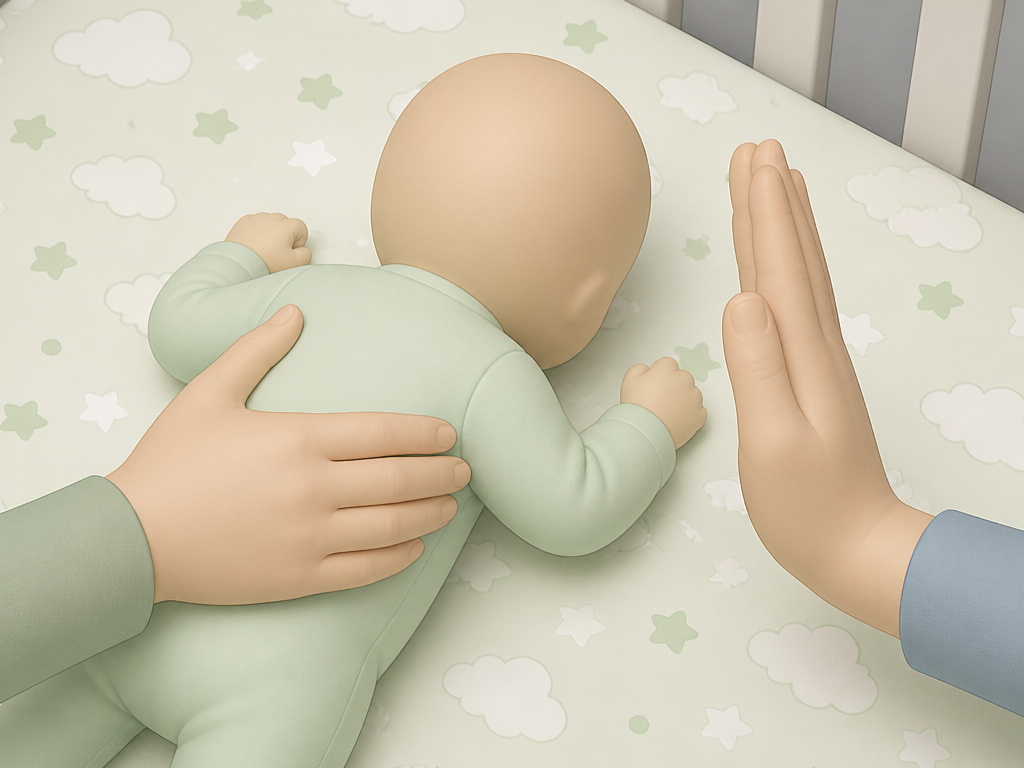
Here is the most critical non-negotiable point from the data, and it’s where well-meaning choices go horribly wrong. The research shows the risk isn’t uniform. An infant who is unaccustomed to prone sleeping but is placed prone for a single sleep, maybe for a nap at grandma’s house, or because they seem to settle easier, faces a catastrophic increase in risk.
The adjusted odds ratio (aOR) for these babies is between 8.7 and 45.4. That means their risk of SIDS is nearly nine to over forty-five times higher compared to a baby who usually sleeps on their back. This statistic underscores why consistency with every caregiver is a matter of life and death. It’s not just about what you do at home. It’s about ensuring grandparents, daycare providers, babysitters, and anyone else who puts your baby down knows and follows the rule: back, every time.
| Sleep Scenario | Relative Risk of SIDS | Why It’s Dangerous |
|---|---|---|
| Usual back sleep, placed on stomach | 8.7 – 45.4x higher | Infant lacks experience in the position; arousal mechanisms are suppressed. |
| Placed on side | ~2.0x higher (similar to prone) | Unstable position; high probability of rolling to prone. |
| Placed on side, found on stomach | 8.7x higher | Combines the instability of side with the dangers of prone. |
| Usual back sleep, rolls to stomach on own | Risk is not increased | Baby has the strength and coordination to move; always start on back. |
This table presents the compiled evidence from case-control studies that form the backbone of the AAP’s 2022 technical report. It tells you where the line is.
Creating a Safe Sleep Environment
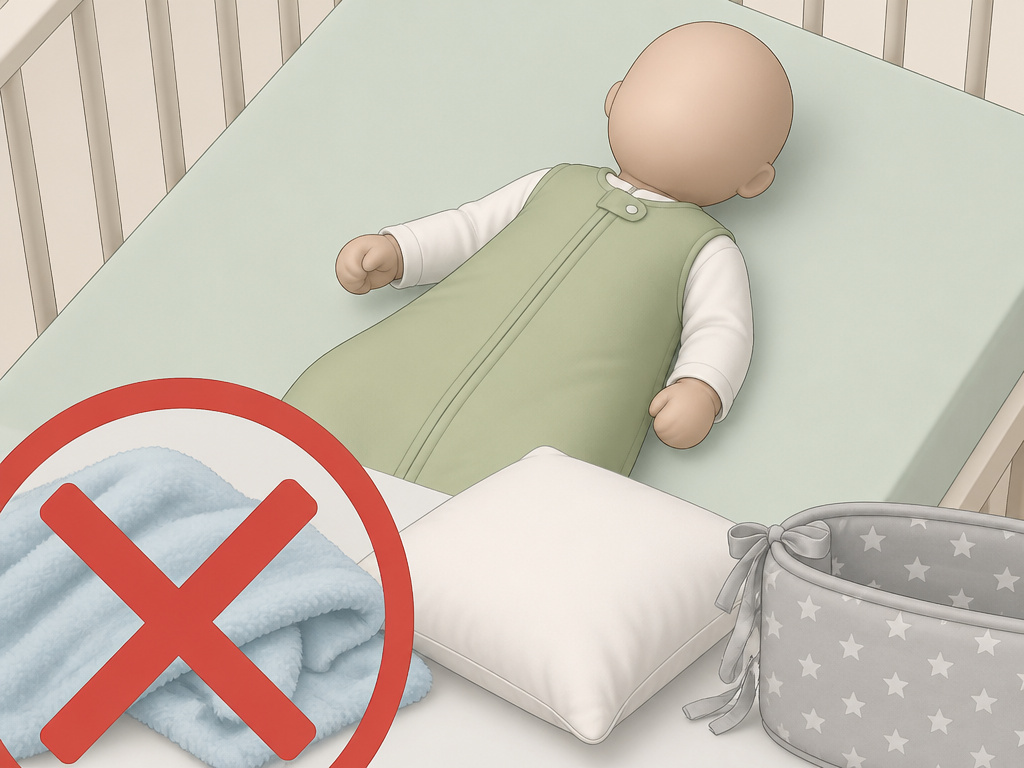
The back sleep position is the cornerstone, but it only works within the right environment. A safe sleep space protects a baby on their back and removes other hazards. Think of it as a system: the position, the product, and the contents.
First, the product. Your baby needs a firm, flat sleep surface that meets current safety standards. This means a crib, bassinet, or play yard approved by the Consumer Product Safety Commission (CPSC). Inclined sleepers, loungers, car seats (for unsupervised sleep), and adult beds are not safe alternatives. The mattress should be firm enough that it doesn’t conform to your baby’s head shape when they are lying on it.
Inside that space, less is more. The checklist is short: – A fitted sheet designed for that specific mattress. – Your baby, dressed in a sleep sack or wearable blanket to stay warm. – Nothing else.
That means no loose blankets, quilts, pillows, stuffed animals, crib bumpers, or positioners. These items pose risks of suffocation, entrapment, and strangulation. The firm mattress is the single most important piece of this puzzle, a soft, plush surface increases rebreathing risk even if the baby is on their back.
Where this goes sideways: Using a padded crib bumper or a soft mattress topper for comfort. These items can block an infant’s face or create a pocket for rebreathing. The hard, firm surface is the safety feature.
Room-sharing, placing your baby’s crib or bedside bassinet in your room, is recommended for at least the first six months. It makes feeding easier and lets you monitor your baby. Bed-sharing, however, is not recommended, as it dramatically increases the risk of accidental suffocation.
When Your Baby Starts Rolling Over
This milestone makes many parents anxious. You’ve been so diligent about back sleeping, and now your 4- or 5-month-old is flipping onto their stomach the minute you lay them down. What do you do?
The guidance is clear and relieving: you don’t need to reposition them. Once an infant can roll from back to stomach and stomach to back on their own, they have developed the muscle strength and coordination to move their head to breathe. The significant risk was in being placed in that position before they had the ability to get into or out of it.
Your job doesn’t change. You still always place them on their back at the start of sleep. If they roll over, they roll over. Continue to provide a clear, safe sleep space free of loose bedding. This is also the time to stop swaddling, as a swaddled baby who rolls over cannot use their arms to push up or adjust their head.
Addressing Common Questions and Concerns
What if my baby seems uncomfortable on their back?
Some babies do startle more or seem less settled on their backs initially. This is normal. The frequent waking associated with back sleeping is actually a protective arousal mechanism. You can try a tight swaddle (for newborns who cannot roll) or a sleep sack. Consistency is key, they will adjust.
Can I let my baby nap on my chest?
Chest napping while you are awake, alert, and unable to fall asleep is a common and cherished practice. The danger comes if you drift off to sleep. If you feel sleepy, move your baby to their own safe sleep space.
Do sleep positioners or wedges help?
No. The FDA and AAP warn against any products that claim to maintain a baby’s sleep position or reduce SIDS risk. These positioners and wedges themselves pose a suffocation hazard and are not a substitute for back sleeping on a flat surface.
How long does the back-sleeping rule last?
The recommendation is for the first year of life. After a year, the risk of SIDS drops dramatically, and children can safely find their own comfortable sleep position.
The Role of Other Safe Sleep Factors
Back sleeping is the most powerful single action, but it’s part of a broader strategy. These other factors stack to further reduce risk: – Breastfeeding: Any amount of breastfeeding is associated with a reduced risk of SIDS. – Pacifier Use: Offering a pacifier at nap and bedtime is linked to a lower risk. Don’t force it, and don’t reinsert it if it falls out. – Smoke-Free Environment: Exposure to smoking during pregnancy and after birth is a major risk factor. – Immunizations: Evidence suggests that following the recommended vaccine schedule may offer some protective benefit against SIDS.
These are layers of protection you build around the core, non-negotiable rule of back sleeping.
Frequently Asked Questions
What if my baby was a preemie?
The rule is the same, and may be even more critical. Preterm infants should be placed on their backs to sleep as soon as they are medically stable. Their vulnerability may be greater, making a consistent, safe sleep environment essential.
Is it okay to use a swing or bouncer for sleep?
No. Sitting devices like swings, bouncers, and car seats (when not in a vehicle) are not designed for safe, unsupervised sleep. The inclined position can cause a baby’s head to fall forward, compromising their airway. If your baby falls asleep in one, move them to a flat, firm surface as soon as possible.
My parents say they put me on my stomach and I was fine. Why is it different now?
This is a common point of friction. The evidence from the past 30 years is unequivocal. The dramatic drop in SIDS rates since the “Back to Sleep” campaign began is the proof. We now know what they didn’t know then: the physiological mechanisms that make stomach sleeping so dangerous. This is an area where following the updated, evidence-based guidance is the only choice.
Are there any exceptions to the back-sleeping rule?
In extremely rare medical circumstances, such as after certain types of surgery, a pediatrician may recommend a different sleep position. This decision must be made on a case-by-case basis by your child’s doctor, weighing very specific risks and benefits. For the vast, vast majority of infants, there are no exceptions.
Before You Go
The question of back versus stomach sleeping has a definitive, evidence-backed answer: back, every time. It’s a simple action with a profound impact, cutting the risk of a sudden, unexplained tragedy by more than half. The science explains why, from rebreathing and overheating to impaired arousal, and dismantles the persistent myth about choking.
Your job is threefold: place your baby on their back on a firm, flat surface, keep that surface completely bare, and ensure every single person who cares for your baby does the same. Once they can roll over on their own, you can relax that vigil a little. Until then, this rule is the bedrock of safe sleep. It’s not just a recommendation. It’s the guardrail.
