
How to Keep Baby Cool in Bed and Prevent Overheating Risks
This post contains affiliate links. As an Amazon Associate we earn from qualifying purchases.
To keep a baby cool in bed, maintain the room at 16–20°C, dress them in a single light layer (or just a nappy above 24°C), and use a firm, breathable mattress with a tight-fitting, natural-fiber sheet. Overheating is a modifiable risk factor for Sudden Unexpected Death in Infancy (SUDI), so airflow and material choice are safety issues, not just comfort.
That temperature range isn’t a suggestion, it’s the evidence-backed sweet spot where an infant’s immature thermoregulation isn’t pushed into overdrive. The Lullaby Trust, a UK infant sleep safety charity, states it directly. The risk climbs when the room can’t be kept that cool, which is why the guidance has a clear fallback: in really hot weather, a short-sleeve vest or just a nappy is fine.
What follows is a breakdown of the three things that actually matter: the room environment, the sleep surface itself, and the clothing or bedding on top. Each has a hierarchy, from the non-negotiable (a firm mattress) to the nuanced (bamboo versus cotton). By the end, you’ll know which fan hack works, which sheet material breathes best, and the one sign that you’ve already added one layer too many.
Key Takeaways
- The 16–20°C room temperature target is from the Lullaby Trust; above 24°C, a nappy-only sleep rule applies to prevent overheating.
- Bamboo or linen crib sheets outperform standard cotton for breathability and moisture-wicking, making them the first upgrade for a cooler sleep.
- Never use a hat on a baby indoors (Johns Hopkins Medicine) and avoid swaddling in heat, both trap heat against the head and core.
- A clip-on sunshade or parasol for a pram is safer than any blanket cover, which stops airflow and creates a heat trap.
- Check for overheating on the chest or back of the neck; hands and feet are naturally cooler and are not a reliable gauge.
The 16–20°C Target and the “Nappy-Only” Threshold
The number comes from the Lullaby Trust. It’s not an arbitrary comfort zone. A baby’s ability to sweat and regulate body temperature is underdeveloped. A room at 16–20°C removes the extra work.
The Lullaby Trust recommends keeping the room your baby sleeps in at a fairly cool temperature of 16 – 20°C. Buying a room thermometer can help you check the temperature of your baby’s room. In really hot weather, it’s fine to have your baby in a short sleeve vest or even just a nappy.
That second sentence is the critical fail-safe. When the outdoor heat makes 20°C impossible, the goalposts move. The charity’s own advice pivots to minimizing layers on the baby themselves. Tommy’s, another UK pregnancy and baby charity, gives a more specific trigger: “especially above 24 degrees.”
This is where a basic room thermometer becomes a safety tool, not a gadget. Place it near the crib, away from direct sunlight or drafts. If it reads 24°C or higher at bedtime, the equation changes. The default light sleepsuit or bodysuit comes off.
What most people get wrong: Trying to cool the baby by uncovering their feet or hands. An infant’s extremities are often cool to the touch even when their core is overheating. The only reliable checkpoints are the chest or the back of the neck. If those feel hot or clammy, they need cooling down, not more air on their toes.
How to Hack the Room When You Can’t Control the Thermostat
You live in an older apartment. The AC is broken. A heatwave has settled in. Hitting 16–20°C is off the table. The strategy shifts from achieving a perfect temperature to maximizing airflow and minimizing heat gain.
First, manage solar heat. Keep curtains closed in the daytime on any window that gets direct sun. This simple step can lower a room’s peak temperature by several degrees.
Second, use a fan intelligently. Do not point it directly at the crib. Instead, place it across the room to stir the air. For a cooling boost, put a bowl of ice or a frozen water bottle in front of it. The fan pulls air over the cold surface, creating a crude but effective air-cooling stream. This is far safer than any “cooling” mattress pad that requires electricity or contains gels.
Third, open multiple points. If safety allows, open the bedroom door and a window to create a cross-breeze. Stagnant air is the enemy.
| Tool | Best Use for Cooling | Risk If Misused |
|---|---|---|
| Room Thermometer | Monitoring the 16–20°C zone near the crib | Placing in sunlight, giving a false high reading |
| Oscillating Fan | Creating room-wide airflow, not directed at baby | Pointing directly at crib, causing drafts/chills |
| Blackout Curtains | Blocking daytime solar heat gain | Keeping room dark and stuffy with no nighttime breeze |
| Bowl of Ice + Fan | Spot-cooling a room during a heatwave | Placing where condensation drips create a slip hazard |
Fabric is Everything: From the Mattress Up
The sleep surface is a heat engine. Body heat transfers downward into the mattress and sheet. A memory-foam topper or a waterproof vinyl cover turns the crib into a heat sink. Breathability starts from the bottom layer up.
A firm crib mattress is a safe sleep requirement, but not all firm mattresses breathe the same. Innerspring cores generally allow more airflow than solid foam blocks. Some brands, like the Newton Baby crib mattress, are designed specifically for breathability with a washable, air-permeable core. This isn’t a marketing gimmick, it addresses the physics of heat and moisture pooling underneath a sleeping infant.
The most critical breathable layer is the one touching your baby: the fitted sheet. This is your primary tool for conductive cooling.
- Bamboo Viscose (Rayon from Bamboo): The current benchmark for cool, breathable baby sheets. The fibers are naturally thermo-regulating and wick moisture away faster than cotton. They feel cooler to the touch. For a hot sleeper, this is the first swap you make.
- Linen: Exceptionally breathable and moisture-wicking, but often stiffer and more expensive. A superb choice if you can find soft, pre-washed linen crib sheets.
- Cotton Percale: A tight, plain weave that feels crisp and cool. Better than cotton flannel or jersey, which trap more heat. Look for a high thread count (200-400) in percale for the best airflow.
- Cotton Flannel/Jersey: Avoid in warm weather. These are designed for warmth and coziness. They are the thermal underwear of the sheet world.
Skip this if: You’re using a waterproof mattress protector that isn’t breathable. A vinyl-backed protector blocks fluids but also blocks air, creating a sweaty barrier. Opt for a quilted, breathable protector or one made with a moisture-proof but air-permeable membrane.
Your choice of baby bedding sets the baseline temperature. A bamboo sheet on a breathable mattress is a cooler foundation than the fluffiest, warmest cotton set money can buy. This is a non-negotiable part of creating a safe sleep environment as outlined in peer-reviewed guidance.
The Layer Rule: Clothing and Blankets
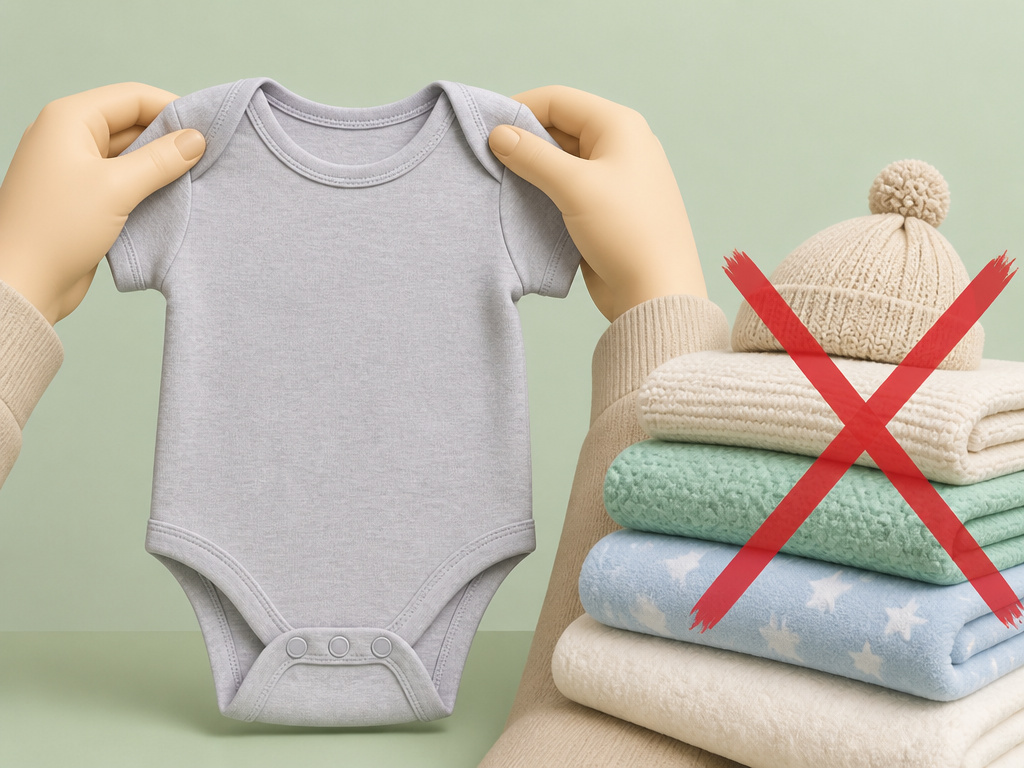 Dressing a baby for sleep in a warm room is an exercise in restraint. The adult impulse to add “just one more layer” is the most common pathway to overheating. NSW Health frames it clearly: dress babies as adults would dress to be comfortably warm, not hot.
The single-layer rule dominates. This means one light item: a short-sleeve bodysuit (onesie) or a lightweight sleepsuit. In the 16–20°C range, a 1.0 tog sleep sack over this single layer is often sufficient instead of a blanket. Above 20°C, drop the sleep sack.
Above 24°C, the layer is a nappy. Maybe a short-sleeve vest. That’s it. If the baby seems unsettled, a single, thin muslin blanket is the absolute ceiling, not a swaddle, not a cellular blanket, just a loose muslin square.
Swaddling is a hard stop in hot weather. It prevents the baby from kicking off heat, and the wrapped fabric can become a damp, warm cocoon. The Tommy’s baby cooling advice explicitly says to avoid it so they can kick off a blanket if needed.
The Hat Indoors Ban and Cultural Considerations
Johns Hopkins Medicine states it plainly: do not use a hat on a baby indoors. A huge proportion of a baby’s body heat is lost through their head. A hat worn inside actively prevents that cooling mechanism, raising core temperature rapidly. Hats are for outdoor sun protection or extreme cold only.
Common mistake: Following cultural or family traditions of wrapping a baby in multiple layers. NSW Health notes this as a specific risk factor: “Some cultures prefer to wrap baby in several layers which may lead to overheating.” The safety rule overrides tradition when the temperature climbs. Explain the 16–20°C science and the SUDI risk link; it’s not about comfort, it’s about physiology.
The Travel and On-the-Go Heat Traps
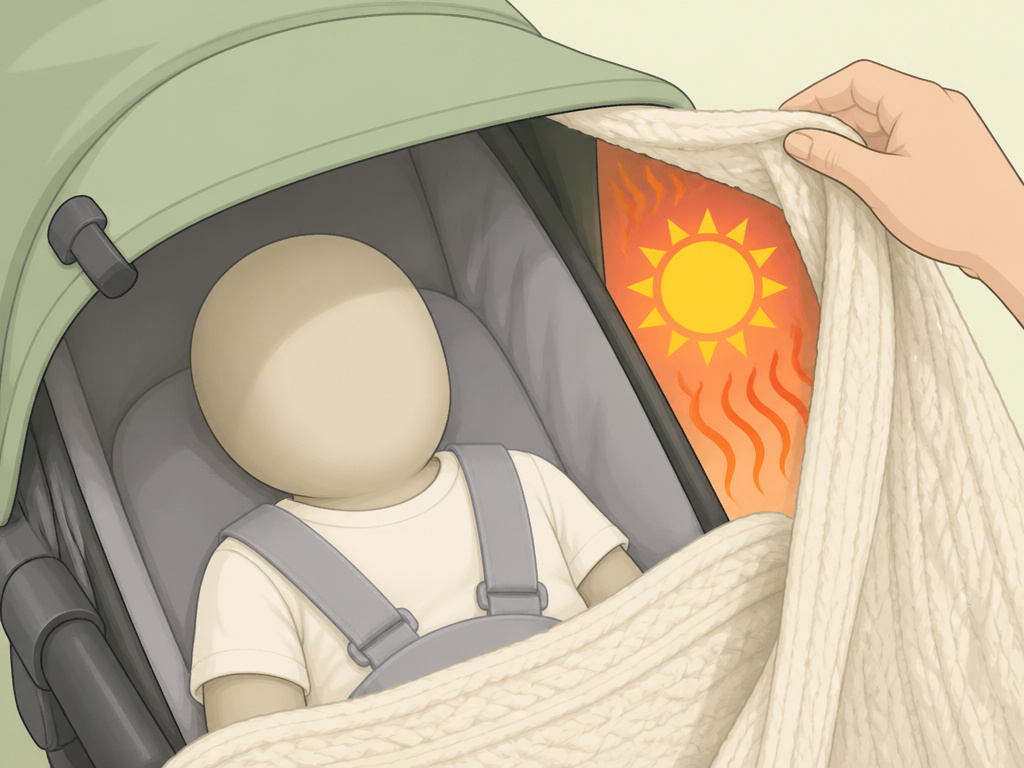 The rules change outside the controlled bedroom. The biggest danger is the covered pram or stroller.
Never cover a pram with a blanket. It seems like a sun shield, but it creates a stagnant, greenhouse-like environment with no airflow. The temperature inside can soar dangerously high within minutes, and you lose sight of your baby. The Lullaby Trust’s top tip: use a clip-on sunshade or parasol. This provides shade while maintaining full air circulation and visibility.
Car seats are another risk. They are not designed for unsupervised sleep. The semi-reclined position can compromise a baby’s airway, and the padded, non-breathable materials trap heat. On a hot journey, dress the baby even more lightly than you would at home, and never add a blanket behind or over them that wasn’t designed with the seat. At your destination, move them to a firm, flat surface immediately.
| Scenario | Cooling Priority | Immediate Danger |
|---|---|---|
| Hot Car Journey | Light clothing, AC on, sunshade on window | Baby slumped in seat, airway restricted, overheating |
| Walk in Hot Sun | Clip-on pram sunshade, light cotton layer | Blanket over pram, creating a still-air oven |
| Nap at Grandma’s | Portable fan, assess the room’s sun exposure | Using a padded, non-breathable travel sleep pod |
Troubleshooting an Overheated Baby
You check their neck. It’s hot and sweaty. What now?
- Remove a layer. Take off the sleep sack or blanket. If they’re in a sleepsuit, change them into a short-sleeve bodysuit.
- Offer a feed. Breast milk or formula provides hydration. For formula-fed babies over six months, a small amount of cooled boiled water can be offered between feeds, as per the Lullaby Trust.
- Cool the skin. Dampen a cloth with lukewarm (not cold) water and gently wipe their face, neck, arms, and chest. Evaporation will cool them.
- Improve airflow. Move them to a cooler room, or use a fan to circulate air in the room (not pointed at them).
- Hydration for you. If you’re breastfeeding, your hydration directly impacts your milk supply. Drink plenty of water.
Do not plunge them into a cold bath or use ice packs. The shock can be dangerous. Gradual cooling is safe cooling.
Frequently Asked Questions
What is the ideal room temperature for a baby to sleep in?
The ideal room temperature is 16–20°C (approximately 61–68°F). This range, recommended by the Lullaby Trust, helps prevent overheating, which is a known risk factor for Sudden Unexpected Death in Infancy (SUDI). Use a room thermometer placed near the crib to monitor this.
Can I use a fan in my baby’s room?
Yes, you can and should use a fan to circulate air. Do not aim it directly at the crib or baby. Place it across the room to stir the air gently. For added cooling, place a bowl of ice in front of it. This is much safer than covering the crib or using unregulated cooling pads.
How many layers should my baby wear to bed?
Start with one single light layer, like a short-sleeve bodysuit or lightweight sleepsuit. In a room at 16–20°C, this may be paired with a 1.0 tog sleep sack. If the room is above 24°C, the safest option is for the baby to sleep in just a nappy. Always check for overheating by feeling their chest or back of the neck.
Are there specific sheets that help keep a baby cool?
Yes. Bamboo crib sheets and linen sheets are the most breathable and moisture-wicking options, making them significantly cooler than standard cotton flannel or jersey. Pair them with a firm, breathable crib mattress for the best effect.
Is it safe to let my baby sleep in just a diaper?
Yes, it is safe and recommended by experts like the Lullaby Trust and Tommy’s when the room temperature is particularly high (especially above 24°C). The priority is preventing overheating. A nappy-only sleep with no blankets is safer than adding layers that risk raising their core temperature.
The Bottom Line
Keeping a baby cool in bed isn’t about luxury. It’s a documented pillar of safe sleep. Anchor your decisions on the 16–20°C target with a room thermometer. Build the sleep surface with breathability in mind: a firm mattress and a bamboo or linen fitted sheet. Dress them in one light layer, and know that above 24°C, a nappy alone is the safest choice. Finally, never cover a pram with a blanket, use a clip-on shade. These steps are straightforward, but they’re backed by the hard science of infant physiology and the urgent goal of preventing overheating.
