
How to Get Baby to Nap in Crib During Day: Proven Methods
This post contains affiliate links. As an Amazon Associate we earn from qualifying purchases.
To get a baby to nap in a crib during the day, start between 4 and 6 months when their circadian rhythm develops, ensure the crib meets all AAP safe sleep standards, and put them down drowsy but awake after a short, consistent pre-nap routine. Rocking or holding to sleep creates a dependency that leads to short, broken naps and night wakings by 9 months.
That 4-to-6-month window is the biological pivot point. Before it, newborns sleep in short bursts dictated by hunger. After it, the brain starts organizing sleep into longer daytime blocks and a consolidated night—if you let it. Miss the window by always providing motion to sleep, and you teach the brain that stillness means danger, which is why a baby who naps fine in arms screams the moment their back touches the crib.
What follows: the three safety specs that are not optional, the seven-step wind-down that replaces rocking, the head-to-head comparison of sleep training methods for naps, and the one mistake that resets progress every time.
Key Takeaways
- The optimal time to start crib naps is between 4 and 6 months old, when infants neurologically adapt to a day-night schedule.
- A firm sleep surface is a safety standard, not a comfort suggestion; a soft mattress or pad can conform to an infant’s face and create a rebreathing pocket.
- Always place the baby in the crib “drowsy but awake” to build self-soothing skills; falling asleep in your arms teaches them to need your arms to connect sleep cycles.
- Check any used crib or alternative sleep product against the June 2021 CPSC rule, which mandates they meet the same federal safety standards as a new crib.
- In-bed sleepers and baby nests that don’t carry a CPSC safety certification for cribs or bassinets are not approved for unsupervised sleep.
The Non-Negotiable Crib Safety Checklist
Your first job is to make the crib itself a non-negotiable safe zone. This isn’t about comfort. It’s about eliminating physical hazards that can turn a nap into a tragedy.
The crib must have a firm, flat mattress designed specifically for its dimensions. The AAP defines a firm surface as one that does not indent or conform to the shape of the infant’s head. You should not be able to press a hand into it and leave a lasting impression.
A firm surface maintains its shape and does not indent or conform to the shape of the infant’s head when the infant is placed on the surface. The surface does not change its shape when the fitted sheet designated for that model is used.
Use only a tight-fitting crib fitted sheet. No loose blankets, quilts, pillows, stuffed animals, or crib bumpers. The sleep environment should be as bare as a hotel room at checkout. For warmth, use a wearable sleep sack.
If you’re using a hand-me-down or a secondhand find, you must verify its safety. The AAP explicitly recommends new cribs because used ones may have missing hardware, be incorrectly assembled, or no longer meet current standards. Many infant deaths have occurred in cribs that were broken or had missing parts.
Before you start: Check the CPSC website for recalls on your specific crib model. If any hardware is missing, the assembly instructions are lost, or you see cracks in the wood, stop. Do not attempt a DIY fix.
| Crib Component | Safe Standard | Risk If Compromised |
|---|---|---|
| Mattress | Firm, flat, and designed for the specific crib. No gaps larger than two fingers. | Conforms to face, creating a carbon dioxide pocket; entrapment in gaps leads to suffocation. |
| Sheets | Tight-fitting fitted sheets only. No loose fabric. | Loose fabric can cover nose and mouth; tangled sheets pose a strangulation risk. |
| Condition | No missing, broken, or loose hardware. No cracks in slats or frame. | Structural failure can create entrapment gaps; drop-side cribs are banned and lethal. |
| Location | Away from windows, blinds, cords, and heavy wall art. | Strangulation from dangling cords; injury from falling objects. |
This checklist is your foundation. A baby will not nap peacefully in a space that feels insecure, and you cannot relax enough to enforce a routine if you’re worried about the crib itself. Once the physical space passes inspection, you can work on timing.
Why 4 to 6 Months Is the Make-or-Break Window
Trying to enforce a crib nap schedule with a one-month-old is like trying to schedule a thunderstorm. Their sleep is driven by hunger, not daylight. The biology changes on a predictable timeline.
The Merck Manual states that infants usually adapt to a day-night sleep schedule between 4 months and 6 months of age. This is when the brain’s suprachiasmatic nucleus starts responding to light cues and producing melatonin in a reliable pattern. It’s the neurological green light for a routine.
Before this window, focus on safe sleep practices and feeding on demand. After it, you have a baby whose brain is primed to learn that crib equals sleep. This is also when sleep disturbances commonly emerge because separation anxiety develops and babies become more mobile.
Where this goes sideways: Creating a motion-to-sleep dependency before 4 months. An infant who is always rocked or driven to sleep will have a hard time learning to fall asleep on their own and may develop problems with frequent night awakenings.
If you’ve missed the window and have a nine-month-old who only naps on you, the principle is the same—you’re just undoing a learned habit. The biology is on your side; the baby can sleep independently. You just need to teach them that the crib is where that happens.
The 7-Step Pre-Nap Routine That Actually Works
Consistency tells the baby’s brain what comes next. A routine is a sequence of cues, not a drawn-out production. Keep it short, sweet, and the same for every nap.
- Watch the clock, not just the cues. Aim for naps about 1.5 to 2 hours after the last wake-up. Overtired babies fight sleep harder.
- Start the wind-down. Take them to their room. Close the blinds or curtains. This signals a shift from playtime to quiet time.
- Change the diaper. A fresh diaper prevents a mid-nap wake-up from discomfort.
- Use a sleep sack. The act of zipping them into their safe crib bedding is a powerful physical cue that sleep is next.
- Read one short book. Use a quiet, monotone voice. This isn’t storytime; it’s a signal.
- White noise on. Place a sound machine near the crib and turn it on. It masks household sounds.
- Into the crib, drowsy but awake. This is the non-negotiable step. Give a quick pat, say your sleepy phrase (“Time for nap, sweet one”), and walk away.
The “drowsy but awake” part fails most people. Drowsy means their eyes are heavy, they’re calm, and they might be sucking slower on a pacifier. Awake means they are placed in the crib with their eyes open. They should close them themselves in the crib. If they fall asleep in your arms, they will panic when they rouse 20 minutes later in a different place.
That panic is why naps are short. They can’t connect sleep cycles because the conditions at sleep onset (your arms) are gone.
Crib vs. Arms vs. Swing: The Sleep Training Comparison
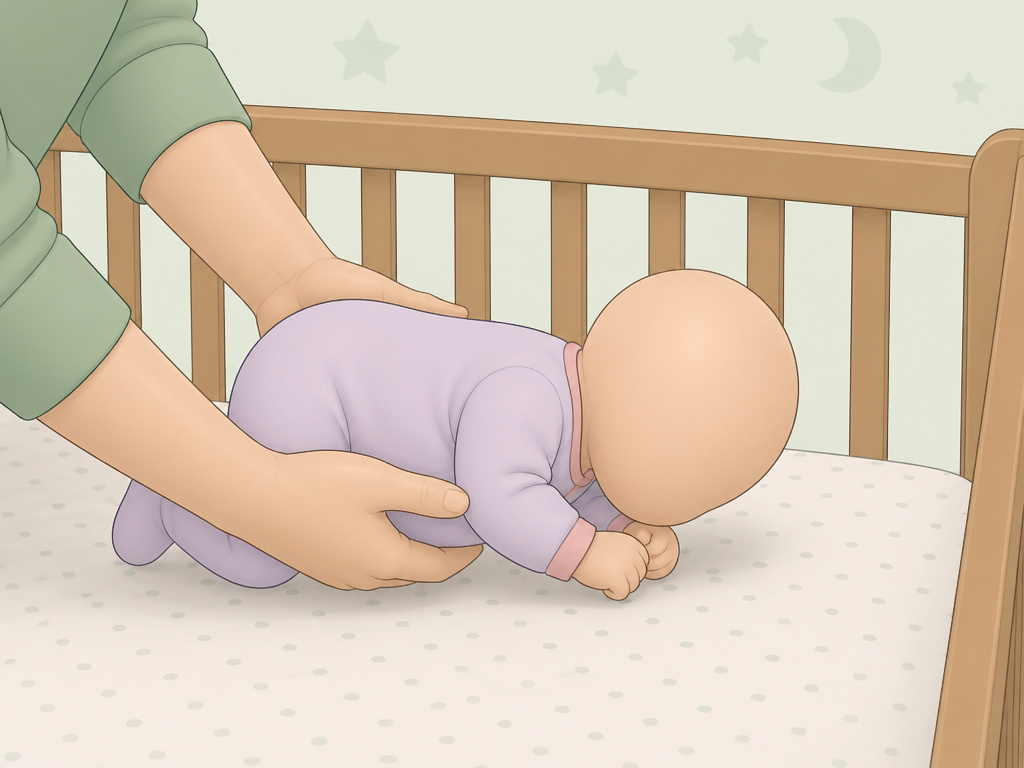 You have a few paths to break the hold-to-sleep habit. Each has a different tempo and emotional cost. Pick one based on your baby’s temperament and your stamina.
| Method | Best For | How It Works | Realistic Timeline |
|---|---|---|---|
| Fading | Gentle transition, parents who hate to hear crying. | Gradually reduce intervention. Rock less each day until you’re just placing in crib. | 10-14 days for consistent crib naps. |
| Chair Method | Visual reassurance, older infants (6+ months). | Sit in a chair next to crib, offering only verbal comfort. Move chair farther each day. | 7-10 days. Can be prolonged if baby is standing. |
| Check & Console | Structured comfort, clear boundaries. | Put down awake, leave room. Check at set intervals (5, 10, 15 min) with minimal touch. | 3-5 days of intense protest, then rapid improvement. |
| Extinction | Quick results, deeply ingrained habits. | Put down awake after routine, do not re-enter room until nap time is over. | 1-3 days of crying, then baby learns self-soothe. |
The Chair Method often backfires with curious babies who stand up and cry for you to sit back down. Check & Console can overstimulate some infants, making the checks counterproductive. There is no single best method. There is only the method you can stick with for five days straight.
Inconsistency is the killer. Trying Check & Console for one nap, then rocking to sleep the next because you’re tired, teaches the baby to cry longer.
What to Do When the Nap Is Short (The 20-Minute Intruder)
 A baby waking after one sleep cycle (20-45 minutes) is the most common crib nap problem. It means they haven’t learned to string cycles together in this new environment.
Do not rush in immediately. Give them 10-15 minutes of fussing or babbling in the crib. This is the practice zone for self-soothing. They might surprise you and fall back asleep.
If they’re fully crying, go in. Keep the lights off and interaction minimal. Try a gentle pat on the back or a quiet “shhh” without picking them up. If after 10 minutes of this they’re not settling, end the nap. Get them up, keep the room dim, and have quiet play. Try again in 60-90 minutes.
The goal is not to “save” every short nap by any means necessary. The goal is to give them the opportunity to practice. Rescuing every nap by bringing them to your bed just reinforces that the crib is only for one cycle.
FAQ: Your Top Crib Nap Questions, Answered
Why won’t my baby nap in the crib but sleeps there at night?
Night sleep is driven by a stronger biological pressure (homeostatic sleep drive) and higher melatonin levels. Daytime sleep is lighter and more dependent on habit. The association of crib=sleep is weaker for naps. Consistency with the pre-nap routine will build that association.
Is it okay to use an in-bed sleeper or baby nest for naps?
The CPSC passed a rule in June 2021: any product marketed for infant sleep must meet federal safety standards for cribs, bassinets, or play yards. Most in-bed sleepers and pods do not meet these standards. The AAP does not recommend them for any sleep, naps included. A safe crib mattress in a certified crib is the only proven safe surface.
How long should I let my baby cry during a nap transition?
It depends on the method you chose and your baby’s age. For a check-and-console approach with a 6-month-old, 10-15 minutes of crying before a check is reasonable. For a younger baby (4-5 months), intervals of 5-10 minutes are more common. Never let a baby cry to the point of vomiting or hysterical hyperventilation.
My baby only naps 30 minutes. Is that enough?
For a newborn, yes. For a baby over 6 months, a 30-minute nap is a “catnap” and often insufficient. They likely woke after one sleep cycle and couldn’t transition. Focus on the “drowsy but awake” put-down and giving them space after waking to see if they’ll resettle. Over time, naps should lengthen to 1-2 hours.
Can the wrong sheets affect crib naps?
Absolutely. A loose, puffy sheet is a suffocation hazard and can feel unsettling. A rough, scratchy sheet can cause micro-awakenings. A well-fitting, breathable crib sheet made from soft cotton or bamboo is part of the safe, comfortable environment. Pair it with a waterproof crib mattress protector underneath for practicality.
The Bottom Line
Getting a baby to nap in the crib is a three-part project: a safe sleep space, a biological timeline, and a consistent pre-sleep ritual. Start between 4 and 6 months, use a firm mattress with a tight sheet, and put them down awake every single time.
The crying is practice, not punishment. The short nap is a lesson, not a failure. Your job is to provide the safe, boring crib and the predictable routine. Their job is to learn how to sleep in it. That learning is a physical skill, like rolling over. It takes repetition.
Skip the gadgets and the unregulated sleep pods. A basic crib, a firm mattress, and your consistency are the only tools that work every time.
