
Master How to Crib Sheet for Newborn with These Secure Fit Tips
This post contains affiliate links. As an Amazon Associate we earn from qualifying purchases.
To crib sheet for a newborn, you need a fitted sheet that matches a standard 28″ x 52″ crib mattress with a maximum 6-inch thickness. The sheet must fit tightly enough to prevent a corner gap larger than 3.15 inches, a federal safety limit tested with a 100% cotton sheet washed in hot water. That gap is where entrapment risk lives.
The 3.The 15-inch corner gap is the line between a safe sleep surface and a documented hazard, defined in the federal crib mattress requirements.Your sheet is the primary defense against that gap forming.
What follows: the exact dimensions you’re working with, why the fabric choice is a safety spec, a head-to-head on buying versus making your own, and the one feature that separates a safe sheet from a merely cute one.
Key Takeaways
- The federal safety test uses a 100% cotton sheet washed hot twice, that’s the benchmark for breathability and shrinkage stability.
- A safe fit prevents a corner gap over 3.15 inches, which is measured with the sheet on the mattress inside the crib.
- Standard crib interior dimensions are 28″ x 52″, but the mattress must be slightly smaller (27.25″ x 51.625″) to fit inside.
- For a DIY sheet, you need 2 yards of 45-inch wide fabric and a 2-yard length of elastic to hit the correct dimensions and secure fit.
- Skip jersey knit sheets for newborns; they stretch too much and can loosen into a hazardous gap overnight.
The Non-Negotiable Safety Specs (and Why They Exist)
Your [crib sheet](https://littledoze.A crib sheet is a piece of safety equipment. The dimensions and materials are engineered to close a specific physical hazard.
A full-size crib’s interior measures 28 ± 5/8 inches wide by 52 3/8 ± 5/8 inches long, per the official crib safety requirements. The mattress that goes inside must be slightly smaller: at least 27 1/4 inches wide and 51 5/8 inches long. That difference creates a necessary installation gap.
When the mattress with the test mattress sheet is placed against the perimeter and in the corner of the crib, the corner gap shall not exceed 3.15 in. (80.0 mm). Dimensions shall be tested in accordance with 6.2. From 16 CFR § 1241.2(i) 5.6.1.1
The sheet’s job is to take up that slack. A loose sheet can get pushed into that space, creating a pocket larger than 3.15 inches. That’s the entrapment zone.
Why is the test sheet 100% cotton? The regulation specifies the test mattress sheet must be 100% cotton, washed in hot water (50°C/122°F or higher) and dried twice on the highest setting. This isn’t about preference. Cotton has predictable, minimal shrinkage compared to synthetic blends, and the hot wash/dry cycle simulates real-world use. If a sheet can pass the gap test after that treatment, it’s stable. A polyester blend that shrinks or warps unpredictably might pass off the shelf but fail after its first wash.
| Specification | Requirement | Why It Matters |
|---|---|---|
| Crib Interior | 28″ x 52″ (approx) | The fixed space the mattress and sheet must fit within. |
| Mattress Minimum | 27.25″ x 51.625″ | Ensures the mattress can actually be installed in the crib. |
| Max Corner Gap | 3.15 inches (80 mm) | The largest allowable space between mattress and crib corner. |
| Test Sheet Material | 100% cotton | Provides a consistent, predictable baseline for shrinkage and fit. |
| Max Mattress Thickness | 6 inches (per many manuals) | Prevents the crib sides from becoming too low, a fall hazard. |
The crib mattress itself is the foundation. If it’s the wrong size, no sheet can fix the problem. Always check your crib manual, like the Dorel Home guide that specifies a max thickness of 6 inches.
Crib Sheet Fabric 101: What Actually Works for a Newborn
Forget thread count marketing. With a newborn, you’re choosing a functional layer. The fabric needs to manage moisture, resist pilling, and survive hundreds of washes without changing shape.
100% cotton is the default for a reason. It’s breathable, absorbent, and becomes softer with each wash. Percale or sateen weaves are both fine; sateen feels silkier but may show wear faster. The key is choosing a tight, dense weave that won’t thin out. A good set of baby crib sheets will use long-staple or organic cotton for durability.
Cotton flannel is a great choice for colder climates. It provides extra warmth without the overheating risk of synthetic fleece. Look for brushed, garment-washed flannel that’s pre-shrunk.
What to avoid for newborns: Jersey knit (the T-shirt material). It stretches too easily. A sheet that goes on snug can work itself loose as the baby moves, recreating that dangerous corner gap. Save knits for toddler beds. Also avoid any fabric you can’t breathe through easily when held against your face, that’s a suffocation risk indicator.
The best crib sheet fabric balances safety, durability, and comfort. It should feel substantial in your hand, not flimsy.
Common mistake: Prioritizing cuteness over fiber content. A printed polyester sheet might look adorable, but if it pills, traps heat, or shrinks unevenly, it’s failing its primary job.
Your choice here directly impacts the longevity of your crib bedding set. Cheap fabric wears out at the corners and elastic channel first, usually within a year of constant washing.
Buying vs. Making: Which Path Wins?
You have two reliable paths: buy a proven brand or sew your own. Both can achieve a perfect, safe fit. The right choice depends on your time, budget, and desire for customization.
Buying a Sheet: The Fast Path
When you buy, you’re paying for consistency and convenience. A high-quality organic crib sheet from a brand like Burt’s Bees Baby or Kyte BABY will hit all the safety specs and come pre-washed for shrinkage. The elastic will be strong and evenly distributed.
Look for these features: * Full elastic all the way around: Not just corner elastics. This ensures an even, secure grip. * Deep pockets: Advertised to fit mattresses up to 6, 7, or even 8 inches thick. Deeper is generally better for a tight fit. * Material transparency: The tag should clearly state 100% cotton, organic cotton, or cotton flannel.
The downside is cost, especially for organic options. You’re also limited to available prints and colors.
Sewing a Sheet: The Custom Fit
Making your own sheet guarantees a perfect fit for your exact mattress. It’s also significantly cheaper per sheet, you can make two or three for the price of one high-end store-bought sheet.
You control everything: the fabric (crib sheet materials like organic linen, specific prints), the elastic width, and the seam finish. The process is a straightforward beginner sewing project. The math is fixed: with standard 45-inch wide fabric, you have just enough material to create the necessary “overhang” under the mattress for the elastic to grip.
| Aspect | Buying | Making |
|---|---|---|
| Cost per Sheet | Higher ($20-$40+) | Lower ($10-$15 for materials) |
| Time Investment | Minutes (online or in-store) | 1-2 hours (cutting, sewing, elastic) |
| Fit Guarantee | Good (if specs match) | Perfect (custom to your mattress) |
| Material Choice | Limited to retail offerings | Unlimited (any woven fabric you find) |
| Skill Required | None | Basic sewing machine proficiency |
For most parents, a mix is ideal. Buy two or three trusted sheets for baby for everyday rotation, and sew a special one with a meaningful fabric.
The 7-Step Sew-Your-Own Guide (With the Crucial Math)

This isn’t a vague tutorial. The dimensions come from the federal specs and standard fabric width. If your mattress is a true standard 28″ x 52″ x 6″, these cuts will work. If it’s an IKEA or a mini-crib, you’ll need to adjust the math.
Materials Needed:
- 2 yards of 45-inch wide woven fabric (100% cotton, flannel, linen)
- 2 yards of 1/2-inch or 3/4-inch wide braided elastic
- Thread, scissors, pins, safety pin, iron
The Math You Can’t Skip:
Standard fabric is 45 inches wide. Your mattress is about 28 inches wide. 45 – 28 = 17 inches of fabric left to cover the depth and wrap under. 17 ÷ 2 = 8.5 inches on each side. This number is critical, it’s the size of the square you’ll cut from each corner.
Step 1: Pre-wash and iron your fabric.
Do not skip this. You must pre-shrink the fabric exactly as you’ll wash the finished sheet. Wash and dry it on hot settings twice, just like the federal test. Iron it flat.
Step 2: Cut your rectangle.
Trim the selvages if they are tight. Cut a rectangle that is 68 inches long by 45 inches wide. The length comes from: mattress length (51″) + left side (8.5″) + right side (8.5″) = 68″.
Step 3: Cut the corner squares.
Fold your rectangle in half lengthwise. At one short end, measure and mark an 8.5-inch square in the corner that does not have the fold. Cut through both layers. Repeat at the other short end. When you unfold, you’ll have a rectangle with a square missing from each corner.
Step 4: Sew the corners with French seams.
This creates a durable, enclosed seam that won’t fray. For each corner, match the two cut edges with wrong sides together. Pin and sew a 1/4-inch seam. Trim the seam allowance close. Then, turn the fabric so right sides are together, encasing the first seam. Press, pin, and sew a 3/8-inch seam. This buries all raw edges inside a clean finish. Repeat for all four corners.
Step 5: Create the elastic channel.
Fold the entire outer edge of the sheet over by 1/4 inch to the wrong side and press. Fold over again by 1/2 inch and press to create the channel. Pin in place. Stitch close to the inner folded edge, leaving a 3-inch gap unsewn to insert the elastic.
Step 6: Insert the elastic.
Attach a safety pin to one end of your 2-yard elastic length. Feed it through the entire channel until it comes out the gap. Overlap the two ends by 2 inches and sew them together securely with a box stitch or multiple zig-zags.
Step 7: Close the channel and finish.
Tuck the elastic and the joined ends back into the channel. Distribute the fabric gathers evenly. Edgestitch the 3-inch gap closed.
You now have a custom-fitted sheet that meets the mandatory crib mattress standard for fit. The 8.5-inch corner cutouts and 2-yard elastic are what create the 2.5 inches of “overhang” under the mattress that the elastic pulls tight, eliminating the corner gap.
How to Test Any Sheet for a Safe Fit
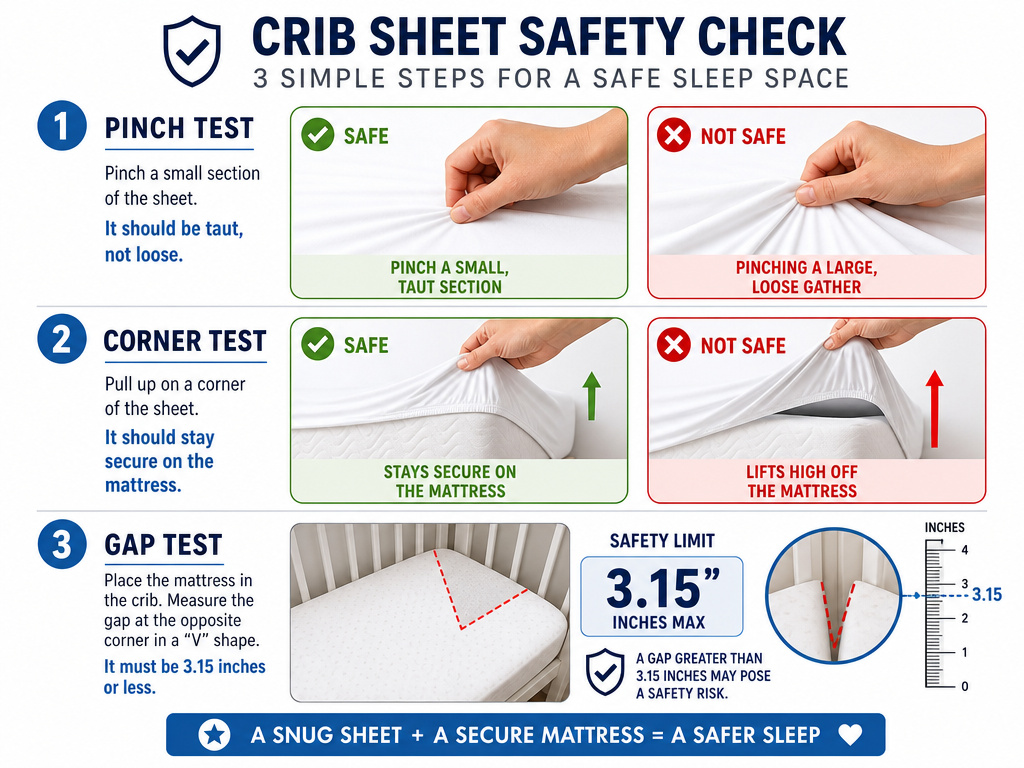
Before a sheet ever touches your newborn’s crib, test it. This takes two minutes and catches the majority of poor-fitting sheets.
- The Finger Test: With the sheet on the mattress, try to pinch more than an inch of sheeting at the center of any side. If you can gather a significant amount, it’s too loose.
- The Corner Pull Test: Grasp the sheet at the center of a corner and pull straight up. It should not lift easily off the mattress. If the corner comes up more than an inch or two, the elastic is too weak or the pocket is too shallow.
- The Visual Gap Check: Place the sheeted mattress in the crib. Push it firmly into one corner. Look at the opposite corner gap. Can you see a clear, wide V-shaped space? Shine a phone flashlight into the gap. If it looks large, measure it. Remember the limit: 3.15 inches.
A sheet that passes these tests is doing its job. It’s maintaining tension across the entire mattress surface, preventing pockets and gaps.
This level of diligence is part of setting up a safe newborn bedding environment. It’s the same reason you’d use a crib mattress protector, to manage contingencies (moisture) without compromising the core safety function (a firm, flat, gap-free surface).
Frequently Asked Questions
What size crib sheet do I need for a standard crib?
You need a fitted sheet labeled for a standard 28″ x 52″ crib mattress. Always confirm the mattress thickness (usually 5 or 6 inches) and choose a “deep pocket” or “extra deep pocket” sheet if your mattress is at the thicker end of that range.
Can I use adult sheets on a crib mattress?
No. Adult sheets are the wrong dimensions and are not designed with the tight, all-around elastic required for crib safety. They will be dangerously loose.
How many crib sheets do I need for a newborn?
Start with three or four. Newborns have frequent spit-ups, diaper leaks, and night sweats. Having multiple sheets means you can change the bed immediately without doing laundry daily. It’s a core part of your essential newborn bedding stash.
Are crib sheets and bassinet sheets the same size?
No. Bassinet mattresses are much smaller and come in non-standard sizes. You must use a sheet specifically designed for your bassinet model. Never try to stretch a crib sheet onto a smaller bassinet mattress.
How often should I wash my newborn’s crib sheets?
Wash them at least once a week, or immediately after any spit-up or leak. Use hypoallergenic, fragrance-free detergent and the hot water cycle to kill dust mites and bacteria, following the same wash protocol used in the federal safety test.
Before You Go
A safe crib sheet fits tightly, uses breathable fabric, and survives the laundry cycle without changing shape. The federal 3.15-inch corner gap rule exists because a loose sheet is a tangible risk, not a theoretical one.
Your two reliable options are buying from a brand that respects those specs or sewing your own using the 8.5-inch corner cutout math. Both paths lead to a secure sleep surface. Avoid stretchy knits and always perform the pull test on a new sheet.
Pair a well-fitted sheet with a quality crib mattress and a waterproof protector for a sleep space that’s safe, comfortable, and easy to maintain. That’s how you crib sheet for a newborn.
