
Can’t Keep Toddler in Bed? What CPSC Fall Data Reveals
This post contains affiliate links. As an Amazon Associate we earn from qualifying purchases.
If you can’t keep your toddler in bed, start with the bed itself. Federal safety data shows 78% of toddler bed injuries are from falls, and many happen because the sleep setup—the bed type, rail security, or room layout—doesn’t match a toddler’s developing mobility. The fix is a three-part plan: verify the bed meets CPSC/ASTM safety standards, secure the environment to prevent wandering, and implement a consistent, calm bedtime routine that addresses the need for connection, not just containment.
That 78% figure from the Consumer Product Safety Commission is the core reason bedtime turns into a chase. A toddler’s drive to explore collides with a sleep space that either feels insecure or too much like a cage.Your job is to engineer a room where staying in bed feels safe, comfortable, and like the obvious choice.
What follows is a breakdown of that data, a safety audit you can do in ten minutes, and a staged response plan. We’ll cover when a toddler bed itself is the problem, how the right bed rails or a floor bed changes the game, and why the bedtime script you use matters as much as the mattress you buy.
Key Takeaways
- The CPSC reports 78% of toddler bed injuries are from falls, often due to inadequate rails, poor mattress fit, or beds placed too close to other furniture.
- Before changing behavior, rule out physical causes: ensure the bed complies with ASTM F1821 standards, guardrails are securely attached, and there’s a 12-inch clearance from walls.
- A consistent, predictable bedtime routine reduces anxiety-driven escapes. Keep it short, calm, and end with a clear “goodnight” signal.
- Transition timing matters. Moving from a crib before a child can understand basic safety instructions (often around 2.5-3 years) sets the stage for nightly escapes.
- For persistent climbers, a floor bed eliminates the fall hazard entirely and can reset the entire dynamic around bedtime independence.
What the Safety Data Actually Says About Nighttime Escapes
You’re not failing. The environment might be.
The U.S. Consumer Product Safety Commission (CPSC) reviewed incident data from 2005 to 2009, finding 4 fatalities and 81 nonfatal incidents related to toddler beds. In a later review of emergency room data, 78% of the injuries were from falls out of the bed. The injured body parts were head and face (59%) and limbs (25%). The most common injury types were head injuries (31%) and fractures (22%).
Where this goes sideways: Assuming a toddler will “learn” not to fall. The CPSC data shows falls are the dominant physical risk. A child’s motor skills and impulse control are still developing; safety is a design problem, not a training issue.
This is about cause and effect. When a toddler repeatedly gets out of bed, the first question should be: “Is the bed itself contributing to this?” The data points to several specific, fixable hazards that correlate with escapes and injuries.
| Hazard (from CPSC data) | How It Relates to Bedtime Escapes | The Immediate Fix |
|---|---|---|
| Falls from bed (78% of injuries) | Child rolls or climbs over inadequate railings. | Install secure, full-length bed rails that attach to the bed frame. |
| Broken/loose guardrails or hardware (14 incidents) | Wobbly rails feel unsafe, or gaps allow easy climbing. | Tighten all bolts monthly; replace damaged rails immediately. |
| Entrapment (10 incidents) | Child gets a limb stuck, panics, and thrashes to get free. | Ensure mattress fits snugly (less than two fingers’ width gap). |
| Inadequate mattress fit (3 incidents) | Mattress shifts, creating a climbable gap between bed and rail. | Use a standard crib mattress (min. 51⅝” x 27¼”) that fits the frame perfectly. |
| Bed placed too close to furniture | Child uses a nearby dresser or shelf as a climbing step to exit. | Maintain >12 inches of clearance between bed and any solid object. |
The federal safety standard for toddler beds, 16 CFR § 1217.2, mandates compliance with ASTM F1821, the consumer safety specification. This standard exists precisely to minimize these incidents. If your child’s escapes feel relentless, the bed may not be the safe container you assume it is.
The 3-Part Safety Check Every Parent Misses
Do this before you try another sticker chart. It takes ten minutes and rules out the physical triggers for nighttime roaming.
Part 1: The Bed & Mattress Audit
Pull the mattress out. Check the label. A true toddler bed requires a full-size crib mattress with minimum dimensions of 51⅝ inches long by 27¼ inches wide. If the mattress is smaller, you have a dangerous gap. Push the mattress back in. Can you fit more than two fingers between the mattress and the bed frame or guardrail? If yes, that’s an entrapment hazard and an escape ladder. The ASTM F1821 safety specification includes a “wedge block” test to prevent exactly this.
Part 2: The Rail & Hardware Check
Grab each guardrail and shake it firmly. Does it wobble or click? Get a screwdriver and tighten every bolt connecting the rails to the headboard and footboard. This isn’t a one-time assembly task. Monthly checks are necessary. Look at the rail height. When your child is standing in the bed, does the top of the rail come up to at least their mid-chest? If it’s lower, they can pivot their torso over it too easily.
Part 3: The Room Layout Scan
Get a tape measure. The CPSC-mandated instruction manuals state a toddler bed must have more than 12 inches (31cm) of space between the bed and solid objects like a wall or dresser. This prevents a child from becoming trapped in a narrow space. It also removes launch pads for climbing. Check window blind cords, dangling lamp wires, or furniture they could use to climb out. The room itself should be a safe, boring box at night.
The short version: A safe bed is a snug mattress, rock-solid rails, and a clear perimeter. Fail any of these, and you’re asking for a midnight explorer.
Is It the Bed, the Child, or the Timing?
Sometimes the equipment is fine. The problem is the transition itself.
Moving from a crib to a toddler bed is a massive loss of security for a child. The walls are gone. The world is open. If this move happens before a child has the cognitive ability to understand basic safety rules (“stay in bed”) or the emotional regulation to handle this new freedom, escapes are guaranteed. Most children are ready between 2.5 and 3.5 years old, not at an arbitrary age or because a new sibling needs the crib.
Ask yourself: * Can they follow a simple two-step instruction during the day? (“Pick up the block and put it in the box.”) * Do they understand “wait” or “stay” in other contexts? * Is the move being driven by climbing out of the crib? If yes, that’s a safety emergency requiring an immediate change, but it also means you’re transitioning under duress. Your plan needs to be extra thorough.
If the answer is “no” to the first two, the escapes are likely developmental, not defiant. Your goal shifts from enforcement to support and safer alternatives, like a floor bed or a ultra-secure crib to toddler bed conversion kit that keeps the familiar crib sides a bit longer.
Your Step-by-Step Plan to Stop the Nighttime Patrol
This is a sequence, not a menu. Start at Step 1 and move forward only when the previous step is solid.
Step 1: Execute the Safety Check (Above).
Fix every physical issue you find. This is non-negotiable. You cannot expect a child to stay in an unsafe or intimidating bed.
Step 2: Craft a Boring, Predictable Bedtime Routine.
Ambiguity fuels anxiety. Anxiety fuels escapes. Your routine should be 20-30 minutes, max, and follow the same order every night: bath, pajamas, two books, lights out, one song, goodnight. The final step should be a clear, loving, and firm “goodnight” as you leave the room. Dragging it out teaches them to negotiate.
Step 3: The Calm Return Method.
When they get out, don’t lecture, sigh, or get angry. Say, “It’s time to stay in bed,” and lead or place them back. Be a boring robot. Do this 50 times if you have to. The instant they stay in bed, even for a second, offer quiet praise: “Good job staying in your bed.” The first few nights are the test.
Step 4: Address the “Why” Behind the Escape.
Are they scared? A small, dim nightlight and a “monster spray” (water in a spray bottle) can help. Are they seeking connection? Build in 10 minutes of focused cuddle time earlier in the routine. Are they not tired? Re-evaluate nap length and daytime activity.
Step 5: Consider a Hardware Reset.
If falls are the main concern and rails aren’t enough, a floor bed eliminates the altitude as the ultimate safe-fail setup. If the crib transition was too early, a convertible crib that changes back to its highest setting for a few more months might be the reset button you need.
When to Switch Gears: Bed Rails, Floor Beds, and Convertible Options
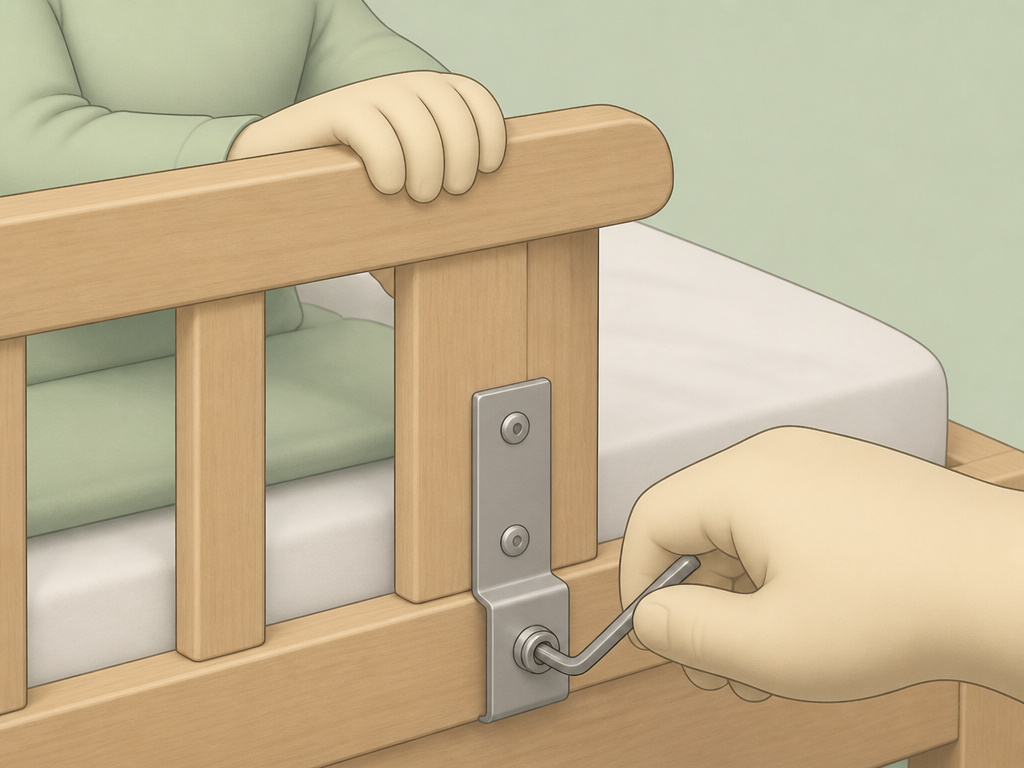
If the standard plan isn’t cutting it, a different piece of furniture might be the solution. Here’s how the options compare.
| Option | Best For | How It Cuts Down Escapes | One Caveat |
|---|---|---|---|
| Bed Rails (e.g., securely attached safety rails) | Toddlers in standard beds who roll or sit up in sleep. | Provides a physical, familiar boundary that prevents falls and makes the bed feel secure. | Must be properly installed with no gaps; some climbers can scale them. |
| Toddler Floor Bed (mattress on floor in safe room) | Persistent climbers, Montessori families, or toddlers scared of heights. | Removes the fall risk entirely; empowers child to get in/out safely, reducing the “forbidden fruit” appeal. | Room must be fully childproofed (outlet covers, anchored furniture, safe toys only). |
| Convertible Crib to Toddler Bed | Families wanting a gradual transition using familiar crib hardware. | Lets you remove one side while keeping the other three crib walls, easing the shock of the open space. | The child must not have been climbing out of the crib, or this offers no new containment. |
A floor bed is a strategic choice. It acknowledges the child’s drive for autonomy while controlling the environment to make that autonomy safe.The entire room becomes the crib. For many families, this single change stops the bedtime battles because the power struggle over the boundary line disappears.
Frequently Asked Questions
My toddler just turned 2 and climbs out of the crib. Is it time for a bed?
Yes, immediately. Crib climbing is a severe fall hazard. You must transition to a safer sleep setup now. Opt for a toddler bed with very secure safety rails or a floor bed to manage the new freedom safely. Understand that because the move is forced by climbing, you’ll need to be exceptionally consistent with the bedtime routine.
Are bed rails safe for a 2-year-old?
Yes, when they are the right product and installed correctly. Choose rails that run the full length of the bed, attach securely to the bed frame (not just the mattress), and have a tight gap specification to prevent entrapment. Always follow the manufacturer’s instructions and the CPSC toddler bed business guidance on safe use.
How many nights will the “calm return” method take?
Plan for 3 to 14 nights of intense consistency. The first 3 nights are usually the hardest. If you see no reduction in escape attempts after 7 nights, go back and re-do the safety check. The problem might be physical (an uncomfortable mattress, a scary shadow) or developmental (they’re genuinely not ready for the open bed).
What if my toddler sleeps fine but just plays quietly in their room?
This is often a win, not a problem. If they are safe in a childproofed room and eventually put themselves to sleep, they are learning self-regulation. Ensure the room is absolutely safe (anchor furniture, cover outlets, use a floor bed), then consider allowing this space. It beats hours of battling at the door.
Could a pillow or blanket help my toddler stay in bed?
Maybe, but for comfort, not containment. A toddler pillow and a small, breathable toddler blanket can make the bed more inviting and cozy. However, never use pillows, loose bedding, or stuffed animals with children under 12 months, and ensure any blanket is lightweight and small enough not to be a entanglement hazard.
Before You Go
If you can’t keep your toddler in bed, pause the frustration and pick up a tape measure. The federal data is clear: most incidents are preventable falls. Your first job is to engineer a safe sleep space—check the mattress fit, torque the rail bolts, and clear a 12-inch perimeter. That solves the physical half of the equation.
The other half is behavioral, but it’s not about discipline. It’s about routine and readiness. A predictable, calm bedtime and a transition timed to your child’s understanding are what make the safe bed a place they’ll want to stay. For the climbers who outsmart every rail, remember that a floor bed is a smarter boundary that turns the whole room into the safe sleep zone. Start with safety, follow with consistency, and adjust the furniture to fit the child—not the other way around.
