
Why Soft Mattresses Are Bad for Your Baby’s Back & Safety
This post contains affiliate links. As an Amazon Associate we earn from qualifying purchases.
A soft mattress is bad for a baby’s back and, more critically, significantly increases the risk of suffocation and Sudden Unexpected Infant Death (SUID). The American Academy of Pediatrics (AAP) and the U.S. Consumer Product Safety Commission (CPSC) mandate a firm, flat sleep surface that does not indent or conform to an infant’s head. Materials like memory foam are explicitly warned against, and new federal standards now include a measurable firmness test.
The mandate for firmness is a direct, physical safety intervention, not primarily about comfort or spinal support in the adult sense. A surface that gives under an infant’s head can create a pocket that traps exhaled carbon dioxide, a process called rebreathing, or block the airway entirely if the baby rolls face-down.
What follows is the breakdown of the standard: the measurable definition of “firm,” the two specific hazards softness introduces, the federal dimensions and gap rules that mattresses must meet, and how to verify a mattress is safe before you buy.
Key Takeaways
- Firmness is a safety spec, not a comfort feature. A safe mattress maintains its shape and shows no indentation under pressure, as defined by the AAP and now tested under ASTM F2933-25.
- Memory foam and air mattresses are explicitly dangerous. The CPSC has stated memory foam should not be used in crib mattresses, and air mattresses are associated with infant suffocation deaths.
- Gaps are a silent hazard. A fitted sheet can compress a mattress, creating a corner gap over 3 inches where an infant can become entrapped. The federal standard limits this gap to 3.15 inches.
- Softness is now measurable. Research shows infant sleep surface softness ranges from 7.4mm to 36.9mm of depression; adding a single folded fleece blanket can add over 6mm of dangerous softness.
- The standard is legally binding. All crib mattresses sold in the U.S. Must comply with 16 CFR Part 1241, which incorporates the ASTM F2933-25 standard, including its new firmness test.
What Does “Firm” Actually Mean?
The word “firm” in every safe sleep guideline is a technical requirement, not a subjective description. The AAP defines a firm surface as one that “maintains its shape and does not indent or conform to the shape of the infant’s head.” If the surface molds to the baby, it’s too soft.
This definition exists because an infant lacks the neck strength and motor control to reposition their head if it sinks into a soft material. The risk isn’t a sore back—it’s a blocked airway.
A firm sleep surface retains its shape and does not indent when pressure is applied. This prevents the creation of a pocket that could lead to carbon dioxide rebreathing or airway obstruction, which are documented mechanisms in SUID cases.
The new ASTM F2933-25 standard, which becomes federal law in May 2026, finally adds an objective test for this. It incorporates a firmness test based on sections 6 and 8 of AS/NZS 8811.1:2013, an Australian/New Zealand standard for testing infant sleep surfaces. For the first time, manufacturers must prove their mattress meets a measurable performance threshold for firmness, moving beyond vague claims.
Why a Soft Mattress is a Direct Hazard
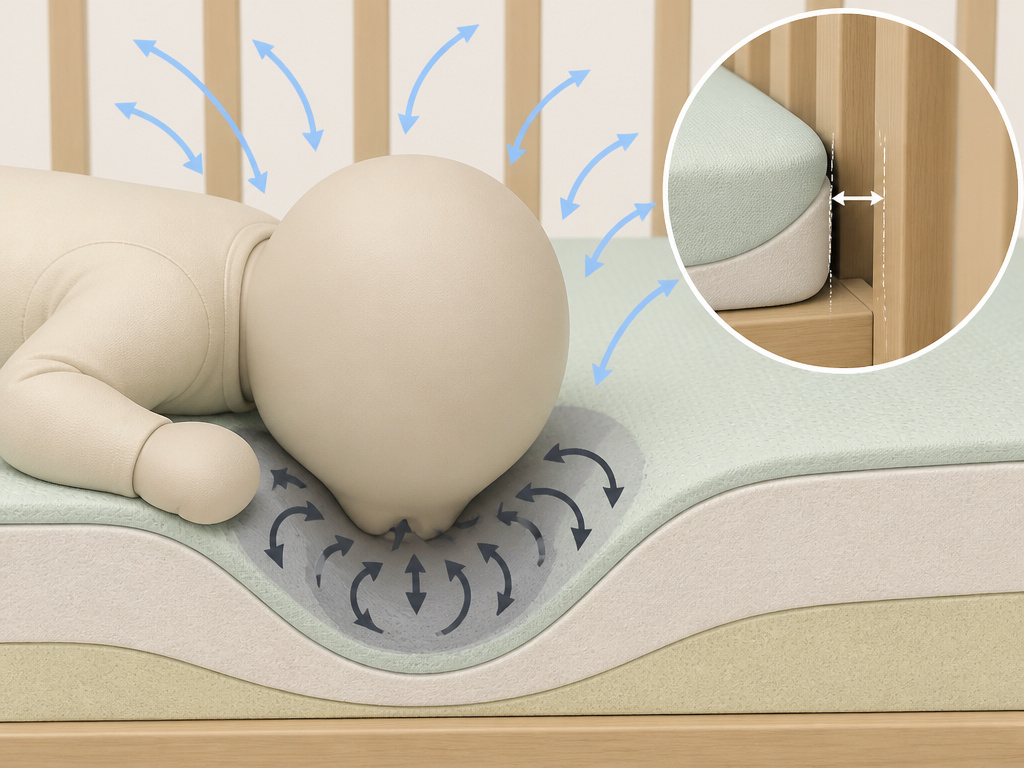
A soft mattress creates two primary, life-threatening hazards: suffocation through rebreathing or airway obstruction, and entrapment in gaps that form when the mattress compresses.
The Rebreathing & Suffocation Mechanism
When an infant’s head sinks into a soft surface, it can create a micro-environment of still air around the nose and mouth. The baby breathes in its own exhaled carbon dioxide instead of fresh oxygen. Over time, this leads to oxygen depletion. Alternatively, the material can directly block the nose and mouth. This is why the CPSC crib mattress safety letter to ASTM specifically called out memory foam, stating it “should not be used in crib mattresses” until a firmness test was developed.
The Gap Hazard No One Sees
A mattress might seem firm and fit well when bare. But a fitted sheet applies circumferential pressure, squeezing the mattress and shortening its length and width. The CPSC’s own investigation of a complaint found that a mattress compressed by a sheet created a corner gap as large as 3 3/8 inches.
Those gaps are entrapment zones. The federal CFR crib mattress safety standard (16 CFR Part 1241) now requires testing with a washed, fitted sheet and mandates that the corner gap not exceed 3.15 inches (80 mm). This is a non-negotiable pass/fail test.
| Hazard | How a Soft Mattress Causes It | Potential Consequence |
|---|---|---|
| Rebreathing Suffocation | Material conforms to face, creating a pocket of trapped exhaled air. | Infant breathes in CO2, leading to oxygen depletion and SUID. |
| Airway Obstruction | Nose and mouth are pressed into a conforming material like memory foam. | Direct physical blockage of airflow, leading to suffocation. |
| Entrapment | Mattress compresses under a sheet, pulling away from crib sides and creating gaps. | Infant’s head or body becomes wedged between mattress and crib rail. |
The Specific Materials to Avoid
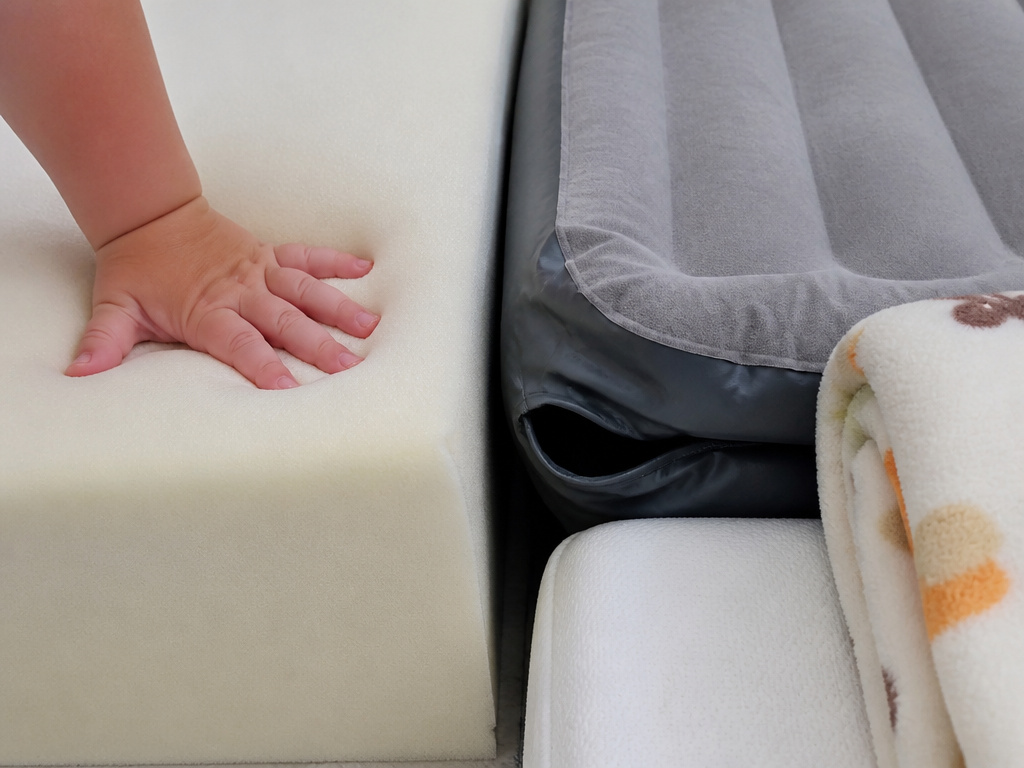
Some soft materials have earned explicit warnings from regulators, though not all are equally dangerous.
Memory Foam
This viscoelastic material is designed to conform to body heat and weight. For an infant, that property is lethal. The CPSC’s letter cites AAP guidance that “soft mattresses, including those made from memory foam, could create a pocket… And increase the chance of rebreathing or suffocation.” It is not a suitable material for any safe mattress for newborns.
Air Mattresses and Inflatable Beds
The CPSC air mattress warning publication (Publication 5222) is unequivocal: “Never place infants to sleep on air mattresses.” Even fully inflated, they are too soft and unstable. Leaks or deflation can create deadly gaps and slopes. They are for camping with adults, not for infant sleep.
Pillow-Tops or Cushioned Pads
Any add-on that creates a plush, cushioned layer violates the firm, flat rule. This includes aftermarket pads sold for playards or bassinets unless they are specifically designed as a replacement and tested to the relevant standard (like ASTM F406 for play yards).
Where this goes sideways: Using a folded blanket or quilt under the sheet to “make it softer.” A peer-reviewed study found a single-fold fleece blanket added 2.3–6.5mm of softness; a double-fold added nearly 12mm. This directly undermines the mattress’s firmness and is a suffocation hazard.
How to Check Your Current Mattress
You don’t need a laboratory. Two simple physical tests can tell you if your mattress is unsafe.
The Hand Pressure Test
Place the mattress on the floor. Press firmly with your hand in the center. A safe, firm mattress will offer strong resistance and spring back immediately with no visible indentation. If your hand sinks in and leaves a noticeable dent, the mattress is too soft.
The Sheet & Gap Test
- Place a snug, 100% cotton fitted sheet on the mattress.
- Install the mattress in the crib, pushing it firmly into one corner.
- Check the opposite corner. Slide your hand between the mattress and crib rail. If you can fit more than two fingers (about 1.5 inches) into the gap, there’s a problem. The federal limit is 3.15 inches, but any significant gap is a warning sign.
- Check all four sides for gaps.
If your mattress fails either test, it’s time for a replacement. Look for a certified breathable crib mattress or a standard firm model that explicitly states compliance with ASTM F2933-25.
Choosing a New, Safe Mattress
Navigating the marketplace requires ignoring marketing fluff and focusing on verifiable standards.
The Only Label That Matters: ASTM F2933-25
This is the current mandatory safety standard. Any crib mattress sold must comply. Look for this designation on the product label or spec sheet. It means the mattress has been tested for firmness, gaps, and other hazards. This is your baseline for any crib mattress, mini crib mattress, or bassinet mattress.
Prioritize Breathability & a Firm Core
A breathable mattress, often with a porous core or 3D mesh surface, adds a layer of safety by allowing air to pass through even if the baby ends up face-down. While not a substitute for firmness, it is a valuable complementary feature for a breathable baby mattress.
Fit is Non-Negotiable
A mattress must be specifically designed for your crib model. A travel crib mattress must match the exact dimensions of your portable crib. An aftermarket cot mattress must lay completely flat on the support structure with no gaps. Don’t force a slightly smaller mattress into a crib; the resulting gaps are dangerous.
| Mattress Type | Key Safety Check | Common Pitfall |
|---|---|---|
| Full-Size Crib | Compliance with ASTM F2933-25; gap <3.15″ with sheet. | Assuming “firm” without checking for the standard. |
| Mini or Portable Crib | Exact dimensional match to the manufacturer’s specs. | Using a “close enough” mattress that creates gaps. |
| Bassinet or Cradle | Mattress is firm and non-inclined; often integrated. | Adding a soft pad for comfort, which destroys firmness. |
| Toddler/Kids Bed | Firm support is still needed, but material rules relax. | Moving to a soft, adult-style memory foam mattress too early. |
For older children transitioning from a crib, the safety calculus changes. While suffocation risk drops, proper spinal support becomes important. Our guide on selecting a best mattress for kids covers that next stage.
Frequently Asked Questions
Can a mattress be too firm for a baby’s back?
No. From a safety perspective, a mattress cannot be too firm for an infant. Their spine is developing differently than an adult’s, and a firm surface provides the necessary stable foundation. The concern is always softness, not excessive firmness.
What if my baby seems uncomfortable on a firm mattress?
Infant discomfort is rarely about mattress firmness. Check for other issues: gas, temperature, hunger, or the need to be swaddled. A firm, flat surface is the safest sleep position, period. Comfort comes from a consistent routine and a safe environment, not a soft bed.
Are organic or natural latex mattresses safer?
“Organic” refers to material source, not safety performance. A natural latex mattress can still be too soft if not designed to the firmness standard. Always verify ASTM F2933-25 compliance first. An organic but soft mattress is more dangerous than a conventional firm one.
When is it safe to introduce a softer mattress?
The AAP recommends a firm sleep surface for the first year. After that, the risk of SIDS drops significantly, and toddlers have the mobility to reposition themselves. However, a supportive, medium-firm mattress is still best for growing spines. The transition to a softer children’s mattress is typically around age 3 or older.
Do all crib sheets affect mattress fit?
Yes. The federal test uses a 100% cotton fitted sheet washed twice in hot water to simulate shrinkage and maximum compression. Thicker, tighter, or padded sheets can compress a mattress even more. Always use the sheet recommended by the mattress manufacturer.
Before You Go
The question concerns a baby’s airway as much as it does their back. The science is unambiguous, the regulations are specific, and the consequences of getting it wrong are tragic.
Your checklist is short but absolute: a mattress labeled to ASTM F2933-25, one that passes the hand test, and one that fits your crib without gaps under a fitted sheet. Ignore any product that markets plushness, cushioning, or memory foam for infant sleep. The right choice is firm, flat, and certified. Everything else is a risk you don’t need to take.
