
Proven Methods: How to Get Rid of Baby Bed Head Safely
This post contains affiliate links. As an Amazon Associate we earn from qualifying purchases.
To get rid of baby bed head, positional plagiocephaly, you have two safe, effective methods: repositioning the baby’s head during sleep and ensuring daily supervised tummy time while awake. The ISPID safe sleep recommendations confirm back sleeping on a firm surface is non-negotiable for safety, which means corrective pillows or positioning devices are not safe options. Repositioning works because the skull bones are still soft and moldable, responding to consistent, gentle pressure changes over weeks.
That pressure change is the whole game. A baby’s skull plates don’t fuse until around 18 months, leaving a window where consistent force in one spot flattens it. The goal isn’t to stop back sleeping. It’s to redirect the force evenly around the head.
What follows: the exact repositioning schedule that works, the tummy time progression most parents miss, the clear line between normal flatness and a medical helmet referral, and the products you should never buy.
Key Takeaways
- Reposition the baby’s head to the opposite side every time they sleep. Alternate the end of the crib where you place their feet to encourage natural head turning.
- Start supervised tummy time the first week home, aiming for at least 30-60 minutes total per day by 3 months of age. Short, frequent sessions prevent frustration.
- Never use a flat head pillow, positioner, or any soft bedding in the sleep space. These violate safe sleep guidelines and increase suffocation risk.
- Most flattening improves significantly with consistent repositioning and tummy time by 6 months. If it doesn’t, that’s the point to ask your pediatrician about a cranial specialist.
- The firmness of your baby mattress is a foundational safety item, not a comfort feature. A soft surface increases flattening risk.
The Two Proven Methods (And What Doesn’t Work)
You have two tools. Both are free. Both require consistency, not strength.
Repositioning changes where the head meets the mattress. Tummy time removes the pressure entirely. The flattening happened over weeks of repeated pressure on one spot. Fixing it works the same way, gentle, repeated pressure on the other spots.
Common mistake: Relying on a “flat head pillow” or head-shaping device. These products introduce soft, pliable materials into the sleep space, which creates a suffocation hazard. The ISPID safe sleep recommendations PDF explicitly advises against pillows, positioners, and any items in the bed.
Repositioning: It’s a Schedule, Not a Suggestion
Think of the head like a ball of dough. If you always leave it resting on the same spot on the counter, it flattens there. You need to turn it.
- Alternate the head direction each sleep. After every nap and nighttime sleep, gently turn the baby’s head to the opposite side when you lay them down. They will often turn back, but the initial positioning matters.
- Switch the crib orientation. Babies naturally turn their heads toward the room or a light source. Alternate which end of the crib you place their feet. One week their head is at the crib’s north, the next week at the south.
- Change feeding sides. If you bottle-feed, switch the arm you hold them in for feedings. If breastfeeding, alternate breasts naturally encourages head-turning.
Skip step one, and the other two have less effect. The skull needs that direct pressure shift. Doing this inconsistently, every other day, adds months to the correction timeline.
| Repositioning Tactic | How It Works | If You Skip It |
|---|---|---|
| Alternate head side each sleep | Directly changes pressure point on skull | Flattening continues or worsens on the favored side |
| Switch crib ends weekly | Uses baby’s curiosity to encourage turning | Baby always looks the same direction, nullifying head-turning |
| Change feeding/holding sides | Breaks muscle memory in the neck (torticollis) | Neck muscle tightness can develop, locking the head in one position |
The Tummy Time Schedule That Works
Tummy time isn’t just for neck strength. It’s zero-pressure time for the skull. The goal is cumulative minutes, not marathon sessions.
Start the first week home. Place the baby on your chest while you’re reclined. That counts. By two weeks, aim for 2-3 minutes, 2-3 times a day on a firm, flat surface like a play mat. Crying is normal. End the session before frustration peaks.
Increase the time gradually. Target 30-60 minutes of total tummy time spread throughout the day by 3 months of age. Don’t try to get it in one 30-minute block.
Where this goes sideways: Waiting for the baby to “like” tummy time before doing it regularly. They often won’t like it at first. Doing it in short, positive bursts builds tolerance. Waiting until 2 months to start means you’ve lost 8 weeks of zero-pressure time and the flattening is more established.
When Flat Spots Are More Than Cosmetic
Most baby bed head is mild and correctable. Some signs mean you should loop in your pediatrician sooner.
See your doctor if: * The flat spot is very pronounced on one side, and the ear on that side seems pushed forward. * The baby strongly prefers turning their head one direction and resists the other (possible torticollis). * The flattening is getting noticeably worse between monthly check-ups despite consistent repositioning. * The baby is over 5 months old and the flat spot shows no improvement.
A pediatrician will check for torticollis, a tightening of the neck muscle that locks the head in place. They may recommend physical therapy exercises. For significant, unresolved positional plagiocephaly after 5-6 months of age, they may refer you to a cranial specialist to discuss a helmet (cranial orthosis).
TL;DR: Repositioning and tummy time fix most cases. If the head shape isn’t responding by 5-6 months, that’s your cue for a professional opinion.
Safe Sleep Rules You Cannot Bend
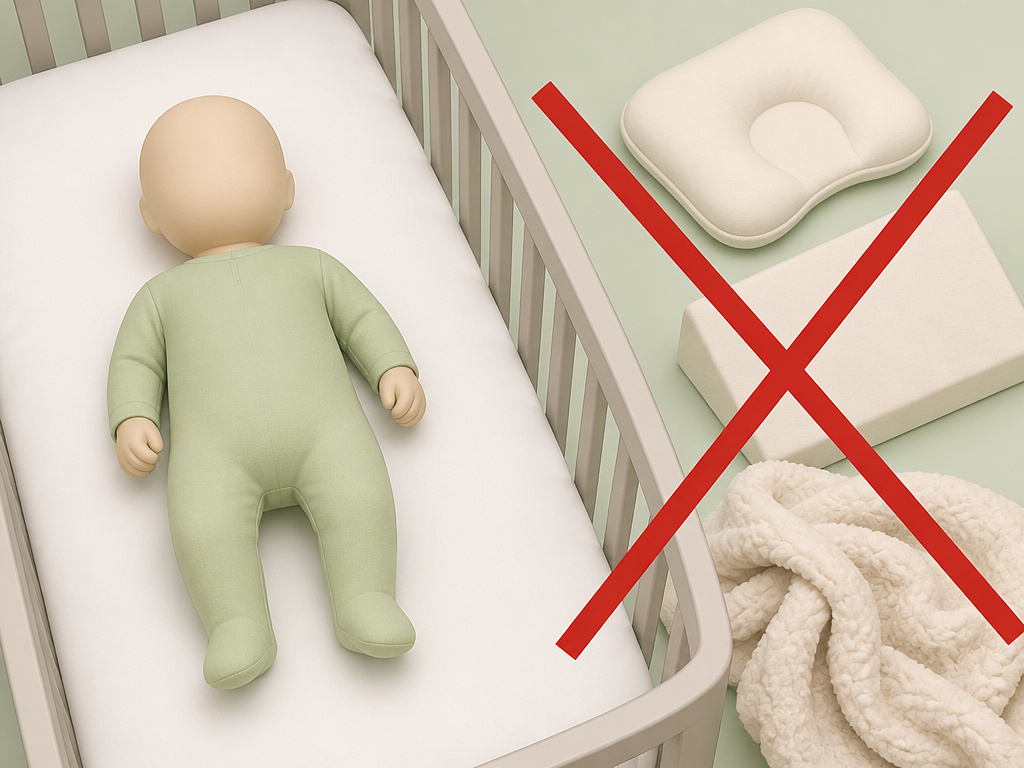
The urge to “fix” the flat spot can lead to dangerous choices. Safe sleep guidelines exist to prevent Sudden Infant Death Syndrome (SIDS). They are not negotiable.
The baby must sleep on their back, on a firm, flat surface with no loose bedding. This is the cornerstone of the International SIDS prevention guidelines. A firm crib mattress is essential, it resists indentation, which reduces pressure points.
This means the following are not safe in the crib, bassinet, or bedside sleeper: * Flat head pillows or “positional” pillows: Any pillow designed to cradle the head in a specific position. * Sleep positioners or wedges: Products that claim to keep the baby on their back or at an angle. * Loose blankets, comforters, or padded bumpers: These are suffocation hazards.
Using a baby pillow for flat head inside the sleep space directly contradicts every major safe sleep organization. The risk isn’t theoretical.
Never add a mattress, pillow, comforter or padding. Use ONLY the pad provided by the manufacturer. Sealybaby Bassinet & Bedside Sleeper Instruction Manual
The same rule applies to a breathable baby mattress, use only the one that came with the product or a manufacturer-approved replacement. An aftermarket mattress that doesn’t fit perfectly can create a deadly gap.
Products That Can Help (And Ones That Can’t)
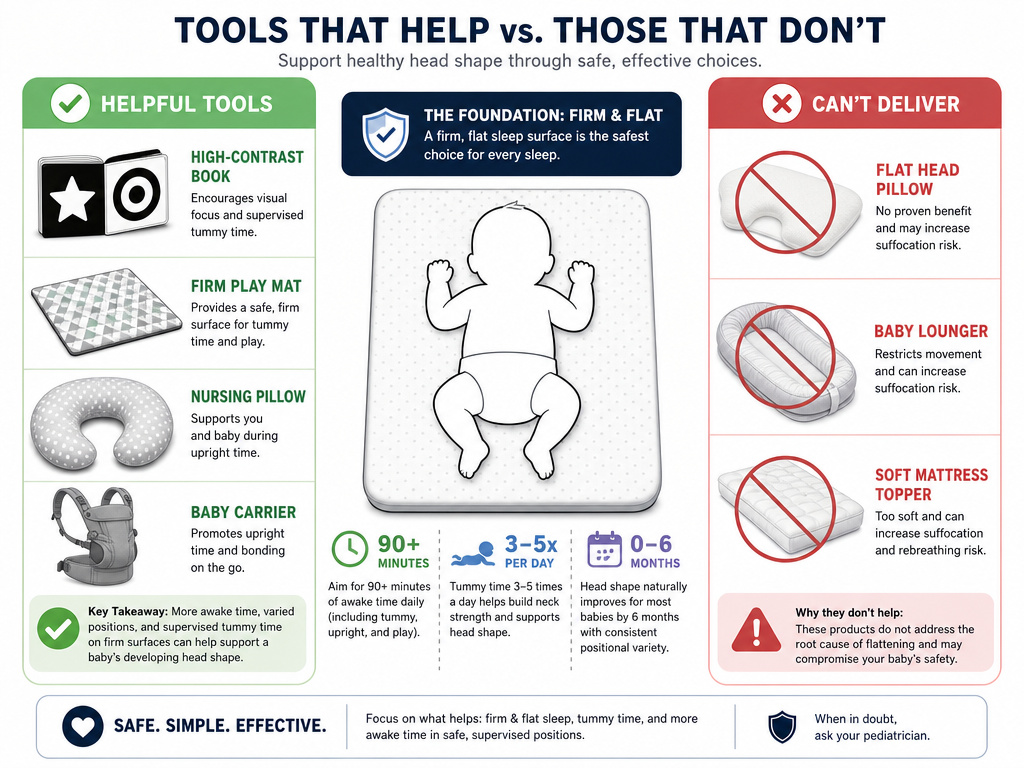
You can’t buy a fix for flat head. You can buy tools that support the two proven methods.
Helpful Tools:
- A high-contrast black and white toy or book. Use it during tummy time to encourage lifting and turning the head.
- A simple, firm play mat. This is your tummy time headquarters. Avoid overly padded mats that sink under the baby’s weight.
- A nursing pillow. Fantastic for supported tummy time when the baby is very young. Place them across the pillow with arms and chest supported.
- A baby carrier or wrap. Upright carrying counts as zero-pressure time and strengthens neck muscles.
Products That Promise But Can’t Deliver:
- Flat head shaping pillows. As established, these are unsafe for sleep. Using them during supervised awake time is redundant, that’s just tummy time with extra steps.
- Specialized baby lounger pillows for sleep. These are for supervised lounging only, never for unsupervised sleep.
- Mattress toppers or soft pads. They make the sleep surface unsafe and can worsen flattening by allowing the head to sink in.
Your money is better spent on a few good, supportive items for awake time than on any sleep-positioning gadget. A complete baby bedding set should include a fitted sheet for a firm mattress, nothing more.
From Infant to Toddler: The Head Shape Timeline
When does this stop being a concern? Most skull growth and rounding happens in the first year, with the biggest window for change before 6 months.
- 0-4 months: The most rapid period of change. Consistent repositioning and tummy time have the highest impact here.
- 4-6 months: This is the “make-or-break” window. If flattening is still significant, this is when a pediatrician referral for a helmet evaluation typically happens. Helmets are most effective between 4-7 months.
- 6-12 months: The skull is still growing but hardening. Minor flat spots can continue to round out with natural growth, especially as the baby sits, crawls, and sleeps less.
- 12+ months: By a child’s first birthday, the major skull bones are fusing. Any remaining asymmetry is likely permanent but usually mild. This is when choosing a supportive toddler pillow becomes relevant for comfort, not correction.
The transition from a safe, bare crib to a toddler bed with a pillow is a major milestone. It happens only after the risk of flat head and the acute risk of SIDS have passed.
Frequently Asked Questions
Can a baby pillow fix flat head?
No. A pillow for newborn flat head is not safe for unsupervised sleep. Using any pillow in a baby’s sleep space increases the risk of suffocation and SIDS. The only safe, proven methods are repositioning and tummy time.
How long does it take for a baby’s flat head to round out?
With consistent repositioning and daily tummy time, you can see noticeable improvement in 4-8 weeks. Significant rounding often occurs by 4-6 months of age. The pace depends on how early you start and how consistent you are.
Is flat head a sign of something serious?
Positional plagiocephaly (flat head from external pressure) is usually not a sign of serious brain development issues. However, a rare condition called craniosynostosis (where skull bones fuse too early) can also cause a misshapen head. Your pediatrician can tell the difference. Always mention any head shape concerns at your well-baby visits.
Will my baby need a helmet?
Most babies do not need a helmet. Helmets (cranial orthotics) are typically considered only for moderate to severe positional plagiocephaly that hasn’t improved with several months of consistent repositioning and tummy time, usually around 5-6 months of age. A specialist makes this determination.
Can I let my baby sleep on their side to prevent flat head?
No. Side sleeping is not as safe as back sleeping for preventing SIDS. It also doesn’t solve the pressure problem, it just moves it to a different part of the head. The back-sleeping recommendation is absolute for safety.
Before You Go
Forget the gadgets. The plan is simple but requires daily attention: turn the head, switch the crib, get them on their belly. Do that from the first week home, and you’ll likely never need to search for an infant pillow for flat head.
The flat spot developed over time. It corrects the same way. Trust the process, follow the safe sleep rules without exception, and bring any lingering concerns to your pediatrician at the 4 or 6-month visit. You’ve got this.
