
Safe Sleep: Can Infants Sleep With Blankets? AAP Guidelines
This post contains affiliate links. As an Amazon Associate we earn from qualifying purchases.
Infants cannot sleep with loose blankets, quilts, pillows, or any soft bedding. The only safe sleep environment for a baby under one year is a bare, firm, flat crib or bassinet with a fitted sheet. For warmth, use a wearable blanket or layered clothing. This rule is backed by the American Academy of Pediatrics and federal law to prevent suffocation, entrapment, and Sudden Infant Death Syndrome (SIDS).
That ‘bare is best’ mandate results from decades of data tracking exactly how infants die in their sleep. The shift from “maybe” to “never” on blankets happened because researchers could pinpoint the mechanisms, a pillow covering the nose and mouth, a quilt trapping exhaled carbon dioxide, a baby’s face pressing into a soft surface they lack the strength to lift away from.
What follows breaks down the federal regulation that bans inclined sleepers, the 2022 pediatric policy that outlawed weighted blankets, and the only two proven-safe methods for keeping a sleeping baby warm. You’ll also see the numbers on how many parents still use bedding despite the warnings, and why that statistic matters for your own choices.
Key Takeaways
- Loose blankets are a suffocation and entrapment hazard for all infants under 12 months, regardless of how lightweight or “breathable” the fabric is.
- The Consumer Product Safety Commission (CPSC) rule 16 CFR § 1236.2 mandates that any product marketed for infant sleep must have a seat back angle of 10 degrees or less from horizontal.
- The 2022 AAP safe sleep policy explicitly advises against weighted blankets, weighted sleepers, and weighted swaddles, linking them to documented fatalities.
- For warmth, the only safe options are a wearable blanket (sleep sack) that fits correctly or layered pajamas; room temperature should be comfortable for a lightly clothed adult.
- If a baby falls asleep in a car seat, swing, or stroller, move them to a firm, flat sleep surface as soon as possible; these products are not designed for unsupervised sleep.
The Straight Answer: Why Blankets Are a Hard No
The prohibition stems from physics and infant development. A newborn lacks the head control and arm strength to reposition themselves if their breathing becomes obstructed.A loose blanket can cover their face in seconds, and the reflexive struggle is often too weak to be heard.
Common mistake: Using a “light” muslin or receiving blanket. Even thin fabric can form a seal over an infant’s nose and mouth, or become tangled around their neck. Suffocation can occur in under a minute.
The official AAP safe sleep policy statement states the risk in terms of SIDS and “other sleep-related causes of infant death,” which include accidental suffocation and entrapment. Their 2022 update strengthened the language, moving from “not recommended” to a clear directive against all soft bedding accessories in the crib.
This stance is echoed by the CPSC safe sleep guidelines, which use the phrase “Bare is Best.” Their website lists recalls of products like weighted blankets following infant deaths, making the consequences tangible and specific.
The Mechanics of the Hazard
Three specific failure modes turn a blanket from cozy to dangerous:
- Suffocation: Fabric covers the nose and mouth, blocking the airway. This can happen if a baby kicks a blanket over their own face or if a blanket placed over them shifts during sleep.
- Entrapment: The baby becomes trapped between a blanket and the crib rail, mattress, or wall, unable to breathe.
- Strangulation: A loose corner of a blanket wraps around the infant’s neck.
These are the documented causes behind thousands of sudden, unexpected infant deaths each year. The switch to a bare sleep environment is the single most effective change a caregiver can make to eliminate these physical risks.
The Federal Rules: More Than Just Advice
This isn’t a matter of best practices. For products sold in the United States, it’s the law. In June 2021, the CPSC enacted a rule targeting a gray area in the market: products that looked like sleepers but didn’t meet existing crib or bassinet standards.
The core of the federal infant sleep product regulations is ASTM F3118-17a, a standard that now governs any product marketed for an infant up to 5 months old to sleep in. The most critical specification is the angle rule.
The angle of the seat back or sleep surface intended for sleep shall not exceed 10 degrees from horizontal when measured along the occupant’s head-to-toe axis.
This 10-degree rule effectively banned the dangerous generation of inclined sleepers linked to infant deaths. It means any bassinet, bedside sleeper, or compact crib you buy must have a virtually flat sleep surface. If you’re using a hand-me-down or a multi-use product, you must check this angle. A nap in a car seat or a swing that holds a baby at a steeper angle is a known risk.
| Sleep Product Type | Governed By | Key Safety Requirement |
|---|---|---|
| Crib, Bassinet, Play Yard | CPSC Standards (16 CFR Parts 1219, 1218, 1222) | Firm, flat mattress with tight-fitting sheet only. |
| Infant Sleep Product (under 5 mos) | 16 CFR § 1236.2 (ASTM F3118-17a) | Sleep surface angle ≤10 degrees from horizontal. |
| Bedside Sleeper | ASTM F2906 | Secure attachment to adult bed, mesh sides for breathability. |
| Car Seats, Swings, Bouncers | Not for unsupervised sleep | Must move baby to flat surface if they fall asleep. |
The Only Safe Ways to Keep a Baby Warm
If blankets are out, how do you prevent a baby from getting cold? The answer relies on insulation that stays put and cannot cover the face. You have two clear paths, both endorsed by the AAP and CPSC.
1. Wearable Blankets (Sleep Sacks)
This is the default, go-to solution. A wearable blanket is a sleeveless garment that zips or snaps around the baby’s torso, leaving their arms free but enclosing their legs and feet in a blanket-like pouch. It cannot be kicked off or pulled over the head.
- Fit is non-negotiable. The neck and arm holes must be snug enough to prevent the baby from sliding down inside the sack, but not tight. The sack should allow for free hip and leg movement.
- TOG rating matters. This measures thermal resistance. A TOG of 1.0 is for standard room temperatures (68-72°F). Use a lighter sack (0.5 TOG) for warmer rooms and a heavier one (2.5+ TOG) for cooler rooms, instead of adding layers underneath.
- Stop using it when the baby can climb. Once a child can pull up to stand, a sleep sack becomes a tripping hazard.
2. Layered Clothing
Dressing the baby in layers of fitted clothing is a simple and effective alternative. The rule of thumb is to dress the infant in one more layer than a comfortable adult would wear in the same room.
- Base layer: A snug, long-sleeved onesie or pajamas.
- Mid layer (if needed): A footed sleeper.
- Avoid: Hats indoors (they can overheat the baby and are a suffocation risk if they slip down) and any clothing with strings, ties, or loose hoods.
For most families, a selection of Halo SleepSack wearable blankets in different TOG ratings covers all needs. They are consistently well-designed with reverse zippers for easy diaper changes and come in cotton, muslin, and fleece options. For a pure clothing-layer approach, Burt’s Bees Baby organic cotton pajamas are soft, durable, and fit true to size.
What the Data Says About Bedding Use
You might feel like the only parent not using a cute blanket in the crib. The data says otherwise, and also shows how stubborn the habit is. A peer-reviewed bedding use trends study published in Pediatrics analyzed nearly two decades of surveys (1993–2010).
Despite warnings first issued in 1996, a significant portion of caregivers continued to use hazardous bedding. The study classified hazardous bedding as blankets thicker than a receiving blanket, quilts, pillows, sheepskins, and similar soft materials under or over the infant.
Where this goes sideways: Assuming “everyone does it.” The NIH study found that while bedding use declined after public health campaigns, it remained prevalent, particularly in certain demographic groups. This normalization is the enemy of safe sleep.
The research is crucial because it moves the conversation from “experts say” to “we have measured the behavior, and it’s still happening, and here’s who we need to reach.” It confirms that safe sleep education must be repetitive, culturally competent, and delivered by all caregivers, grandparents, babysitters, and daycare providers included.
Navigating Edge Cases and Gray Areas
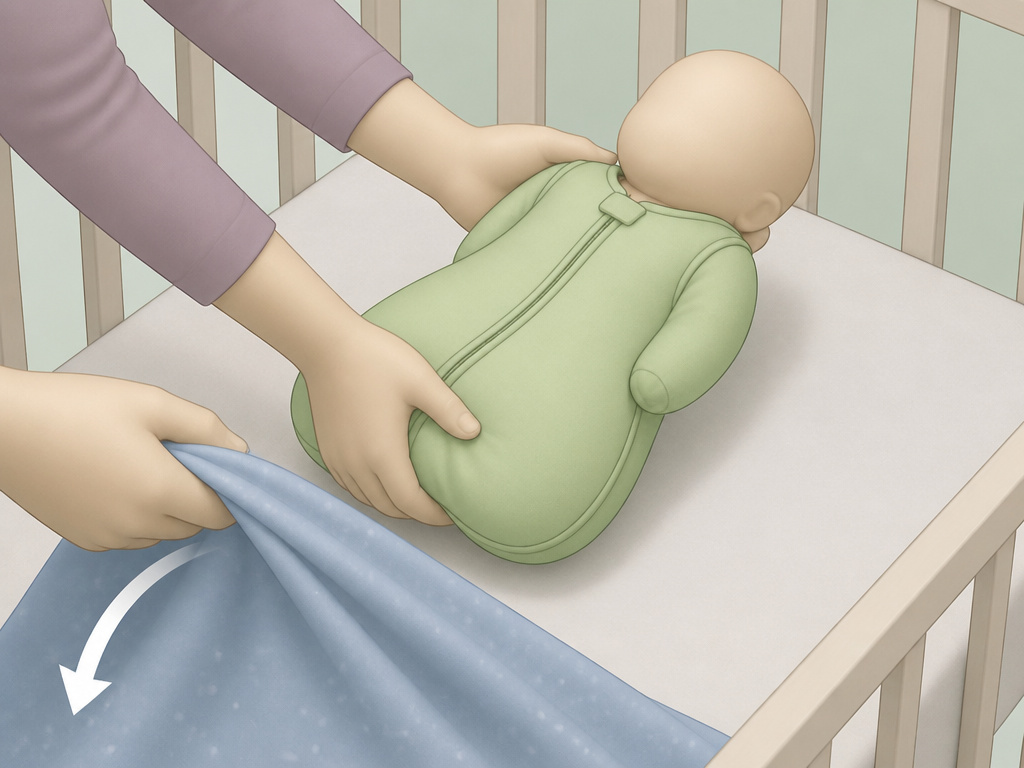
Real life with a baby doesn’t always fit the perfect scenario. Here’s how to apply the rules to common tricky situations.
If the Baby Rolls Over
Once a baby can roll from back to front and front to back independently (usually around 4-6 months), you do not need to reposition them all night. However, the crib must still be bare. The ability to roll does not magically make a blanket safe. They can still become entangled. Continue using a wearable blanket.
Twins or Multiples
The 2022 AAP policy is definitive: “Any potential benefits of cobedding for twins and higher-order multiples are outweighed by the risk.” Each baby needs their own separate, bare sleep space. The risk of one infant overlaying the other or sharing bedding that could cover a face is too great.
When Baby Falls Asleep Elsewhere
It will happen in the car seat, the stroller, the swing. The rule is to move them to their firm, flat crib or bassinet as soon as you are able. The angled position in a car seat can cause their head to fall forward, potentially obstructing their airway, a risk that increases the longer they stay in it.
Swaddling
Swaddling is a specific technique using a swaddle blanket or sack to wrap a young infant snugly. It is only safe until the baby shows signs of rolling, which can happen as early as 8 weeks. Once rolling begins, swaddling must stop immediately, as a swaddled infant who rolls onto their stomach cannot use their arms to push up or reposition their head. Transition directly to a wearable blanket.
Frequently Asked Questions
What about a lightweight muslin blanket?
No. Any loose blanket is a hazard. A muslin blanket can still cover the face, get tangled, or bunch up around the baby’s neck. If you want the feel of muslin, buy a muslin sleep sack.
Can I use a blanket if I tuck it tightly under the mattress?
The AAP does not recommend this method for infants. It is difficult to achieve a tuck that remains secure all night as the baby moves. A wearable blanket is a safer, more reliable choice.
When can my baby finally have a blanket?
The blanket ban applies for the first year. After their first birthday, the risk of SIDS drops dramatically, and most toddlers have the motor skills to push away a blanket that covers their face. You can then introduce a small, lightweight blanket. Pillows and large comforters should wait until the child transitions to a toddler bed, usually after age 2.
Are sleep positioners or crib bumpers safe?
No. The CPSC has banned the sale of crib bumper pads due to suffocation and strangulation risks. Sleep positioners, including wedges or nests, are also unsafe as they can cause a baby to roll into a position that traps their face against the soft material.
What if my baby seems cold without a blanket?
Check the room temperature and feel the back of their neck or chest, their hands and feet are often cool and are not a good indicator. Adjust their clothing or switch to a wearable blanket with a higher TOG rating. A room temperature of 68-72°F is ideal.
Before You Go
The rule is absolute because the stakes are. A bare crib with a fitted sheet and a baby in a Halo SleepSack is the engineered solution to a set of proven physical dangers. The 10-degree federal rule for sleep surfaces and the AAP’s ban on weighted items aren’t arbitrary; they are written in response to specific, documented fatalities.
Your job is to filter out the noise of cute nursery photos and well-meaning but outdated advice from relatives. The safe path is clear, simple, and backed by every major child health and safety organization in the country. Dress them in layers, zip them into a properly fitted sleep sack, and put them on their back in an empty crib. That’s it. That’s the whole game for the first year.
