
Can a Newborn Sleep in a Rocker Safely? The 10-Degree Rule
This post contains affiliate links. As an Amazon Associate we earn from qualifying purchases.
No. A newborn cannot and must not sleep in a rocker. These products are designed for supervised, awake, reclined play, not sleep. The U.S. Consumer Product Safety Commission (CPSC) warns that inclined rockers pose a fatal suffocation risk and have been linked to at least 13 infant deaths between 2009 and 2021. The only safe sleep surface for a newborn is a firm, flat mattress in a crib, bassinet, or play yard.
That 10-degree threshold is the law for any product marketed for infant sleep, effective June 2022. A rocker’s seat back, by definition, reclines at an angle greater than 10 degrees.This incline can cause a baby’s head to slump forward, compressing their airway. The risk isn’t theoretical; it’s documented in fatality reports where infants were found unresponsive.
What follows explains the mechanical and regulatory why behind the rules: the specific angle that triggers the hazard, the fatality data that forced new warnings, the exact language from product manuals, and the clear, flat alternatives that keep a sleeping baby safe.
Key Takeaways
- The CPSC has documented at least 13 infant deaths in specific rocker models, with most occurring during sleep.
- A 10-degree seat angle is the legal cutoff. Any product with a recline greater than 10 degrees is unsafe for infant sleep.
- ASTM F3084-22, the safety standard, defines a rocker by this >10-degree recline, explicitly separating it from sleep products.
- Every major rocker manual states “not safe for sleep or unsupervised use” in bold warning labels.
- The only safe sleep surface is a firm, flat mattress in a certified crib, bassinet, or play yard, with the baby on their back.
The 10-Degree Angle That Changes Everything
This number is the line between a supervised seat and a lethal sleep environment. In June 2022, the CPSC enacted a rule requiring that any product marketed for infant sleep must have a sleep surface angle of 10 degrees or less. Rockers fail this test by design.
The ASTM F3084-22 standard defines an infant rocker as a product intended to support an occupant “in a seated, reclined position greater than 10°.” This technical specification is what legally classifies it as a rocker, not a sleeper.
The physics are simple. An infant’s head is large and heavy relative to their body. In a reclined seat, gravity pulls the chin down toward the chest. This chin-to-chest position can kink the trachea, restricting airflow. A newborn lacks the neck strength to lift their head back into a safe position. Oxygen levels drop silently. The baby doesn’t cry out or struggle; they suffocate.
This is why a bedside sleeper or bedside bassinet with a fully flat, firm mattress is the only safe overnight option. These products are tested to meet crib safety standards, not rocker standards.
What “Supervised Play” Really Means (And When It Fails)
The instruction to “always supervise your baby” in a rocker is meant to prevent a specific, acute hazard: a fall. But supervision cannot prevent the slow-motion suffocation caused by positional asphyxia. A baby who appears to be sleeping peacefully in a rocker could already be in distress.
The CPSC’s fatality data reveals the common, deadly scenarios. In the incidents behind the CPSC Fisher-Price rocker death warning, most infants were placed in the rocker for a nap or sleep. Many were unrestrained. Pillows or blankets were often present. In one case, a caregiver left the room for just 20–30 minutes.
| Supervision Gap | Reported Consequence in Fatality Data |
|---|---|
| Infant falls asleep | Caregiver assumes it’s safe, leaves room |
| Use of soft bedding | Blanket found covering infant’s face |
| Skipping restraints | Infant found slumped over or tipped sideways |
| Elevated surface | Rocker placed on adult bed or soft sofa |
Where this goes sideways: Thinking “I’ll just watch them.” Positional asphyxia gives no visual cue. A baby’s skin color may not change until it’s too late. By the time you notice something is wrong, irreversible damage has occurred.
What the Manuals Actually Say
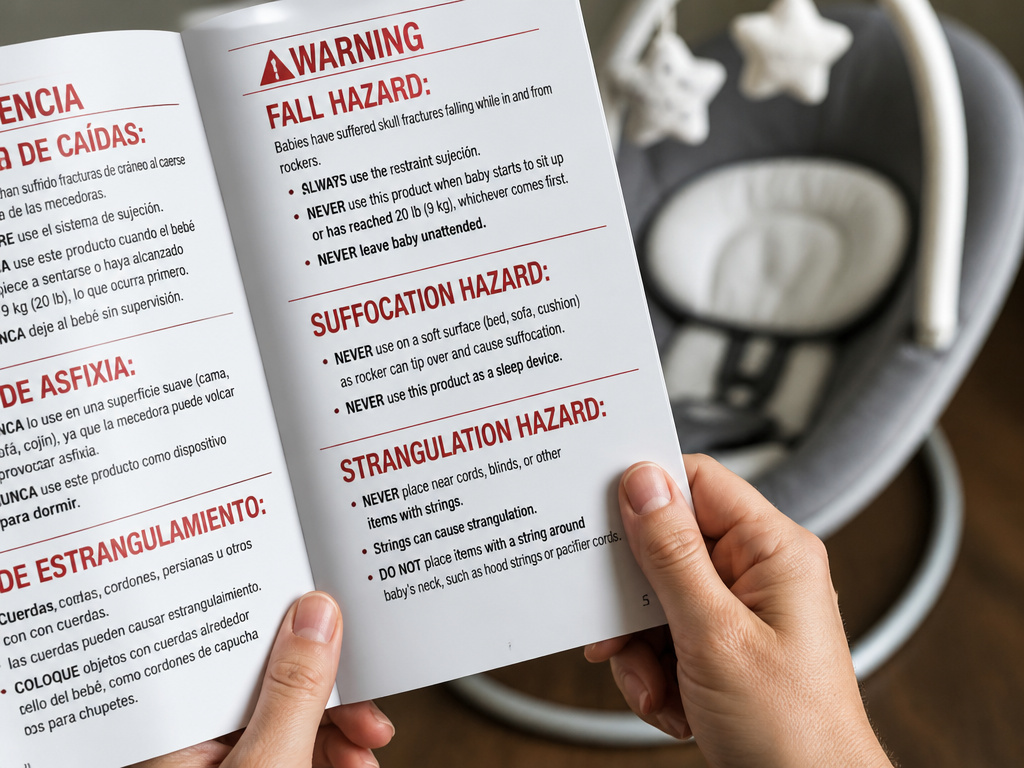
Manufacturer warnings are liability-driven, blunt statements written after reviewing incident reports. Ignoring them means ignoring the product’s defined limits.
The manual for the Nuna BRYN Newborn Rocker states directly: “This product is not safe for sleep or unsupervised use.” It commands: “ALWAYS use restraints. NEVER lift or carry baby in rocker. ALWAYS place rocker on floor.” The weight limit is 20 lb, and you must stop use when the baby can try to sit up unassisted.
Similarly, the Mattel instruction sheet for a popular model warns of both “FALL HAZARD” and “SUFFOCATION HAZARD,” explicitly noting that “children have suffocated when seats tipped over on soft surfaces.” Its directive is absolute: “NEVER use on a bed, sofa, cushion, or other soft surface.“
These are the operational boundaries of the product. Using a rocker outside these boundaries, for sleep, on a couch, without restraints, voids any claim of safety and matches the exact conditions described in fatality reports.
Rocker vs. Sleeper: A Regulatory Comparison
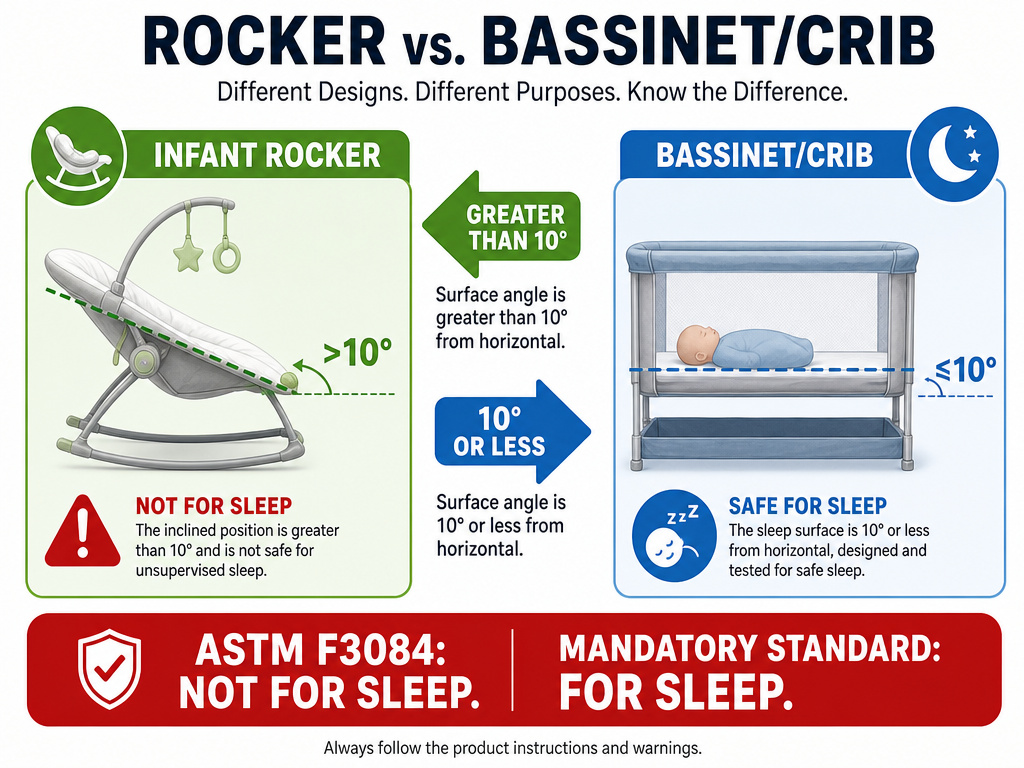
Understanding the difference requires looking at the standards. A rocker is governed by ASTM F3084, a voluntary safety specification. A bassinet or crib is governed by mandatory federal standards that are far more stringent.
| Feature | Infant Rocker (ASTM F3084-22) | Bassinet/Crib (Mandatory Standard) |
|---|---|---|
| Primary Purpose | Supervised, awake, reclined play | Sleep |
| Surface Angle | Greater than 10 degrees | 10 degrees or less (flat) |
| Surface Firmness | Proposed test: <11mm displacement under force | Rigid, non-deforming mattress |
| Restraint System | Required | Not used for sleep |
| Sleep Warning | Must state “not for sleep” | Certified for sleep |
The ASTM infant rocker safety specification explicitly states it “does not address positions or modes on products that recline to 10 degrees or less… Or are intended primarily for sleeping.” The regulatory framework itself draws the line.
This is why choosing true safe sleep products like a crib mattress that meets federal flammability and firmness standards is a non-negotiable step. A rocker, by its governing definition, is on the other side of that line.
The Only Safe Alternatives for Newborn Sleep
When your baby needs to sleep, the rocker is not an option. Move them to a product designed and certified for the job. The transition is simple, and the right gear makes it effortless.
- Crib, Bassinet, or Play Yard: This is the absolute standard. The mattress must be firm and flat, covered only by a tight-fitting bassinet sheet. No pillows, blankets, or stuffed animals. This is the environment referenced in every official infant rocker fatality report as the safe alternative.
- A Proper Bedside Solution: For easy night feeds, use a certified bedside sleeper that attaches securely to your bed. It provides a separate, firm, flat sleep surface for the baby within arm’s reach. It is not a rocker.
- Safe Swaddles and Wearables: Keep your baby warm without loose blankets. A well-fitted swaddle blanket or a wearable blanket (sleep sack) are part of safe newborn bedding.
TL;DR: The rocker’s job ends when the baby’s eyes close. The sleeper’s job begins. Have the safe space ready before you need it.
Frequently Asked Questions
Can a newborn nap in a rocker under supervision?
No. A nap is sleep. The hazard of positional asphyxia is present whether it’s a 10-minute nap or overnight sleep. Supervision does not prevent this internal airway blockage. If your baby falls asleep in a rocker, bouncer, or swing, the CPSC and every manufacturer manual instruct you to move them to a firm, flat surface immediately.
What about rockers that vibrate or play music to soothe a baby?
Soothing features are for calming a fussy, awake baby. They do not change the product’s physical structure or the associated suffocation risk. A reclined seat angle greater than 10 degrees is unsafe for sleep, regardless of added features. The government rocker standard publication makes no exceptions for vibration or sound.
Are some rockers safer than others?
All rockers that meet the ASTM definition have a seat back angle greater than 10 degrees, which is the key risk factor for positional asphyxia. While some may have sturdier bases or better restraints to prevent falls, none are safe for sleep. The mandatory rocker safety requirements under development aim to make all rockers safer for their intended use, supervised, awake play, not to certify them for sleep.
My parents used a rocking cradle for me. Why is it different now?
Older rocking cradles often had a fully flat, horizontal sleeping surface that rocked. Modern infant rockers are reclined seats that rock. The hazard is the incline, not the motion. Today’s regulations and warnings are based on decades of collected fatality data that did not exist in the past. We now know the specific, deadly mechanism of inclined sitting devices.
What should I do with my rocker if I can’t use it for sleep?
Use it as intended: for short periods of interactive, supervised play when your baby is awake and alert. It’s a place for them to look at a mobile, watch you fold laundry nearby, or enjoy a different view. Always use the safety restraints, always place it on the floor, and never leave the room.
Before You Go
The rocker question is settled. The data from the CPSC is stark, the manufacturer warnings are unambiguous, and the physics of a 10-degree incline are unforgiving. A rocker is a seat, not a bed.
Your safest path is to invest in a dedicated, certified sleep space, a quality infant bed, and use the rocker only for its designed purpose. When those little eyes get heavy, the move to a firm, flat surface is the most important trip you’ll make all day. Make it a habit from the first day home.
