
A Bed for Every Child | The 3 Standards That Decide Safety
This post contains affiliate links. As an Amazon Associate we earn from qualifying purchases.
A bed for every child is defined by three non-negotiable standards: the child’s age and weight, the product’s mandatory safety certification (ASTM/CPSC), and the exact mattress dimensions it’s engineered to hold. The right bed isn’t about style first; it’s about a verified match between these specs.
That match is a legal requirement, not just good advice. Federal law codifies specific ASTM standards for cribs, toddler beds, and mattresses. A bed that is merely “sized” to fit a crib mattress is not the same as one “intended” for it—a subtle wording change in the 2026 ASTM F1821-26 standard that clarifies the law’s scope and closes a loophole for unsafe gaps.
What follows is a breakdown of each bed type by its governing standard, the age and weight limits that trigger a transition, and the physical specs you must verify before you buy. We’ll cover cribs, toddler beds, bunk beds, and specialized options, grounding each in the official CPSC business guidance and ASTM documents that define safety.
Key Takeaways
- The mandatory U.S. Safety standard for toddler beds updates to ASTM F1821-26 on August 29, 2026, changing the definition from “sized” to “intended” for a full-size crib mattress to prevent dangerous gaps.
- A full-size crib mattress must measure at least 27¼ inches wide by 51⅝ inches long per 16 CFR § 1241.2; any gap larger than 3.15 inches in the crib corner is a failure.
- The American Academy of Pediatrics (AAP) recommends new cribs over used ones because older models may have missing parts, be incorrectly assembled, or no longer meet current safety standards.
- Bunk beds and high beds are governed by ISO 9098-1:2023, which sets requirements for guardrails, ladder access, and minimum/maximum bed base heights.
- Mattress firmness is non-negotiable for infants; soft, adjustable, or memory foam mattresses can create a suffocation hazard and are not safe for sleep under one year of age.
The 3 Non-Negotiable Safety Standards (And What They Mean)
You don’t pick a bed. You verify its certification. In the United States, children’s sleep products are regulated under federal law, with specific ASTM International standards incorporated by reference into the Code of Federal Regulations (CFR). These aren’t suggestions.
Before you start: Never use a children’s bed that lacks a visible compliance label citing the current ASTM standard. Never modify a bed to fix a broken part. Never assume a mattress from one product fits another safely. These actions void certifications and introduce unregulated hazards.
The three pillars are the product standard, the mattress standard, and the pediatric guidelines that interpret them for real-world use.
First, the product standard. For a toddler bed, the law is 16 CFR § 1217.2, which mandates compliance with ASTM F1821. The current version is F1821-19ε1, but a direct final rule published in the Federal Register updates this to ASTM F1821-26 effective August 29, 2026. This revision includes a critical clarification: a toddler bed is now defined as a bed “intended to accept a full-size crib mattress,” replacing the older word “sized.” The official regulatory text for toddler beds makes this distinction legally binding.
Why does one word matter? A twin bed frame is “sized” to hold a crib mattress—it’s physically big enough. But it is not “intended” for one, leaving hazardous gaps a child can roll into. The new language tightens the scope.
Second, the mattress standard. A crib mattress is governed by 16 CFR § 1241.2. It must be firm, flat, and maintain its shape. The exact dimensions are law: at least 27¼ inches wide by 51⅝ inches long. When placed in the crib with a fitted sheet, the maximum allowed gap in the corner is 3.15 inches (80 mm). This federal crib mattress safety standard exists solely to prevent entrapment.
Third, the medical guidance. The American Academy of Pediatrics (AAP) publishes evidence-based policy statements that interpret these technical standards for caregivers. Their 2022 safe sleep environment evidence is explicit: use a new, safety-approved crib. They advise against used cribs due to the risk of outdated standards, missing hardware, or failed DIY repairs. They also warn that soft or memory foam mattresses can create a suffocation pocket for an infant.
| Standard / Guideline | Governs | Key Number / Clause | Why It Exists |
|---|---|---|---|
| ASTM F1821-26 (from Aug 2026) | Toddler Beds | Section 1.3: “intended to accept a full-size crib mattress” | Prevents misuse of larger beds with unsafe mattress gaps. |
| 16 CFR § 1241.2 | Crib Mattresses | Mattress dimensions: 27¼” x 51⅝”; max corner gap: 3.15″ | Eliminates entrapment zones between mattress and crib wall. |
| AAP Safe Sleep Policy | Clinical Practice | Recommends new over used cribs; bans soft/memory foam for infants. | Translates engineering standards into actionable, life-saving caregiver advice. |
These documents talk to each other. The ASTM standard sets the physical test. The CFR turns it into law. The AAP tells you how to apply it in your child’s room. Missing any one layer is a risk.
Cribs: The Gold Standard for Infants
A full-size baby crib is the safest place for an infant to sleep. Its safety is defined by ASTM F1169, a standard that covers everything from slat spacing and mattress support strength to the integrity of the hardware. The Consumer Product Safety Commission crib guide outlines the business requirements, but the takeaway for parents is in the details.
The crib’s interior dimensions are precise: 28 ± ⅝ inches wide by 52 ⅜ ± ⅝ inches long. This tight tolerance is why a mattress must be equally precise. A mattress that is too small creates a gap. One that is too thick can elevate a child higher than the side rail, enabling a fall.
Common mistake: Using an after-market mattress in a non-full-size crib or playard without checking its compliance with ASTM F406. The federal rule states such a mattress must be “at least the same size as the original equipment mattress or larger and lay flat on the floor of the product.” It also must be tested for stability and side height with that specific product model. Guessing here is how a mattress dislodges.
The AAP’s strong preference for new cribs stems from documented fatalities in cribs that were broken or had missing parts. Hardware fatigues over time. Plastic components become brittle. A crib that has been disassembled and reassembled multiple times may not have the same structural integrity. If you must use a hand-me-down, you become the compliance officer. You need the original assembly instructions, all original hardware, and you must verify there is no active recall on the exact model.
When is a child too big for a crib? The transition is not about age alone. The limit is when the child can climb out, or when the height of the top rail is less than three-quarters of the child’s height. For most, this happens between 18 months and 3 years. That’s when you look at the next category: toddler beds.
Toddler Beds: The Regulated “First Big Kid Bed”
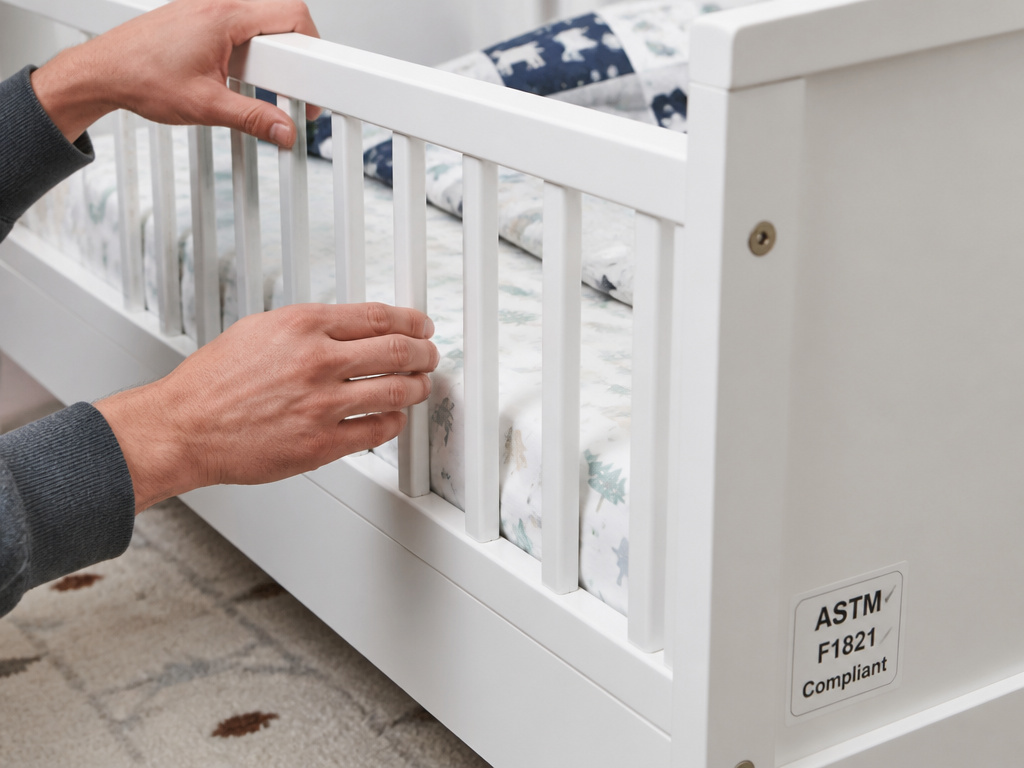
A toddler bed is not a miniature adult bed. By legal definition in ASTM F1821, it is a bed intended for a child not less than 15 months old and weighing no more than 50 lbs (27.7 kg). Its sole purpose is to safely accommodate a standard full-size crib mattress, providing lower sides for easy access while retaining guardrails to prevent falls.
The guardrail requirements are specific. They must be present on both sides if the bed is against a wall, and their height and spacing are tested to prevent entrapment of the head or torso. The CPSC toddler bed business guidance details these performance tests.
The upcoming August 2026 update to ASTM F1821-26 is more than a paperwork shuffle. It’s a clarification born from real-world misinterpretation. The old “sized to accept” language was technically met by any bed frame larger than a crib mattress. The new “intended to accept” language ties the standard explicitly to products designed for that sole mattress size. This is the regulatory answer to the “twin bed with a crib mattress” hack, which was always a bad idea.
A smooth crib to bed transition relies on this safety continuity. The child sleeps on the same familiar, certified mattress. The new frame is just a new boundary. When shopping, look for the ASTM F1821 label and a stated weight limit of 50 lbs. Many kids will exceed this weight limit before they outgrow the bed’s length, which is your signal to move to a larger bed for a 4-year-old.
Bunk Beds & Loft Beds: Managing Vertical Space Safely

When floor space is tight, you go vertical. Bunk beds and loft beds introduce a new set of hazards: falls from height, entrapment in the guardrail or between the bed and wall, and impact with the ladder or upper structure.
Internationally, ISO 9098-1:2023 provides the benchmark, specifying requirements for beds with a sleeping surface over 600mm (about 23.6 inches) from the floor. It covers guardrail height and strength, ladder design, and warnings. In the U.S., while there is a specific ASTM standard for bunk beds (F1427), the CPSC also enforces general hazard guidelines under the Federal Hazardous Substances Act.
Where this goes sideways: Using a bunk bed for a child under 6 years old on the upper bunk. The CPSC and all major standards recommend against this. Younger children lack the coordination and judgment to use a ladder safely at night or to recognize roll-off hazards.
Guardrails are non-optional on all four sides of the upper bunk, even the side against a wall. The gap between the guardrail and the mattress surface must be small enough to prevent a child’s body from slipping through. There must also be no openings in the guardrail or headboard that could trap a child’s head.
For small rooms, a loft bed with a desk underneath can be a fantastic space-saver. The same fall-prevention rules apply. Ensure the work area underneath is clear of sharp edges and that the bed structure is permanently fixed to prevent wobbling. A wobbly loft bed is a tipping hazard.
Choosing a safe bunk bed for kids means looking for a stated compliance with ASTM F1427, checking that all guardrails are permanently attached, and ensuring the ladder is sturdy and securely fastened. Mattresses for the upper bunk must be the exact size specified by the manufacturer to prevent gaps at the guardrail.
Specialized Beds: When Standard Options Don’t Fit
Some children have needs that a typical bed frame cannot meet. This includes children with autism, ADHD, or physical disabilities who may be at higher risk for falls, wandering, or needing sensory containment.
A bed for an autistic child is often a “safety bed” or “hospital-grade bed.” These are specialized products with very high guardrails, often fully enclosed mesh or fabric panels, and sometimes a lockable exit. They are medical devices, not just furniture. While they may not have a specific ASTM standard, they should be manufactured by a company experienced in durable medical equipment and should be recommended by an occupational therapist or physician.
The key is to match the bed to the specific behavior. For a child who climbs, a fully enclosed canopy is necessary. For a child who needs deep pressure input, a mattress in a snug, padded frame might be appropriate. The goal is the same as for any bed: to provide a safe, secure place to sleep without risk of injury. These specialized beds for sensory needs are a critical tool for many families, but they require careful selection and professional guidance.
Mattresses & Foundations: The Support System
The best bed frame is useless with the wrong mattress. For infants and toddlers, the rules are absolute: firm, flat, and exact-fitting. As children grow into twin or full-size beds, the principles shift from entrapment prevention to support for growing bodies.
For a young child in a twin bed, a high-quality, firm innerspring or dense foam mattress is ideal. Avoid ultra-plush pillow tops or soft memory foam, which can hinder spinal alignment. The mattress should be paired with an appropriate foundation—either a bunkie board, a slatted foundation with gaps no wider than 3 inches, or a solid platform. A sagging box spring from an adult bed is not suitable.
Mattress protectors are essential, but they must be tight-fitting and waterproof without being slippery or creating a loose fabric hazard. For older children who may be prone to allergies, look for protectors with a mite-proof barrier.
| Bed Type | Ideal Mattress Type | Critical Fit Check | What to Avoid |
|---|---|---|---|
| Crib | Firm, flat crib mattress meeting 16 CFR § 1241.2 | Corner gap ≤ 3.15 inches with fitted sheet. | Memory foam, adjustable firmness, soft surfaces. |
| Toddler Bed | Same certified crib mattress from the crib. | Must sit flush on the support system with no overhang. | Using a smaller “toddler” mattress; they are not a regulated term. |
| Bunk / Loft Bed | Low-profile, the exact dimensions specified by bed maker. | Must not raise sleeping surface above guardrail top. | Mattresses thicker than recommended; they raise fall risk. |
| Twin/Full (Child) | Firm innerspring or high-density foam for support. | Check foundation slat spacing (<3″ gaps). | Old, sagging adult mattresses or ultra-plush pillow tops. |
The mattress is the part of the bed that wears out first. Plan to replace a child’s mattress every 5-8 years, or sooner if there are visible signs of sagging or deformation. A worn-out mattress defeats the safety of even the best bed frame.
Frequently Asked Questions
What is the safest type of bed for a 1-year-old?
The safest bed for a 1-year-old is a full-size crib that meets current ASTM F1169 standards. A child at 12 months is almost always too young for a toddler bed (minimum 15 months) and is still at the highest risk for sleep-related injuries. Keep them in a certified crib with a firm, fitted mattress and no loose bedding until they show signs of climbing out or reach the crib’s height/weight limits.
Can I use a regular twin mattress in a toddler bed?
No. A toddler bed is engineered and legally intended to hold only a standard full-size crib mattress (27¼” x 51⅝”). A twin mattress is both longer and wider. It will not fit the support system correctly, creating dangerous overhangs and gaps, and it voids any safety certification. This mismatch is a fall and entrapment hazard.
How do I know if a used crib is safe?
The AAP recommends new cribs. If you must use a used one, you need to conduct a full audit: verify the exact model has no CPSC recalls, ensure you have all original hardware and the assembly instructions, inspect for cracks, splinters, or loose joints, and check that the slat spacing is still less than 2 3/8 inches. Most importantly, never attempt to repair a broken crib with non-original parts. Many deaths have occurred in cribs that were “fixed.”
Are bunk beds safe for a 5-year-old?
5-year-old can use the lower bunk of a bunk bed, provided the bed meets ASTM F1427 and the child is supervised. However, no child under 6 years old should use the upper bunk. Their motor skills and judgment are not sufficiently developed to navigate the ladder safely in the dark or to understand the risk of rolling off a high surface.
What does the August 2026 change for toddler beds mean for me?
If you buy a toddler bed on or after August 29, 2026, it must comply with the updated ASTM F1821-26 standard. The main change is a clarification in the definition, tightening what qualifies as a toddler bed to prevent unsafe gaps. Beds manufactured before that date can still be sold and used if they meet the previous standard (F1821-19ε1). When shopping later in 2026, look for labels citing the newer F1821-26 to ensure you have the latest safety revisions.
Before You Go
Finding a bed for every child is an exercise in verification. Start with the child’s age and weight, then find the product category that legally matches those numbers. Let the ASTM standard and the CPSC business guidance be your checklist, not marketing copy. The right bed is the one that passes the test, fits the mattress perfectly, and gives you the label to prove it.
From the certified crib for your infant to the space-saving loft bed for your tween, safety is a thread that runs through every standard. It connects the precise language of federal safety standard for toddler beds to the practical warnings in pediatric research. Your job is to follow that thread, link by link, until the choice becomes clear.
