
Baby Latex Mattress Guide: Is It Good for Safety & Firmness?
This post contains affiliate links. As an Amazon Associate we earn from qualifying purchases.
A latex mattress can be good for a baby only if it meets two non-negotiable conditions: it passes the federal firmness and fit standards, and your child has no latex allergy. Certified organic latex reduces chemical exposure but introduces a known allergen for 1-6% of the population. The material itself is not inherently unsafe, but the trade-off between reduced off-gassing and allergy risk is the real decision.
That allergy statistic changes the calculation. You are not just choosing a material; you are placing a bet on your child’s unknown immune response. A mattress is the one object in the nursery used for 12+ hours a day, every day, for years. It is the wrong place for an allergen trial.
This guide walks through the federal size and firmness rules that every mattress must pass, the peer-reviewed pressure data on latex versus foam, the specific chemical and allergy warnings, and the recall that proves standards matter. By the end, you’ll know whether a latex mattress fits your safety priorities or if a non-allergenic alternative is the smarter default.
Key Takeaways
- Federal law mandates a crib mattress fit with less than a 3.15-inch gap and firmness tested at 73°F ± 9°F. Latex must meet these same physical standards as any other material.
- An estimated 1-6% of people have a latex allergy, with reactions ranging from skin rash to anaphylaxis. There is no cure, only avoidance.
- A 2023 recall of Room & Board latex crib mattresses cited failure to pass the federal firmness test, proving certification labels are not guarantees.
- Latex reduces peak body pressure by up to 35.1% compared to polyurethane foam, but that comfort benefit is irrelevant if the mattress is too soft for safe infant sleep.
- For a latex mattress to be a legitimate choice, look for dual certifications: GOTS for organic material and GreenGuard Gold for low emissions. One without the other misses half the point.
What the Safety Standards Actually Require
Every crib mattress sold in the US must comply with the federal standard ASTM F2933-25. This is not a suggestion. The Consumer Product Safety Commission rules make it law, and the legal code for crib mattresses (16 CFR § 1241.2) spells out the penalties for non-compliance. The standard boils down to two physical truths: dimensions and firmness.
A full-size crib mattress must be at least 27 1/4 inches wide by 51 5/8 inches long. When you push it firmly into any corner of the crib, the gap on the opposite side cannot exceed 3.15 inches. This “two-finger rule” prevents entrapment. The test uses a standard 100% cotton sheet washed and dried twice, because a tight-fitting sheet pulls the mattress edges in slightly, making the gap measurement real-world.
Firmness testing is equally specific. The mattress must sit in a room at 73°F ± 9°F with 20-70% humidity for at least 24 hours before testing. Why? Materials like latex and polyurethane foam are viscoelastic, their firmness changes with temperature and humidity. A mattress that feels acceptably firm in a cool warehouse might soften dangerously in a warm nursery. The 2025 update to the standard added this humidity control and longer preconditioning to close that loophole.
Where this goes sideways: Assuming an “organic” or “natural” label means the mattress automatically passes these physical tests. The 2023 Restwell recall proved otherwise, a marketed natural latex mattress failed the firmness standard, creating a suffocation hazard.
| Safety Requirement | Federal Specification (ASTM F2933-25) | Why It Matters for Latex |
|---|---|---|
| Maximum Corner Gap | ≤ 3.15 inches (80 mm) | Latex can have a rounded, pillow-top edge that increases gap risk. Must be tested with a fitted sheet. |
| Pre-Conditioning | 24 hrs at 73°F ± 9°F, 20-70% RH | Latex firmness is temperature-sensitive. This ensures the test reflects real nursery conditions. |
| Test Mattress Sheet | 100% cotton, washed & dried 2x | Simulates real use. A snug sheet must not compromise the gap or firmness result. |
| Global Standard | ISO 23767:2021 | The international crib mattress requirements align closely, but US law requires the ASTM standard. |
The takeaway is material-agnostic. Latex gets no special passes. Your first question for any brand should not be about the core material, but about their third-party test reports proving compliance with ASTM F2933-25. If they cannot provide them, walk away.
The Latex Allergy Question You Can’t Ignore
The core conflict with latex is health versus health. On one hand, certified organic latex replaces polyurethane foam, which often contains flame retardants and emits volatile organic compounds (VOCs). On the other, latex is a known allergen. The Environmental Working Group’s licensing criteria restrict butadiene in latex to 1 ppm due to toxicity concerns, but they cannot restrict the proteins that trigger immune responses.
An estimated 1-6% of the general population has a latex allergy. Infants are a special case, they have never been exposed, so you will not know if they are in that percentage until a reaction occurs. Allergies develop through exposure. The mattress is a constant, hours-long exposure every single night.
Common mistake: Thinking a latex allergy is always immediate and severe. Symptoms can start mild, localized rash, itching, sneezing, and escalate with repeated exposure. By the time you see a systemic reaction, the allergy is already established.
Reactions happen through skin contact or inhaled particles. For a baby, that means direct contact with the mattress surface, dust from the material, or even particles released when you change the fitted sheet. There is no cure. Management means removing all latex from the child’s environment, which could mean discarding an expensive mattress, waterproof protectors, and even certain pacifiers or toys.
This is why brands like Naturepedic explicitly avoid latex in their infant lines. They position the allergy risk as an unacceptable gamble when non-allergenic alternatives (like their patented polyethylene core) exist. Their stance is clear: why introduce a common allergen when you don’t have to?
The short version: If your family has a history of latex allergies, hay fever, or eczema, a latex mattress is an obvious skip. For everyone else, it’s a risk calculation with a potentially expensive downside.
Latex vs. Polyurethane Foam: The Pressure Data
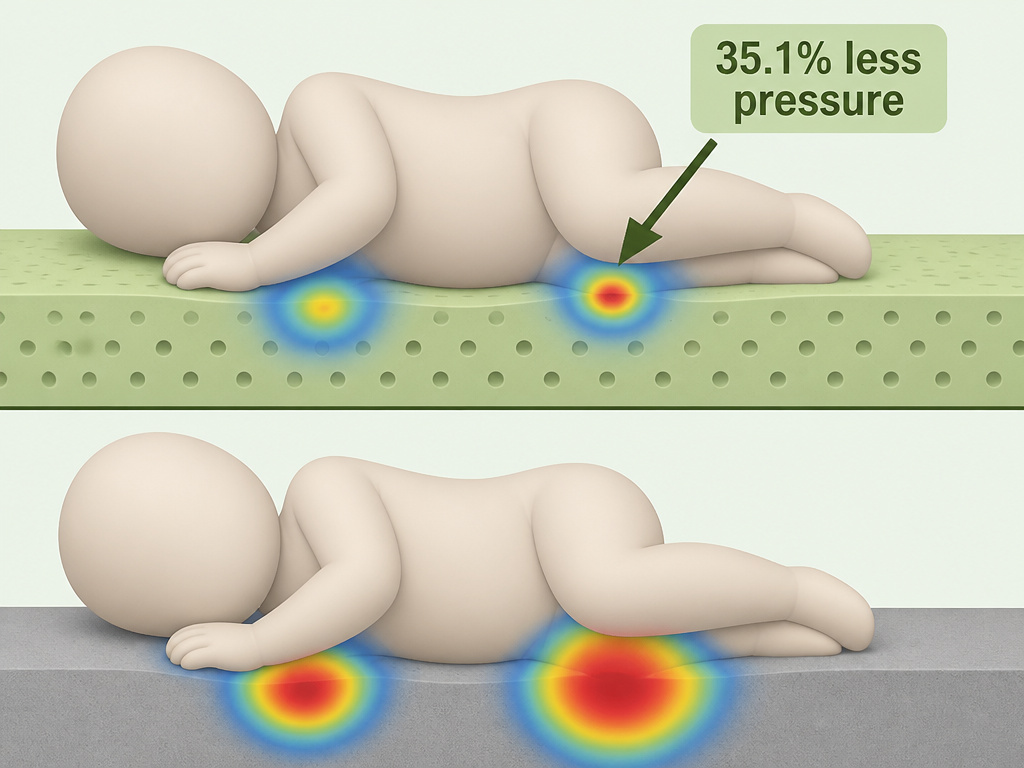 If we set allergy aside and look purely at physical performance, peer-reviewed data gives latex an edge. A study comparing a latex mattress to a high-density polyurethane foam model measured body pressure distribution across back, side, and front sleeping postures.
The latex mattress placed 90.9–96.1% of the body surface area in the lowest pressure range (0–0.6 psi). The foam mattress placed only 82.1–91.8% in that range. More importantly, latex reduced peak pressure on the torso and buttocks by up to 35.1%. For a side-sleeping infant, that means less pressure on the hip and shoulder.
| Sleeping Posture | Peak Pressure Reduction with Latex | Body Region |
|---|---|---|
| Back | 26.1% lower | Torso |
| Back | 28.4% lower | Buttocks |
| Side | 35.1% lower | Torso |
| Side | 28.2% lower | Buttocks |
| Front | 30.9% lower | Torso |
This sounds like a pure win for comfort and development. But there is a critical caveat: this study was on adult mattresses. The absolute firmness required for a safe infant mattress, where any indent is a suffocation risk, overrides these pressure benefits. A crib mattress must be firm enough that these pressure differentials are minimal. The comfort advantage of latex is largely irrelevant for infants; it becomes a real factor only when the child transitions to a toddler or big-kid bed that allows more cushioning.
The data is useful, however, for understanding material behavior. Latex is more resilient and breathable than memory foam. It contours without sinking, which helps with temperature regulation. This is why many parents consider it a good long-term investment, a mattress that can work from infancy into the toddler years. But you must verify that the firmness for the infant stage still meets the federal standard.
Certifications and Chemicals: Reading the Labels
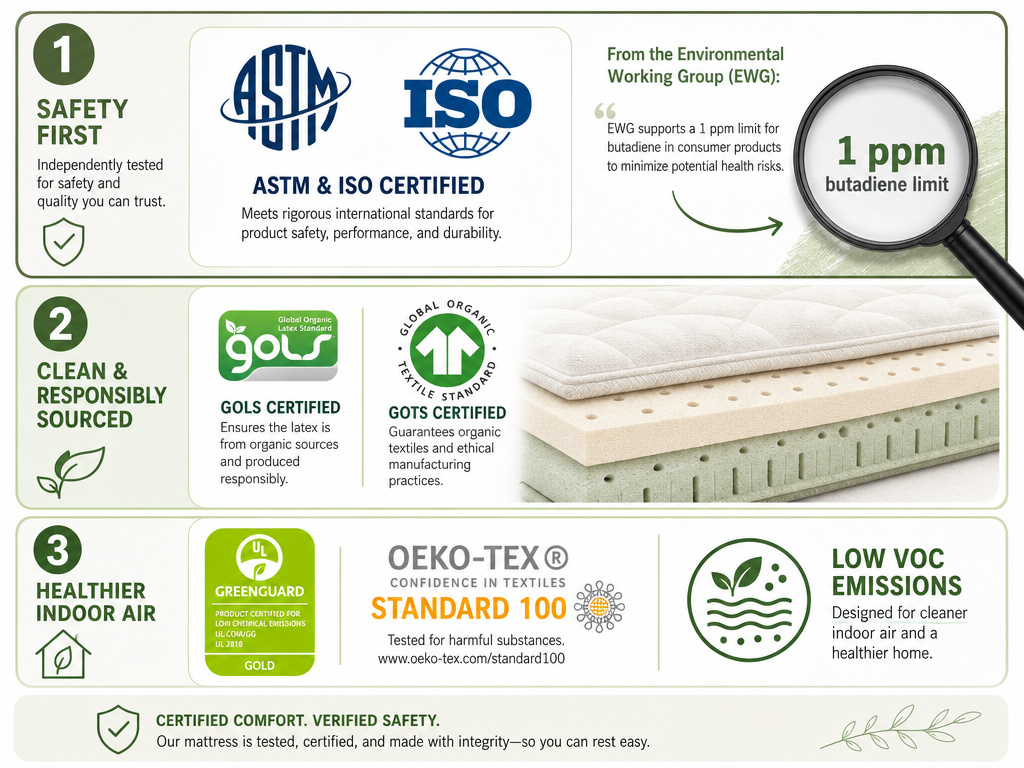 Navigating mattress marketing requires a decoder ring. “Natural” means nothing without a certification. Here is what to look for, in priority order.
- Safety Certification: Proof of compliance with ASTM F2933-25 or the ISO cot mattress specification (ISO 23767:2021). This is non-negotiable and should be from an independent lab.
- Organic Material Certification: Global Organic Textile Standard (GOTS) or Global Organic Latex Standard (GOLS). GOLS certifies the latex core; GOTS certifies the entire mattress (cover, core, and stitching). GOTS-approved latex limits synthetic additives to 5%.
- Emissions Certification: GreenGuard Gold or OEKO-TEX Standard 100. These test for VOC off-gassing. Latex, especially synthetic latex made from petrochemicals, can emit styrene and other VOCs. GreenGuard Gold is the stricter standard for sensitive individuals.
Latex is restricted to contain no more than 1 ppm of butadiene. Products containing latex or latex-coated fibers must contain no more than 1 ppm of butadiene.
That quote from the EWG criteria highlights a hidden chemical risk. Butadiene is a known carcinogen used in synthetic rubber production. The 1 ppm limit is a good benchmark for clean material. You will not see this on a product tag; you must rely on a brand’s transparency or their EWG Verified status.
Be deeply skeptical of “synthetic latex” or “latex blend.” This is often petrochemical-based foam with similar properties but higher emission risks. If a mattress is not explicitly GOLS-certified for the core, assume it contains synthetic blends.
The Recall That Proves Standards Matter
In August 2023, Restwell Mattress Co. Issued a recall for non-compliant mattresses. The recalled products were Room & Board brand “Natural Organic Latex” and “Spring Crib” mattresses. The cause: failure to comply with the federal safety standard for crib mattresses, specifically the firmness test.
No injuries were reported, but the hazard was real, a mattress that is too soft creates a suffocation risk. This recall is a perfect case study. The mattresses were marketed as natural and organic, sold through a reputable retailer. They still failed.
The lesson is powerful. A certification like “organic” speaks to material content, not to safety performance. You must have both. Always check the CPSC recall database for the brand and model you are considering. A past recall is a major red flag about a company’s quality control.
Practical Steps for Parents Considering Latex
If, after weighing the risks, you decide to explore a latex crib mattress, follow this checklist.
- Verify Compliance First. Before anything else, contact the manufacturer and request a copy of the third-party test report showing compliance with ASTM F2933-25. No report, no sale.
- Prioritize Dual Certification. Seek out a mattress that is both GOLS (for the latex) and GreenGuard Gold certified. This covers material purity and air quality.
- Check for a Waterproof Barrier. A high-quality, breathable organic crib mattress protector is essential. It creates a barrier between your baby and the latex core, potentially reducing allergen exposure and protecting the investment from spills.
- Monitor for Early Signs. Once the mattress is in use, watch for any unexplained rash, redness, or congestion that appears after sleep and improves during the day. Document it and consult your pediatrician.
- Have a Backup Plan. Know the return policy. If you suspect an allergy, you need to be able to remove the mattress immediately. A 30-day trial period is not enough; allergies can develop over weeks or months.
For most families, the simplest path is to choose a proven, non-allergenic best breathable crib mattress that meets all standards without the latex variable. Brands like Newton and Naturepedic have built their reputations on this premise.
Frequently Asked Questions
Can a latex mattress be too soft for a baby?
Yes, and this is the primary safety hazard. The federal firmness standard exists to prevent this. Any mattress, latex or otherwise, that does not pass the ASTM F2933-25 firmness test is unsafe for infant sleep, regardless of its other certifications.
How do I know if my baby is allergic to latex?
Look for contact dermatitis, red, itchy skin where their body touches the mattress. Other signs can include runny nose, sneezing, or eye irritation during or after sleep. A severe allergy may cause hives or difficulty breathing. Any suspicion warrants a call to your pediatrician and immediate removal of the latex source.
Is organic latex safer than regular latex?
Certified organic latex (GOLS) is safer from a chemical exposure standpoint. It severely restricts synthetic additives, pesticides, and harmful solvents like butadiene. However, it contains the same natural latex proteins that cause allergies, so it does not mitigate that risk.
What are the best alternatives to a latex crib mattress?
Look for mattresses with cores made from food-grade polyethylene (like the Newton Baby), innerspring coils with organic cotton padding, or certified polyurethane foam that meets GreenGuard Gold emissions standards. The key is pairing a safe, firm support layer with a breathable crib mattress cover for optimal airflow.
Do I need a special sheet for a latex crib mattress?
You need a fitted sheet that meets the standard used in compliance testing: 100% cotton, washed and dried at least twice before first use. This ensures a snug fit that doesn’t artificially tighten the mattress and alter the safety gap. Any quality crib mattress pad or protector should also be tested with this type of sheet.
Before You Go
A latex mattress is not a simple yes-or-no decision. It is a material with documented pressure benefits, strict chemical certification paths, and a fixed, known allergy risk. The federal safety standards for firmness and fit apply equally to all materials, as the 2023 recall bluntly demonstrated.
For parents with no family history of allergies who prioritize natural materials and can verify dual GOLS/GreenGuard Gold certification, a latex mattress is a defensible choice. For everyone else, especially those seeking the simplest, lowest-risk path, a high-quality, non-allergenic organic crib mattress made from alternative materials is the more prudent default. Your child’s sleep surface should solve problems, not introduce new ones.
