
Infant Sleep Sack Safety: Understanding the Crucial CPSC Rule
This post contains affiliate links. As an Amazon Associate we earn from qualifying purchases.
Sleep sacks for infants are safe when they meet the federal safety standard for infant sleep products (16 CFR 1236) and fit your baby correctly. The mandatory CPSC rule, effective June 2021, requires any product marketed for infant sleep to have a sleep surface angle under 10 degrees and prohibits designs that can incline a baby. A proper fit means the arm and neck openings are snug enough that the baby cannot slip down inside the sack.
That 10-degree limit is the line between a safe sleep surface and a suffocation hazard. Most parents check for recalls and loose threads. Almost nobody checks the product’s compliance with 16 CFR 1236, because the label doesn’t scream it. You have to know the rule exists to look for it.
What follows: the three physical checks that matter more than brand marketing, the data on how sleep sacks actually delay risky rolling, and the one combination with bedding that reverses all the safety benefits.
Key Takeaways
- The U.S. Consumer Product Safety Commission (CPSC) mandated a 10-degree maximum sleep surface angle for all infant sleep products in June 2021. A sleep sack that inclines a baby past this limit violates federal law.
- Fit overrules everything. An opening too large lets a baby slip down into the sack. The neck hole should be snug, and the armholes should not gap.
- Never pair a sleep sack with a duvet or comforter. An ISPID report notes this combination increases SIDS risk, especially with a padded sack.
- Sleep sacks delay a baby’s first prone roll by about 6 weeks on average, according to unpublished data cited by the ISPID. This shrinks the dangerous window where a baby can roll onto their stomach but can’t roll back.
- Switching from a swaddle to a sleeveless sleep sack is non-negotiable at the first sign of rolling attempts, usually around 8 weeks. A swaddled baby who rolls face-down has pinned arms and cannot rescue themselves.
The 3 Non-Negotiable Safety Checks for Any Sleep Sack
You can ignore most marketing claims about “breathability” or “pediatrician-approved.” Three concrete specs determine real safety. If a product misses one, it doesn’t belong in a crib.
First, verify it’s regulated as a sleep product. The CPSC’s 2021 rule defines any item “marketed or intended for sleep” for infants under five months as an infant sleep product. This pulls it under the mandatory safety standard 16 CFR 1236. That standard incorporates ASTM F3118, which sets the hard engineering rules.
A sleep sack marketed for overnight sleep must comply with 16 CFR 1236. This means its sleep surface cannot exceed a 10-degree angle, it must have a stable base, and it cannot have a restraining system that keeps the infant inclined. The Federal Register safety standard notice published this rule on June 23, 2021.
Second, confirm the sleep surface angle. This is the most overlooked check. The rule states the “seat back or sleep surface angle” must not exceed 10 degrees. Some multi-use loungers or inclined sleepers were recalled because they held babies at a 30-degree angle, a known suffocation risk. A flat, rigid back panel inside a wearable blanket is rare, but you must ensure the product doesn’t create an incline when the baby is on a mattress.
Third, assess the fit. The ISPID sleeping sack factsheet is blunt: “the opening for the arms and head should not be too large to ensure that the baby cannot slip out of the sack.” Slip out is a typo—they mean slip down. If the neck hole is too big, a baby can wiggle down into the sack, and the fabric can cover their face. The armholes should be snug, not gaping.
| Check | What to Look For | Risk If Missed |
|---|---|---|
| Regulatory Compliance | Label or website mention of “meets ASTM F3118” or “CPSC 16 CFR 1236”. | Product may have an unsafe incline or design not tested for sleep. |
| Sleep Surface Angle | A completely flat back panel. No built-in incline or padding that tilts the head up. | Suffocation risk increases dramatically above a 10-degree angle. |
| Fit (Neck & Arms) | Snug neck hole that doesn’t gap. Armholes that are close-fitting. | Baby can slip down into sack, leading to potential entrapment or rebreathing. |
These aren’t suggestions. The TJX recall in May 2021 involved infant sleep bags sold under brands like Dylan & Abby and Shabby Chic because they posed a suffocation risk—a direct violation of these principles. The CPSC infant sleep product guidance exists so manufacturers know the rules. Your job is to buy from those who follow them.
How Sleep Sacks Actually Reduce Risk (The Data)
Most advice says sleep sacks are safer than loose blankets. That’s true, but it’s surface-level. The deeper mechanics are in the data on infant movement and positioning.
The ISPID Epidemiology Working Group report pulls from Dutch studies where sleep sack use is widespread. One finding is pivotal: babies in sleep sacks change position less often and turn onto their stomachs (prone) significantly later. The unpublished data they cite shows a 6-week delay: babies without a sack first turned prone at 21.7 weeks on average; those with a sack turned at 28.0 weeks.
Where this goes sideways: Combining a sleep sack with a duvet. The ISPID report states this combination increases SIDS risk, especially if the sack is padded. In countries where duvets are common, this cancels the protective effect.
Why does this delay matter? The highest risk period is when a baby can roll onto their stomach during sleep but lacks the strength and coordination to roll back. That’s “inexperienced prone sleeping.” A sleep sack that hinders rolling shortens that dangerous gap. The fabric resistance gives the baby’s motor skills time to catch up. By the time they can roll in the sack, they’re more likely to be able to roll back or lift their head.
The second mechanism is simpler: it enforces back-sleeping. A sack with a front zipper makes it physically awkward to place a baby on their stomach. Parents are more likely to put the baby down on their back, which is the single most effective SIDS reduction step. The sack also replaces loose bedding, eliminating the risk of covers shifting over the face.
This is why the AAP safe sleep policy statement advises against any loose blankets in the crib. A wearable blanket is the engineered solution. It provides warmth without the entanglement hazard of traditional baby blankets.
Sleep Sack vs. Swaddle vs. Blanket: When to Switch
This is the transition parents get wrong, usually by holding onto a swaddle for too long. Each option has a strict expiration date tied to your baby’s development.
Swaddles (Swaddle Blankets) are for newborns who still have the Moro reflex. The tight wrap mimics the womb and can soothe. The AAP policy document is clear: stop swaddling at the first sign of rolling attempts. That’s around 8 weeks, not 4 months. A swaddled baby who rolls face-down is trapped. Their arms are pinned, making it nearly impossible to push up or roll back. This is a critical safe swaddling rule.
Sleep Sacks are the next stage. A sleeveless design is mandatory. Free arms are the baby’s self-rescue tool. If they roll, they can use their arms to push up, turn their head, or shimmy back. This is the core safety upgrade over a swaddle. You can use a sleep sack from birth if it’s sized correctly for a newborn, but it becomes essential after ditching the swaddle.
Loose Blankets are not safe for unsupervised sleep until at least 12 months. The risk of suffocation and entanglement is too high. If you want to use a beautiful organic baby blanket, save it for tummy time or the stroller.
Common mistake: Using a weighted sleep sack. There is no safety standard for added weight on an infant’s chest or torso. The AAP warns against them because they may impair breathing and make it harder for a baby to arouse from sleep, which is a protective mechanism against SIDS.
The switch isn’t optional. It’s a binary safety protocol. When your baby shows any rolling effort—rocking to the side, getting a shoulder up—the swaddle is done. Move to a sleeveless sleep sack that night. Brands like Halo and Burt’s Bees make transitional wearable blankets for newborns that work for this phase.
The Recall List: What Fails in the Real World
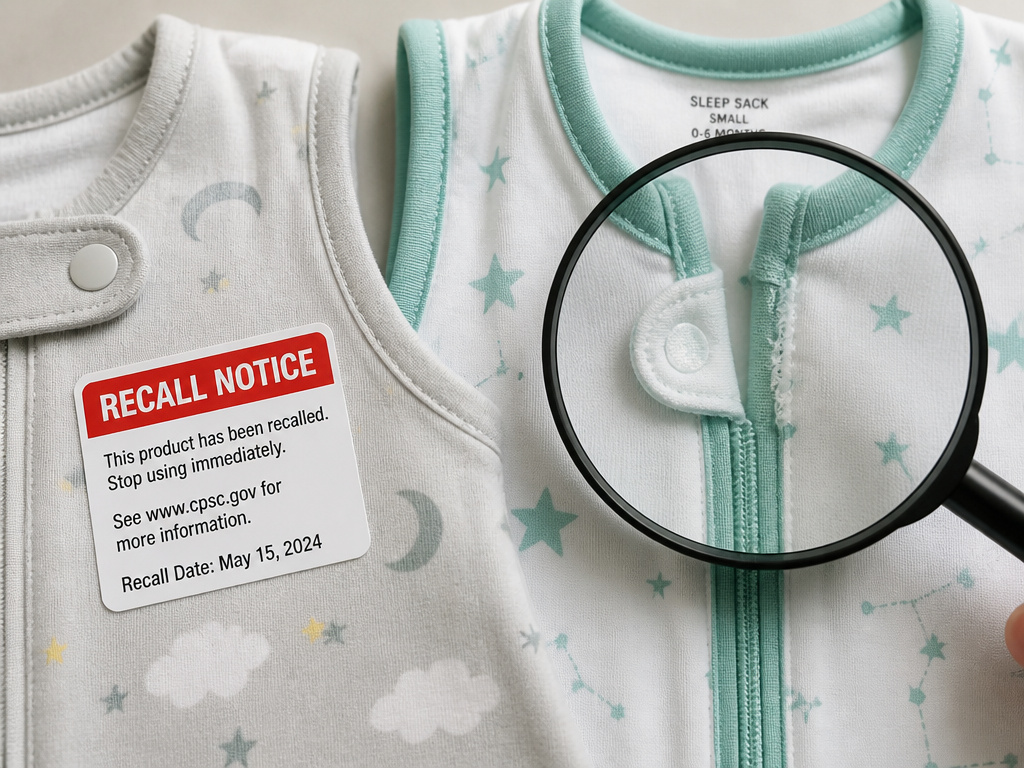
Regulations are written in blood, as they say. The recalls show exactly how products fail the three checks.
The Zigjoy Sleep Sacks with Feet were recalled in 2025 for violating the children’s sleepwear flammability standard. They posed a burn hazard. This is a failure of material safety, separate from but as critical as design. The fabric itself was dangerous.
The TJX Infant Sleep Bags recall in 2021 was for suffocation risk. The products were sold at T.J. Maxx and Marshalls under numerous brand names. The CPSC recall notice didn’t specify the exact flaw, but suffocation risk in a sleep bag typically means the design allowed the baby to slip into a position where airflow was blocked, or the material could cover the nose and mouth.
These recalls share a theme: they were products that fell outside the strict manufacturing controls of major juvenile product brands. They were likely imported without rigorous testing for U.S. Safety standard compliance. The lesson is to buy from reputable companies that specialize in juvenile products and openly state compliance with CFR infant sleep product standard 1236.
| Recall | Brand/Retailer | Hazard | Root Cause |
|---|---|---|---|
| Zigjoy (2025) | Zigjoy-US | Burn | Fabric violated mandatory flammability standard for children’s sleepwear. |
| TJX (2021) | Multiple brands (Dylan & Abby, Shabby Chic, etc.) | Suffocation | Sleep bag design posed an entrapment/suffocation risk. |
Your best defense is to check the CPSC recall database before buying any infant blanket or sleep product. But better yet, choose brands whose entire business is built on adhering to the regulator compliance guidance document.
Choosing a Safe Sleep Sack: A Step-by-Step Filter
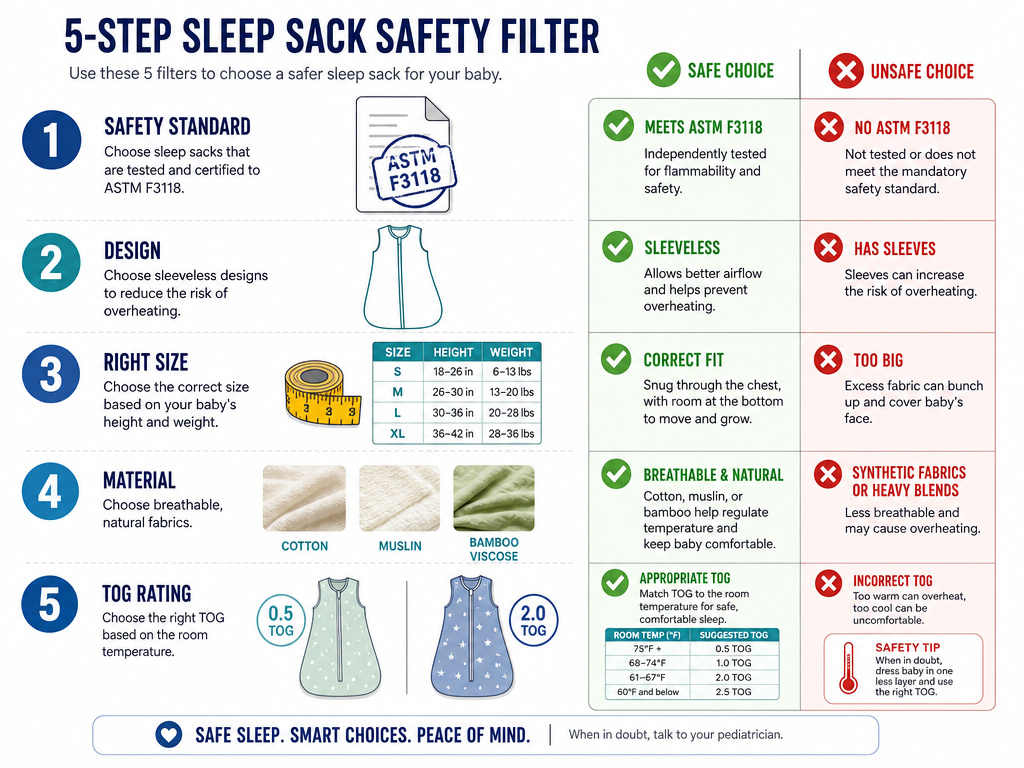
Forget cute prints. Use this filter to narrow the field.
- Filter for Compliance. Go to the product description or label. Look for “Meets ASTM F3118” or “Complies with 16 CFR 1236.” If it’s not there, move on. This is the non-negotiable first gate.
- Filter for Design. Select only sleeveless sacks. Avoid any with weighted inserts, loose interior fabric, or a shape that could bunch up around the face. A front zipper is best for easy dressing and diaper changes.
- Filter for Fit. Match the size to your baby’s current height and weight, not their age. The sack should be roomy enough for the hips and legs to move freely (good for hip development) but snug at the neck and armholes. You shouldn’t be able to fit more than two fingers between the neckline and your baby’s collarbone.
- Filter for Fabric. Choose breathable materials like cotton, muslin, or bamboo. Avoid polyester fleece for overnight sleep unless the room is very cold, as it can cause overheating. For sensitive skin, an organic blanket material like GOTS-certified cotton is a wise choice.
- Filter for Season. Have at least two sacks: a lightweight one (0.5-1.0 TOG) for warm rooms and a medium-weight one (1.5-2.5 TOG) for cooler temperatures. The TOG rating should be on the label.
After these filters, you can consider features like inverted zippers, shoulder snaps, or two-way zippers for convenience. The Halo SleepSack Wearable Blanket and the Burt’s Bees Baby Beekeeper Wearable Blanket are two examples that consistently meet these core safety criteria. They are plain, functional, and built to standard.
Frequently Asked Questions
Are sleep sacks safe for newborns?
Yes, sleep sacks are safe for newborns if they are the correct size. The sack must be designed for a newborn’s proportions so the neck hole is high and snug on the shoulders, preventing the baby from slipping down into the sack. Many parents start with a swaddle and transition to a sleep sack, but you can use a newborn sleep sack from day one if it fits properly.
Can a baby roll over in a sleep sack?
Yes, a baby can and will eventually roll over in a sleep sack. The sack may delay the first roll by several weeks, but it does not prevent rolling once the baby is strong enough. This is why sleeveless designs are critical—the baby needs their arms free to push up and reposition their head if they roll onto their stomach during sleep.
How long can a baby use a sleep sack?
Baby can use a sleep sack until they outgrow the largest size, typically around 2-3 years old or when they learn to climb out of the crib. There’s no safety-based age limit. It remains safer than a loose blanket until the child is consistently able to handle a blanket safely, which is usually well into toddlerhood. It’s a key part of a safe sleep environment.
Do sleep sacks prevent SIDS?
Sleep sacks are not marketed or proven to prevent SIDS. However, they are part of a safe sleep environment that reduces SIDS risk. By promoting back-sleeping, eliminating loose bedding, and potentially delaying inexperienced prone sleeping, they address several known risk factors. The epidemiology working group report associates their use with a risk reduction, but does not claim causation.
What is the difference between a sleep sack and a wearable blanket?
There is no functional difference. “Sleep sack” and “wearable blanket” are synonymous terms for the same product. Some brands use “wearable blanket” to emphasize that it replaces a traditional blanket. Both must meet the same federal sleep product regulations if marketed for infant sleep.
Before You Go
Safety boils down to a compliant product and a proper fit. Verify the 16 CFR 1236 standard, ensure the neck and arm openings are snug, and never add a duvet on top. The data shows these sacks work by delaying risky rolls and enforcing back-sleeping—simple, mechanical advantages over loose bedding.
Switch from a swaddle to a sleeveless sack the moment your baby shows any sign of rolling. That transition is a hard stop, not a gentle suggestion. For everyday use, stick with simple, well-established brands that specialize in baby bedding and clearly state their compliance. The peace of mind is worth skipping the cute, unregulated impulse buy.
