
Can Newborns Sleep in a Pack N Play | The CPSC & AAP Rules
This post contains affiliate links. As an Amazon Associate we earn from qualifying purchases.
Newborns can sleep in a Pack N Play, it’s a CPSC-approved sleep surface, but only under three strict conditions: using the original, thin mattress pad provided by the manufacturer, following the bassinet attachment weight limit (usually 15 lbs), and ensuring the product is fully assembled with no gaps. Adding any other mattress creates a deadly suffocation hazard documented in multiple federal recalls.
The gap between those rules and what parents actually do is where infants get hurt. The playard’s mesh sides are flexible, not rigid like a crib. A mattress that’s even half an inch too thick lets a baby’s head wedge between the pad and the side, cutting off air in under a minute. That’s not speculation; it’s the violation cited in every Consumer Product Safety Commission recall for these products.
What follows is the breakdown most parenting sites skip: the exact mattress dimensions from the Graco manual, the bassinet weight limit you won’t find on the box, and the two specific aftermarket brands the government has already pulled from sale for suffocation and entrapment risks. By the end, you’ll know how to set it up, when to stop using the bassinet, and what to do if you already bought an extra mattress.
Key Takeaways
- The original manufacturer mattress pad is the only safe surface. Graco’s pad is less than one inch thick and measures 27″ x 39″. Any other mattress violates federal safety standards.
- Use the newborn bassinet attachment only until your baby reaches the 15-pound limit or can push up on hands and knees, whichever comes first. The main playard floor is for supervised play until 35 inches tall or 30 lbs.
- Multiple aftermarket Pack N Play mattresses have been recalled by the CPSC for suffocation hazards, including brands like Modera and DODO Baby House. They are often sold as “fits standard playards.”
- Always place a sleeping newborn on their back on a firm, flat surface with no pillows, blankets, or padded bumpers. This is non-negotiable AAP guidance.
- Inspect the playard before every use for loose joints, torn mesh, or damaged latches. A collapsed side with a baby inside is an entrapment emergency.
The Official Safety Rules (And What They Actually Say)
The question is whether your use of a Pack N Play matches the rules written by its builders and the agencies that regulate it. Those rules are not suggestions.
Pack ’N Play mattress is specially designed to prevent suffocation. The Pack ’N Play mattress has a solid base, a certain length and width, and is less than one inch thick in order to meet safety standards. Using a thicker or a different sized mattress may allow a child’s head to get between mattress and the side of the Pack ’N Play causing suffocation. . Graco Pack ‘N Play Instruction Manual
That warning is in the manual for a reason. The playard’s mesh sides give under pressure. A rigid crib side forms a tight seal with its mattress; a flexible mesh side does not. The one-inch thickness and specific 27-by-39-inch dimensions of the Graco pad are calculated to leave no gap a baby’s head can enter. Go thicker, and you create a ramp.
The American Academy of Pediatrics is clear: a firm, flat sleep surface is mandatory. Their 2022 AAP policy evidence base states that only mattresses designed for the specific product should be used. This is a geometry problem. When hospitals like Johns Hopkins publish their infant sleep safety recommendations, they cite the CPSC standard for a reason.
| Rule Source | Key Specification | Consequence of Violation |
|---|---|---|
| Graco Manufacturer | Mattress pad must be <1″ thick, 27″ x 39″. Use only provided pad. | Suffocation hazard from head entrapment between mattress and flexible mesh side. |
| AAP Policy | Firm, flat surface with no soft bedding or added padding. | Increased risk of Sudden Infant Death Syndrome (SIDS) and suffocation. |
| CPSC Standard (16 CFR 1221) | Playard mattresses must meet federal thickness, firmness, and fit requirements. | Product recall (as seen with Modera, DODO Baby House). Illegal to sell non-compliant mattresses. |
The bassinet attachment has its own rulebook. It’s for newborns up to approximately 15 pounds or until the baby can push up on hands and knees. That’s usually around 3-4 months. The main playard floor is rated for up to 30 pounds or 35 inches tall. Mixing those up, using the bassinet for a rolling 5-month-old, defeats the product’s engineered safety.
The Mattress is the Whole Game
Forget comfort. In a playard, safety is a function of mattress thickness and firmness. The moment you add a plush, 3-inch foam topper from Amazon, you’ve built a trap.
The CPSC doesn’t issue recalls for theoretical risks. The Modera Pack N Play mattress recall and the DODO Baby House recall alert both cite the same violation: the mattresses failed the mandatory federal thickness test. They were 1.5 inches thick and measured 38″ long by 26″ wide. That’s a full half-inch thicker and a different size than the Graco pad. In a flexible-sided playard, that discrepancy is a fatal flaw.
Where this goes sideways: Buying a “fits all playards” mattress online. The recalled models were sold exactly that way. If the listing doesn’t name your specific Graco model number, it’s not approved. The gap might not be visible until a baby’s head presses the mesh inward.
So what should you use? The answer is boring. Use the thin, board-like pad that came in the box. If it’s lost or stained, order a replacement directly from Graco, not a third-party seller. The correct pack n play mattress is an OEM part, not an accessory. The same principle applies when choosing a crib mattress for a newborn, firmness and exact fit are non-negotiable.
If you need a more comfortable sleep solution for travel, look at dedicated portable infant beds that are themselves certified to CPSC bassinet standards, rather than trying to modify a playard.
Step-by-Step Setup for Safe Newborn Sleep
A safe sleep space is assembled, not assumed. Follow this sequence every single time.
Before You Start: Ensure the playard is on a flat, stable floor away from windows, blinds cords, heaters, and dangling cords. Have the official instruction manual in hand. If any part is missing or broken, do not use the product.
-
Latch All Four Top Rails. Push down on each corner until you hear and feel a distinct click. Visually check that the locking mechanism is fully engaged. An unlatched rail can collapse under weight.
- Skip this, and the side could fold inward with the baby against it, causing entrapment.
-
Press the Center Floor Down. Apply firm pressure to the middle of the floor until it is flat and taut. A bowed or loose floor creates an uneven sleep surface.
- A sagging floor can cause the baby to roll into a trapped position against the side.
-
Secure the OEM Mattress Pad. Place the original Graco pad flat on the floor. Fasten the Velcro straps securely to the bottom of the playard frame. Run your hand across the surface, it should be perfectly flat with no wrinkles or gaps at the edges.
- An unstrapped pad can shift, creating a gap at the perimeter where the mesh meets the floor.
-
Install the Bassinet Attachment (If Using). Snap the bassinet frame securely onto the top rails. It should lock firmly with no wobble. Place the bassinet mattress pad (it’s even thinner than the main pad) and secure its straps. The bassinet must be level.
- An angled sleep surface increases the risk of positional asphyxia. The AAP explicitly warns against inclined sleep for infants.
-
Perform the Gap Test. With the mattress secured, push it firmly against one mesh side. The gap should not exceed two finger-widths (about 1.5 inches). If it does, the mattress is not the correct one.
- This is the test Health Canada mandates. A gap wider than 3 cm (1 3/16 in) is a fail.
-
Clear the Sleep Area. Place the baby on their back in a sleep sack. No pillows, blankets, stuffed animals, or waterproof pads that aren’t fitted tightly to the mattress.
- Soft bedding is a proven suffocation hazard. The sleep surface must be bare.
-
Verify the Side is Raised and Locked. Never, ever leave a baby in the playard with a side lowered, even for a moment. The mesh can pool and create a pocket for suffocation.
- This is the most commonly ignored warning in the manual. It takes one roll.
Bassinet vs. Main Level: When to Switch
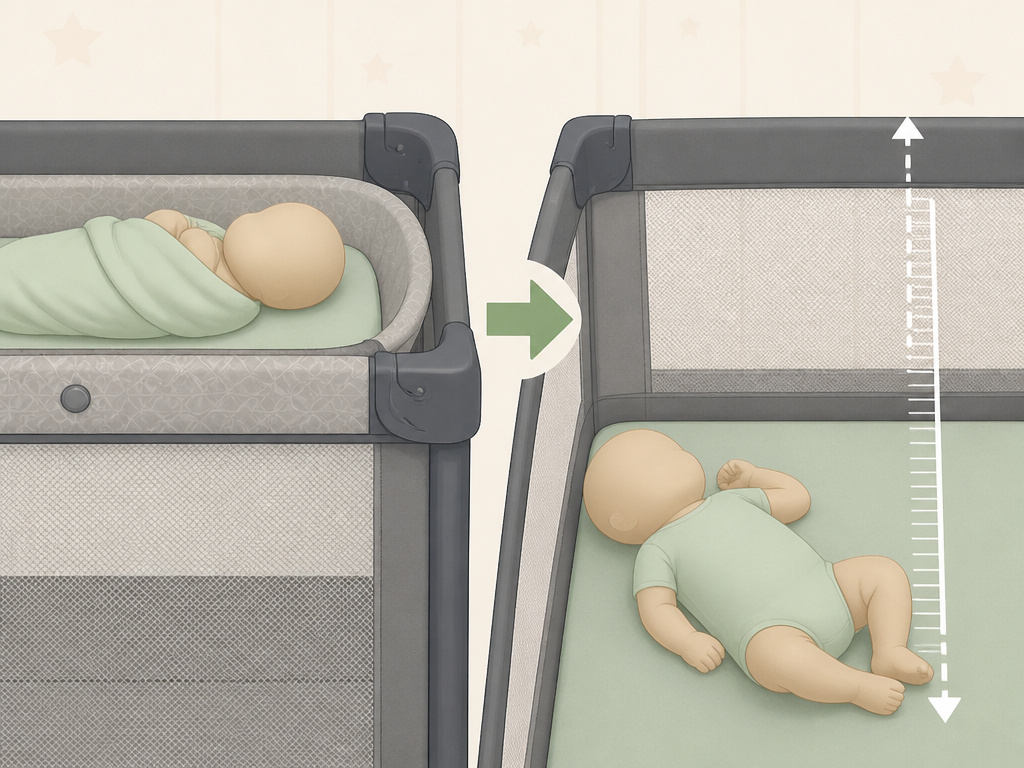
The bassinet attachment is a short-term solution with a strict expiration date.
The upper bassinet is convenient, but its weight limit is low, typically 15 pounds. Most newborns hit that between 3 and 4 months. The other limit is developmental: the moment your baby can push up on hands and knees, the bassinet is no longer safe. Their movement could tip the lightweight frame.
The main playard floor is rated for longer use: up to 30 pounds or 35 inches tall. That’s roughly the 95th percentile for a 21-month-old. This is the zone for supervised play and sleep once the baby outgrows the bassinet. The mattress is the same, the rules are the same, but the baby is contained within the taller, stable walls of the fully assembled playard.
| Sleep Zone | Weight Limit | Height/Developmental Limit | Primary Use Case |
|---|---|---|---|
| Bassinet Attachment | 15 lbs | Can push up on hands/knees | Newborn sleep (0-4 mos) for easy access. |
| Main Playard Floor | 30 lbs | 35 inches tall or able to climb out | Infant & toddler sleep/play (post-bassinet). |
When your baby graduates from the bassinet, you have options. You can continue using the main playard floor, or transition to a crib. For families needing a portable option for an older infant, a certified portable bed for a toddler might be the next logical step.
Common Mistakes and Recall Realities
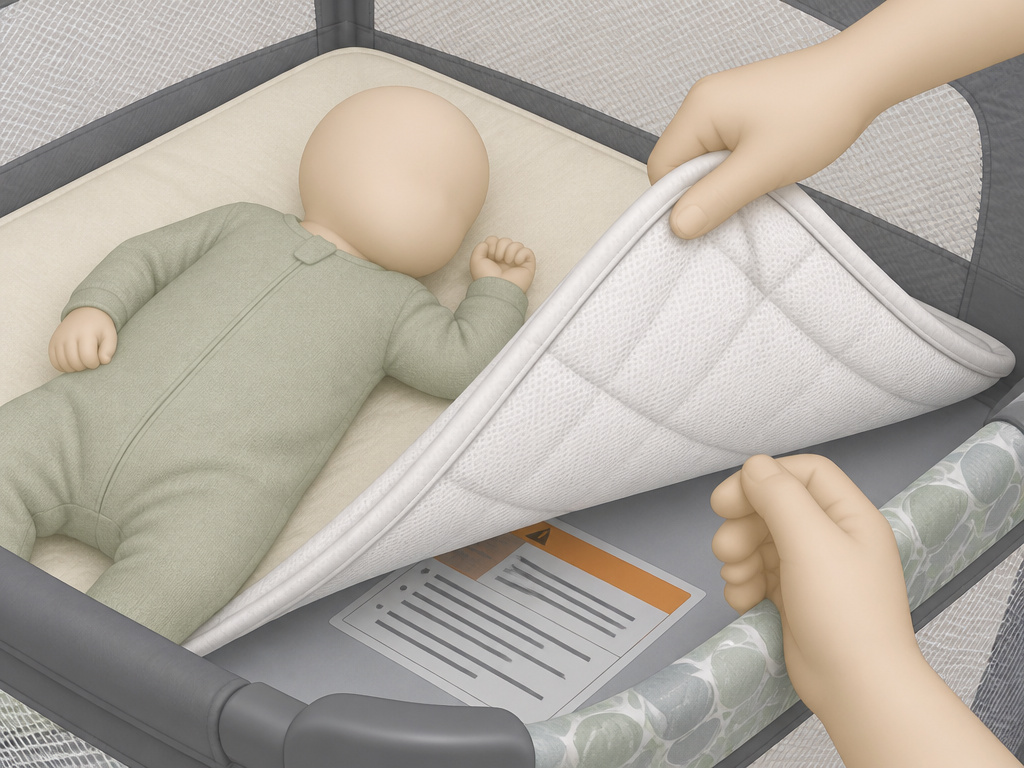
The gap between knowing the rules and following them is filled with well-intentioned mistakes. These are the ones that show up in incident reports.
Adding a Mattress Topper for Comfort. This is the number one error. The playard pad is firm for a life-saving reason. A soft topper conforms to a baby’s face, blocking the airway. It also increases the effective thickness, creating the entrapment gap. There is no safe topper.
Using the Playard on an Unstable Surface. Placing the playard on a bed, sofa, or table to bring it closer is a tipping hazard. A sibling can pull it over. The baby’s movement can shift it off the edge. The product’s stand is designed for floor use only.
Ignoring Recall Notices. The CPSC doesn’t recall products for minor issues. The federal crib mattress violation for aftermarket mattresses is a direct suffocation warning. If you own a Modera or DODO Baby House mattress, stop using it immediately. The government’s mandatory safety standard PDF exists because these products failed.
Treating it Like a Crib. A playard is portable and has flexible sides. It is not a substitute for a long-term, rigid-sided crib in the nursery. For primary sleep, a dedicated safe bedside bassinet options or a full-size crib with a proper newborn crib mattress is the safer, more durable choice.
Frequently Asked Questions
Can a newborn sleep in a Pack N Play overnight?
Yes, a newborn can sleep in a Pack N Play overnight, provided it is set up correctly with the original mattress pad, the bassinet attachment is used within its weight limit, and the baby is placed on their back with no loose bedding. It is a CPSC-approved sleep surface for full-night sleep.
What is the weight limit for a Pack N Play bassinet?
The weight limit for the newborn bassinet attachment on a Graco Pack N Play is 15 pounds. You must also stop using it if your baby can push up on their hands and knees, even if they haven’t reached the weight limit. Always check your specific model’s manual.
Why can’t you add a mattress to a Pack N Play?
You cannot add a mattress to a Pack N Play because the flexible mesh sides require a specific, thin (less than 1 inch), firm pad to prevent gaps. A thicker mattress creates a space where a baby’s head can become entrapped, leading to suffocation. This violation is the cause of multiple CPSC recalls.
Is it safe for a baby to sleep in a playard every night?
It is safe for a baby to sleep in a properly assembled playard every night as a primary sleep space, following all manufacturer and AAP guidelines. However, for long-term use beyond infancy, a traditional crib with a certified safe crib mattress for infants may offer more durability and stability.
How do I know if my Pack N Play mattress is safe?
Your Pack N Play mattress is safe if it is the original pad provided by Graco, measures 27 inches by 39 inches, is less than one inch thick, and secures tightly to the floor with straps. If you purchased an aftermarket mattress, check the CPSC recall list for Modera and DODO Baby House models.
Before You Go
A Pack N Play is a versatile tool, but its safety is binary. It’s either set up exactly to the manufacturer’s and regulator’s specifications, or it’s not safe. The margin for error is zero inches.
Stick with the pad that came in the box. Respect the bassinet’s 15-pound limit. Place the baby on their back, on a bare, firm surface. Those three actions address the vast majority of documented hazards. For peace of mind, register your product with Graco to get direct recall notices, and bookmark the CPSC recall page. Your vigilance is the final, most important safety feature.
