
Survival Guide: How to Survive Lack of Sleep With a Newborn
This post contains affiliate links. As an Amazon Associate we earn from qualifying purchases.
Surviving newborn sleep deprivation requires a two-part plan: protect the baby’s safety above all, and systematically trade off sleep between caregivers. The American Academy of Pediatrics states room-sharing on a separate, flat surface cuts SIDS risk by up to 50%, but bed-sharing raises it. You split the night into shifts, use pumped milk or formula for feeds, and nap when the baby naps, even if the house is a mess.
That 50% reduction hinges on a specific setup: a crib, bassinet, or play yard that meets Consumer Product Safety Commission (CPSC) standards, placed right next to your bed. The gap between that safe space and an adult mattress is where exhaustion tries to bridge it with a dangerous shortcut.
What follows is not just a pep talk. It’s a tactical breakdown of the sleep-split schedule that works, the unsafe products to avoid when you’re desperate, and the one non-negotiable safety rule that overrides every tip about parental rest.
Key Takeaways
- Split nighttime care into defined shifts (e.g., 8 PM–2 AM and 2 AM–8 AM) so each adult gets one uninterrupted 5–6 hour block. Use expressed milk or formula to make this possible.
- Room-share, never bed-share. Place a CPSC-certified crib or bassinet within arm’s reach of your bed. This setup is linked to a 50% reduction in SIDS risk by the AAP.
- Nap strategically, not ideally. A 20-minute power nap while the baby sleeps in a safe space is more valuable than a 2-hour nap you spend stressing about chores.
- Identify and ban unsafe sleep products. Any inclined sleeper, in-bed nest, or padded crib bumper violates the June 2021 CPSC rule. Desperation is the marketing target for these items.
- Ask for specific help. Tell visitors, “Hold the baby for 45 minutes while I nap” or “Could you prep dinner?” Vague offers yield no sleep.
The Reality of Newborn Sleep (By the Numbers)
You are not imagining the severity. A Lullaby Trust survey of parents with babies under one year old found that 59% reported their baby sleeps for less than four hours at a stretch. Almost half of those parents believed their baby should be sleeping longer. The kicker: 98% of surveyed parents experienced sleep deprivation.
Newborns need feeding every 2–3 hours because their stomachs are the size of a cherry. Their circadian rhythm, the internal clock that regulates sleep, doesn’t start developing until around 3–4 months. Expecting longer stretches before that is like expecting a solar panel to charge at midnight.
This biological reality creates a predictable crisis. An adult needs about 7 hours of quality sleep to function. A newborn needs 14–17 hours of total sleep, fragmented into those short bursts. The math never works in your favor. The goal isn’t to “solve” newborn sleep. It’s to manage the deficit without compromising safety, which is where most well-meaning advice fails.
Strategy 1: Split the Night in Half (The Only Sustainable Fix)
Trying to both wake up for every night feeding is a fast track to mutual exhaustion and dangerous mistakes. The solution is not taking turns; it’s taking shifts.
The 6-Hour Shift Schedule
This works if you have a partner, a supportive family member, or a hired night doula. One person is “on duty” for a defined block while the other sleeps in a separate, quiet room with earplugs and a white noise machine.
| Shift Schedule | Primary Caregiver Duty | Off-Duty Parent |
|---|---|---|
| 8:00 PM – 2:00 AM | Handles all feeds, diapers, and soothing. Sleeps when baby sleeps in the safe sleep space. | Uninterrupted sleep in another room. |
| 2:00 AM – 8:00 AM | Uninterrupted sleep in another room. | Takes over all care. May bring baby to breastfeeding parent for a feed, then handles burping, diapering, and settling. |
Where this goes sideways: Skipping the “sleep in another room” part. If the off-duty parent stays in the same room, they will still wake to every sound, defeating the entire purpose. Earplugs and a closed door are mandatory.
The shift system requires that the baby can be fed by someone other than a breastfeeding parent. This means introducing a bottle of expressed breast milk or formula for one or two feeds per 24 hours. The clinical Perinatal Sleep Care Guide PDF from the University of Washington explicitly recommends this: “ensure adequate time for sleep – split infant night care between caregivers (use formula/pump so others can assist with feeding).”
Resistance to bottles is common, but framing it as a critical safety intervention changes the calculus. A parent who has had five consecutive hours of sleep is dramatically less likely to fall asleep accidentally in a rocking chair or on a sofa, two of the most dangerous places for an infant.
Strategy 2: Engineer a Safe Sleep Space (Your #1 Job)
When you are sleep-deprived, your environment makes your decisions for you. If the safe sleep space is inconvenient, you will rationalize an unsafe one. The setup must be foolproof.
The ABCs of Safer Sleep are non-negotiable, as outlined in the American Academy of Pediatrics recommendations: Always place your baby Alone (no toys, blankets, pillows), on their Back, in a Crib (or bassinet/play yard) that is clean, firm, and flat.
A sleep surface that inclines more than 10 degrees is not safe for infant sleep. This single rule eliminates entire categories of products marketed to exhausted parents.
Your safe sleep space is not just a crib in the nursery. For the first six months, the AAP recommends room-sharing. The ideal setup is a bedside bassinet or bedside sleeper that attaches securely to the side of your adult bed, creating a separate, CPSC-compliant surface. This lets you tend to the baby with minimal movement, reducing the temptation to bring them into your bed.
| Safe Product | Key Feature | Risk If Compromised |
|---|---|---|
| Firm crib mattress | No soft padding, fits snugly with no gaps. | Creates a suffocation pocket if the baby turns face-down. |
| Fitted bassinet sheets | Tight elastic on all corners, made of breathable cotton. | Loose fabric can bunch and cover an infant’s mouth and nose. |
| Wearable blanket (sleep sack) | Armholes and a fitted neck, no hood. | Replaces loose blankets, which are a proven entanglement and suffocation hazard. |
Avoid any product that claims to “make baby sleep longer” by encouraging deeper sleep. As the Lullaby Trust warns, encouraging longer, deeper sleep than is biologically normal can impair a baby’s ability to rouse if their airway becomes blocked, a known SIDS risk factor. This includes weighted sleep sacks, inclined sleepers, and crib wedges.
Strategy 3: Master the Art of the Strategic Nap
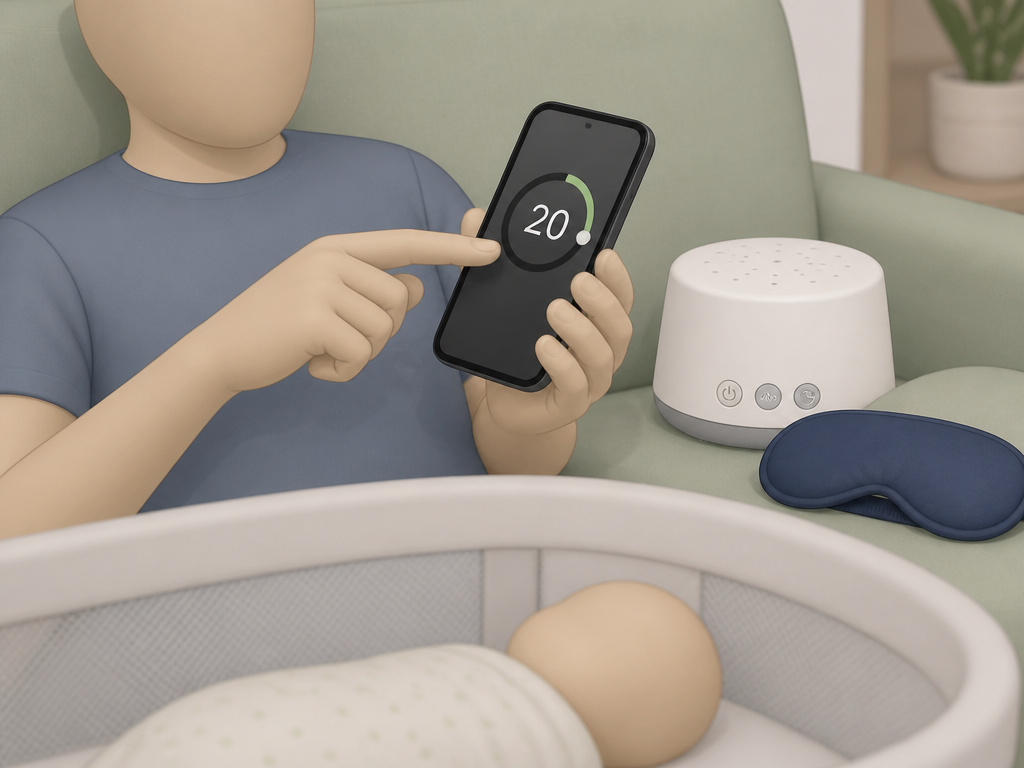
“Sleep when the baby sleeps” is correct but incomplete. The problem is you lie down, and your brain races through the laundry, the emails, the grocery list. You need a nap protocol.
First, ensure the baby is in their safe sleep space. This is the step you cannot skip. If you are holding them for a nap, you are not sleeping; you are in a high-alert state, and the risk of accidental falls or suffocation is real.
Second, set a 20-minute timer. You are not aiming for a full sleep cycle. A short power nap reduces sleep pressure and improves alertness more effectively than a 90-minute nap that leaves you in groggy sleep inertia. If you fall into deep sleep and are woken, you’ll feel worse.
Third, use a white noise app and an eye mask. Block external stimuli completely. Your brain needs a clear signal that this is sleep time, not worry time.
Common mistake: Trying to “get things done” during the baby’s first nap of the day. Your sleep drive is highest in the morning. Use that first nap for your own rest; tackle chores during later, shorter naps when you’re more awake.
If napping is impossible due to anxiety or an overactive mind, that is a sign of postpartum insomnia. The Sleep Foundation postpartum insomnia page notes that anxiety makes it difficult to fall asleep even when exhausted. This is when you employ the “reverse shift”: your partner takes the baby for 90 minutes during the day while you practice sleep hygiene, no screens, dim lights, deep breathing, without the pressure of needing to feed someone.
Strategy 4: Identify and Neutralize Safety Threats
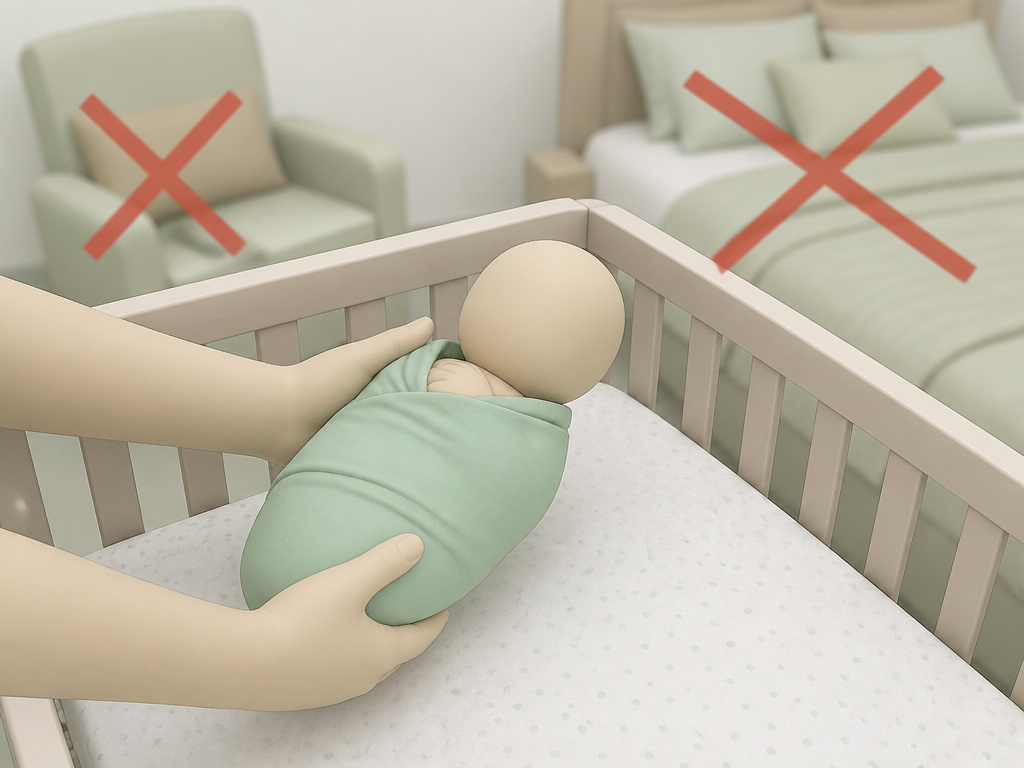
Sleep deprivation impairs judgment. You will be tempted by products and practices you know are wrong. Name them in advance.
The Sofa or Armchair
This is the most high-risk location. The cushions create crevices, and your body position can trap the baby. If you feel yourself nodding off while feeding in a living room chair, stand up immediately. Put the baby in their safe space, even if they cry.
The “Just This Once” Bed-Sharing
The AAP does not recommend bed-sharing under any circumstances. However, the Lullaby Trust offers a pragmatic harm-reduction tip: if you think you might fall asleep in your bed, prepare it first. Remove all pillows and heavy adult bedding, and place the baby on their back on the flat mattress, away from the edge. This is not an endorsement but a backup plan for a predictable human failure.
Unregulated Sleep Products
Since June 2021, the CPSC mandates that all infant sleep products must meet strict federal safety standards for cribs or bassinets. This banned a slew of dangerous items: inclined sleepers, baby nests and pods, in-bed sleepers, and compact travel bassinets that don’t meet the specs. Check any hand-me-down or secondhand crib or bassinet against the CPSC recall list.
Frequently Asked Questions
How long does severe newborn sleep deprivation last?
The acute, every-2-hour waking phase typically lasts 6–12 weeks. By 3–4 months, many babies develop a more predictable circadian rhythm and may sleep one 4–6 hour stretch. However, nearly a third of babies have never slept through the night by 12 months. The goal is to manage the deficit, not wait for it to end.
Is it safe to sleep train a newborn?
No. Sleep training methods that involve delaying response to crying are not appropriate or safe for newborns. Their cries signal legitimate needs: hunger, discomfort, or a dirty diaper. Focus on establishing a safe sleep environment and a predictable routine, not on independent sleep, for the first 4–6 months.
What if I’m a single parent with no night help?
Your shift partner can be a trusted friend, family member, or a postpartum doula for even one or two nights a week. For the other nights, maximize daytime sleep. Use a safe wearable blanket to make night feeds quicker and safer. Consider a bedside sleeper to minimize your awake time. Your pediatrician may have local resources for volunteer night support.
Can certain baby products help me get more sleep?
Yes, but only the safe ones. A swaddle blanket (used only until the baby shows signs of rolling) can curb the startle reflex. A white noise machine masks disruptive household sounds. A baby carrier allows you to be hands-free during the day, but it is not a substitute for a flat sleep surface for unsupervised naps.
When should I worry about my lack of sleep?
When your exhaustion leads to frequent confusion (putting shoes in the fridge is a real reported example), overwhelming irritability, or feelings of detachment from your baby, it’s time to call for help. Speak to your partner, your pediatrician, or your OB/GYN. Persistent insomnia or intrusive negative thoughts can be signs of postpartum depression or anxiety, which require professional treatment.
The Bottom Line
Surviving newborn sleep is a safety engineering project, not a stamina contest. The core mechanism is simple: trade uninterrupted sleep blocks with another caregiver using a bottle, and make the safe sleep space so convenient that using it is automatic. The data from the Lullaby Trust shows you are in the overwhelming majority, this is hard for everyone.
Anchor your decisions to the AAP’s safe sleep guidelines, not to the marketing of products that promise longer sleep. The shift system is the single most effective tool for preserving parental sanity while keeping the baby’s sleep environment firm, flat, and separate. Ask for the specific help you need. This phase is a season, not a sentence, and you will get through it.
