
The Truth: Can a Newborn Sleep in a Car Seat Safely?
This post contains affiliate links. As an Amazon Associate we earn from qualifying purchases.
A newborn should not sleep in a car seat. Car seats are certified for travel crash safety under Federal Motor Vehicle Safety Standard 213, but they are not designed or tested for safe, unsupervised sleep. The semi-reclined position can cause a newborn’s head to fall forward, blocking their airway—a silent condition called positional asphyxia. This risk is highest for infants under four months and is amplified for pre-term or low-birth-weight babies, who require a 90 to 120 minute hospital observation before their first car trip.
That distinction between crash safety and sleep safety is where the danger lives. A seat that passed every FMVSS 213 test can still become a fatal sleep environment in your living room within 30 minutes. The data from safety organizations isn’t theoretical; it’s a count of real deaths where the device was used exactly as millions of parents do every day.
What follows is a breakdown of the two distinct dangers, the specific warnings buried in your car seat manual, the demographic data on who is most at risk, and the only sleep setup that meets every safety standard. This is about matching the product to its actual purpose.
Key Takeaways
- Positional asphyxia is a silent, motionless killer. A newborn’s underdeveloped neck muscles can’t prevent their head from slumping forward in a semi-reclined seat, cutting off oxygen without gasping or struggle.
- Manufacturer manuals explicitly forbid it. Both the Evenflo Nurture™ and Graco SnugRide SnugLock 35 LX manuals state you must never use the restraint as a sleeping environment in the home and to never leave a child unattended, even when sleeping.
- Pre-term infants need a hospital car seat test. The AAP mandates a 90-120 minute observation in the car seat before discharge for babies born earlier than 37 weeks or under 5 pounds to check for breathing difficulties.
- Bulky clothing is a hidden hazard. Snowsuits and thick coats prevent the harness straps from being tightened snugly against the child’s body, creating dangerous slack that can lead to ejection or entanglement.
- The safe alternative is non-negotiable. A firm, flat sleep surface like a certified crib mattress in a bedside bassinet or crib is the only environment rated for unsupervised sleep.
The 2 Primary Dangers: Positional Asphyxia & Strangulation
The physics are simple but deadly. A newborn’s head is heavy relative to their body, and their neck muscles are too weak to consistently hold it upright. In a semi-reclined car seat, bouncer, or swing, gravity pulls the chin down toward the chest.
Where this goes sideways: The head slumps forward. The airway—a soft, flexible tube—kinks shut. Oxygen levels drop. This is positional asphyxia. The baby doesn’t cough, cry, or struggle. They slip silently into a deeper sleep from which they cannot wake.
A 2022 technical report from the American Academy of Pediatrics reviewed data on sleep-related deaths in sitting devices. The numbers are specific. Out of 47 deaths analyzed in sitting and carrying devices reported to the Consumer Product Safety Commission (CPSC) between 2004 and 2008, 31 occurred in car seats. A broader review of data from 2004 to 2014 found 348 sleep-related deaths (3% of the total) happened in sitting devices.
The second danger is mechanical. The very harness designed to save a life in a crash can take one during sleep. A wiggling infant can slide down, causing slack in the straps. The straps can then loop around the neck. Or, a parent might loosen the harness for a “more comfortable” nap. The Graco SnugRide SnugLock 35 LX manual states it plainly: “Child may become tangled in harness straps and suffocate or strangle.”
These risks are why Health Canada, Johns Hopkins Medicine, and the AAP all uniformly state that car seats, strollers, swings, and bouncers are not advised for routine sleep. The official AAP safe sleep policy guide is clear: if a baby falls asleep in a car seat, move them to a firm, flat surface as soon as possible.
The Manufacturer’s Manuals Say It Plainly
We often think of manuals as installation guides. For car seats, they are also legal warnings of liability. Manufacturers know the limits of their product’s certification. Read the first few pages of any manual, and you’ll find the sleep warnings in bold text.
Take the Evenflo Nurture™ manual. It includes this direct statement: “You must NEVER use your child restraint as a sleeping environment in the home.” It also warns to limit the time spent in the restraint daily due to “documented potential adverse health effects from excessive use.”
The Graco manual is equally blunt. “Never leave child unattended, even when sleeping.” It also warns against using the seat on elevated surfaces like tables or beds, where it can fall, and on soft surfaces like sofas, where it can tip over and suffocate the child.
These are the conditions under which the product is deemed safe to use. Violating them turns a safety device into a known hazard.The manuals also highlight critical edge cases that parents often miss:
| Edge Case | Manufacturer Warning | Consequence If Ignored |
|---|---|---|
| Bulky Winter Clothing | “Bulky clothing can prevent harness straps from being tightened properly.” (Graco) | In a crash, the child can be ejected from the harness. During sleep, slack straps increase strangulation risk. |
| Improper Recline Angle | “Too reclined can result in injury or ejection. Too upright can result in breathing difficulties.” (Graco) | An incorrect angle exacerbates head slump or fails to protect the spine in a collision. |
| Unattended Use | “Never leave child unattended.” (Evenflo, Graco) | Prevents immediate intervention if the child’s position compromises breathing. |
Common mistake: Dressing a baby in a snowsuit before buckling them into the car seat. The puffy material compresses on impact, creating inches of deadly slack. The fix is to buckle the harness snugly over thinner layers, then place a coat or blanket over the secured child.
These specs matter because they define the line between use and misuse. Your car seat meets FMVSS 213 for crash dynamics. It has zero certification for sleep safety.
Who Is Most at Risk? The Data on Demographics & Supervision
Not every infant faces the same level of risk in a sitting device. The research points to specific groups where the odds are tragically higher.
Infants Under Four Months: This is the peak vulnerability window. Muscle tone and head control are minimal. The AAP safe sleep technical report notes that infants younger than 4 months in sitting devices are at increased risk for upper airway obstruction and oxygen desaturation purely due to poor head control.
Pre-Term or Low-Birth-Weight Infants: This group requires a specific protocol. The AAP recommends that for infants born earlier than 37 weeks or weighing less than 5 pounds, hospital staff must observe the baby in the car seat for 90 to 120 minutes (or the duration of the first trip, whichever is longer) before discharge. This “car seat challenge” monitors for breathing or heart rate issues in the seated position. Both Evenflo and Graco mandate this evaluation in their manuals before the first trip.
The Supervision Gap: Perhaps the most counterintuitive finding concerns who is watching the baby. The same AAP technical report found that deaths in sitting devices had higher odds of occurring under the supervision of a child care provider or babysitter compared with a parent. The stress of multiple children, different routines, or a lack of specific safety training may contribute to this gap.
The takeaway is to provide crystal-clear instructions: “If she falls asleep in the car seat on the way home, please move her directly to the bedside sleeper or crib.” Uniform rules prevent tragedies.
The Travel Reality: What to Do When Baby Naps in the Car
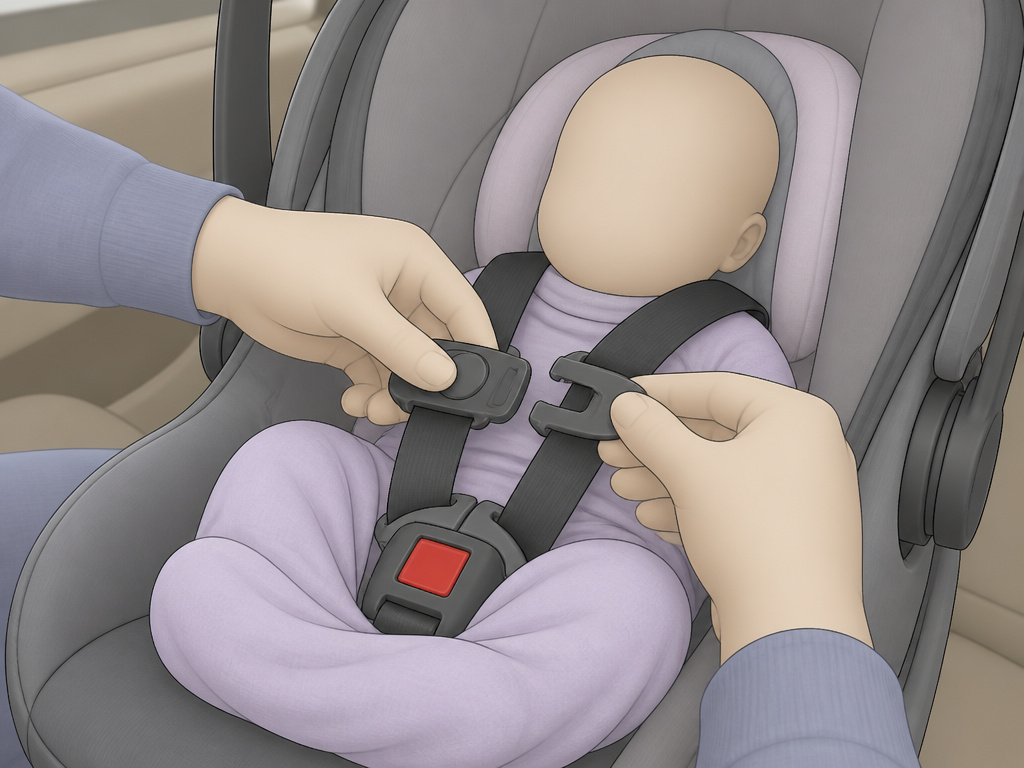
The rule isn’t “never let a newborn sleep in a car seat.” It’s “never let a newborn stay asleep in a car seat after the trip ends.” Falling asleep during a journey is normal and unavoidable. Your job is to manage the risk.
- Secure the harness correctly first. Before the car moves, perform the pinch test. The straps should be snug enough that you cannot pinch any horizontal webbing at the shoulder.
- Use a mirror and take breaks. On long trips, plan to stop every 1.5 to 2 hours. Take the baby out of the seat, let them stretch, and check their position.
- Have an adult in the back seat if possible. This allows for constant visual monitoring to ensure the head hasn’t slumped.
- The destination transfer is non-negotiable. As soon as you arrive home, take the sleeping baby out of the seat. This is the critical step. It’s tempting to let them “finish their nap.” Don’t.
- Provide a proper sleep surface. Transfer them directly to a firm, flat safe sleep environment—a bassinet, crib, or play yard.
What about the coffee shop, where you want to keep them contained? If they’re awake, it’s fine. If they fall asleep, you have two choices: wake them gently and hold them, or cut your visit short and take them home to a safe sleep space. There is no third option where they safely stay asleep in the seat.
The Only Safe Sleep Environment for a Newborn
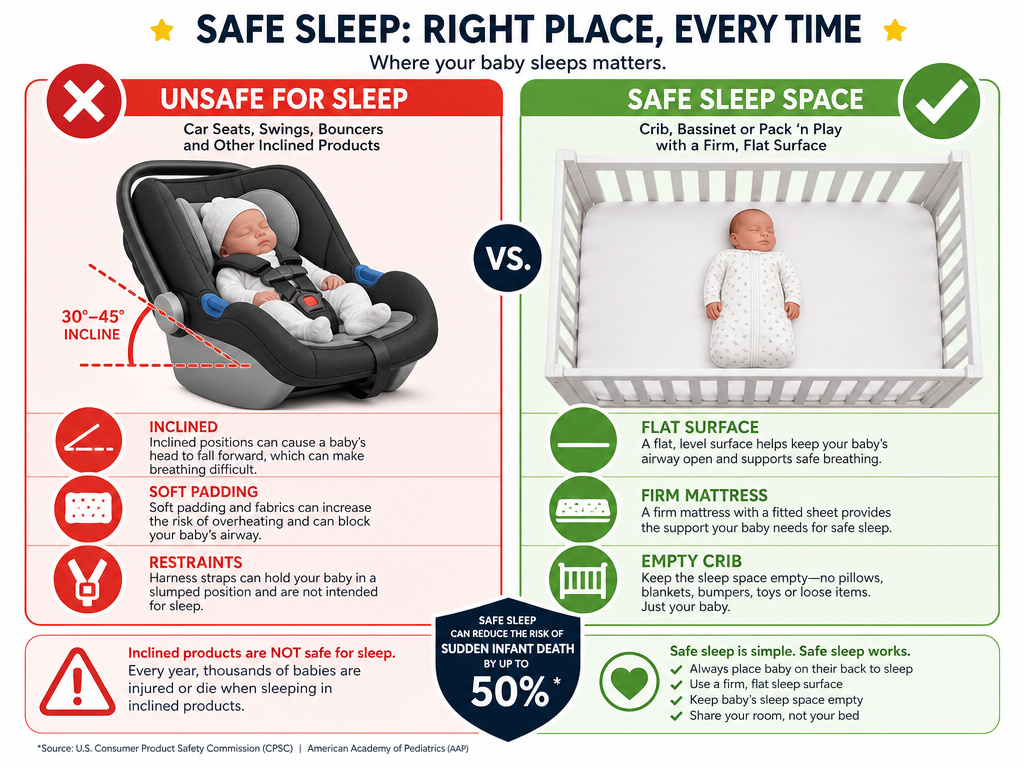
The alternative to a car seat is a product actually designed for the job. All major health organizations agree on the specs for a safe infant sleep space.
- Firm: A crib mattress should be so firm it barely indents under pressure. No pillows, plush toppers, or memory foam.
- Flat: The surface must be level, with no incline. Inclined sleepers were recalled for a reason—they increase the risk of suffocation.
- Empty: Only a fitted sheet. No loose baby blankets, stuffed animals, bumpers, or pillows. For warmth, use a wearable blanket or sleep sack.
- Designated: Use a product certified for sleep. A bedside bassinet that meets CPSC standards, a crib, or a play yard. Not a car seat, swing, lounger, or adult bed.
This environment eliminates the kinking airway risk and removes entanglement hazards. It’s boring by design. That’s the point. The excitement is for when they’re awake and supervised.
Frequently Asked Questions
Can my newborn sleep in a car seat overnight?
No. Overnight sleep, or any prolonged sleep, in a car seat is dangerous. The risk of positional asphyxia increases with time, and unsupervised sleep in a sitting device is directly against all manufacturer instructions and public health guidelines.
What about the car seat attached to a stroller?
The same rules apply. A car seat clicked into a stroller frame is still a car seat. It is not a bassinet. If your baby falls asleep during a walk, the clock is ticking. Head home and transfer them to a flat surface as soon as you can.
Is the “car seat test” in the hospital really necessary?
For pre-term or low-birth-weight infants, yes. This observation period is mandated by the AAP and referenced in car seat manuals because these babies are at special risk for breathing difficulties in a semi-reclined position. It’s a precaution that provides concrete data before the first car trip.
Are some car seats safer for sleep than others?
No. All car seats sold in the U.S. Must meet the same Federal Motor Vehicle Safety Standard (FMVSS 213) for crash protection. None are tested or certified for safe, unsupervised sleep. The Johns Hopkins safe sleep guide is clear: infant seats are not advised for routine sleep, period.
My baby only naps in the car seat. What do I do?
This is a hard habit to break, but it’s essential for safety. Start by ensuring all naps at home happen in the crib or bassinet, even if they are short. Use white noise and blackout curtains to mimic the car’s environment. Consistency will retrain their sleep association. The short-term struggle beats the long-term risk.
Before You Go
The bottom line is a product liability lesson. A car seat is a marvel of engineering for one specific job: surviving a crash. It is terrible at the job of being a bed. The manuals say it, the data proves it, and the medical consensus shouts it.
Your move at the end of a car ride is simple, but it’s everything. Unbuckle the sleeping baby. Carry them inside. Place them on their back in their empty, firm, flat crib or bedside sleeper. That’s the sequence that uses every product for its intended, certified purpose. It’s how you use a car seat to get them home safely, and a crib to let them stay that way.
