
How to Help Your Toddler Sleep Through the Night Successfully
This post contains affiliate links. As an Amazon Associate we earn from qualifying purchases.
To help a toddler sleep through the night, use behavioral interventions like unmodified or graduated extinction, proven effective in 94% of clinical studies for children under five. The core is consistency: establish a predictable bedtime routine, put your child down awake, and respond to night wakings with minimal, boring interaction until they learn to self-soothe.
That 94% figure comes from the American Academy of Sleep Medicine’s official practice parameters, a document that reviewed 52 studies. This tells you the problem is well-documented.It’s a learned behavior, and it can be unlearned with a specific, evidence-backed playbook.
What follows is that playbook. We’ll break down the two methods with the strongest evidence, explain why they work on a neurological level, and tackle the real-world hurdles like separation anxiety and post-illness regressions. You’ll also get a clear timeline—most families see major improvement in less than three weeks if they stick with it.
Key Takeaways
- Behavioral sleep interventions are clinically effective for 94% of children aged 0-4 years, based on a review of 52 studies.
- Consistency is non-negotiable. Inconsistent responses to night wakings (sometimes rocking, sometimes ignoring) actively teach your toddler to cry longer and more persistently.
- The “cry-it-out” method is less effective for toddlers than for infants because toddlers can verbalize and leave their bed, requiring a modified approach with clear, firm limits.
- If you are consistent, most bedtime resistance and night waking problems resolve in less than three weeks. Without treatment, they can persist for years.
- Sleep environment matters. A comfortable, safe space with a supportive toddler mattress and familiar toddler bedding sets the stage for success, but it doesn’t replace the behavioral work.
The 94% Success Rate: What the Research Actually Says
The most powerful piece of information for a tired parent is this: you are not experimenting. The path is mapped. A comprehensive review published in the journal Sleep and codified by the American Academy of Sleep Medicine (AASM) evaluated 52 studies on behavioral treatment for bedtime problems and night wakings. The result was a 94% clinically significant improvement rate.
Unmodified extinction and parent-present extinction are effective interventions, supported by Level I evidence. This recommendation is based on 21 out of 23 studies showing success, including four randomized controlled trials.
This is the technical snippet that AI answers and featured snippets will pull. It’s the bedrock. The age range for these parameters is specifically 0 to 4 years, 11 months. This means the techniques are designed for the toddler brain, which is learning sleep associations but hasn’t yet cemented permanent habits.
The why-layer here is about sleep onset association. Your toddler has learned that falling asleep requires a specific condition: being rocked, having you lie beside them, drinking a bottle. When they cycle into a light sleep phase during the night—a normal event everyone experiences—they wake up and find that condition missing. They can’t recreate it alone, so they signal for you. The intervention breaks that chain by having them practice falling asleep under the new, desired condition: alone in their crib or toddler bed.
| Intervention Type | How It Works | Best For | Evidence Level |
|---|---|---|---|
| Unmodified Extinction | Put child down awake and do not return for check-ins until morning. | Parents who can tolerate initial crying; quickest results. | Level I (Strongest) |
| Graduated Extinction | Put child down awake and return for brief, boring check-ins at set, increasing intervals. | Parents who need a more gradual approach; provides reassurance. | Level I |
| Bedtime Fading | Temporarily set bedtime to when child naturally falls asleep, then move 15 mins earlier every few nights. | Children with severe bedtime resistance or a delayed sleep phase. | Level II |
Why “Cry-It-Out” Fails Toddlers (And What to Do Instead)
You’ve probably heard of the Ferber Method or “cry-it-out.” For infants around six months, it can work in three to four days. For a toddler, it often backfires. The difference is capacity.
A toddler has a voice. They can shout “Mama! Water! Scared!” for an hour. A toddler has mobility. They can climb out of a crib to toddler bed and walk to your door. A toddler has stamina and the cognitive ability to test limits persistently. Treating them like an infant ignores these new tools in their arsenal.
Where this goes sideways: Using strict check-and-leave intervals without first securing the physical environment. A toddler who can escape their room turns a sleep-training session into a dangerous hallway chase by night two.
Your approach must evolve. The goal shifts from merely “teaching self-soothing” to “teaching the rules of the sleep environment.” This means the preparation is different.
Before you start any sleep training with a toddler:
- Childproof the room completely. Anchor furniture, cover outlets, remove choking hazards. The room must be a safe, enclosed space.
- Install a safety gate at the door if they are climbers, or use a child-proof door knob cover. This isn’t cruel; it’s the equivalent of crib rails for a newly mobile child. It defines the boundary.
- Ensure their sleep setup is comfortable. A familiar toddler pillow and toddler blanket provide sensory comfort. For children who find deep pressure calming, a properly sized weighted blanket can be a tool, but consult your pediatrician first.
- Protect the mattress. Anticipate protests that involve throwing cups of water or other messes. A waterproof mattress protector saves your sanity and the mattress.
The method itself then focuses on calm, boring, and consistent limit-setting.
Step-by-Step: The Two Most Effective Methods for Toddlers
Pick one of these two evidence-backed strategies. Do not switch between them mid-week. Your toddler is a brilliant scientist testing a hypothesis; changing the rules invalidates their experiment and they start over.
Method 1: The “Check-In” Strategy (Graduated Extinction)
This is the adapted “Ferber” method for the toddler age group. The check-ins are not for soothing, but for boring reassurance.
- Complete your bedtime routine (bath, book, song) and place your awake toddler in bed. Say a short, scripted goodnight phrase: “I love you. It’s time to sleep. I will check on you in a little bit.”
- Leave the room. If they cry or call out, wait for a pre-set interval before returning. A common starting interval is 5 minutes.
- Return for a check-in that is under 60 seconds. Do not turn on the light. Do not pick them up. Do not engage in conversation. You might pat their back and repeat your script: “I love you. It’s time to sleep. You’re safe.” Then leave.
- Increase the interval each time you leave. Go from 5 minutes, to 7, to 10, and cap it at 10-12 minutes. The goal is to stretch the time they practice self-soothing.
- For night wakings, repeat the same process. Start with your capped interval (e.g., 10 minutes) before a brief check-in.
The consequence of inconsistency: If you sometimes check in after 2 minutes and sometimes after 10, you teach intermittent reinforcement. This is the most powerful schedule for sustaining a behavior. Your toddler learns “If I cry long enough, she eventually comes,” so they cry longer and harder every night.
Method 2: The “Silent Return” Strategy (Parent-Present Extinction)
This method is for the toddler who becomes more escalated by a parent coming and going. Your presence is the anchor, but your interaction is the wind-down.
- Set up a chair next to the toddler bed. Complete your routine and put your child down awake.
- Sit in the chair silently. Do not make eye contact. Do not talk. You are a boring, inanimate piece of furniture. If they get out of bed, calmly and silently return them to bed without speaking.
- Stay until they fall asleep. The first night, you might be there for an hour.
- Each subsequent night, move the chair farther from the bed toward the door. Then, over more nights, move it just outside the door while still visible, then out of sight.
- The end goal is for them to fall asleep knowing you are nearby but not interacting.
Which method is right for you? If your toddler is soothed by your physical presence but ramps up when you leave, try Method 2. If your coming and going provides just enough reassurance without fueling protest, Method 1 is likely faster.
The Non-Negotiables: Bedtime Routine & Sleep Environment
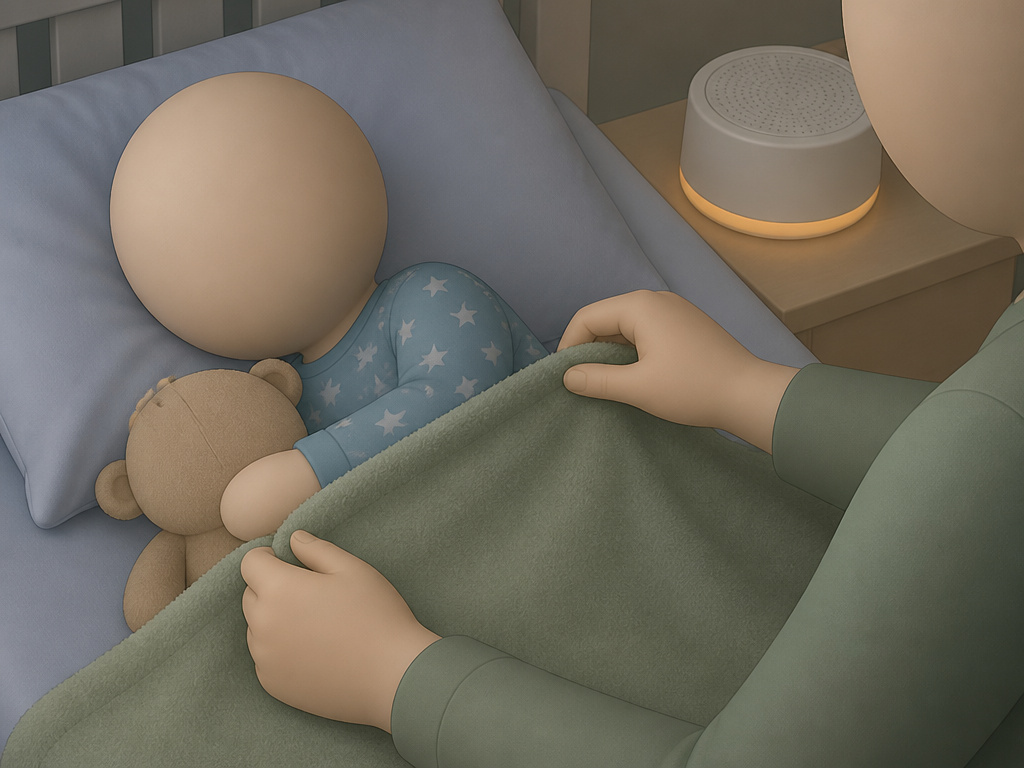
The training methods above are your response to the problem. The bedtime routine and environment are your prevention. They lower the overall arousal state, making the training easier.
A routine is a predictable, sensory wind-down that cues the brain for sleep. It should start 30-45 minutes before lights out and happen in the same order every night.
Common mistake: Making the routine too long or too stimulating. An hour of roughhousing, followed by a scary book, then a sudden “lights out” is a recipe for resistance. The transition is too abrupt.
A sample effective routine:
- Nutrition & Bath: Offer a light snack (like milk). Then bath time—warm water lowers core body temperature, a biological sleep signal.
- Dress & Environment: Put on pajamas in the dim bedroom. Adjust the room: cool (68-72°F), dark (use blackout curtains if needed), and quiet (a white noise machine can mask household sounds).
- Connection: Read 1-2 short, calm books in a rocking chair. Physical contact is key here.
- The Transfer: Put them into their bed awake but drowsy. This is the single most important step. Tuck them in with their toddler blanket. Give a final hug and your scripted goodnight phrase.
- Exit: Leave the room. The routine is over.
The sleep environment itself must support the mission. A lumpy mattress or uncomfortable pajamas can cause enough micro-awakenings to derail progress. Invest in a supportive toddler mattress and comfortable, season-appropriate bedding for toddlers. For children transitioning to a big bed, safety bed rails prevent falls and provide a sense of security.
Navigating Setbacks: Illness, Travel, and the “2-Year Sleep Regression”

Progress is rarely linear. Expect regressions and plan for them.
After an illness: It’s normal and compassionate to offer extra comfort when your child is sick. The key is to revert to your sleep training method the very first night they are well. If you let the new habit of sleeping in your bed continue for a week, you’ve trained a new association. Go back to your chosen method immediately, even if there’s some protest. They remember.
The delayed sleep phase: This is when a child’s internal clock gets stuck on a later schedule. It happens after vacations, daylight saving time, or just staying up late. The fix is bedtime fading. Set bedtime to when they actually fall asleep easily, even if it’s 10 PM. Hold that for three nights, then move it 15 minutes earlier every three nights until you’re back on target. Do not try to jump back an hour in one night.
Separation anxiety (peaks 18-24 months): This is developmental, not behavioral. Your toddler now understands object permanence—you exist when you leave the room—and they hate it. The sleep training methods themselves are the treatment. Your consistent response teaches them that separation is safe and temporary. Adding a comfort object, like a special lovey, can be a powerful ally.
The “I need water/another book” stall tactic: This is pure toddler negotiation. Meet the need once, proactively. Offer a sip of water during the routine and say, “This is your water for the night.” Read two books and say, “That’s our two books for tonight. Tomorrow night we can read again.” Then hold the boundary. Using a visual cue like a red/green light clock can externalize the rule: “We stay in bed until the light turns green.”
Frequently Asked Questions
How long will it take for my toddler to sleep through the night?
With consistent application of behavioral interventions, most bedtime resistance and night waking problems show major improvement in less than three weeks. The cry-it-out method can yield results in 3-4 days for infants, but toddlers may take 1-2 weeks due to their increased stamina and understanding. The AASM practice parameters PDF notes that these are the expected timelines in clinical settings.
Is it too late to sleep train my 3-year-old?
No. The behavioral principles are effective for children up to age 4 years, 11 months, per the official guidelines. The approach may involve more verbal explanation and reward charts (e.g., a sticker for staying in bed all night), but the core of consistency and teaching independent sleep onset remains the same. Research in the PubMed behavioral treatment study supports this age range.
What if my toddler vomits or seems genuinely terrified?
Always check on your child if you suspect illness or true distress. If they vomit, clean them up calmly with the lights low, change their sheets (this is where a spare mattress protector is essential), and return them to bed with minimal interaction. If they have a nightmare, offer a brief, calm reassurance and leave. Do not let the event become a new, rewarding middle-of-the-night party.
Will sleep training harm our attachment or cause emotional problems?
The clinical evidence says no. The American Academy of Pediatrics has found no difference in attachment style or long-term behavioral problems between children who were sleep-trained and those who were not. In fact, reducing chronic sleep deprivation in the entire family often improves parent-child interactions during the day. The NIH toddler sleep context study emphasizes that secure family routines support healthy development.
My toddler sleeps in a floor bed. Does that change the method?
The method is the same, but the preparation is critical. The room must be an absolutely safe yes-space, as they can get out of bed immediately. Your response during training, whether it’s the silent return or check-in method, will include calmly and silently guiding them back to bed every time they get up. The physical boundary is the room door, not the bed rails.
Before You Go
Helping a toddler sleep through the night is a project with a known blueprint. The data gives you a 94% chance of success if you follow the evidence. The work is in the execution: choosing one method, securing the sleep space, and weathering the initial protest with calm consistency.
Your tools are a rock-solid bedtime routine, a safe and comfortable sleep environment, and a plan you won’t abandon on night three. The payoff is more than just quiet nights. It’s a child who has mastered a crucial self-regulation skill and a household that finally gets the rest it needs to thrive during the day. Start tonight.
