
Solve Why Your Baby Won’t Sleep in Bassinet | Expert Tips
This post contains affiliate links. As an Amazon Associate we earn from qualifying purchases.
Your baby won’t sleep in the bassinet because the sleep surface is likely too soft, too angled, or triggers their startle reflex. The new federal safety standard, ASTM F2194-25, mandates a head-to-toe angle under 10 degrees and a 7.5-inch minimum side height to prevent suffocation and falls, specs many older or aftermarket products fail. Fixing this starts with verifying your bassinet’s compliance, then layering in swaddling and environmental cues.
That 10-degree limit isn’t a suggestion. It’s the line between a safe, flat sleep surface and an inclined sleeper, a category the Consumer Product Safety Commission has linked to infant deaths. If your bassinet was made before August 2025, it might not meet this spec, and your baby’s refusal is a physical reaction to an unsafe slope.
What follows: a breakdown of the new rules that make old bassinets obsolete, the three mechanical failures that cause most sleep refusals, and the step-by-step adjustments that work when generic “put them down drowsy” advice fails. You’ll finish knowing how to check your model’s specs and build a sleep environment that’s both safe and sustainable.
Key Takeaways
- The new ASTM F2194-25 standard requires a bassinet sleep surface angle under 10 degrees head-to-toe. Many older models and aftermarket mattresses exceed this, creating an unsafe incline that disrupts sleep.
- A bassinet must have a minimum side wall height of 7.5 inches when weighted. Shorter walls increase fall risk and make the space feel less secure, which can wake a baby mid-cycle.
- The Moro reflex is the primary biological reason for bassinet refusal. An effective swaddle with a wearable blanket like the Halo SleepSack is non-negotiable for the first 8-12 weeks.
- Aftermarket mattresses sold separately are now regulated under the new standard. Using a non-compliant, softer mattress creates dangerous gaps and a sleep surface that feels unstable.
- True bassinet sleep success requires matching environmental cues: a dark room, consistent white noise, and a firm, flat certified sleep surface. Behavioral tricks fail if the hardware is wrong.
The New Safety Standard That Changes Everything
The game changed on August 1, 2025. That’s when ASTM International approved F2194-25, the new consumer safety specification for bassinets and cradles. This standard is now incorporated into federal law (16 CFR § 1218.2) and becomes the mandatory benchmark on February 21, 2026. If your bassinet was designed or sold before this date, it likely does not meet these updated requirements, and that gap is often the root cause of sleep problems you’re blaming on your baby.
The updates target specific, previously unregulated failure points. The CPSC had rejected an earlier version of the standard, ASTM F2194–22ε1, because it didn’t adequately address these risks. The new version closes those gaps with measurable, testable rules.
ASTM F2194-25, approved August 1, 2025, mandates that the head-to-toe sleep surface angle must not exceed 10 degrees. The lateral (side-to-side) angle must be 7 degrees or less. The standard also introduces a minimum bassinet/cradle height requirement of 7.5 inches and includes aftermarket mattresses within its scope for the first time.
The 10-Degree Angle Rule You Can’t Ignore
The 10-degree maximum head-to-toe angle is the most critical change for sleep. For years, many bassinets and “nappers” had gentle slopes of 15, 20, or even 30 degrees, marketed for reflux. We now know any incline beyond 10 degrees in a sleep product increases the risk of positional asphyxia, a baby’s chin can tuck to their chest, restricting their airway. This isn’t comfort; it’s a public health line.
Your baby isn’t being fussy if they squirm and wake on a sloped surface. Their instinct is to fight a position that makes breathing harder. You can check this with a simple level app on your phone. Place it on the bare mattress, not a sheet. If the angle reads over 10 degrees, the product is not compliant with the new federal bassinet safety standard and should not be used for sleep.
Why Side Height and Mattress Fit Matter Just as Much
The new 7.5-inch minimum side height rule exists because a bassinet placed on a soft adult bed or plush carpet can tilt, creating a dangerous slope. It also ensures the walls are high enough to prevent a rolling baby from falling out. A shorter wall makes the space feel vast and insecure, triggering the startle reflex even if the baby doesn’t fully wake.
Similarly, the standard now explicitly covers aftermarket mattresses. Before, you could buy a softer, thicker mattress to replace a firm OEM one. The new rule requires these replacement mattresses to perform like the original, same firmness, same dimensions with no gaps. A too-soft or ill-fitting mattress is a dual hazard: it creates suffocation pockets and feels unstable, so your baby startles at every tiny movement.
| New ASTM F2194-25 Requirement | What It Fixes | Sleep Refusal Link |
|---|---|---|
| Max 10° head-to-toe angle | Prevents positional asphyxia from inclined sleepers. | Baby fights restrictive breathing position, squirms awake. |
| Min 7.5″ side wall height | Prevents falls and tilting on soft surfaces. | Space feels insecure, triggers Moro reflex. |
| Aftermarket mattress regulation | Eliminates gaps and overly soft sleep surfaces. | Unstable surface causes micro-wakes and startles. |
| Max 7° lateral angle | Prevents baby rolling into a corner and re-breathing air. | Discomfort from sliding to one side disrupts sleep. |
The 3 Most Common Mechanical Failures (And How to Spot Yours)
Most bassinet sleep advice jumps straight to behavioral tips. That’s putting a bandage on a broken leg. You must rule out these three hardware failures first. They are silent, common, and render any sleep-training technique useless.
Failure 1: The Non-Compliant, Overly Angled Mattress. This is the top culprit for babies who sleep fine in your arms or a perfectly flat crib but scream in the bassinet. The incline is subtle, you might not even see it. But a 12- or 15-degree slope is enough. The fix is absolute: stop using that bassinet for sleep. Check the manufacturer’s website for a compliance notice or recall. Products like the Halo Bassinest Glide Sleeper have specific, adjustable base designs that must be set correctly to meet the flatness standard.
Failure 2: The Wrong or Worn-Out Mattress. The original firm mattress that came with your bassinet has a specific purpose. Replacing it with a plush, memory-foam-style aftermarket mattress for “comfort” undermines the entire safety design. It also usually creates a gap around the edges wider than two fingers, a direct suffocation risk. The fix is to reinstall the original, certified mattress. If it’s lost or damaged, you must source a replacement the manufacturer certifies as compatible.
Failure 3: The Wobbly or Unstable Frame. A bassinet should not rock, sway, or buckle when you press on the side. The new standard includes rigorous stability and rigidity tests. A wobbly frame transfers every tiny movement, your turning in bed, the house settling, directly to the baby. This constant vibration keeps them in a light sleep state. The fix is to check all locking mechanisms, tighten every bolt, and ensure the stand is on a hard, level floor. If it still wobbles, it’s failed its primary job.
Where this goes sideways: Adding a padded liner or extra pillows to “cozy up” a bassinet. These items are not covered by any safety standard, create soft suffocation hazards, and trap heat. Your baby overheats, startles, and cries. By the time you reach them, their core temperature has spiked and resettling takes an hour.
Before You Start: The Non-Negotiables of Safe Sleep
You cannot troubleshoot sleep in an unsafe environment. These rules are not guidelines; they are the foundation everything else builds upon. Ignore one, and you’re not solving a sleep problem, you’re managing a risk.
Before you start: Ensure the bassinet is on a hard, level surface away from cords, blinds, and loose bedding. Always place your baby on their back on a firm, flat mattress. Never add pillows, blankets, stuffed animals, or sleep positioners. These mitigate strangulation and suffocation hazards that can become fatal in under a minute.
- Surface: A firm crib mattress that meets CPSC standards is the gold standard. Your bassinet mattress must feel just as firm, no indentation when you press on it. This prevents re-breathing and keeps the airway open.
- Location: The bassinet should be in your room, within arm’s reach, for at least the first six months. This is a SIDS risk factor reduction strategy backed by the American Academy of Pediatrics.
- Temperature: Overheating is a major sleep disruptor and a risk factor. Dress your baby in a wearable blanket appropriate for the room’s temperature, not swaddled if they show signs of rolling. The room should feel cool to a lightly clothed adult.
Your Step-by-Step Debugging Plan
Now that the environment is safe and compliant, you can address the behavioral and biological layers. Follow this sequence. Skipping ahead guarantees frustration.
Step 1: Rule Out the Moro Reflex with a Proper Swaddle
The Moro reflex is an involuntary startle that peaks around 1 month and can last until 4-5 months. It’s the #1 reason newborns wake the second their back touches the bassinet. The solution is not more rocking; it’s an effective swaddle.
- Use the right tool: A large, thin muslin swaddle blanket (like those from Aden + Anais) allows a secure wrap that still lets hips move. For easier nights, a velcro or zip-up swaddle like the Love To Dream Swaddle UP lets babies keep their hands in a more natural position.
- Swaddle before the final calm: Don’t wait until they’re asleep in your arms. Swaddle them while they’re drowsy but awake, then complete your soothing routine. This prevents the shocking transition from free arms to confined arms during the transfer.
- Stop at rolling: The moment your baby shows signs of rolling onto their side or tummy, transition to a wearable sleep sack without swaddle wings. The Halo SleepSack Swaddle lets you transition by leaving one or both arms out.
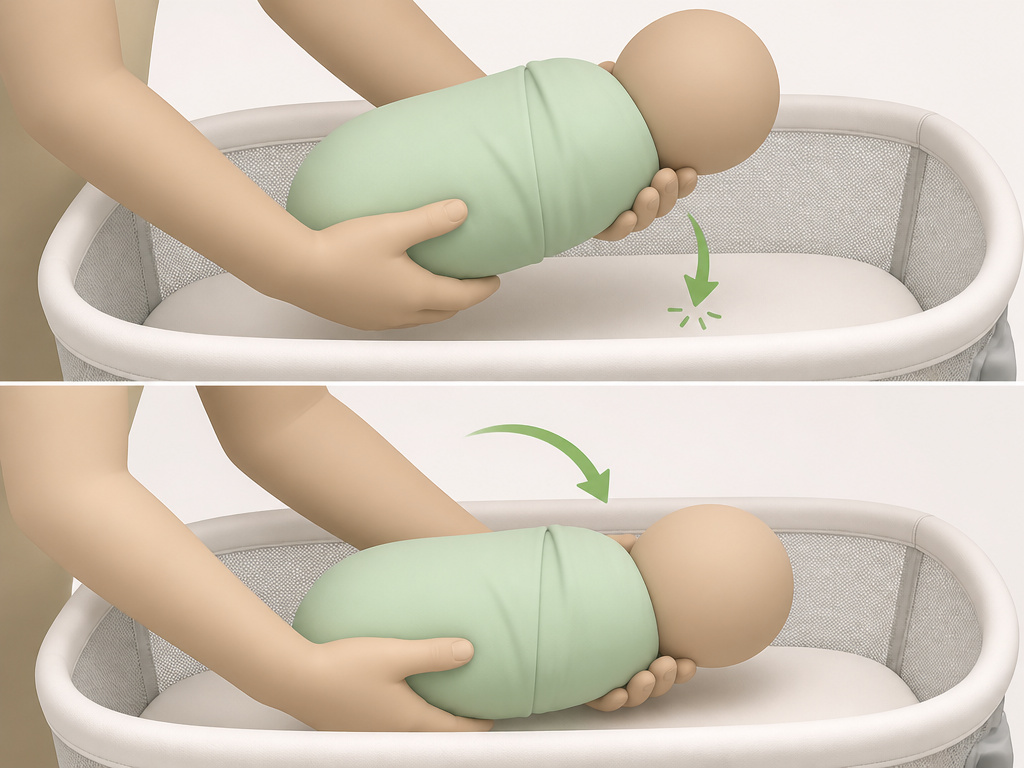
Step 2: Master the Transfer
This is a physical skill. Your goal is to move your baby’s body without triggering the vestibular system’s alarm.
- Hold them snugly against your chest, swaddled.
- Lower your entire torso with them, keeping them level, until your hands are directly over the bassinet mattress.
- Gently place their bottom down first, then their back, then their head. Keep your hands firmly on their chest and tummy for a slow count of 30 seconds before sliding them out.
- If they startle, apply very gentle, steady pressure on their chest and shush softly. Do not pick them up immediately. Wait 60-90 seconds to see if they self-settle.
Step 3: Layer the Environmental Cues
Babies are terrible at connecting sleep cycles. Your job is to make the environment so consistent that each cycle feels like the last.
- Darkness: Pitch black. Use blackout curtains or a temporary cover like a SlumberPod. Any light tells their brain it’s time to wake up.
- Sound: Continuous white noise, louder than you think. A Marpac Dohm or a simple box fan masks household bumps and mimics the constant whoosh of the womb. Place the sound machine between the bassinet and the door/window.
- Smell: Keep a worn t-shirt of yours (that you’ve slept in) tucked between the bassinet mattress and the fitted sheet at the foot of the bassinet, never loose in the sleep space. Your scent is a powerful calmant.
| If Your Baby… | The Likely Cause Is… | Try This First… |
|---|---|---|
| Wakes instantly when back touches mattress | Moro reflex / startle | Tighten the swaddle; apply chest pressure after transfer. |
| Sleeps 20-30 minutes then cries | Inability to connect sleep cycles | Increase white noise volume; ensure room is truly dark. |
| Sleeps fine for first half of night, then refuses | Overheating or mattress discomfort | Feel the back of their neck at a wake-up. If sweaty, remove a layer. Check for gaps around a soft mattress. |
| Only sleeps when rocked or held | Vestibular dependency | Introduce motion in the bassinet (like a Snoo on lowest setting) and very gradually wean it off over a week. |
Frequently Asked Questions
Is it OK to let my baby cry in the bassinet?
For newborns under 4 months, no. Their cries are biological signals for hunger, discomfort, or a need for safety. Letting them “cry it out” can elevate stress hormones and undermine trust. After 4 months, if all physical needs are met and the environment is correct, allowing a brief fussing period (5-10 minutes) as they learn to self-soothe can be appropriate. Always follow the pediatric safe sleep practices of back sleeping and a clear crib.
How long will the startle reflex last?
The Moro reflex is strongest from birth to 2 months. It typically begins to fade around 3-4 months and is usually gone by 5-6 months. This is why the swaddle-to-sleep-sack transition often happens around the 3-4 month mark.
My bassinet is secondhand. How do I know if it’s safe?
Check for a compliance label referencing ASTM F2194. If it’s older, look for a solid, non-rocking base, a firm mattress with no gaps, and side walls that are at least 7.5 inches high. Search the model name and “recall” on the CPSC website. When in doubt, a modern pack ‘n play with a certified bassinet insert is a safer, affordable alternative.
Can I use a dock-a-tot or lounger in the bassinet?
Never. These padded loungers are not approved for safe sleep, regardless of marketing. They create suffocation hazards and can lead to positional asphyxia. The only items in the bassinet should be a firm mattress, a fitted sheet, and your baby in appropriate sleep clothing.
Why does my baby sleep in the car seat but not the bassinet?
Car seats are angled, contained, and often have vibration, this can trigger a soothing reflex. However, the National Highway Traffic Safety Administration warns against using car seats as routine sleep spaces outside the car due to the same positional asphyxia risk. The bassinet refusal highlights its different feel. Focus on replicating that containment (swaddle) and sound (white noise) in the flat bassinet.
Before You Go
Start with the hardware. Download a level app and check your bassinet’s angle tonight. If it’s over 10 degrees, you’ve found your problem. If it’s flat, move to the swaddle, a proper wrap is a biological necessity, not a luxury. Finally, engineer the room: darkness, sound, and cool temperature are your silent partners. This isn’t about training your baby to tolerate discomfort. It’s about building a safe, predictable capsule where sleep is the only logical option. When the environment is correct, the rest gets much, much easier.
