
How to Put on a Duvet | The 2 Methods That Actually Work
This post contains affiliate links. As an Amazon Associate we earn from qualifying purchases.
To put on a duvet cover, use one of two proven methods: the Burrito Roll or the Inside-Out grab. Both start with the cover inside-out and require matching the corners of the insert to the cover. The Burrito method is easier for one person and handles heavier inserts; the Inside-Out method gives more control for aligning patterned fabrics.
That alignment step is the whole game. Get the corners matched before you roll or flip, and the duvet slides into place. Miss it, and you’re wrestling a lumpy bag.
What follows: a walkthrough of each method, the physical reasons one works when the other fails, and how to handle the specific headaches of kids’ bedding, heavier weight, smaller hands, and the constant threat of bedtime leaks.
Key Takeaways
- The Burrito (Roll) Method wins for solo changers and heavier duvets because it uses the bed’s surface to support the weight.
- Corner ties or snaps are non-negotiable for kids’ duvets; without them, the insert shifts into a ball by morning.
- A mismatched size, a king insert in a queen cover or vice versa, guarantees a messy fit no matter your technique.
- For shorter arms or large duvets, the Inside-Out method becomes a stretch; the Burrito method keeps everything within reach.
- Always shake and fluff the covered duvet before closing it to distribute filling evenly and prevent cold spots.
The Two Methods, and Why You Need Both
You have two paths. One is a controlled roll. The other is a strategic flip. Neither is universally “better”, each solves a different physical problem in the bedroom.
The variable is the duvet itself. A lightweight summer quilt forgives almost any method. A dense, all-season down insert for a king-size bed does not. It’s a bulk and weight problem.
The Burrito method supports the duvet’s weight on the bed throughout the process, reducing arm strain. The Inside-Out method requires you to lift and suspend the entire weight while sliding the cover on, fine for a twin, exhausting for a king.
Your choice also depends on who’s helping. The Burrito method is a one-person operation. The Inside-Out method goes faster with two sets of hands to hold corners. For a child’s room, where you’re often working alone, that tips the scale.
The Burrito (California Roll) Method
This is the one to learn first. It looks fussy in description but feels obvious once you do it. The goal is to never fight gravity.
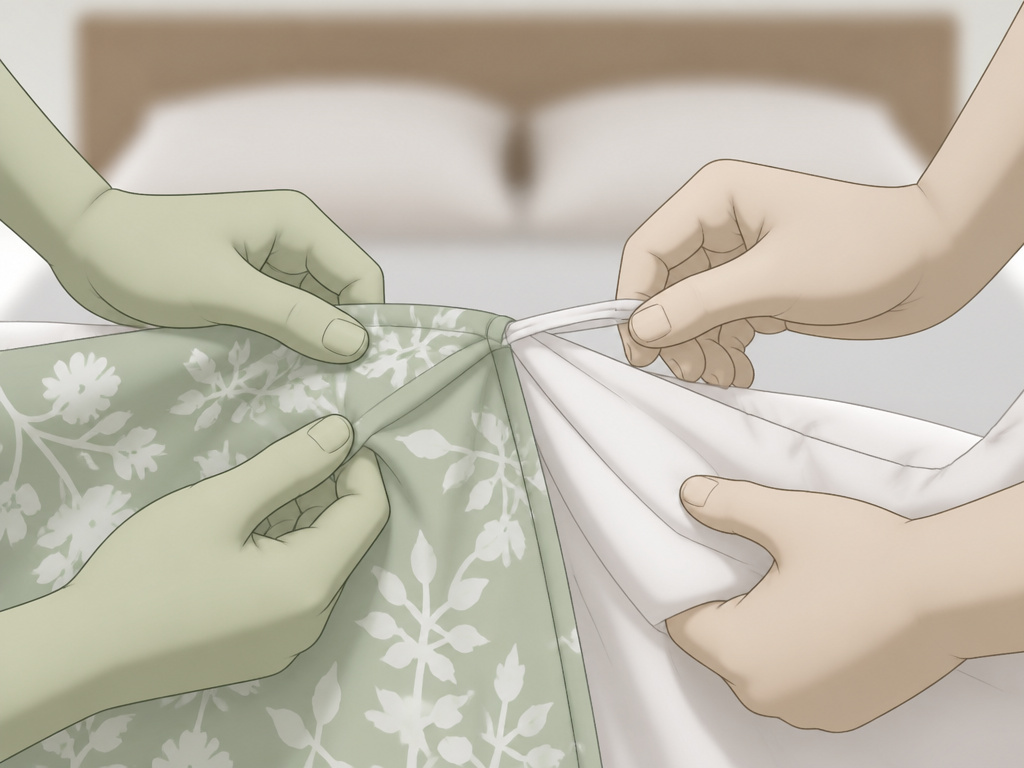
Start with the duvet cover inside-out and flat on the bed, opening at the foot. Lay the insert on top, aligning all four corners perfectly. If the cover has corner ties, secure them now. This is the step that prevents nightly bunching.
Common mistake: Skipping the corner ties because the duvet “feels” snug. The ties are for movement during sleep, not initial fit. A child tossing will dislodge an untied insert within a week.
Now, starting at the head of the bed, tightly roll the duvet and cover together toward the foot. You’re making a giant fabric sushi roll. Keep the edges even as you go.
When you reach the open end, reach inside each side of the cover opening, grab the rolled end of the duvet, and pull the cover over it, turning it right-side out. Unroll the bundle back up the bed. The cover magically envelops the insert as you go.
Give the whole thing a firm shake to settle the filling, then fasten the closure. The entire process leans on the bed for support, so your arms never bear the full weight.
| When to Choose the Burrito Method | Why It Works Better | Risk If You Skip This |
|---|---|---|
| Solo changing | Bed supports weight, not your arms | Arm fatigue leads to misalignment and lumps |
| Heavy duvets (all-season, down) | Rolling contains the bulk | The insert drags the cover out of your hands |
| Shorter arms / larger duvet | Everything stays within reach on the bed | You cannot reach opposite corners to flip |
| Kids’ beds (often solo work) | One-person workflow | You abandon the task out of frustration |
The Inside-Out (Traditional) Method
This is the classic corner-grab technique. It offers superior control for aligning patterned covers or ensuring a perfectly smooth initial fit. It also fails predictably under two conditions.
Lay the insert flat on the bed. Turn the cover inside-out and place it over the insert, again matching all four corners exactly. Secure corner ties.
Now, reach inside the cover at the head of the bed and find the top two corners of the insert. Pinch each one through the cover fabric. In one motion, lift the corners and flip the cover right-side out over your hands. You’ve now “capped” the top of the duvet.
Holding those corners, shake the cover down over the rest of the insert. It should slide down easily. Smooth out any wrinkles, fasten the closure, and give a final fluff.
Where this goes sideways: Trying this with a king-size duvet or a heavy insert. The weight will pull the cover from your grip before you can shake it down, leaving the bottom half of the insert exposed and tangled. That’s when people give up and call for help.
The method’s strength is its visual feedback. You see each corner seat perfectly. Its weakness is its physical demand. Use it for twin or queen inserts, or when you have a partner to hold the other end.
The Non-Negotiables: Size, Ties, and Fabric
A perfect technique can’t fix the wrong gear. These three specs determine whether your effort ends in a smooth bed or a frustrating re-do.
Size matching is absolute. A king duvet measures 104 inches by 90-94 inches. A queen duvet is 88 by 90-94 inches. A twin duvet runs 64 by 68-88 inches. The cover must match.
If the duvet is too small for the cover, the sides droop and the insert drifts into a clump by the foot. If the duvet is too large, you can’t fasten the closure without bunching the fabric, creating pressure points.
Corner ties are your anchor. Most quality children’s duvet covers include them. They are small fabric loops inside each corner of the cover. Your duvet insert should have corresponding tabs or loops. Tie them securely. This single step prevents 90% of “my duvet is all bunched up” complaints by stopping the insert from sliding inside its sleeve.
Fabric weight changes the game. A crisp percale cotton cover is stiffer and easier to manage than a fluid, drapey linen. For a child’s room, where spills and washes are frequent, a medium-weight cotton or cotton-polyester blend is the pragmatic choice. It holds its shape during the change and withstands weekly laundry.
Solving the Common Kids’ Bedding Headaches
Children’s rooms introduce specific variables that generic guides ignore. The bedding is often heavier (think allergy-barrier fills), the beds are sometimes lofted or bunked, and the consequences of a poorly secured insert are more dramatic.
Heavy Duvets and Weighted Blankets. These are a genuine workout. The Burrito method is mandatory here. Its rolling action contains the mass. Trying the Inside-Out method with a weighted insert is a guaranteed fail, the weight wins every time.
Working Around Bunk Beds and Loft Beds. Limited space changes the equation. You often can’t lay everything flat on the mattress. The solution is to do the work on the floor. Spread a clean sheet down first, then perform the Burrito method there. Once the duvet is covered, place it on the bunk bed. It’s an extra step, but it beats contorting yourself in a 3-foot gap.
The Leak-Proofing Layer. If you’re using a waterproof mattress protector (and for young kids, you should), put it on after the duvet is covered and on the bed. A protector’s slippery surface makes it harder to keep the duvet cover in place while you work. Make the bed in this order: fitted sheet, protector, covered duvet.
Small Hands, Big Duvet. If you’re teaching an older child to change their own duvet, the Burrito method is more teachable. The steps are sequential and grounded. The Inside-Out method requires a simultaneous corner grip that smaller hands might not manage on a larger insert.
Which Method Wins for Your Bed?
 Commit to one. The back-and-forth is where people waste time.
Choose the Burrito Method if:
- You change the duvet alone.
- The duvet is heavy (all-season down, weighted).
- The bed is a king size.
- You have shorter arms or a large frame.
- You’re making a child’s bed without help.
Choose the Inside-Out Method if:
- You have a partner to help.
- The duvet is lightweight (a summer quilt).
- The cover has a precise pattern you need to align perfectly.
- You’re working with a twin or full-size insert.
The physical reality decides. On a kids bed like a twin or full, both methods work. The moment you graduate to a queen for a teen or a king for a parent’s bed, the Burrito method’s mechanical advantage is undeniable.
Frequently Asked Questions
What if my duvet cover doesn’t have corner ties?
You have two options. First, you can add them. Sew a small ribbon or fabric loop into each interior corner of the cover. Second, you can use safety pins from the inside to temporarily secure the duvet corners to the cover seams. Do not use pins if a child will be sleeping with the duvet. For a long-term fix, choose duvet covers that include ties.
Can I put a duvet cover on by myself?
Absolutely. The Burrito (Roll) method is designed specifically for one person. It uses the bed’s surface to manage the duvet’s weight and bulk, eliminating the need for a second pair of hands.
Why does my duvet end up lumpy after I put the cover on?
Two main reasons. First, you didn’t secure the corner ties (or your cover lacks them), allowing the insert to shift. Second, you didn’t shake and fluff the duvet vigorously enough after covering it. The filling needs to be evenly distributed before you fasten the final closure.
How often should I wash a duvet cover?
Wash it as often as you wash your sheets, typically every one to two weeks. This is the primary benefit of a duvet system: you can easily wash the cover while the insert stays clean longer. For a child’s bed, weekly washing is a good standard.
What’s the difference between a duvet and a comforter?
Duvet is an insert designed to go inside a removable cover. A comforter is a one-piece, decorative blanket that is used as-is. Duvets are more versatile and hygienic for kids’ rooms because you can wash the cover frequently without damaging the insulating insert.
Before You Go
Your takeaway is simple. Match the corners, pick your method based on weight and help, and never underestimate a 50-cent fabric tie. For a child’s room, the Burrito method plus secured corners is the reliable combo. It turns a monthly chore into a five-minute task.
The right bedding, a well-sized duvet, a cover with ties, a protective layer underneath, works together. Changing a cover isn’t just about neatness. It’s about maintaining a clean, comfortable sleep space where the bedding does its job and then gets washed without a battle. That’s a win for any bedroom, especially the one where your little one dreams.
