
How to Dress Your Toddler for Sleep for Safe, Restful Nights
This post contains affiliate links. As an Amazon Associate we earn from qualifying purchases.
Dress your toddler for sleep in one more layer than you’d wear for the same room temperature, using a fitted sleep sack or wearable blanket instead of loose bedding. The goal is to keep them comfortably warm, not hot, with their head and face uncovered to prevent overheating, a known risk factor for sleep-related incidents.
That “one more layer” rule works because a toddler’s smaller body mass loses heat faster than an adult’s. Their internal thermostat is also still developing. The real trick isn’t guessing; it’s matching a specific garment’s warmth rating to your home’s actual nighttime climate.
What follows: how to decode TOG ratings, the exact fabrics that breathe (and the one that traps sweat), the safe transition out of the swaddle, and why the Bonds Wondercool range gets a specific nod from safety organizations. You’ll leave knowing how to layer for a 65°F bedroom versus a 75°F one.
Key Takeaways
- Use the “one more layer than you” rule as a starting point, but always verify by feeling your toddler’s chest or back, hands and feet are poor temperature indicators.
- Sleep sacks are the safest top layer for toddlers; loose blankets increase entanglement and suffocation risks, especially once a child can roll and move.
- Match the TOG (Thermal Overall Grade) rating of a sleep sack to your room’s temperature: 0.5 TOG for warm rooms (75°F+), 2.5 TOG for standard rooms (68-72°F).
- Stop swaddling or wrapping the moment your child shows signs of rolling, typically around 3-4 months. A safe sleep bag is the next step.
- Avoid weighted blankets, heavy quilts, and hooded pajamas for sleep; they pose overheating and rebreathing risks that aren’t worth the perceived comfort.
The Goldilocks Zone: Not Too Hot, Not Too Cold
Finding the right sleep temperature isn’t about hitting a magic number on the thermostat. Official guidelines are deliberately vague for a reason. Red Nose Australia, a leading safe sleep authority, states there is “no evidence to show that a certain room temperature prevents sudden infant death.” They advise dressing babies, and by extension, toddlers, as you would dress yourself for comfort in that room.
A toddler’s core temperature is best checked by placing your hand on their chest or upper back. Warm and dry is perfect. Clammy, sweaty, or hot to the touch means they’re overdressed. Cool hands or feet are normal and not a reliable sign of being cold.
Your home’s overnight temperature dictates the uniform. For most homes kept between 68°F and 72°F (20°C – 22°C), a long-sleeved cotton pajama set under a 2.5 TOG sleep sack is the standard. Colder rooms down to 65°F might need a onesie under those pajamas. Warmer rooms above 75°F call for a short-sleeve bodysuit and a lightweight 0.5 TOG sack or just pajamas alone.
The Two-Piece Rule for Active Sleepers
Once toddlers are walking and actively rolling all night, footed pajamas can sometimes twist and bind. Switching to a two-piece pajama set (top and pants) with a sleep sack over top provides more flexibility and prevents the costume-change struggle at 3 a.m. This setup is also ideal for easier diaper changes.
Decoding the TOG: Your Sleep Sack’s Warmth Rating
TOG stands for Thermal Overall Grade. It’s a standardized measure of thermal insulation. Think of it as the “warmth weight” of the fabric. A higher TOG number means a warmer, thicker sack. This isn’t marketing, it’s your cheat sheet.
| TOG Rating | Room Temperature | Recommended Base Layer |
|---|---|---|
| 0.5 TOG | 75°F+ (24°C+) | Short-sleeve bodysuit or lightweight short pajamas |
| 1.0 TOG | 72-75°F (22-24°C) | Short-sleeve or lightweight long-sleeve pajamas |
| 2.5 TOG | 68-72°F (20-22°C) | Long-sleeved cotton footed or two-piece pajamas |
| 3.5 TOG | Below 65°F (18°C) | Long-sleeved pajamas over a onesie (check for sweat) |
Manufacturers provide these guides for a reason. A 2.5 TOG sack in a 75°F room will almost certainly lead to a sweaty, restless toddler. The American Academy of Pediatrics technical report consistently links overheating with increased sleep risks. Use the TOG chart that comes with your sack, not a generic one.
Where this goes sideways: Using a winter-weight 3.5 TOG sack in a climate-controlled home because “it looks cozy.” The toddler overheats within an hour, sleeps fitfully, and wakes up damp and cranky.
Fabric First: What to Wear Under That Sack
The layer against your toddler’s skin matters as much as the outer sack. You need fabrics that wick moisture and allow airflow.
- Cotton: The default champion. It’s breathable, soft, and easy to wash. Look for 100% cotton pajamas or sleepers. It’s the workhorse fabric for a reason.
- Muslin: A woven cotton that is exceptionally breathable and gets softer with each wash. It’s ideal for warmer nights, lightweight sleep sacks, or as a swaddle transition blanket. Its open weave promotes air circulation.
- Bamboo Viscose: Often marketed as “bamboo,” this fabric is silky-soft, temperature-regulating, and hypoallergenic. It’s a great choice for toddlers with sensitive skin or eczema.
- Polyester Fleece: Tread carefully. Fleece is warm but not breathable. It traps heat and moisture next to the skin. It can be okay as a very lightweight layer in a very cold room (think below 65°F), but you must check diligently for overheating. In most homes, it’s too much.
The CPSC sleepwear flammability standards exist for a reason. Tight-fitting sleepwear, like most sleep sacks and fitted pajamas, is designed to be safer. Loose, flowy nightgowns made from untreated cotton can be a fire hazard. Stick to snug-fitting sleepwear or garments labeled as flame-resistant.
The Safe Sleep Bag: Why Blankets Are a “No” for Toddlers
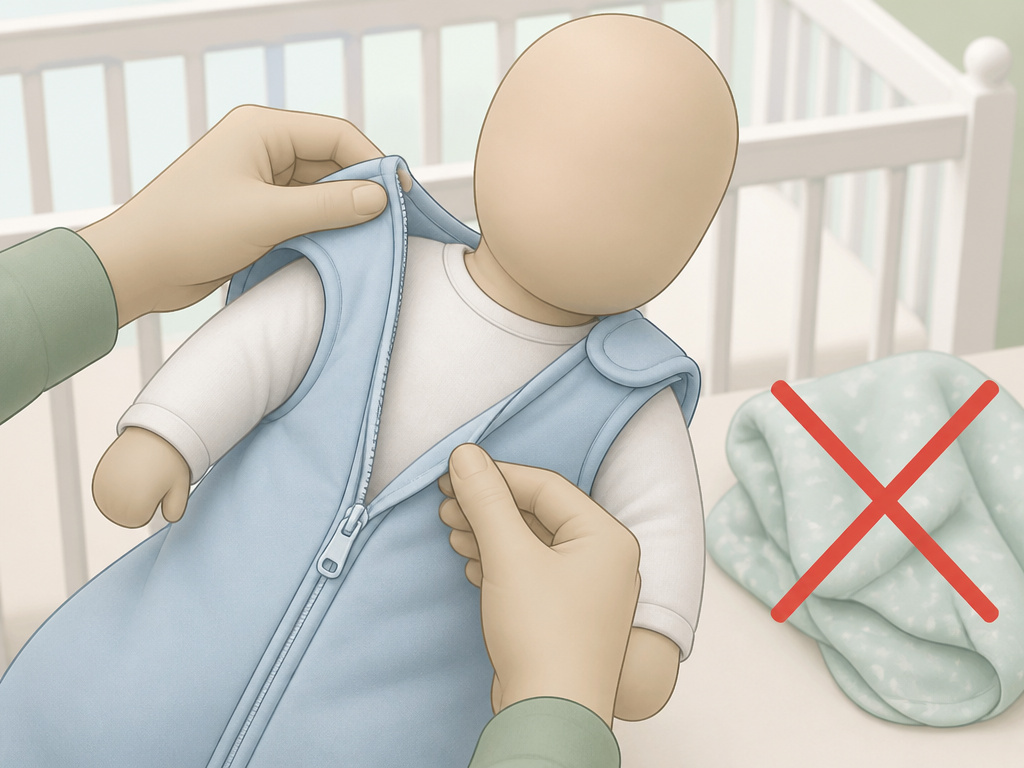 You might think a toddler is old enough for a blanket. The hard safety data says otherwise. The AAP safe sleep policy evidence shows that soft objects and loose bedding in the sleep space increase the risk of suffocation and entrapment fivefold, and much higher if the child rolls prone.
A toddler moves. A lot. A blanket gets kicked down, tangled around legs, or pulled over the face. A sleep sack, on the other hand, is worn like a dress or suit, it moves with them. It cannot cover their face. It keeps their core temperature regulated without the hazard of a loose fabric.
This is why the transition from swaddle to sack is non-negotiable. The moment your baby shows signs of rolling (often around 3-4 months), the swaddle must go. A wearable sleep bag is the safe, developmentally appropriate next step. For older toddlers, a safe sleep sack remains the safest choice until they are ready for a blanket for sleep in a big-kid bed, usually around age 3.
What About Loveys and Pillows?
A small, breathable security blanket or lovey is generally considered safe after 12 months, once the risk of SIDS has dropped significantly. Ensure it’s no bigger than your toddler’s head and has no ribbons, beads, or hard parts.
Toddler pillows are not recommended until your child transitions to a toddler bed, typically between 2 and 3 years old. Even then, choose a firm, flat, small pillow specifically designed for toddlers, not an adult pillow. The same goes for weighted blankets; the AAP safe sleep policy evidence explicitly recommends against placing weights on or near a sleeping infant, and that caution extends to toddlers due to overheating and entrapment risks.
Step-by-Step: Dressing Your Toddler for Bed Tonight
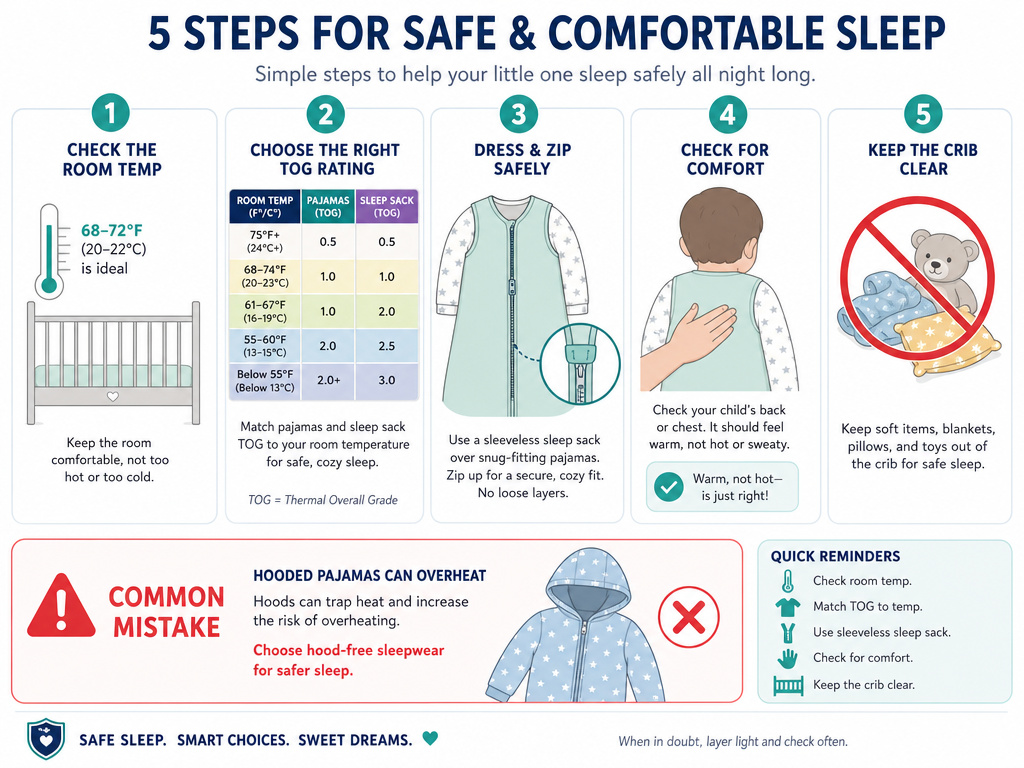 1. Check the room temperature. Use a reliable thermometer placed near the crib, not on a far wall.
2. Select the base layer. Match the pajamas to the TOG of your sleep sack using the chart above. In doubt, err on the lighter side.
3. Put on the sleep sack. Ensure it’s the correct size, snug around the neck and armholes so it can’t ride up over the face, but roomy enough in the body and legs for comfortable movement.
4. Do the chest check. After 15-20 minutes of sleep, place your hand on your toddler’s chest or upper back. Adjust layers tomorrow night based on what you feel.
5. Maintain a clear crib. The crib should contain only your toddler in their sleep clothes and sack. No extra crib blankets, stuffed animals, bumpers, or pillows.
Common mistake: Dressing a toddler in a hooded pajama for sleep. The hood can twist during the night, covering the mouth and nose or creating a pocket for rebreathing exhaled carbon dioxide. Stick to hood-free sleepwear.
Frequently Asked Questions
How many layers should a toddler wear at night?
Start with one more layer than you would wear. For a standard 70°F room where you’d wear light pajamas, dress your toddler in cotton pajamas plus a 2.5 TOG sleep sack. Always verify with the chest check.
What is the safest thing for a toddler to sleep in?
The safest option is a well-fitting, TOG-appropriate sleep sack (wearable blanket) over a pair of fitted cotton pajamas. This eliminates loose bedding while providing warmth. Products like the Bonds Wondercool range are explicitly designed with this safe sleep principle in mind.
Can a 2-year-old sleep with a blanket?
It is not recommended. The risk of entanglement and face-covering remains. Most experts suggest waiting until a child has transitioned to a toddler bed (around age 3) and can reliably understand and move a blanket. Until then, a safe toddler blanket is one that is worn, not laid loose, aka a sleep sack.
How do I know if my toddler is too cold at night?
Cold toddler will often wake up crying and have trouble settling back down. Their chest or back will feel cool, not cold, to the touch. Cool hands and feet are normal and not a sign of being too cold. If in doubt, add a layer like a onesie under their pajamas or switch to a sleep sack with a 0.5 TOG higher rating.
When should I stop using a sleep sack?
You can use a sleep sack as long as your toddler tolerates it and you can find one in their size. Many are available up to 3T or 4T. Most children naturally outgrow them when they transition to a big-kid bed and want a traditional blanket for sleep. There’s no safety reason to stop until they are ready for a loose blanket.
The Bottom Line
Dressing a toddler for sleep is a practical exercise in risk management. You’re balancing warmth against the very real danger of overheating and the hazard of loose bedding. The toolkit is simple: a room thermometer, cotton or muslin pajamas, and a sleep sack with a clear TOG rating. Trust the chest check over guesswork, and remember that a cool toddler is safer than a sweaty one. When you’re ready to introduce a real first blanket or a pillow for your toddler, do it in the safety of a toddler bed, not the crib.
