
Rolling Babies & Sleep Sacks: A Safety Review & Guidelines
This post contains affiliate links. As an Amazon Associate we earn from qualifying purchases.
Yes, standard sleeveless sleep sacks are safe for rolling babies and are actively recommended over loose blankets. The risk comes from specific, banned designs: sleep sacks with head coverings, weighted sleep sacks, or sacks with swaddle attachments used after rolling begins. A 2023 UK product safety report classified head-covering sacks as a “Serious” risk of suffocation and death.
That distinction between a safe standard sack and a hazardous variant is where most parent confusion lives. The data shows a well-fitted, sleeveless sack doesn’t just keep a baby warm—it changes the mechanics of rolling in bed in a way that safety authorities track.
What follows: the international safety standard that defines a safe sack, the data on how sacks delay prone turning, the three banned designs you must avoid, and how to transition from a swaddle at the right moment.
Key Takeaways
- A standard, sleeveless sleep sack is safe for a rolling baby and is the recommended alternative to loose blankets.
- Stop using any sleep sack with swaddle wings or attachments the moment your baby shows signs of rolling, usually around 8 weeks.
- Never use a sleep sack with a head covering or hood; a UK regulator flagged this design as a “Serious” suffocation risk.
- Weighted sleep sacks are not safe for unsupervised sleep; the AAP states there is no evidence supporting their overnight safety.
- The arms-free, baggy design of a proper sack allows a baby who rolls onto their stomach to push up and reposition.
The Short Answer from the Data
A sleeveless infant sleep sack that meets the EN 16781 safety standard is designed for use up to 24 months and allows free hip and leg movement. It provides warmth without loose bedding and, by design, may delay the age at which a baby first turns prone in the sleep environment, allowing motor skills to develop under supervision first.
The official answer from pediatric and public health bodies is consistent. The Minnesota Department of Health states it directly: “It is generally safe for infants to sleep in a sleep sack which allows their arms to be free and hips and legs to move once they start to roll over.” The critical clause is “arms to be free.” That freedom is the entire safety mechanism.
The sack itself becomes a safe sleep tool because it replaces hazardous loose blankets and, according to data, alters the timeline of a key risk event.
How a Sleep Sack Changes the Rolling Timeline
The International Society for the Prevention of Infant Death (ISPID) working group compiled the numbers. Their analysis found that babies using a sleeping sack turn prone in bed significantly later than those without one.
| Group | Average Age of First Prone Turn in Bed | Standard Deviation |
|---|---|---|
| With a Sleeping Sack | 28.03 weeks | ± 7.96 weeks |
| Without a Sleeping Sack | 21.73 weeks | ± 4.88 weeks |
The difference is nearly seven weeks, with a statistically significant p-value of less than 0.01. The group’s infant sleep sack safety analysis suggests the sack hinders turning prone until the baby has more practice with the maneuver during supervised awake time. This reduces “inexperienced prone sleeping,” which carries a higher relative SIDS risk.
The sack isn’t a restraint. It’s a wearable blanket that makes a certain motion in bed less likely until the baby is more proficient at it elsewhere. Your baby will still roll on the floor or during tummy time. The sack just makes that first accidental roll in the crib happen later, when they’re stronger.
The One Sleep Sack Design That’s Never Safe
Where this goes sideways: Using a sleep sack with a head covering or integrated hood. A December 2023 UK government sleeping bag investigation identified this design as presenting a “Serious” risk of suffocation, overheating, and death. The product breached the BS EN 16781 safety standard.
This isn’t a theoretical worry. Regulators issued a formal product safety report for multiple listed products with hoods. The hazard is twofold: the hood can directly obstruct the airway, and it can cause a dangerous rise in core body temperature. Any sack that can potentially cover the baby’s head is an immediate reject.
This also applies to sizing. A sack that is too large can ride up over the baby’s face. The ISPID factsheet notes the opening for the arms and head “should not be too large to ensure that the baby cannot slip out of the sack.” The fit must be snug at the neck and armholes, with plenty of room in the body for kicking.
The Safety Standard: ÖNORM EN 16781
This European standard, updated in October 2024, is the blueprint for a safe sleep sack. It specifies requirements for sacks used in a domestic sleeping environment for children up to 24 months. Its exclusions are as telling as its rules: * It does NOT apply to products for premature children or those of low birth weight (under 2.5 kg). * It does NOT apply to products for children who can climb out of a cot. * It explicitly does NOT apply to products designed for outdoor use, pushchairs, or car seats (like footmuffs).
A sack that conforms to this standard is engineered for safe, unsupervised sleep in a crib. It’s why checking for compliance is more meaningful than trusting marketing claims. When setting up your nursery, this standard matters as much as choosing a firm, certified crib mattress.
Swaddle Sack vs. Sleep Sack: The Critical Transition
This is the switch most parents get wrong on timing. A swaddle sack and a standard sleep sack are different products with opposite rules for a rolling baby.
A swaddle sack (or a sleep sack with swaddle “wings”) is designed to restrict arm movement, mimicking the womb. A standard sleep sack is a sleeveless wearable blanket that allows full arm and leg movement. The American Academy of Pediatrics is clear: swaddling must stop when the baby shows signs of attempting to roll, which can happen as early as 8 weeks.
The AAP suggests that swaddling should be discontinued as soon as babies begin to show signs that they are attempting to roll over on their own.
Why? A swaddled baby who rolls onto their stomach has pinned arms. They cannot push up to lift their head or roll back. This massively increases the risk of suffocation and SIDS. The Minnesota FAQ states bluntly that babies “should not wear sleep sacks with swaddle attachments or wraps once they start to roll over on their own because they could become entrapped or suffocate.”
Making the Switch
- Watch for the signs: Arching the back, rocking to the side, or getting a shoulder up during diaper changes.
- Transition cold turkey: Remove the swaddle wings or switch to a sleeveless sack immediately. Do not try one arm out.
- Expect a rough night or two: The startle reflex will wake them. This is normal and safer.
- Use other soothing tools: A consistent bedtime routine and a safe baby white noise machine can help.
The transition is non-negotiable. The risk window opens suddenly, and a good stretchy swaddle blanket for a newborn becomes an unsafe product for an 8-week-old showing roll signs. Move to a arms-free wearable blanket designed for older infants.
The Weighted Sleep Sack Warning

Weighted sleep sacks, like those from Nested Bean or Dreamland Baby, add a new layer of hazard. They insert small weights (from a half pound to nearly two pounds) into the fabric, claiming to provide calming pressure.
The official AAP safety standards are unequivocal: “There is no evidence in the peer-reviewed scientific literature evaluating the safety of weighted sleep products on typical, healthy infants” for unmonitored settings. In 2024, major retailers like Amazon and Target stopped selling them.
| Risk Factor | Mechanism of Harm | Timeline / Consequence |
|---|---|---|
| Compression & Restricted Breathing | Extra weight on the chest can compress the diaphragm, making breathing harder. For a newborn, 1 lb can be >10% of body weight. | Can lead to declining oxygen levels (hypoxia) over the course of a sleep period. |
| Inability to Reposition | If the baby rolls prone, the added weight makes it extremely difficult to lift the head or roll back to safety. | Immediate suffocation risk upon rolling. |
| Deepened Arousal Threshold | The deep pressure may inhibit the natural startle reflex that helps a baby wake if in distress. | Removes a protective neurological mechanism against SIDS. |
The only study often cited by manufacturers involved 30-minute supervised sessions. Researchers of another small, unpublished study noted that longer use “may pose the potential for both fatigue and a decline of oxygen into unsafe levels.” Overnight use is an unmonitored experiment.
Your baby’s frequent night wakings are protective. Weighted products aim to suppress that. Stick to a standard, unweighted sack and focus on safe sleep fundamentals like a firm safe sleep surface mattress and a clear crib.
Choosing and Using a Safe Sleep Sack
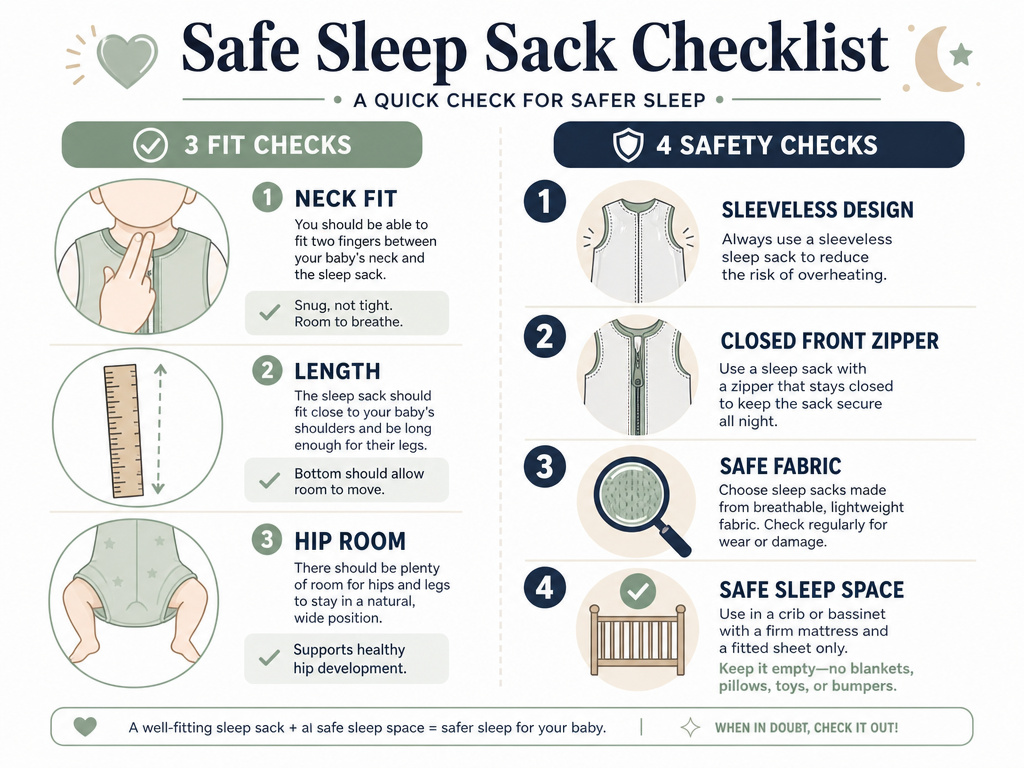
Once you’ve eliminated the dangerous designs, follow this checklist for safe use. It applies whether you’re using a basic cotton sack or part of a full set of crib bedding essentials.
Fit is Non-Negotiable:
- Neck & Armholes: Snug, but you can fit two fingers between the fabric and your baby’s neck. The baby cannot slip inside.
- Length: No more than 6 inches longer than your baby from shoulder to foot. Excess fabric can bunch and pose a hazard.
- Width: Roomy around the hips and legs to allow free movement and healthy hip development.
Material for the Season:
- Summer/Warm Room (over 75°F): A single-layer, 0.5 TOG cotton or muslin sack.
- Standard Room (68-72°F): A 1.0 TOG cotton or microfleece sack.
- Cool Room (under 68°F): A 2.5 TOG quilted or thicker sack. Dress the baby in a onesie or footed pajama underneath—the sack is the blanket layer.
Final Safety Checks Before Bed:
- Arms are completely free and the sack is sleeveless.
- The zipper is fully closed at the bottom (so it can’t be kicked open) and is in the front for supine placement.
- There are no loose threads, broken snaps, or torn fabric.
- The crib is otherwise empty: no pillows, loose baby blankets, stuffed animals, or bumper pads.
When used correctly, the sleep sack is a single, secure layer of warmth. It eliminates the need to ever introduce a loose blanket for infants into the crib before age one.
Frequently Asked Questions
Can a baby roll over in a sleep sack?
Yes, they can and they will. A proper sleep sack does not prevent rolling; it just makes it more difficult to do so accidentally while asleep. The arms-free design ensures that if they do roll onto their stomach, they can use their arms to push up, turn their head to the side, and breathe. This is the key safety difference from a swaddle.
When should I stop using a sleep sack?
You can use a standard sleep sack until your baby outgrows the largest size (typically around 2-3 years old) or until they can reliably climb out of the crib, whichever comes first. There is no safety-based age limit for a well-fitted, sleeveless sack. They transition to a toddler bed and regular blankets when they’re ready.
Are sleep sacks safer than blankets?
Absolutely. Loose blankets are a proven suffocation and entrapment hazard for infants under one year. A sleep sack is attached to the baby, cannot cover the head, and keeps them warm without any loose fabric in the crib. It is the safest way to provide warmth.
My baby rolls onto their stomach in the sack and sleeps that way. Is that okay?
Yes, if they got there on their own. Once a baby can independently roll from back to front and front to back, they can be allowed to remain in the position they choose. The sleep sack is safe for this because their arms are free. Always start them on their back, but don’t feel you must reposition them all night.
Can I use a sleep sack with a duvet?
No. The ISPID factsheet explicitly states that combining a sleeping sack with a duvet is “risk increasing.” The sack is designed to replace all other bedding. In a properly temperature-controlled room, the sack alone provides sufficient warmth. Adding a duvet creates overheating risk and potential entrapment.
The Bottom Line
A standard, sleeveless sleep sack is not just safe for a rolling baby—it’s a recommended layer of protection that replaces hazardous loose bedding. The safety hinges on three bans: no head coverings, no weighted inserts, and no swaddle attachments once rolling begins. Trust the data: a sack that meets the EN 16781 standard and allows free movement supports safer sleep by design. Ditch the swaddle sack on time, ignore the weighted product marketing, and your rolling baby has a safe, warm place to sleep.
