
Is It Ok for an Infant to Sleep in a Swing? Key Dangers
This post contains affiliate links. As an Amazon Associate we earn from qualifying purchases.
No, it is not safe for an infant to sleep in a swing. The American Academy of Pediatrics states sitting devices like swings are not recommended for routine sleep, especially for babies under 4 months. The risk is positional asphyxia, a blocked airway from the chin resting on the chest, and oxygen desaturation, which can happen silently. The only safe sleep surface is a firm, flat crib, bassinet, or play yard.
That airway risk is a physical fact, not a guideline. An infant’s head is heavy relative to their neck. In a semi-reclined swing seat, gravity pulls the chin down. The trachea kinks. Breathing slows. This isn’t about a baby being uncomfortable; it’s about anatomy defeating physiology.
What follows: the specific 10-degree rule that defines unsafe sleep products, the two physical mechanisms that make swings dangerous for sleep, and the clear federal standards that separate a swing from a bassinet. You’ll also see the recall notices that put numbers to the risk.
Key Takeaways
- The AAP says no infant, especially under 4 months, should sleep in a swing due to airway obstruction and oxygen desaturation risks.
- Any sleep product with an incline greater than 10 degrees is unsafe for infant sleep per federal law (the Safe Sleep for Babies Act).
- Positional asphyxia can occur silently, a baby may not struggle or make noise as their airway is blocked.
- Federal safety standards for swings (ASTM F2088) explicitly state they are not for sleep; bassinets (ASTM F2194) are the standard for sleep surfaces.
- If a baby falls asleep in a swing, move them to a firm, flat surface immediately.
The 10-Degree Angle and the Two Physical Dangers
The rule is simple: nothing over 10 degrees. The Consumer Product Safety Commission’s independent expert concluded that no inclined sleep product was safe. This finding led to the law that bans any product marketed for infant sleep with an incline over 10 degrees.
A swing seat typically reclines between 30 and 45 degrees. At that angle, an infant’s head tilts forward, the chin meets the chest, and the trachea, the windpipe, compresses. Oxygen saturation can drop within minutes, a condition documented in the AAP’s technical report on safe sleep environments.
The danger comes from two silent, mechanical failures, not just from a visible struggle.
First, upper airway obstruction. A young infant’s neck muscles aren’t developed enough to lift and turn the head away from a soft surface or a slumped position. In a swing, the headrest and body support can become that surface. The jaw drops back, the tongue falls against the soft palate, and the airway closes.
Second, oxygen desaturation. A 2022 AAP review of CPSC data found that infants in sitting devices are at increased risk for this. Poor head control plus head flexion reduces air flow. Blood oxygen levels dip. A baby might look peaceful but be in distress.
Where this goes sideways: Assuming a sleeping baby in a swing is a content baby. The signs of positional asphyxia are subtle, pale or bluish skin, limpness, and can be missed until it’s too late. This is why the supervision statistic is so stark.
The data shows this risk is highest under non-parental care. Deaths in sitting devices had higher odds of occurring under the supervision of a child care provider or babysitter. The assumption that “someone is watching” doesn’t mitigate the physics.
The Immediate Move Rule
If your baby falls asleep in the swing during awake time, the rule is non-negotiable. Move them. Gently unbuckle the harness, support their head and neck, and transfer them to a firm, flat sleep surface like a crib mattress in a safety-approved crib. The transfer might wake them. That’s better than the alternative.
The swing has one job: supervised, awake soothing. It fails the sleep test on every measurable safety parameter.
What the Federal Standards Actually Say
The law draws a bright line between a swing and a sleep product. You can see it in the standards.
The mandatory federal safety standard for infant swings is ASTM F2088. Its first clause, section 1.3, is unambiguous: “This specification does not cover products in the rest (non-rocking) position that are intended to provide sleeping accommodations for the occupant.” Those products fall under ASTM F2194, the standard for bassinets and cradles.
| Standard | ASTM F2088 (Swing) | ASTM F2194 (Bassinet/Cradle) |
|---|---|---|
| Intended Use | Swinging/gliding for awake infant | Stationary sleep accommodation |
| Surface Incline | Often 30+ degrees | Must be nearly flat (≤10 degrees) |
| Side Height & Integrity | Tested for containment during motion | Tested for prevention of falls and entrapment during sleep |
| Warning Labels Required | “ALWAYS use restraints.” “Stay near and watch infant during use.” “Not for unsupervised sleep.” | Labels regarding firm mattress and avoiding soft bedding. |
This division is why a “cradle swing” has a special rule. The federal infant swing safety standard (16 CFR Part 1223) states that if a cradle swing is in its stationary, non-rocking mode, it must comply with the bassinet standard. Most are not tested to that higher bar. The warning labels on your swing are not suggestions; they are legal requirements because the product is not designed to be a bed.
Manufacturers know this. The 2021 infant swing rule amendments strengthened the language on warnings, changing “Never leave infant unattended” to the more direct “Stay near and watch infant during use.” The shift is from passive rule-following to active supervision.
Recalls and Warnings: The Real-World Consequences
When the standards are ignored or products are mis-marketed, the results are recorded in official recalls. These aren’t theoretical risks.
In October 2024, Fisher-Price recalled over 2 million Snuga Infant Swings. The CPSC recall for suffocation hazard cited five reported deaths between 2012 and 2022. The infants, aged 1 to 3 months, were in swings being used for sleep, often with added bedding. The recall instructs parents to cut off and remove the headrest and body support insert immediately.
Then, in May 2025, the CPSC issued a stark stop-use warning for suffocation risk for Elephtt-baby Infant Swings. These were explicitly marketed for infant sleep and had an incline greater than 10 degrees, violating federal law. The warning tells consumers to stop using them immediately.
These actions highlight the two main failure modes: a legitimately labeled swing used incorrectly for sleep, and a product illegally marketed as a sleep device. Both lead to the same hazardous outcome.
Why “But My Baby Loves It” Isn’t a Safety Argument
A baby who sleeps soundly in a swing is succumbing to a motion-induced trance, not endorsing a safe product. The rocking is a powerful soother, but it doesn’t change the underlying physics of their airway in that position.
The convenience is undeniable. The average young infant spends 5.7 hours a day in a car seat or similar device. That habit normalizes the risk. Breaking it means committing to the transfer, every single time.
The Only Safe Alternative: Firm, Flat, and Bare
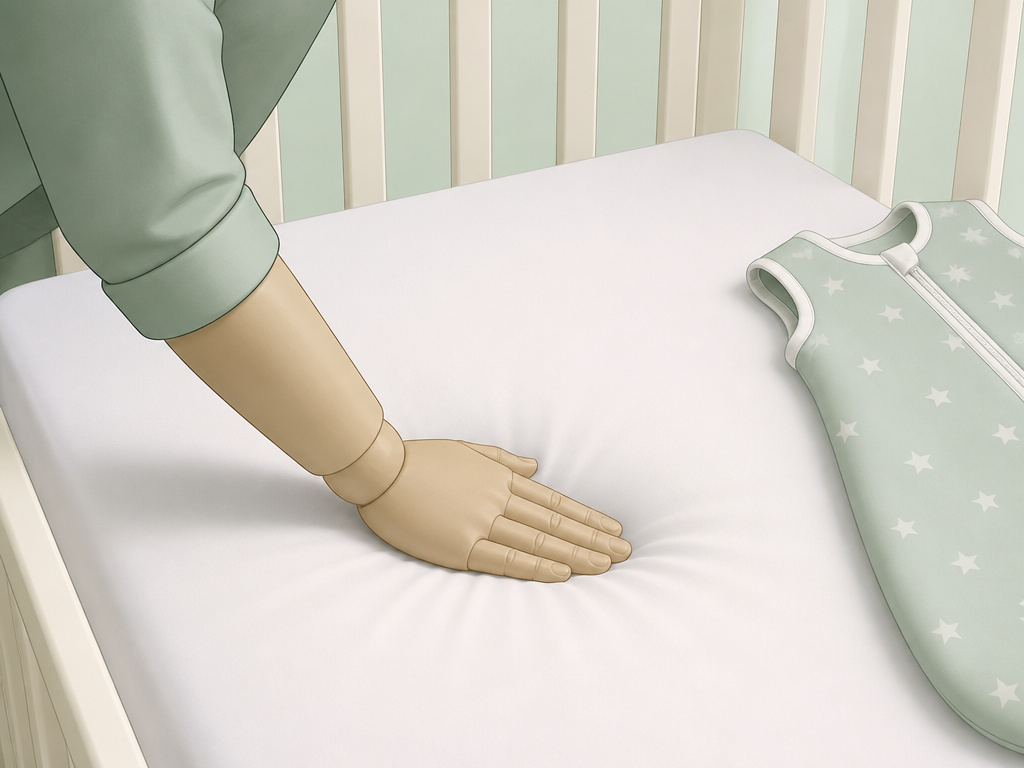
The safe sleep checklist is short, specific, and non-negotiable. This is the ABCs of safe sleep: Alone, on their Back, in a Crib (or bassinet/play yard).
The surface must be firm. Press your hand down and lift it. The surface should snap back quickly, with no indent. This prevents the baby’s face from sinking into a plush material. A proper firm crib mattress is essential, not optional.
The surface must be flat. A slight incline for reflux is not recommended by the AAP. It increases the risk of sliding down or rolling into a dangerous position. True bedside bassinets and infant beds are designed to be level.
The sleep space must be bare. No pillows, blankets, stuffed animals, crib bumpers, or loose sheets. Use a fitted sheet designed for the specific mattress for newborn and a wearable sleep sack for warmth.
This setup is for every nap, not just for nighttime. The consistency reduces risk and builds a safe sleep habit.Products that blend functions, like a swing that becomes a stationary sleeper, often fail at one of them. Choose a dedicated, certified sleep space instead.
Making the Switch Practical
If your baby only naps in motion, the transition takes patience. Start with the first nap of the day in the crib, when sleep drive is highest. Use white noise and blackout curtains to replicate the womb-like environment the swing provided. It might take a week of short, frustrating naps. The payoff is a baby who can sleep safely anywhere, and a parent who isn’t tethered to a swing’s plug.
For those seeking materials that align with a safety-first mindset, an organic infant mattress can provide peace of mind regarding materials, but its firmness and flatness are the non-negotiable traits. Similarly, a breathable crib mattress can add a layer of airflow reassurance, but it still must be used in a bare, flat crib.
Frequently Asked Questions
Can a newborn sleep in a swing for a short nap?
No. The risk of positional asphyxia is highest for infants under 4 months, and it is not related to the length of the nap. A 20-minute nap is enough time for oxygen levels to drop dangerously. The AAP safe sleep policy evidence base is clear: move them to a flat surface.
What about swings that recline completely flat?
If a swing seat truly reclines to a fully flat position (≤10 degrees) and is certified as a bassinet (meets ASTM F2194), it could be used for sleep only in that flat position. Most swings do not meet this dual standard. Check the product manual and labels for bassinet certification, it will be explicitly stated.
Is it safer if I’m watching my baby sleep in the swing?
Supervision does not prevent positional asphyxia. The airway blockage is internal and often silent. A baby can look asleep and be in distress. Being in the same room doesn’t change the unsafe sleep environment. Your presence is crucial for awake time in the swing, not for mitigating sleep risk.
My pediatrician said a swing nap was okay. What now?
Guidelines change as new evidence emerges. The current AAP policy and federal law are based on the latest injury and fatality data. Have a follow-up conversation with your pediatrician, citing the 2022 AAP report and the recent CPSC recalls. A safe infant mattress in a crib is the medically recommended standard.
Are baby bouncers and car seats just as dangerous for sleep?
Yes. The AAP groups all sitting devices together. Car seats, bouncers, strollers, and swings pose the same positional risk. A study of 47 deaths in sitting devices found 31 were in car seats. If the baby falls asleep in any of them, the same rule applies: move them to a firm, flat surface.
Before You Go
The swing is a tool for calm, alert moments. It is not a crib.
The evidence is physical, statistical, and regulatory. An incline over 10 degrees is illegal for a reason. The recall of millions of swings is not a precaution; it’s a correction. Your baby’s anatomy doesn’t negotiate.
The safe path is unambiguous: a firm, flat mattress for baby in a safety-certified crib, bassinet, or play yard. Every single time. That transfer, that consistency, is the only reliable barrier between a common convenience and a documented, silent danger.
