
How to Use Baby Donut Pillows: A Simple Step-by-Step Guide
This post contains affiliate links. As an Amazon Associate we earn from qualifying purchases.
To use a baby donut pillow, place your baby on their back with the back of their head centered in the pillow’s hollow. The neck support should cradle the cervical spine, and the shoulders must rest on the flat surrounding area. This pillow is for supervised positioning during awake time or feeding, never for unsupervised sleep. Using the wrong size, typically defined by your baby’s weight, leads to poor support and negates any benefit.
That “never for sleep” clause isn’t a suggestion. It’s the line between a positioning aid and a suffocation hazard. The hollow is designed to offload pressure from a soft skull, but it creates a pocket that can trap an infant’s face if they roll or are placed incorrectly.
What follows is the breakdown: the three-step placement check, the weight-based size chart that matters more than age, and the federal safety rule that redefined these products in 2025. By the end, you’ll know exactly when to use it, when to put it away, and how to spot a design that’s actually built for the job.
Key Takeaways
- A baby donut pillow is strictly for supervised awake time or feeding; it is not a sleep product and carries a suffocation risk if misused.
- Correct placement is non-negotiable: baby on their back, head centered in the hollow, neck supported, and shoulders on the pillow’s flat surface.
- Match the pillow size to your baby’s current weight, not their age, using the manufacturer’s chart, common sizes support up to 6kg, 8kg, and 10kg.
- The U.S. Consumer Product Safety Commission (CPSC) now regulates nursing pillows, which includes many donut-style pillows, with mandatory safety standards as of April 2025.
- Never adjust the stuffing yourself; if a pediatrician or physiotherapist recommends a custom fit, they should oversee the modification through the pillow’s zip.
What a Baby Donut Pillow Is Actually For
These pillows have one job: to provide pressure-free support for a baby’s head during supervised, awake periods. The hollow in the center elevates the occipital bone (the back of the skull) so it isn’t pressing flat against a mattress or floor. This can help prevent or improve positional head flattening, known as positional plagiocephaly.
They are also used to support proper alignment during feeding. A study on the Ing Oun breastfeeding pillow, a donut-style design, found it helped maintain a baby’s head and body in line during side-lying feeds, which improved latch and reduced nipple pain for mothers. The key term is during feeds, a short, supervised activity.
A 2020 randomized controlled trial published by the NIH breastfeeding pillow study found that using a breastfeeding pillow significantly reduced maternal discomfort in the back, neck, and arms during feeding sessions. The support allowed for better positioning, which is the core principle behind donut pillow use.
This is not a tummy time aid, a napping dock, or a sleep positioner. Confusing it for those is where the danger starts. Its utility is narrow, specific, and time-limited, typically from birth until a baby becomes too mobile to stay on it, usually around one year old.
Step-by-Step Guide to Using a Donut Pillow
Follow this sequence every time. Skipping a step compromises the support and the safety.
1. Prep the Pillow.
Remove any plastic packaging. If it has a removable cover, wash it according to the label, most Oeko-Tex certified cotton covers handle a gentle 30°C cycle. Ensure the pillow itself is clean, dry, and firm. The stuffing shouldn’t be lumpy or shifted.
2. Position the Pillow on a Firm, Flat Surface.
Place the pillow on the floor, a play mat, or a firm mattress. Never use it on an adult bed, sofa, or cushioned recliner. Those surfaces are too soft and increase the risk of rolling and entrapment. For a very active baby who scoots, you can place the pillow under a fitted crib sheet on a firm mattress to prevent slipping, but only during supervised awake time.
3. Place Your Baby.
This is the critical move. Lay your baby on their back. Gently center the back of their head in the middle of the hollow. Look and feel for two contact points: the neck should be snug against the raised neck support, and the baby’s shoulders and upper back should be resting on the flat surrounding area of the pillow. If the shoulders are hanging off, the pillow is too small. If the head isn’t deep enough in the hollow, the pillow is too big or not positioned correctly.
4. Supervise and Limit the Session.
Stay within arm’s reach. Use the pillow for short periods, 15-20 minutes during play or for the duration of a feeding. When the session is over, or if your baby falls asleep, immediately remove them from the pillow and place them in a bare, flat crib.
Where this goes sideways: Using the pillow for “just a quick nap.” Drowsiness sets in fast. If the baby’s head slumps forward or to the side, their face can press into the padded ring. Airflow is restricted within minutes. The rule is absolute: if the baby sleeps, the pillow goes away.
Safety Rules You Cannot Skip
 The mechanics of infant breathing make these rules non-negotiable. A baby’s airway is the diameter of a drinking straw and easily obstructed.
Rule 1: Back is Best, Face is Never.
The baby must always be on their back. Never place them on their tummy or side with the pillow. The Federal Register safety standard for nursing pillows, which covers these products, explicitly states they are for feeding support only, not for sleep.
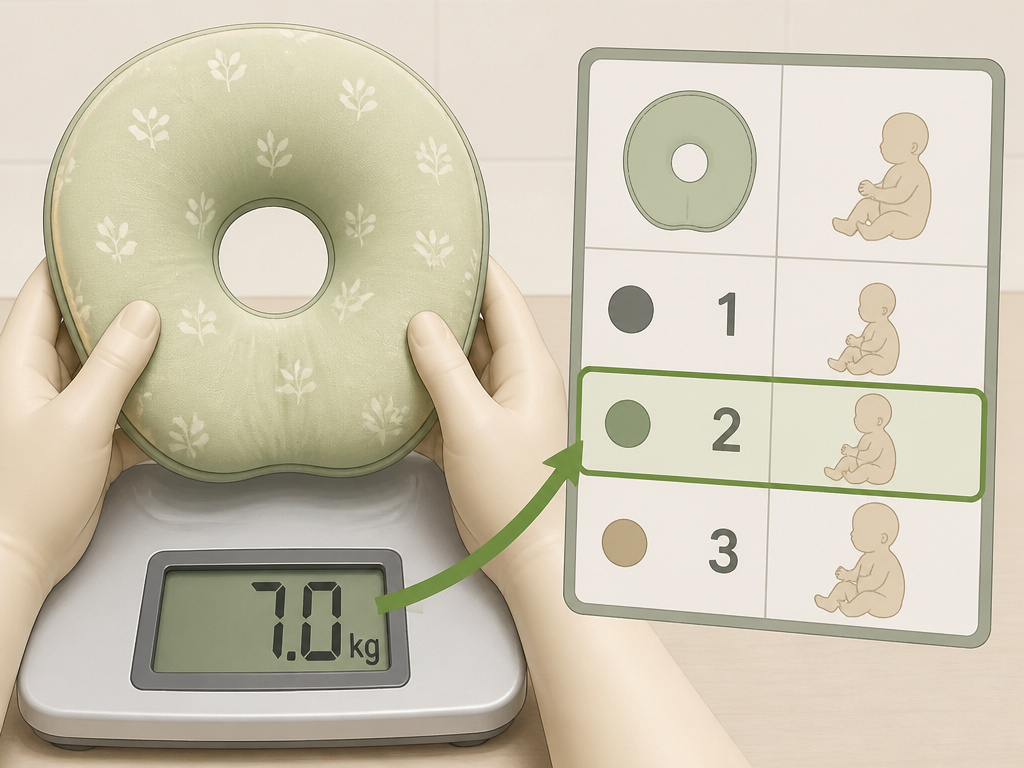
Rule 2: Match the Size to Weight, Not Age.
Age ranges are guesses. Weight is physics. Use the manufacturer’s weight chart. For example, the BabyDorm pillow comes in three precise sizes: | Pillow Size | Weight Range | Head Hollow Dimensions | |——————|——————|—————————-| | Size 1 | Up to 6 kg | 7.2 x 7.2 cm | | Size 2 | 6–8 kg | 9.5 x 9.5 cm | | Size 3 | 8–10 kg | 9 x 10.5 cm |
A too-large hollow won’t support the neck. A too-small hollow creates pressure points on the skull. This is why grabbing a hand-me-down baby pillow without knowing its size is a bad idea.
Rule 3: Never Modify the Stuffing Yourself.
Some pillows, like the BabyDorm, have a zip for adjustment. The manufacturer’s instructions are clear: “do not do this yourself, but only under the supervision of a paediatrician or a physiotherapist.” Adding or removing filling changes the pillow’s safety profile and support mechanics. Leave it to a professional with a specific therapeutic goal.
Rule 4: Understand the New Legal Landscape.
As of April 23, 2025, all new nursing pillows manufactured for the U.S. Market must comply with a mandatory government nursing pillow regulation (CPSC rule based on ASTM F3669-24). This standard defines these products, mandates warning labels, and requires them to be registered as durable infant products. When shopping, look for evidence of compliance, it means the product has been tested for stability and has clearer safety warnings.
Choosing the Right Pillow and Using It Correctly
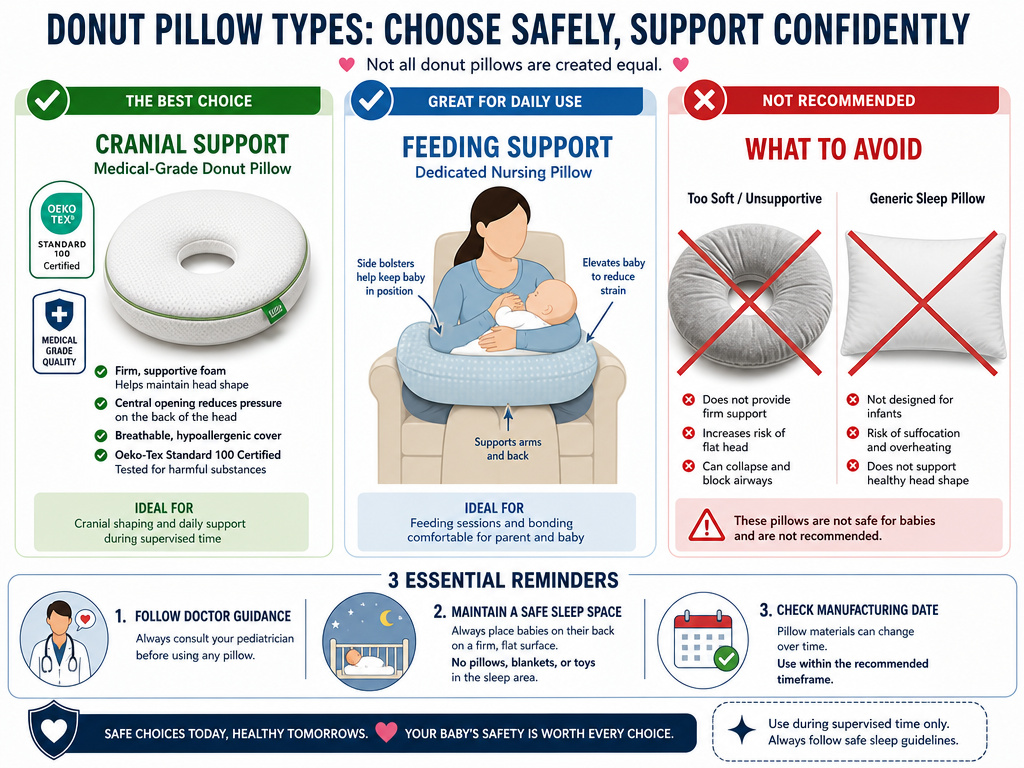 Not all donut pillows are created equal. The right choice is defined by material, adjustability, and intended use.
For Cranial Support: BabyDorm or Similar Medical-Grade Pillows.
These are designed specifically for positional plagiocephaly. They are firmer, have defined weight/size categories, and often use Oeko-Tex certified fabrics. They are tools for a specific purpose, preventing or managing flat head, and should be used under a doctor’s or therapist’s guidance. Their three-size system is a benchmark for what proper sizing looks like.
For Feeding Support: Dedicated Nursing Pillows.
A pillow like the Ing Oun breastfeeding pillow is designed for the side-lying position. It has additional components (like round side-pillows) to support the baby’s back and prevent rolling. According to the Consumer Reports safety guide, when using any pillow for feeding, you must move the baby to a safe sleep space if they or you become drowsy. This type of pillow is a feeding pillows for baby, not a general-purpose lounger.
What to Avoid.
Skip any pillow that is overly soft, lacks a firm neck support, or has a hollow that looks too deep. Avoid pillows marketed for “sleep” or “napping.” Steer clear of second-hand pillows where the integrity of the stuffing is unknown or that were manufactured before the 2025 CPSC rule. A pillow that has been compressed in storage for years may not provide the intended support.
Cleaning and Maintenance
Keeping the pillow clean is part of safety. Germs and dust mites are irritants.
The Cover.
Most removable covers are machine washable in cool or warm water. Use a mild, fragrance-free detergent. Tumble dry on low or air dry. The Oeko-Tex certification on many covers means the fabric has been tested for harmful substances, but it doesn’t mean indestructible, follow the wash instructions.
The Pillow Itself.
Most solid donut pillows with bead or polyester fiberfill are not submersible or machine washable. Spot clean only with a damp cloth and mild soap. Let it air dry completely before use. Getting the core wet can clump the filling, break down the materials, and create a mold risk inside. If the pillow is heavily soiled, it’s time to replace it.
When to Replace.
Replace the pillow if the fabric is torn, the stitching is coming apart, or the filling is lumpy and no longer provides even, firm support. The typical functional life for a well-cared-for pillow used with one child is about a year. Do not pass it on to another child unless you are certain of its history and hygiene.
Frequently Asked Questions
Where Do You Place a Baby Donut Pillow?
Place it on a firm, flat surface like the floor or a firm crib mattress. The baby goes on top, on their back. Never place the pillow on an elevated, soft, or uneven surface like a couch, adult bed, or nursing chair where the baby could roll off or sink in.
Can a Newborn Use a Donut Pillow?
Newborn can use a properly sized donut pillow (like a Size 1 BabyDorm for up to 6kg) under very close supervision for short awake periods, such as during a feeding. However, the safest place for a newborn to sleep and spend most of their time is on a flat, firm surface with no pillows, blankets, or padding. The younger the infant, the greater the risk from any padded product.
How Long Can a Baby Stay on a Donut Pillow?
Limit sessions to 15-20 minutes at a time. This is long enough for a feeding or a short play period but short enough to minimize risk and prevent the baby from getting stuck in one position. Always supervise. Total daily use will vary based on the reason for use (e.g., a therapy schedule vs. Occasional feeding support).
Are Donut Pillows Safe for Side Sleeping?
No. Donut pillows are not safe for infant sleep in any position. The official CPSC safety rule specifically addresses the hazard of infants falling asleep on nursing pillows. For side-lying feeding, a specific pillow design like the Ing Oun may be used with the baby facing the mother, but the baby must be moved immediately after the feed.
What’s the Difference Between a Donut Pillow and a Nursing Pillow?
The terms often overlap. A “donut pillow” typically describes the shape with a central hollow. A “nursing pillow” describes the function, support during feeding. Many nursing pillows are donut-shaped. The critical difference is that any pillow used for feeding must adhere to the new CPSC safety standards for nursing pillows, which include specific warnings and design requirements.
Before You Go
A baby donut pillow is a tool, not a toy. Its value is locked behind strict rules: back placement only, weight-based sizing, and constant supervision. It serves two narrow purposes, managing head shape under professional guidance or aiding feeding alignment. The moment your baby drifts off, the tool’s job is over, and they need to be moved to a safe, flat sleep space.
The landscape changed in 2025. Look for products that comply with the new CPSC standard; that label is your signal that the manufacturer has at least considered the documented risks. Whether you’re considering a BabyDorm pillow for positional support or a nursing pillow for feeding, the principle is the same. Use it for the job it was designed for, and put it away when that job is done. Everything else is a risk that isn’t worth taking.
