
How to Make Baby Bed Sheet | The Crib Sheet Math That Fits
This post contains affiliate links. As an Amazon Associate we earn from qualifying purchases.
To make a baby bed sheet, you need your mattress’s exact length, width, and depth. Add twice the depth plus 4 inches to both length and width for your fabric dimensions. Cut squares from each corner, sew the edges to form a box, and attach elastic all the way around the hem. A standard 66” x 96” twin sheet cuts in half to make two crib sheets using this method.
That 4-inch addition is not a guess. It’s the seam allowance and fabric you need to tuck under the mattress so the elastic can grip. Skip it, and your sheet will pop off the first time your baby rolls over. The math is simple, but the margin for error is zero.
What follows is the breakdown of two proven paths: converting a twin sheet for speed, or cutting custom fabric for a perfect fit. We’ll cover the mandatory safety standard, the tools that save time, and the one measurement mistake that ruins sheets.
Key Takeaways
- Always pre-wash new fabric or a twin sheet to account for first-wash shrinkage before you cut.
- The official ASTM F1917 infant bedding standard is the safety benchmark for any crib sheet you make or buy.
- For a custom sheet, your fabric width must be at least: Mattress Width + (2 x Mattress Depth) + 4 inches.
- Attaching elastic only at the corners is faster, but elastic around the entire hem provides a more secure, lasting fit.
- Knit fabric doesn’t fray, making it a forgiving choice for co-sleeper or bassinet sheets.
The Safety Standard You Can’t Ignore
Every piece of infant bedding, including a homemade fitted sheet, should meet the same baseline safety requirements. The ASTM F1917 consumer safety specification for bedding sets those rules. This isn’t optional guidance. It’s the documented performance standard that defines safe infant bedding.
The ASTM F1917-23 standard establishes safety performance requirements, test methods, and labeling to minimize hazards to children from infant bedding, which explicitly includes fitted sheets.
The standard covers everything from fabric flammability to the security of fitted corners. When you choose materials and construct a sheet, you are acting as the manufacturer. Your choices must prioritize safety over cuteness. This means selecting tight-weave, breathable fabrics like cotton or bamboo, ensuring all seams are secure to prevent unraveling and loose threads, and avoiding any decorative elements like ribbons or buttons that could detach.
The Twin Sheet to Two Crib Sheets Method
This is the fastest route to a custom crib sheet if you have a spare twin flat sheet. The math is already done for you. A standard twin sheet measures 66 inches wide by 96 inches long. Cutting it in half horizontally gives you two 66” x 48” rectangles, the perfect starting size for a standard crib mattress.
Do you pre-wash the twin sheet first? If the sheet is brand new, you must launder it before you cut. Cotton fabrics can shrink up to 5% on the first wash. Cutting an unwashed sheet guarantees your finished crib sheets will be too small after that first laundry cycle.
Here is the step-by-step breakdown. The goal is to transform a flat rectangle into a fitted sheet with elasticated corners.
| Step | Action | Key Detail | Risk If Skipped |
|---|---|---|---|
| 1. Prep & Cut | Iron the twin sheet, fold in half horizontally, and cut along the fold. | You now have two identical 66″ x 48″ rectangles. | Uneven halves lead to one poorly fitting sheet. |
| 2. Hem Raw Edge | Create a double-fold hem along the cut edge you just made. | Match the depth of the sheet’s existing factory hems. | The raw edge will fray and weaken with washing. |
| 3. Mark & Cut Corners | Find the single layered corner, mark an 8″ x 8″ square, and cut it out. | This cut goes through all four layers of the folded fabric. | Wrong size or placement creates a too-shallow or too-deep pocket. |
| 4. Sew Box Corners | With right sides together, pin and sew the two cut edges at each corner. | Use a 1/2-inch seam allowance and finish with a zigzag stitch. | Unfinished seams fray; the corner won’t hold the mattress depth. |
| 5. Attach Elastic | Pin elastic at intervals inside the hem, stretch as you sew with a zigzag. | An 80-inch length of 1/4″ elastic is typical for a full perimeter. | Elastic that isn’t stretched while sewing won’t pull the sheet snug. |
Where this goes sideways: Skipping the zigzag stitch to finish the corner seams. A straight stitch alone will fray after a few washes, the seam will weaken, and the corner will tear open just as the sheet gets broken in.
The finished sheet should fit a standard 28″ x 52″ crib mattress snugly. The elastic needs to be tight enough that you have to stretch the sheet to get it over the mattress corners. If it slides on easily, it will slide off just as easily.
Cutting Custom Fabric for Any Mattress
For a non-standard mattress, a mini crib, a bassinet, or a co-sleeper, or if you want a specific fabric, you’ll start from yardage. This method gives you total control. The first step is non-negotiable: measure your mattress. Get the exact length, width, and depth. Mattress depths can vary from 5 inches for a simple crib to 12 inches for a plush toddler bed.
The Custom Fabric Formula
- Fabric Width Needed = Mattress Width + (2 x Mattress Depth) + 4 inches
- Fabric Length Needed = Mattress Length + (2 x Mattress Depth) + 4 inches
That “+ 4 inches” is your buffer. It accounts for the 1/2-inch seam allowance on each side and the fabric that tucks under the mattress for the elastic to grip. For a standard 28″ x 52″ x 6″ crib mattress, you’d need fabric at least 44 inches wide (28 + 12 + 4) and 68 inches long (52 + 12 + 4).
If your chosen fabric isn’t wide enough, you’ll need to seam pieces together. This is common with 45-inch-wide quilting cotton. The best practice is to add panels to each side of a central width panel to avoid a prominent seam running down the middle of the sheet where your baby lies.
Choosing Your Fabric and Elastic
Not all fabric is suitable for baby sheets. You need something breathable, durable through countless washes, and free from harmful chemicals.
- Cotton: The default choice. Look for tight-weave, percale, or organic cotton. It’s breathable and gets softer with washing.
- Bamboo Viscose: Exceptionally soft and temperature-regulating, but can be slippery to work with and often requires a wider hem.
- Knit Fabric: A hidden gem for small, non-standard mattresses. As shown in one tutorial, a yard of 60-inch-wide knit made a perfect co-sleeper sheet. Knit doesn’t fray, so you can skip hemming raw edges inside the casing, but it requires a zigzag stitch for construction seams to retain stretch.
For elastic, standard 1/4-inch braided elastic works. Fold-over elastic is a clean alternative, you sew it over the raw edge of the fabric, finishing and elasticating in one step. For a full perimeter, you’ll need a length roughly equal to the distance around your finished sheet minus 15-20% to create the necessary tension.
The Elastic Decision: Full Perimeter vs. Corner-Only
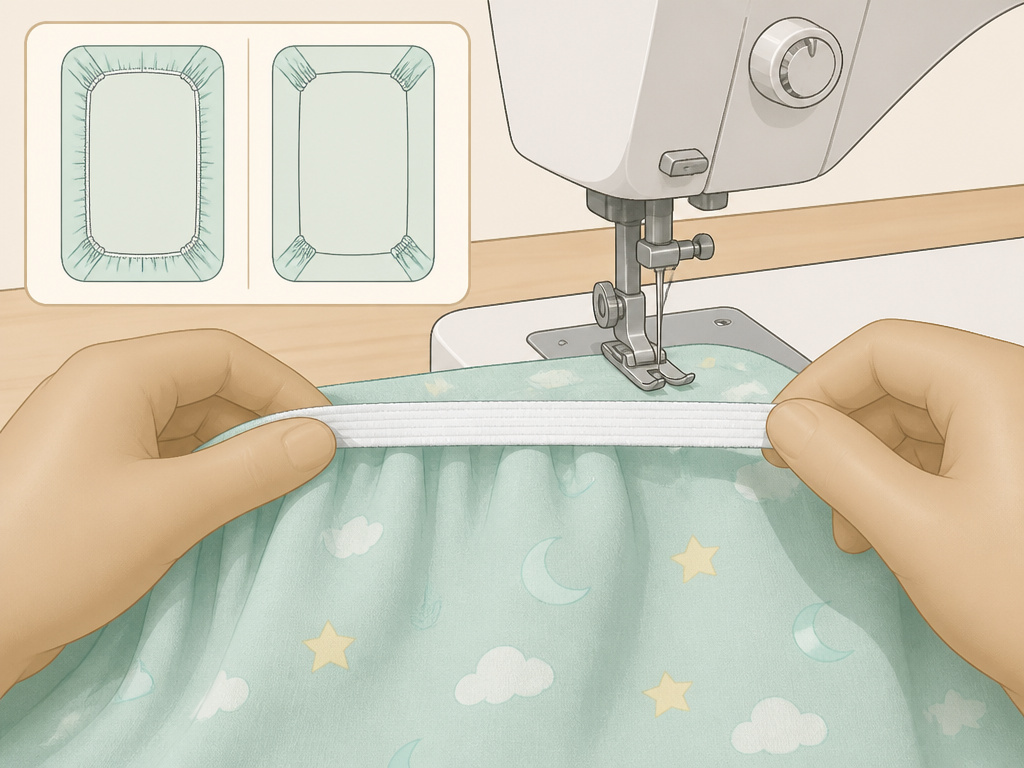
You have two options for securing the sheet, and the choice changes the sewing process. Each has a different outcome for fit and longevity.
| Method | How It Works | Best For | The Trade-Off |
|---|---|---|---|
| Full Perimeter Elastic | A continuous length of elastic is sewn (stretched) to the inside of the entire hem. | Standard crib sheets, active toddlers, mattresses with rounded edges. | Most secure fit. Uses more elastic and takes longer to sew evenly. |
| Corner-Only Elastic | Four separate pieces of elastic (about 10″ each) are sewn only at the bottom of each boxed corner. | Quick projects, bassinet sheets, lightweight mattresses. | Faster to sew. The sheet’s sides can billow and are more likely to come untucked. |
Common mistake: Not stretching the elastic enough while sewing the full perimeter. The elastic should be stretched to match the fabric length under your presser foot. If you sew it relaxed, the sheet will be baggy and won’t grip the mattress.
The full-perimeter method is the professional standard for a reason. The tension is distributed evenly, and the sheet stays locked on. The corner-only method can work for a lightweight co-sleeper mattress that doesn’t get much movement, but for a primary crib sheet, go the full distance.
Finishing, Fitting, and Final Safety Check
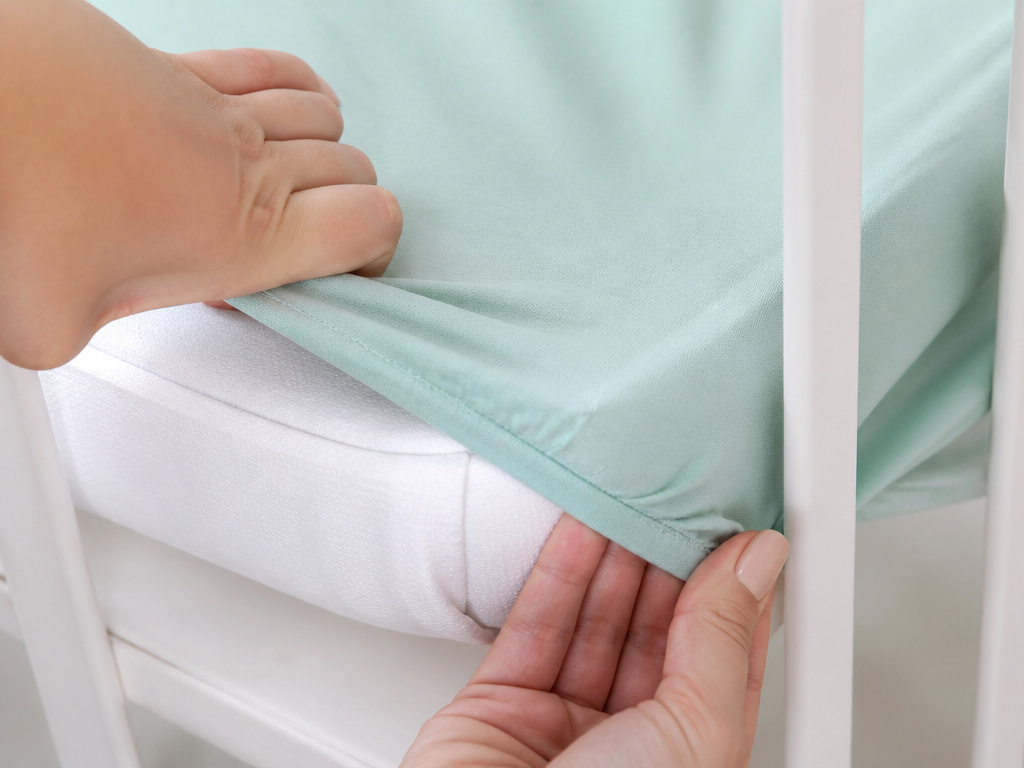
Once the elastic is attached, trim your threads and give the sheet a final press with an iron. This sets the seams and gives you a clear look at your work. Now, fit it on the mattress.
The sheet should require a firm stretch to go over each corner. The fabric should sit smoothly on the mattress top with no loose pockets or wrinkles. The sides should be taut, and the elastic should be completely tucked underneath. If the sheet is loose, you can un-pick a section of the elastic, shorten it, and re-sew. If it’s too tight and distorting the corners, you’ll need to replace the elastic with a longer piece.
Before you use it, perform a safety check. Run your fingers along every seam, especially the box corners, feeling for any gaps or loose threads. Tug gently on the elastic where it’s sewn to ensure it’s secure. Verify the fabric is breathable and the fit is snug, a loose sheet is a entanglement hazard. This final inspection is where you enforce the ASTM International safety standard in your own home.
Frequently Asked Questions
Can I use a full or queen sheet instead of a twin?
You can, but the math changes. A twin sheet’s dimensions are uniquely efficient for yielding two crib sheets with minimal waste. A full or queen sheet is much larger, so you’d need to measure and cut a custom rectangle from it, which may leave odd-shaped remnants. It’s often easier to just buy a yard of fabric.
What’s the best thread for sewing baby sheets?
Use a high-quality polyester or cotton-wrapped polyester thread. It’s stronger than pure cotton and will withstand the repeated stress of stretching the sheet on and off the mattress, plus countless hot washes. A fine, 50-weight thread will create less bulk in your seams.
How do I make a sheet for a round or oval mattress?
The basic principle is the same: create a fabric pocket. For a round co-sleeper, the method is different. One approach is to sew two layers of knit fabric together around the mattress, trace an inner oval, and then sew elastic inside that inner channel. It’s more advanced and benefits from a stretchy fabric that doesn’t require precise corner boxing.
Is knit fabric safe for crib sheets?
Knit fabric is generally safe if it’s breathable and fits snugly. Its stretch can provide a very tight, wrinkle-free fit. However, ensure the knit is a stable, tight weave and not a loose, slinky material that could sag or pose a breathing risk. It’s an excellent choice for breathable mattress pads or fitted layers.
How often should I replace a homemade crib sheet?
Replace the sheet if the elastic loses its stretch, if fabrics become pilly and rough, or if any seams begin to fray or weaken. With high-quality materials and construction, a homemade sheet should last as long as a store-bought one, through one child’s crib use and possibly into the toddler bed years with proper care.
The Bottom Line
Making a baby bed sheet is a straightforward project that rewards precision. Start with the right fabric, pre-washed cotton is your safest bet. Measure your mattress three times, cut once, and follow the box-corner formula. Attach elastic around the entire hem for a fit that lasts. Most importantly, build every stitch with the official infant bedding test methods and safety requirements in mind. The result is more than a custom sheet; it’s a secure, comfortable layer you made specifically for your child’s sleep space.
