
A Complete Guide on How to Decorate a Baby Bed Safely
This post contains affiliate links. As an Amazon Associate we earn from qualifying purchases.
To decorate a baby bed, you start with the mattress. It must be a certified full-size crib mattress that fits snugly within the crib frame, no gaps wider than two fingers. Decoration is limited to a fitted sheet, a breathable mesh liner if needed, and any non-fabric items like wall decals or mobiles placed securely outside the sleep space. Soft toys, pillows, and loose blankets are banned from the bed itself.
That mattress fit isn’t just a suggestion. The ASTM F1169 crib safety standard defines it as the first line of defense against entrapment. A gap wider than 3 centimetres between the mattress and the crib side is a documented hazard.
This guide walks through the three layers of decorating a nursery sleep space: the non-negotiable safety specs, the minimal bedding that actually belongs in the crib, and the decorative touches that live safely around it. You’ll learn how to verify your crib meets current codes, how to choose textiles that don’t add risk, and where to safely add personality.
Key Takeaways
- The mattress is the foundation, it must be at least 27 ¼ by 51 ⅝ inches and no thicker than 6 inches, with less than a 3 cm gap on all sides.
- Slat spacing is not visual. The ASTM standard uses a 2 ⅜-inch wide block test; if it passes through, the crib fails.
- Wood cribs warp with humidity changes. A vaporizer aimed at the crib can swell joints and loosen hardware within a season.
- Inside the crib, decoration is one fitted sheet. Breathable mesh liners are the only safe add-on for bumper-like coverage.
- All soft decor, blankets, pillows, stuffed animals, belongs on a shelf, a rocking chair, or the wall, never in the sleep space.
The Safety Canvas: Your Crib’s Non-Negotiable Specs
You don’t decorate a canvas without checking if it’s sturdy. The crib is that canvas. Every decorative choice sits on top of its physical reality, and that reality is defined by numbers.
The ASTM F1169 crib safety standard is the rulebook. It was written in response to incident data collected by safety commissions. Its measurements aren’t arbitrary.
The standard specifies an interior crib width of 28 ± ⅝ inches and length of 52 ⅜ ± ⅝ inches. The mattress must be at least 27 ¼ by 51 ⅝ inches. This creates a designed gap, but that gap cannot exceed 3 centimetres (about two adult fingers) at any point.
The Mattress Fit Test (It’s Not What You Think)
Don’t just eyeball it. Take the mattress out. Measure it seam-to-seam. It must hit the minimum dimensions printed in your crib’s manual, for a Dorel Home 3-IN-1 CONVERTIBLE Crib, that’s 27-1/4 by 51-5/8 inches. The 6-inch thickness limit is equally critical; a thicker mattress raises the sleeping surface and lowers the effective side rail height.
Now, put the mattress back in. This is the test.
- Press the mattress firmly into one corner.
- Try to slide your hand between the mattress and the crib side at the opposite corner.
- If you can fit more than two fingers (roughly 3 cm) into that gap, the mattress is too small.
A too-small mattress shifts. A sleeping baby can roll into that gap. This is how entrapment happens.
The Hidden Threat: Environmental Warping
A crib is a piece of furniture made from a natural material. The Westwood WESTFIELD crib manual states it directly: extreme humidity changes can cause wood to warp, swell, crack, or shrink.
Where this goes sideways: Running a humidifier or vaporizer directly next to the crib to combat dry air. If the vapor stream hits the wood consistently, the repeated swelling and contracting can loosen glued joints and hardware within months. The crib becomes subtly less stable.
The fix is simple. Place the humidifier across the room. Aim it away from furniture. Your goal is to humidify the air in the room, not the crib itself.
Decorative Textiles That Work (And What to Avoid)
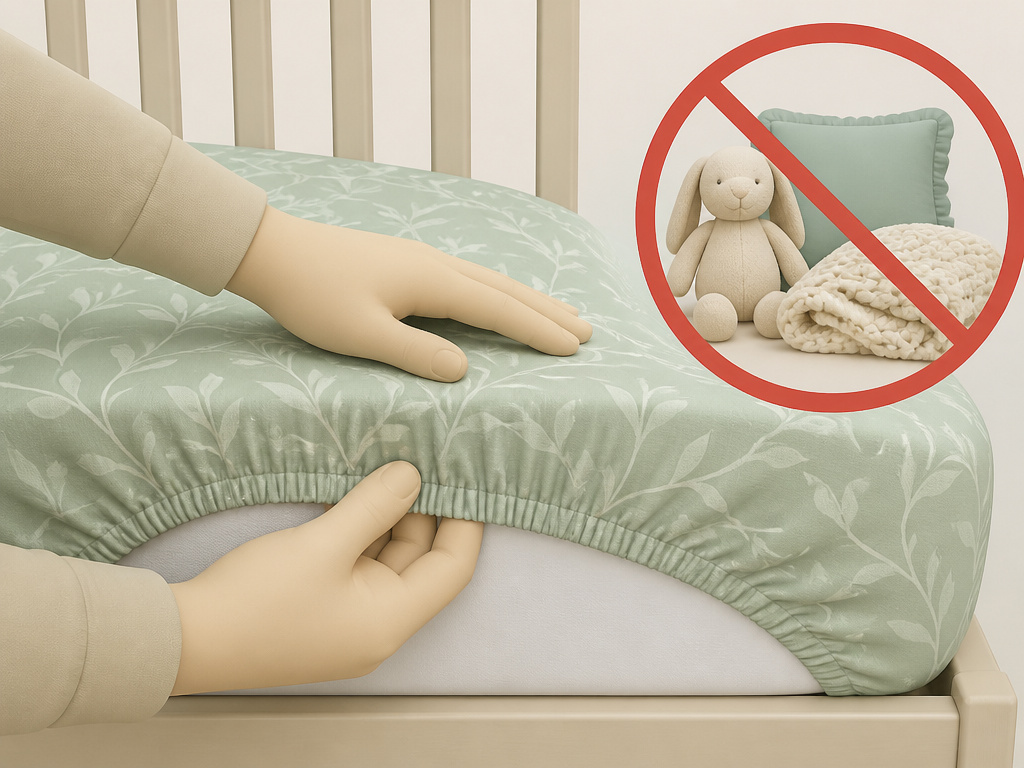 With a safe crib as your base, you can add the soft layer. Here, “decorative” means “minimal and functional.” The list of what goes in the crib is brutally short.
| Item | Safe In Crib? | Why & Alternative |
|---|---|---|
| Fitted Crib Sheet | Yes | Must be tight-fitting with elastic all around. No loose fabric. |
| Breathable Mesh Liner | Yes, if secured | Only for bumpers; must be zip-tied or velcroed tightly to all four sides, no gaps. |
| Loose Blanket | No | Suffocation risk. Use a wearable sleep sack for warmth. |
| Decorative Pillow | No | Suffocation risk. Place on a nursery chair or shelf instead. |
| Stuffed Animal | No | Suffocation and climb-out hazard. Keep on a bookshelf for decor. |
| Quilt or Bedspread | No | Too heavy, too loose. Hang it on the wall as a tapestry. |
Your single best decorative textile choice is a high-quality set of fitted crib sheets. Buy three or four in patterns you love. They are the only soft item that should regularly touch the mattress.
For the look of a bumper without the risk, a breathable mesh liner is the sole option. It must be installed taut, with no slack where fabric could bunch up. Even then, remove it once your baby can pull to a standing position.
The Blanket Dilemma
You will receive beautiful baby blankets. They are gifts of love. They are not for the crib.
Use them for tummy time on the floor. Drape them over the back of the rocking chair. Fold them on a shelf where their pattern adds to the room’s color scheme. For warmth in the crib, a wearable blanket or sleep sack is the only safe answer. This is non-negotiable for infants.
Anchoring Decor Safely Around the Crib
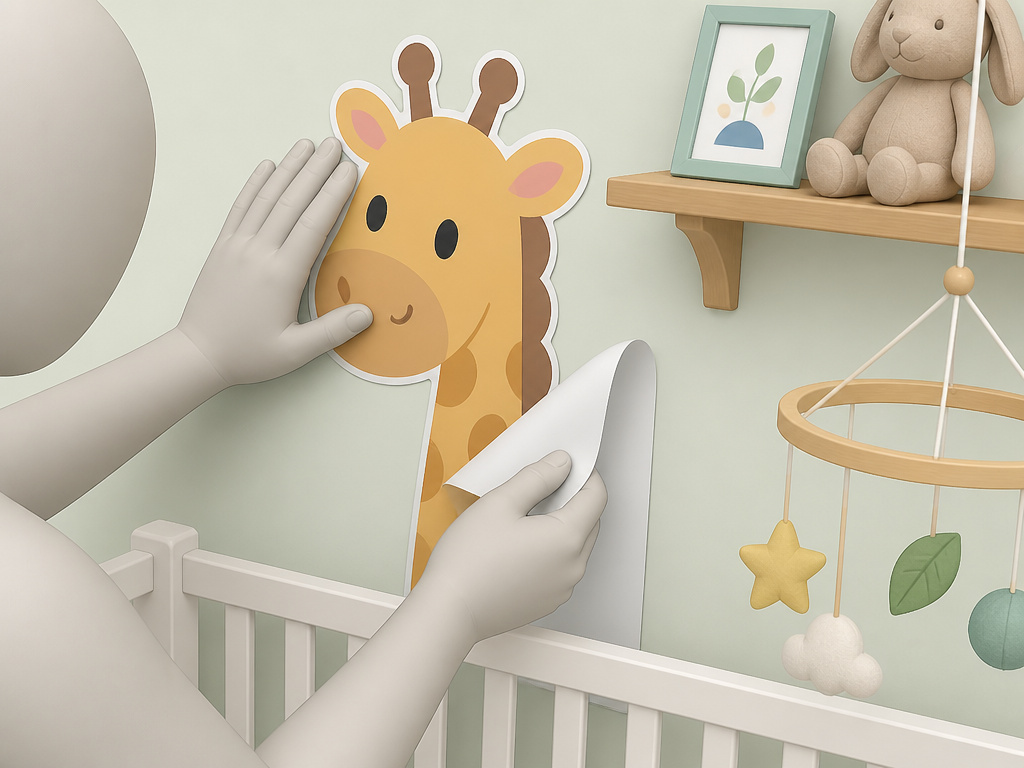 This is where your creativity actually gets room to play. The area surrounding the crib is your decorative zone. The rule is simple: nothing goes inside the rail that isn’t a fitted sheet or a properly installed mesh liner.
Wall Space is Prime Real Estate
- Decals & Murals: Removable wall decals are perfect. Place them on the wall behind or beside the crib. Ensure they are high enough that a standing toddler cannot peel them off.
- Artwork & Shelves: Secure picture frames and floating shelves to the wall studs. Place them well above the crib rail. A falling frame is a serious impact hazard.
- Mobile: Hang it from the ceiling, not from the crib itself. Ensure it is securely anchored and positioned so the baby cannot pull it down. Remove it once the baby can push up on hands and knees.
Furniture as Decor
The nursery chair, the dresser, the side table, these are your spots for plush decor. Arrange personalized blankets and a few select stuffed animals on the chair. It looks cozy and keeps them completely out of the sleep zone.
Lighting Creates Atmosphere
A small, cool-to-touch nightlight plugged in far from the crib is safer and more atmospheric than any string lights draped on the crib rails. Draped cords are a strangulation hazard.
Special Cases: Used Cribs, Convertibles, and Toddler Beds
Not every crib starts new in a box. Each scenario has a specific safety check.
Used or Hand-Me-Down Cribs
If the crib is more than 10 years old, be ruthless. Check for recalls first. Then, inspect every joint. Look for cracks in the wood, especially near corner posts. Test every fastener.
Common mistake: Replacing a missing bolt with one from the hardware store. Hardware store bolts are not strength-rated for cribs. They can shear under stress. If the manufacturer cannot supply the exact part, the crib is not safe to use.
Converting to a Toddler Bed
The manual for the Kolcraft Sealy Bella Crib is explicit: the mattress support must be at its lowest position before conversion. That toddler guard rail is only safe when every bolt is tight. Re-check them monthly.
The moment your child can climb out, the toddler bed is over. The official height limit is 35 inches. In practice, if they can swing a leg over, it’s time for a low-profile youth bed.
Frequently Asked Questions
Can I use a regular pillow in a baby bed?
No. An infant has neither the neck strength nor the motor control to move away from a pillow. It is a direct suffocation hazard. Pillows have no place in a crib.
How can I make the crib look decorated without bedding?
Focus on the perimeter. A beautiful nursery bedding set with a quilt and skirt looks lovely displayed on a wall rack or folded at the foot of a rocker. Inside the crib, let a pretty fitted sheet be the star. Add visual interest with a colorful but safe breathable mesh liner installed tautly around the sides.
Are crib tents or canopies safe?
Crib tents that drape netting over the top are not recommended by safety commissions. They pose entanglement and strangulation risks, and can collapse onto the child. Canopies that attach to the ceiling far above the crib are generally safe if securely installed, but ensure no long cords or ties are within reach.
When can I add a pillow and blanket?
Follow the NIH safe sleep environment guide: the back-sleeping, bare-crib recommendation lasts for the first year. Most experts suggest waiting until at least 18-24 months, when the child transitions to a toddler or youth bed and can verbalize discomfort and move freely. Even then, start with a small, firm toddler pillow and a light, breathable blanket.
Is it safe to hang a bookshelf above the crib?
It can be, but only if it is anchored directly into wall studs with appropriate hardware, not just drywall anchors. Place it high enough that a climbing child cannot reach it, and never store heavy objects on it. Many parents prefer to place shelves on a wall adjacent to, not directly above, the crib.
Before You Go
Decorating a baby bed flips the usual design process. Safety is the first layer, not an afterthought. Your checklist is short: a snug, certified mattress; a crib that passes the block test; a single fitted sheet; and everything else placed thoughtfully outside the rails.
The prettiest nursery is the one where you can close the door at night knowing every choice has a safety reason behind it. The stuffed animal on the shelf, the blanket on the chair, the decal on the wall, they add the warmth. The empty, firm crib is what lets your baby sleep safely. That’s the decoration that matters most.
