
Safe Age for Infants to Sleep on Stomach: Expert Advice
This post contains affiliate links. As an Amazon Associate we earn from qualifying purchases.
Infants can sleep on their stomach when they can independently roll from back to stomach and stomach to back, a milestone most reach between 4 and 6 months. Until that point, the American Academy of Pediatrics mandates back sleeping for every sleep until age one to drastically reduce the risk of SIDS. A baby who can roll both ways can be left in the position they choose, but you must always place them on their back to start.
That “rolling both ways” clause is the pivot. It’s not a birthday you mark on the calendar. It’s a physical skill you watch for, and the difference between the two directions matters more than most parents realize.
What follows is a breakdown of the AAP’s 2022 evidence, the physiology that makes stomach sleeping dangerous before that milestone, and the exact sleep environment that supports the rule. This is about matching a safety protocol to your child’s developing strength.
Key Takeaways
- The safe age for stomach sleeping is defined by a motor skill, not a date: your baby must roll both ways independently.
- Placing a back-sleeping baby on their stomach even once, especially by an unfamiliar caregiver, carries a SIDS risk up to 45 times higher.
- Side sleeping is never safe; it’s an unstable position that easily leads to rolling onto the stomach.
- A firm, flat mattress with a tight-fitting sheet is non-negotiable, as soft surfaces increase rebreathing and suffocation risks.
- Stop swaddling at the first sign of attempted rolling, which can happen as early as 2-3 months.
The Short Answer: It’s a Milestone, Not Just an Age
You won’t find a specific “safe at 4 months” stamp in the official guidelines. The AAP safe sleep policy is clear: infants should be placed supine (wholly on the back) for every sleep until 1 year of age. The exception kicks in only after the infant can roll from supine to prone and from prone to supine. They can then be allowed to remain in the sleep position they assume.
Most babies develop this two-way roll between 4 and 6 months. Some are earlier, some later. Your baby’s timeline is the one that counts.
The supine sleep position on a firm, flat, non-inclined surface does not increase the risk of choking and aspiration in infants, even for those with gastroesophageal reflux. This addresses a common parental fear directly.
This is why a checklist like the one from the SIDS Center of New Jersey asks providers to note both “can roll back to tummy” and “can roll tummy to back” separately. Mastery of one direction isn’t enough. If your baby can roll onto their stomach but not back, you must still reposition them. Their airway protection isn’t automatic yet.
Where this goes sideways: Assuming a 4-month birthday means “stomach sleep okay.” The calendar doesn’t build neck strength or motor planning. Watch for the skill, not the date.
Why Back Sleeping Isn’t Just a Rule
It’s a physiological guardrail. Stomach sleeping increases risk through three specific mechanisms that a young infant can’t overcome.
First, rebreathing. In the prone position, a baby’s face can be pressed against the sleep surface, causing them to rebreathe their own exhaled carbon dioxide. This leads to hypercapnia (too much CO2) and hypoxia (too little oxygen), both known triggers for SIDS. A firm crib mattress is critical because it doesn’t conform to the face, allowing expired air to dissipate.
Second, overheating. The prone position reduces heat loss from the face and torso. An overheated baby has a harder time waking up in response to a physiological stressor, and studies link higher body temperature to increased SIDS risk.
Third, compromised arousal. Infants in the prone position sleep more deeply and are less likely to arouse from sleep. That deep sleep might seem desirable, but the ability to wake up is a vital protective response. A baby who can’t rouse can’t respond to breathing trouble.
These risks are highest between 1 and 4 months, the peak age for SIDS. The incidence begins to decline after 4 months, which aligns with when many babies gain the strength to move their heads and roll. This isn’t a coincidence.
The Critical Role of the Sleep Environment
The “back to sleep” directive is one part of a system. The surface you place them on matters just as much. A safe sleep space neutralizes the other variables.
Your checklist is short and absolute: * A firm, flat mattress. If you press on it, it should snap back immediately without conforming to your hand’s shape. No memory foam, no pillows, no inclined sleepers. * A tight-fitting sheet. That’s it. No loose blankets, quilts, pillows, stuffed animals, or crib bumpers. * Nothing in the crib but the baby. Wearable blankets or sleep sacks are the safe alternative to loose bedding.
This environment supports the back-sleeping rule. A soft mattress undermines it entirely, creating a pocket for rebreathing even if the baby is on their back. This is why selecting a safe infant mattress is a foundational safety purchase, not a comfort one.
| Sleep Environment Factor | Safe Choice | Risk If Ignored |
|---|---|---|
| Mattress Firmness | Firm, flat, non-inclined | Soft surfaces increase rebreathing & suffocation risk; inclined surfaces can cause positional asphyxiation. |
| Bedding | Tight-fitting sheet only; use a wearable blanket for warmth. | Loose blankets, pillows, or bumpers can cover the face or cause entrapment. |
| Crib Contents | Empty crib. No toys, pillows, or positioners. | Any object is a potential suffocation or entrapment hazard. |
| Location | In your room, on a separate surface, for at least the first 6 months. | Room sharing is associated with a lower SIDS risk; bed-sharing increases risk. |
What About Swaddling, Reflux, and Tummy Time?
Three common questions intersect with the stomach-sleep rule. Each has a clear answer grounded in the same evidence.
Swaddling: The AAP states there is no evidence swaddling reduces SIDS risk. In fact, it becomes dangerous if a swaddled baby rolls. You must stop swaddling at the first sign of attempted rolling, which can be as early as 2-3 months. If you use swaddle blankets, the rule is absolute: always place the swaddled baby on their back.
Reflux (GER): Parents often worry back sleeping will cause choking. The AAP and pediatric gastroenterology societies are unified: the back position on a flat surface does not increase aspiration risk, even for babies with reflux. The side position is more dangerous. Follow the rule.
Tummy Time: This is the daytime, supervised training for the muscles your baby needs to roll safely. It is essential to start with a few minutes a day after coming home from the hospital.By 7 weeks, aim for 15-30 total minutes daily. Strong neck, shoulder, and core muscles are what will eventually make stomach sleeping a safe, self-chosen option.
Navigating the Transition: When Your Baby Starts Rolling
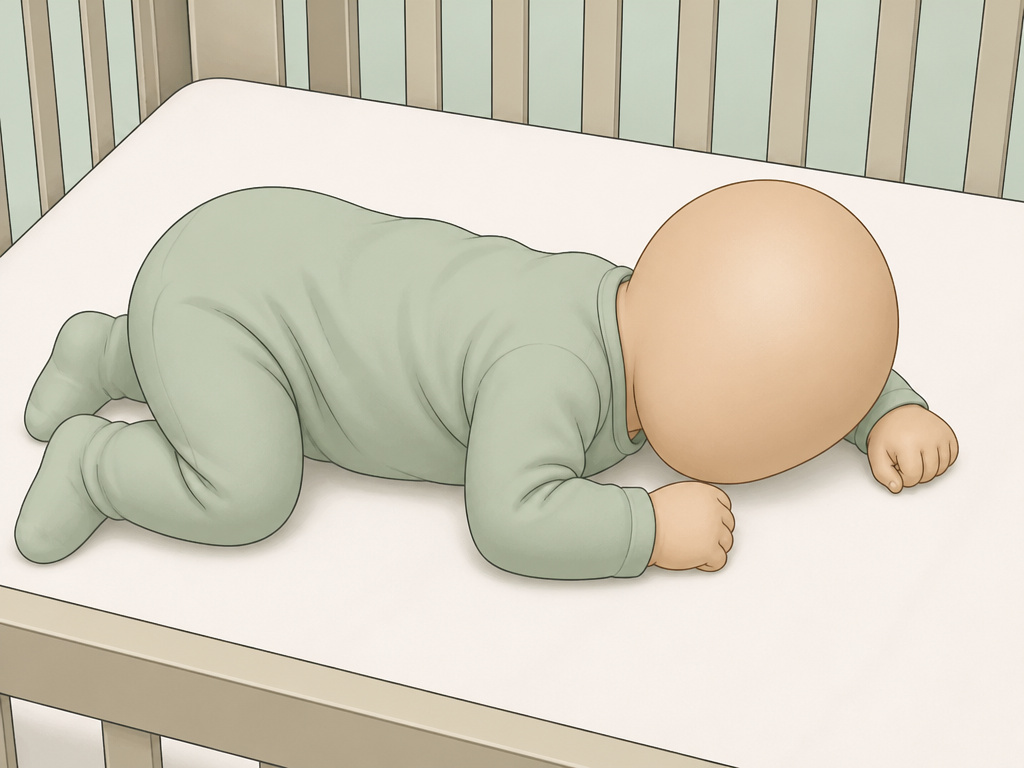
You put them down on their back. Ten minutes later, the monitor shows them happily asleep on their tummy. This is the transition.
Here’s what to do, step by step: 1. Confirm Two-Way Rolling. Before you stop repositioning, you must see them roll from back-to-tummy and tummy-to-back consistently during awake play. One direction doesn’t count. 2. Continue to Place on Back. Always start every sleep on the back. This reinforces the safe habit for you and any other caregiver. 3. Let Them Be. If they roll onto their stomach after you’ve placed them down, you do not need to flip them back. Their ability to get there means they have the strength and coordination to protect their airway. 4. Double-Check the Environment. Now that they’re mobile, ensure the crib is absolutely bare. No loose baby bedding anywhere. 5. Communicate with All Caregivers. This is the most missed step. Grandparents, daycare providers, babysitters, everyone must know the “always start on the back” rule and that rolling is okay. The CDC safe sleep guidelines emphasize consistency across all caregivers to prevent the high-risk scenario of a back-sleeping baby being placed on their stomach by someone unfamiliar with their routine.
The part nobody mentions: The peak risk factor for sleep-related deaths in infants 4 to 12 months old isn’t sleep position itself, it’s rolling into objects in the sleep area. A bare crib is non-negotiable long after they start rolling.
Frequently Asked Questions
What if my baby only rolls one way?
If your baby can roll from back to stomach but not back again, you must still reposition them onto their back if you find them on their stomach. They have not yet mastered the skill that indicates sufficient strength and coordination for safe stomach sleeping. Keep encouraging tummy time to build the muscles for the return trip.
Is side sleeping a safe alternative?
No. The AAP is explicit: side sleeping is an unsafe and unstable position that is not advised, as an infant is more likely to roll from their side to their stomach than from their back. The SIDS risk for side sleeping is similar in magnitude to the risk for stomach sleeping.
My baby hates being on their back. What can I do?
Many do. Try a firm swaddle (stopping at first roll attempts), a pacifier at nap time, and white noise. The startle reflex is stronger on the back, and white noise can dampen it. Remember, frequent waking is physiologically normal for an infant, it’s not a sign they are a “bad sleeper.”
How does a breathable mattress factor in?
breathable crib mattress with good airflow can be a helpful addition to a safe sleep environment, as it may further reduce any potential for rebreathing. However, it does not replace the rules. You still must use a firm, flat mattress, place the baby on their back, and keep the crib empty. It’s a supplement, not a substitute.
Before You Go
The question isn’t really “what age.” It’s “what ability.” The milestone of rolling both ways is the green light, and it arrives on your baby’s schedule. Until then, the rule is simple and non-negotiable: back to sleep, on a firm surface, in a clear crib. Every time.
That protocol, backed by the NIH safe sleep PDF and decades of evidence, has cut SIDS rates dramatically. It works. Pair it with plenty of awake tummy time on a comfortable play mat, and you’re building both safety and strength. Then one day, you’ll see them roll over, settle in, and sleep soundly. You’ll know they got there on their own.
