
Are Mattress Pads Safe for Infants? Key Risks & Safety Guide
This post contains affiliate links. As an Amazon Associate we earn from qualifying purchases.
Mattress pads are generally not considered safe for infants in a crib, bassinet, or play yard. The U.S. Consumer Product Safety Commission (CPSC) advises that nothing but a fitted sheet should be in an infant’s sleep space, a principle known as “Bare is Best.” Pads add softness, height, and potential entanglement points that can lead to suffocation or entrapment. However, a thin, tightly fitted, non-padded waterproof crib mattress protector designed specifically for infant sleep can be safe when it does not compromise mattress firmness or fit.
That “Bare is Best” rule is the starting line, not the finish. The real question isn’t whether a fluffy pad is safe, it’s not, but where the line between a dangerous pad and an acceptable protector actually lies. Federal law draws a sharp, technical distinction between a mattress and a mattress pad for testing, but that distinction creates a gap where products marketed for infant sleep can slip through without the same rigorous safety checks a mattress gets.
What follows: the specific regulatory gap that matters, the two material choices that determine real-world safety, and a checklist for evaluating any product that goes between your baby and their mattress. By the end, you’ll be able to read a product description and know instantly whether it belongs in a crib.
Key Takeaways
- The CPSC’s “Bare is Best” guideline means no pillows, blankets, bumpers, or padded mattress pads in an infant’s sleep space.
- Federal law tests crib mattresses for firmness and fit gaps, but mattress pads are tested only for flammability after laundering, creating a safety standard gap.
- Polyethylene is a safe waterproof barrier for a mattress itself but degrades with washing, making it a poor choice for a washable pad.
- From 2010–2022, the CPSC linked 79 infant fatalities to padded infant support cushions like loungers and mats, highlighting the suffocation risk of added softness.
- A safe alternative is a thin, tightly fitted waterproof crib protector that does not alter the mattress’s firmness or create gaps larger than a finger.
The Regulatory Gap: Mattress Pads vs. Mattresses
Federal safety rules treat a mattress and a mattress pad as completely different products. This isn’t bureaucratic nitpicking, it dictates which lifesaving tests a product must pass before it can be sold.
A crib mattress must comply with ASTM F2933-25, a standard incorporated into law (16 CFR § 1241.2). This standard mandates specific tests for firmness (to prevent suffocation on a too-soft surface) and for fit (to prevent entrapment in gaps between the mattress and crib slats). A full-size crib mattress must measure at least 27 1/4 inches wide by 51 5/8 inches long, and when placed in the crib with a fitted test sheet, the corner gap cannot exceed 3.15 inches (80 mm).
A mattress pad, under 16 CFR § 1632.5, is tested solely for flammability. The test requires the pad to be washed and dried 10 times before burning it on a glass fiberboard. There is no federal requirement for a mattress pad to be tested for firmness, fit, or suffocation risk.
This is the gap. A product can be marketed as a “crib mattress pad,” be certified as flame-resistant after laundering, and still be dangerously soft or ill-fitting. It meets the legal definition of a pad but is used in a context, infant sleep, where mattress-level safety is non-negotiable.
The stakes of this gap are not theoretical. In a 2024 ruling on infant support cushions, the CPSC reported 79 fatal incidents from 2010 through 2022 involving products like loungers and pads that added soft, padded surfaces to sleep areas. Ten of those deaths were directly linked to pads and mats. The agency’s consistent message is that adding any padded surface to an infant’s sleep space introduces a measurable suffocation hazard.
When you’re choosing any crib mattress protector, the first question is whether it acts like a mattress pad (adding padding, altering firmness) or simply protects the mattress without changing its safe characteristics. The former falls into the regulatory gap; the latter can be part of a safe sleep setup.
Material Safety: What a “Waterproof” Label Hides
The promise of a waterproof barrier is often the reason parents consider a pad or protector. The material that creates that barrier determines both its chemical safety and its physical durability. Two common options sit at opposite ends of the safety spectrum.
Vinyl (PVC or PEVA) is a common, effective waterproof material. It’s also a problem. Vinyl can off-gas volatile organic compounds (VOCs), and it often requires plasticizers like phthalates to stay flexible. These chemicals are undesirable in any bedroom, let alone a baby’s. While a vinyl-backed pad might survive many washes, you’re trading waterproofing for a chemical environment you likely want to avoid.
Polyethylene is a food-grade plastic considered very safe and low-VOC. It’s the material used in trusted mattress-wrapping systems designed to contain off-gassing from a mattress itself. However, it has a critical flaw for a washable product.
Where this goes sideways: Choosing a polyethylene-based washable pad. The plastic is brittle and will crack and disintegrate in a washing machine and dryer. One expert, Jane Sheppard of Healthy Child, noted that polyethylene “won’t hold up to washing, so it’s really not a good option for washable mattress pads.”
This creates a paradox. The safest waterproof plastic for a static barrier isn’t durable enough for a product you need to wash. The durable, washable plastics come with chemical concerns. The solution isn’t finding a magical material; it’s rethinking the product’s job.
A modern, safe waterproof crib protector typically uses a polyurethane laminate (PUL) or a similar membrane bonded to a breathable fabric like cotton or polyester. This creates a washable, effective barrier without the need for a vinyl layer. The key is that the waterproofing is a thin membrane, not a thick, crack-prone plastic sheet.
The Safe-Use Checklist: How to Evaluate Any Product
If you need a protective layer, for eczema, allergies, or potty training, use this checklist. Every item is a non-negotiable pass/fail for safety.
| Checkpoint | Why It Matters | How to Verify |
|---|---|---|
| Adds No Noticeable Softness | Infant suffocation risk increases on soft surfaces. The mattress must remain firm. | Place the product on the mattress. Press down with your palm. You should feel the firm mattress resistance immediately, with no cushioning “give.” |
| Fits Like a Second Skin | Gaps between the product and the mattress can create folds or pockets, a entanglement and suffocation hazard. | It should be a stretchy, fitted style that grips the mattress corners tightly. Avoid flat sheets or pads that simply lie on top. |
| Does Not Alter Mattress Dimensions | Adding height or width can create dangerous gaps between the mattress and the crib sides. | The protected mattress must still fit snugly in your crib, with gaps no wider than two fingers (less than 3.15 inches at the corner). |
| Is Specifically Marketed for Infant Sleep | Products not intended for sleep (e.g., changing pads, play mats) are not held to the same safety standards. | The product description should explicitly state it is for use in a crib, bassinet, or play yard. |
| Has No Loose Fabric or Tethers | Strings, ribbons, or loose elastic can wrap around an infant. | The product should have fully enclosed elastic or a zipper. There should be no dangling tags or ties. |
In short: If the product you’re looking at fails any point on this list, it is a mattress pad and does not belong in your baby’s sleep space. Keep looking until you find a protector that passes all five.
This is why selecting the right crib mattress is the foundational first step. A high-quality, waterproof, and breathable organic crib mattress might reduce the need for an additional protector altogether.
Special Cases & Edge-Case Warnings
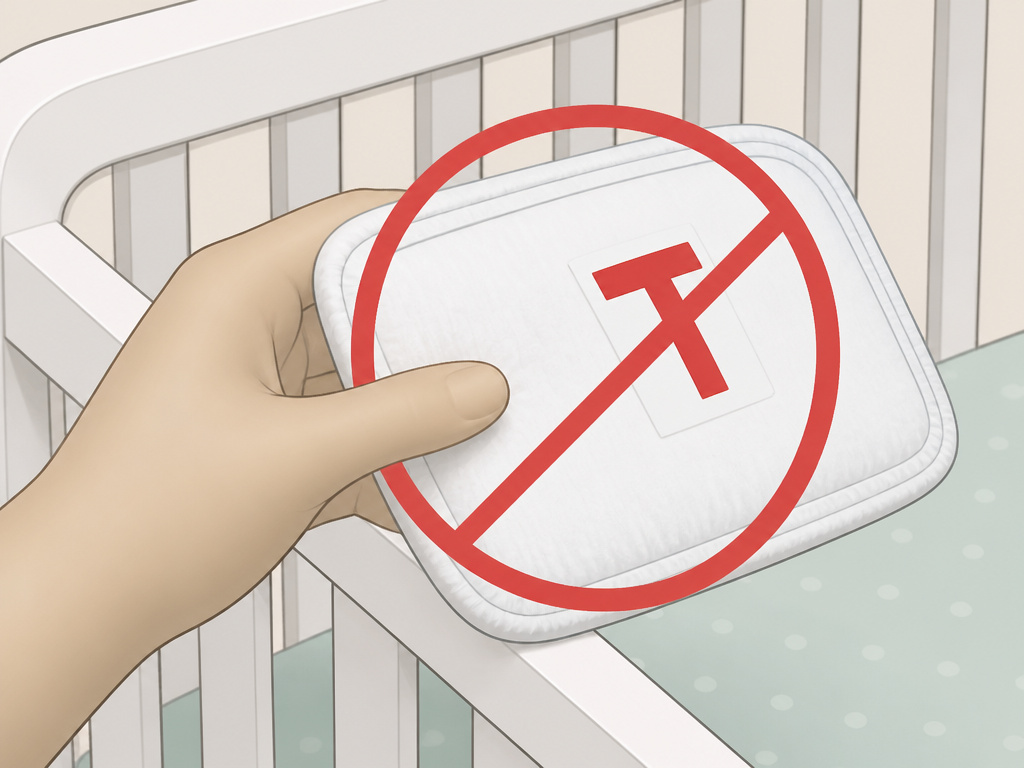
The standard advice breaks down in a few specific scenarios. Knowing these exceptions prevents a well-intentioned mistake.
“Dryclean Only” or Non-Launderable Pads. The flammability standard (16 CFR § 1632.5) has a provision for pads not intended for washing. They must use a CPSC-approved dry-cleaning method instead of the 10-wash cycle. This is a major red flag for infant use. A sleep product that can’t be routinely cleaned is a hygiene risk. Avoid it.
Pads with Chemical Flame Retardants. If a pad uses a chemical treatment to meet flammability standards, the law requires it to be permanently labeled with a “T” and care instructions to protect the treatment. These chemicals can be a source of off-gassing, and the label itself signals a product with more complex material risks. In an infant’s environment, simpler is safer.
After-Market Mattresses for Play Yards and Bassinets. This is a critical, high-risk category. The CPSC crib mattress guidance and the underlying standard (ASTM F2933) have strict rules for after-market mattresses used in products like play yards. They must be the exact same size and thickness as the original, and they must be tested with that specific product model. Using a random, ill-fitting bassinet mattress or pad in a play yard can create fatal gaps where an infant can become trapped. Never substitute.
Common mistake: Using a padded crib mattress pad in a bassinet or bedside sleeper. These smaller sleep spaces have even less tolerance for added height or softness. A pad that seems “snug” can compress unevenly, creating a dangerous slope or side gap.
The principle is consistent: the product must integrate seamlessly with the certified sleep surface. Any alteration is a potential hazard.
What to Use Instead of a Mattress Pad
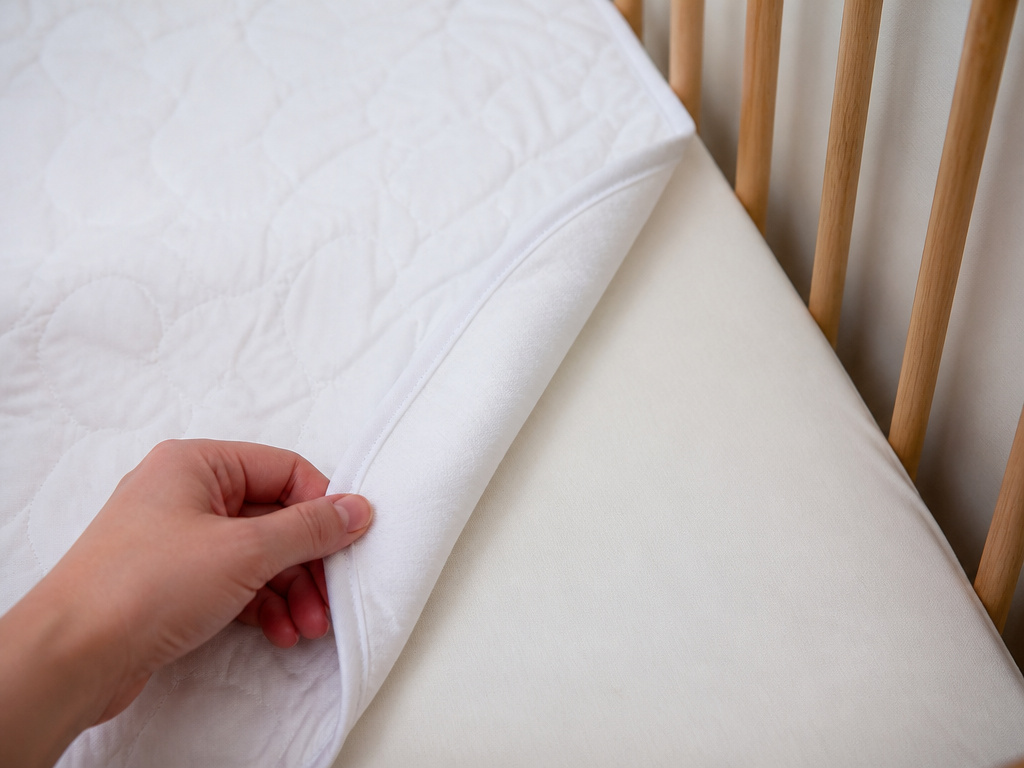
Your goal is protection without compromise. These products are designed to meet that goal.
- Fitted, Quilted Mattress Protectors. Look for protectors with a thin, quilted cotton top layer bonded to a silent, waterproof membrane. Brands like Naturepedic and American Baby Company make versions that are less than a quarter-inch thick. They feel like a fitted sheet, not a pad.
- Breathable, Water-Resistant Covers. For less severe waterproofing needs, a cover made from breathable, water-resistant fabric like PUL or merino wool (lanolized) can work. These allow air flow while blocking minor moisture. Ensure any wool cover is securely fitted and not loose.
- The Mattress Itself. The best line of defense is a high-quality, inherently waterproof breathable crib mattress. Many modern crib mattresses have a waterproof, wipeable surface built into their core design. This eliminates the need for an extra layer entirely.
When you need a protective layer, prioritize products explicitly called “protectors” or “covers” over those called “pads.” Look for terms like “fitted,” “breathable,” and “hypoallergenic.” Thickness is your enemy, the best protector is the one you can barely feel.
The official CPSC safe sleep guidelines are the final arbiter. When in doubt, return to the “Bare is Best” rule. A safe sleep environment is a simple one: a firm, flat, fitted surface with nothing else in it. Any addition must prove it doesn’t break that rule.
Frequently Asked Questions
Can I use a mattress pad if it’s really thin?
Thickness is only one factor. Even a thin pad can be dangerously soft, can bunch or wrinkle creating uneven surfaces, and can affect the precise fit of the mattress in the crib. If it adds any cushioning you can feel, it’s a pad and not recommended. A proper protector should not change the feel of the mattress.
Are mattress pads safe for toddlers?
Safety changes as a child develops. Once a child can roll over, push up on hands and knees, and move freely (typically well over 12 months old), the suffocation risk from a firm, fitted mattress pad decreases significantly. However, entanglement risks from loose fabric and fit risks from a too-thick pad remain. For a toddler in a crib, it’s still safest to use a thin protector. When they move to a toddler bed, a standard mattress pad becomes acceptable.
How do I know if my mattress protector is safe?
Check it against the Safe-Use Checklist above. Specifically, put it on the mattress and place the mattress in the crib. Check the corner gaps, they should still be less than two finger-widths. Feel the surface, it should be just as firm as the bare mattress. If it passes these physical tests and is marketed for infant sleep, it is likely a safe protector.
What about mattress pads for reflux or congestion?
Elevating the sleep surface with a pad or wedge is specifically warned against by the CPSC. An inclined surface can cause an infant’s head to slump forward, blocking their airway. This is a known suffocation hazard. For medical concerns like reflux, consult your pediatrician for safe positioning strategies that do not involve modifying the crib mattress.
Do all crib mattresses need a protector?
Not necessarily. Many modern crib mattresses have waterproof, wipeable surfaces. If your mattress has this feature and is in good condition, a protector is redundant. The protector’s primary job is to extend the life of a mattress that isn’t inherently waterproof or to provide an extra barrier for allergies. The safest setup is always the simplest one that meets your needs.
Before You Go
The question “are mattress pads safe for infants” has a clear regulatory and practical answer: no, not as they are commonly understood. The federal safety framework doesn’t require them to be safe for sleep, only fire-resistant. The material trade-offs make safe, washable versions elusive. And the historical data on infant fatalities linked to padded surfaces is a sobering reality check.
Your move is straightforward. Commit to the “Bare is Best” principle as your baseline. If you need a moisture barrier, invest in a thin, tightly fitted crib mattress protector that is specifically designed for infant sleep and alters nothing about the mattress’s firmness or fit. Your baby’s sleep space isn’t a place for extra comfort layers. It’s a place for safety, engineered down to the last quarter-inch gap. Build it that way.
