
Why My Newborn Doesn’t Sleep | The 1–4 Month Risk Window
This post contains affiliate links. As an Amazon Associate we earn from qualifying purchases.
A newborn doesn’t sleep through the night because their brain and stomach aren’t wired for it yet. They need to feed every 2–3 hours, and their sleep cycles are short and chaotic by adult standards. The real concern isn’t the waking, it’s whether their sleep environment is safe. The peak risk for sleep-related incidents, including SIDS, clusters between 1 and 4 months of age, which is exactly when exhausted parents are most desperate for a solution.
That 1–4 month window is the critical developmental period in the AAP’s triple-risk model for SIDS. It’s when an infant’s inherent vulnerability meets an external stressor, like an unsafe sleep setup. Your baby’s fussiness is likely normal biology, but the stakes for getting the sleep space right have never been higher.
What follows: a breakdown of normal newborn sleep versus red flags, the non-negotiable safety specs that actually matter, and the specific developmental leaps that explain why sleep goes sideways right when you need it most. You’ll leave knowing what to fix tonight and what to wait out.
Key Takeaways
- Newborn sleep is fragmented by design, expect 14–18 hours total sleep in short 2–4 hour chunks, with night wakings for feeding completely normal for the first 3–6 months.
- The sleep surface is non-negotiable: a firm, flat mattress in a CPSC-certified crib or bassinet, with an incline under 10 degrees. Any product claiming to reduce SIDS risk lacks evidence.
- The peak vulnerability period for SIDS is 1–4 months old. This is when safe sleep practices, back sleeping, room-sharing, empty crib, matter most.
- Common sleep disruptors include growth spurts (around 3 weeks, 6 weeks, 3 months), immature circadian rhythms, and needing help linking sleep cycles, not a “problem” you must fix.
- If your baby shows labored breathing, turns blue, or is excessively lethargic when awake, contact your pediatrician immediately. Persistent, high-pitched crying can also signal illness.
Is My Newborn’s Sleep Normal? The 1–4 Month Window
You chart every wake-up. The numbers look broken. But a newborn’s sleep architecture is supposed to be messy.
For the first few weeks, sleep is spread almost evenly across day and night, totaling 14 to 18 hours. These aren’t 6-hour stretches. They’re 2 to 4 hours at most, punctuated by feeding. By three months, total sleep often consolidates to about 15 hours, with a longer 5–9 hour stretch at night becoming possible, but not guaranteed. The variation is enormous. One baby sleeps a 6-hour block at 8 weeks; another takes 5 months. Both are normal.
The Mayo Clinic baby sleep guide frames this simply: your baby has their own pattern. It won’t match your neighbor’s baby, and it certainly won’t match your pre-baby expectations of an 8-hour night.
Where this goes sideways: Comparing your newborn’s sleep to an older infant’s. A 6-week-old is biologically incapable of sleeping 12 hours straight. Expecting them to sets you up for frustration and risky shortcuts.
The 1–4 month age range isn’t just a fussy phase. It’s the identified critical period in the triple-risk model for SIDS, as detailed in the StatPearls SIDS overview. An infant’s inherent vulnerability (like an immature arousal system) collides with external stressors (like a soft sleep surface) during this specific developmental window. Understanding this reframes the mission: your goal isn’t to force longer sleep, but to shepherd them safely through this high-risk period while their brain matures.
| Age | Total Sleep (Avg) | Longest Night Stretch (Typical) | Primary Sleep Disruptor |
|---|---|---|---|
| Newborn | 16–18 hours | 2–4 hours | Hunger / immature rhythm |
| 1 Month | 15–16 hours | 3–5 hours | Cluster feeding / growth |
| 3 Months | 14–15 hours | 5–8 hours | Sleep cycle transitions |
| 6 Months | 13–14 hours | 6–10 hours | Teething / separation anxiety |
TL;DR: If your newborn under 3 months wakes every 2–3 hours to eat, that’s the job. The problem isn’t the frequency; it’s whether you can safely manage your own exhaustion around it.
The Sleep Environment: What’s Actually Safe?
A safe sleep space isn’t about cute nursery themes. It’s a set of physical specifications that prevent airway obstruction and overheating. Get these wrong, and the risk of suffocation or SIDS climbs.
The AAP safe sleep policy is blunt: back to sleep, on a firm, flat surface, in a bare crib. The mattress must be tight-fitting, no more than two fingers’ width of gap between it and the crib side. Use only a fitted sheet designed for that specific mattress. Every other item is a hazard.
A firm sleep surface does not indent under the baby’s weight. An inclined sleeper, padded crib bumper, or soft mattress topper can cause the infant’s head to tip forward, compressing the airway. This positional asphyxia can happen silently in minutes.
The 10-degree incline rule is a hard line. Products like rockers, docks, or napsleepers that tilt beyond 10 degrees are not safe for sleep, full stop. The CPSC’s 2021 infant sleep product rule mandates that any product marketed for infant sleep must meet the same federal standards as a crib, bassinet, or play yard. If a product didn’t exist when your parents raised you, scrutinize it.
This is where your choice of newborn bedding matters critically. Skip the pillow, quilt, and stuffed animal. For warmth, use a wearable blanket or sleep sack. These remove the loose fabric risk while keeping the baby at a stable temperature. A well-fitted swaddle blanket can help with the startle reflex early on, but you must transition out of it once the baby shows signs of rolling.
Room-sharing reduces SIDS risk by up to 50%. Place the crib, bassinet, or play yard right next to your bed for at least the first six months. You hear them stir, you feed them, you put them back. It’s exhausting, but it’s the single most effective environmental change you can make.
The 7 Most Common Reasons Newborns Fight Sleep (That Aren’t Emergencies)
Your baby isn’t giving you a hard time. They’re having a hard time. Their little system is booting up, and these glitches are standard.
- Hunger. This is the big one. A newborn’s stomach is the size of a cherry. It empties fast. They need to feed 8–12 times in 24 hours. If they’re fussing 1–2 hours after a feed, they’re likely hungry again, not broken.
- Immature Circadian Rhythm. Newborns lack melatonin production. They don’t know day from night. You have to teach them by keeping days bright and active and nights dark and boring. This rhythm doesn’t stabilize until around 3–4 months.
- The Startle (Moro) Reflex. A sudden jerk of their own arms wakes them up mid-sleep cycle. A firm, snug swaddle for newborns can dampen this reflex, but only until they start showing signs of rolling.
- Gas and Digestive Discomfort. Their digestive tract is brand new. Bicycling their legs, a warm bath, or a gentle tummy massage can help move gas along. “Colic”, defined as crying for more than 3 hours a day, 3 days a week, often peaks around 6 weeks and resolves by 3–4 months.
- Overtiredness. It sounds backwards, but a baby who is pushed past their awake window becomes flooded with cortisol, a stress hormone. This makes it harder to fall asleep and stay asleep. A newborn’s optimal awake time is only 45–90 minutes.
- Overstimulation. Too much noise, light, or handling can overwhelm a newborn’s nervous system. They shut down by crying. A dark, quiet room and rhythmic white noise can signal safety.
- Growth Spurts & Developmental Leaps. At around 3 weeks, 6 weeks, 3 months, and 6 months, babies often sleep more fitfully and feed constantly. Their brain is doing massive overnight updates. This is temporary.
Easy to miss: Overtiredness. Watch the clock from the moment they wake. At 60 minutes, start winding down. Miss that window by 20 minutes, and the put-down turns into a 45-minute battle.
When to Worry: Red Flags That Need a Pediatrician
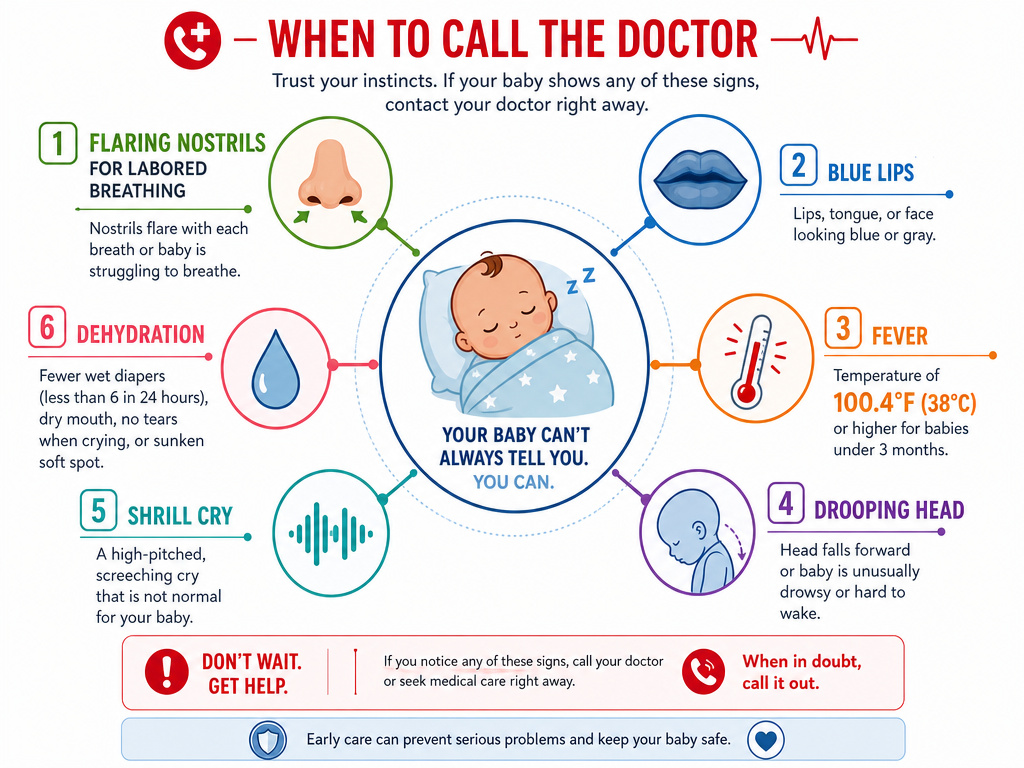
Most sleep struggles are developmental. A few are medical. You need to know the difference.
Contact your pediatrician immediately if you observe: – Labored breathing: nostrils flaring, grunting with each breath, or the skin pulling in between the ribs or above the collarbone. – Blue tint to the lips, face, or torso. – Fever in a baby under 3 months old (100.4°F or 38°C rectally). – Lethargy that’s unusual, your baby is difficult to wake, doesn’t stay awake to feed, or is unusually floppy. – A high-pitched, shrill cry that differs from their normal hungry or tired cry. – Persistent vomiting (not just spit-up) or signs of dehydration (fewer than 6 wet diapers in 24 hours, sunken soft spot).
For preterm infants, the stakes are even higher. The peer-reviewed SIDS risk factors note that prone sleeping in a preterm baby raises the SIDS risk more than either factor alone. Follow safe sleep guidelines with zero deviation.
Illness, even a mild cold, can disrupt sleep. Ear infections cause pain when lying down. Reflux can make back-sleeping uncomfortable. Your pediatrician can diagnose these. Don’t try to troubleshoot a medical issue with a different swaddle technique.
Building Better Sleep Habits (Without Sleep Training a Newborn)
You can’t sleep train a newborn. Their nervous system isn’t ready. But you can build scaffolds for healthier sleep that pay off after the 4-month regression.
- Master the Eat-Play-Sleep Cycle. Feed them as soon as they wake up. Then have some alert, interactive time. Finally, watch for sleepy cues (yawning, staring, rubbing eyes) and put them down drowsy but awake. This breaks the feed-to-sleep association.
- Differentiate Day from Night. During the day, open blinds, run the dishwasher, talk normally. For night feeds and changes, use a dim light, whisper, and be boring. Put them back down immediately.
- Create a Mini-Bedtime Routine. At 6–8 weeks, a 15-minute sequence signals sleep is coming. A warm bath, a fresh diaper, a baby swaddle blanket, a feed in a dim room, and a lullaby. Consistency is the signal.
- Use White Noise. It mimics the whooshing sounds of the womb and drowns out household clatter. Keep it at a low volume (under 50 decibels) and place it across the room.
- Practice Putting Down Drowsy. This is the single most important skill. If they only fall asleep in your arms or on the breast, they’ll need that same condition every time they stir between sleep cycles. Start by getting them calm in your arms, then place them in the crib when their eyes are heavy. Pat their belly until they settle.
Your tools matter. A stretchy swaddle can provide a snug, comfortable hold for a wiggly newborn. When they outgrow the swaddle, a wearable blankets becomes the safe, loose-bedding-free solution for warmth. For the crib itself, focus on a certified firm mattress and a simple fitted sheet, the core of a safe newborn sleep environment.
The 4-Month Sleep Regression: What It Really Is
Just as you glimpse a longer stretch, it vanishes. Welcome to the 4-month sleep regression, which isn’t a regression at all, it’s a progression.
Around this age, a baby’s sleep matures to include distinct cycles of light sleep, deep sleep, and REM sleep, just like an adult’s. The catch: they now fully wake between these cycles, every 45–120 minutes. If they don’t know how to connect those cycles independently, they’ll call out for help each time.
This is the moment your earlier work pays off. If they’ve practiced falling asleep drowsy but awake in their own safe space, they have a chance of resettling. If they’ve only ever fallen asleep while feeding or rocking, you’ll be restarting that engine 6 times a night.
The part nobody mentions: This change is permanent. Their brain has upgraded. You can’t go back to the newborn sleep mode. You must adapt to the new architecture.
This is also the age when blankets for swaddling must be retired if you haven’t already. Rolling is imminent, and a swaddled baby who rolls onto their stomach is at extreme risk. Transition to a sleeveless wearable blankets well before this point.
Frequently Asked Questions
Is it normal for a newborn to only sleep 30 minutes at a time?
Yes, especially during the day. Newborn sleep cycles are short, often just 30–45 minutes. They may need help linking to the next cycle. This consolidates with time. Focus on total sleep in 24 hours, not the length of each nap.
Why does my newborn grunt and squirm so much in their sleep?
Active sleep (REM) is loud. Grunting, squirming, fluttering eyelids, and even brief cries are normal. They are not fully awake. Wait a minute or two before intervening, they might resettle on their own. True crying that escalates is a different signal.
Can I let my newborn sleep on my chest?
The risk is high. An adult bed is not a safe sleep surface. Parents are exhausted, and the combination of soft bedding and adult fatigue can lead to accidental suffocation or entrapment. If you fall asleep with the baby on you, move them to their firm, flat crib as soon as you wake.
How do I know if my baby is too hot or too cold?
Feel the back of their neck or their chest. Hands and feet are poor indicators. They should feel warm and dry, not sweaty or clammy. Dress them in one more layer than you are comfortable wearing. A safe wearable blanket of appropriate tog rating is safer than a loose blanket.
My baby sleeps better on their stomach. Should I let them?
No. The supine (back) sleep position is the single most effective modifiable factor in reducing SIDS risk. While some babies seem to settle easier prone, the safety data is unequivocal. “Back to sleep” is non-negotiable for every sleep until they can roll both ways independently. Once they can roll from back to front and front to back on their own, you can leave them in the position they choose, but always start them on their back.
Before You Go
Your newborn’s sleep is a biology project, not a behavior problem. The waking is mandatory. The feeding is non-negotiable. Your job is to manage the safety around that reality, not fight the reality itself.
Commit to the safe sleep ABCs: Alone, on their Back, in a bare Crib. Use a wearable blankets for warmth and share your room. When the 4-month progression hits, you’ll have a safe, consistent foundation to build on. The first few months are about survival, not schedules. Get through them safely, and the longer stretches will come on their own timeline.
