
Why Does My Newborn Only Want to Sleep on Me? Key Reasons
This post contains affiliate links. As an Amazon Associate we earn from qualifying purchases.
A newborn only wants to sleep on you because your body provides the ultimate regulatory environment, your scent, heartbeat, warmth, and breathing rhythm are biologically programmed cues for safety and survival. This peaks around 2-4 months when their own sleep-wake cycles are immature. The drive is primal, not stubbornness.
That biological imperative collides directly with the public health mandate for a flat, empty, separate sleep surface to prevent sleep-related infant death. You are not doing anything wrong. Your baby is not broken. This is the central tension of early parenthood, and it is why the question feels so urgent.
What follows is a breakdown of the hard science behind the cling, the specific risks of unplanned sleep on couches or in adult beds, and a set of practical, incremental strategies to move toward safer sleep without expecting a tiny human to bypass millions of years of evolutionary programming overnight.
Key Takeaways
- The need for contact sleep is driven by immature nervous system regulation, not habit, and peaks between 2 and 4 months of age.
- Room-sharing, placing your baby in their own safe sleep space in your room, can reduce the risk of SIDS by as much as 50% and is the critical first step away from body sleeping.
- The highest danger isn’t a planned, alert feeding in bed; it’s the unplanned sleep on a sofa, armchair, or in an adult bed with pillows, blankets, or a caregiver impaired by exhaustion or substances.
- Products like a firm bedside bassinet or a wearable blanket (sleep sack) can bridge the gap by providing proximity and security without the hazards of adult bedding.
- Transition strategies must be gradual and responsive, focusing on the first nap of the day in the safe space, not expecting all-night independence immediately.
The Biological Need for Contact (Not a Phase)
This isn’t a preference. It’s a physiological requirement for a human infant. For the first three months, often called the “fourth trimester”, your baby’s systems for regulating temperature, heart rate, and stress are incomplete. Your body completes the circuit.
The “triple-risk model” for SIDS suggests an infant death occurs when a baby with an inherent biological vulnerability encounters an external stressor during a critical developmental period, usually between 1 and 4 months of age. This aligns exactly with the peak age for contact-seeking behavior.
Your chest provides rhythmic breathing for them to sync with, a steady heartbeat that lowers cortisol (stress hormone) levels, and skin-to-skin contact that stabilizes their temperature and blood sugar. Their sense of smell is highly developed; your unique scent is a direct signal for food, comfort, and safety. When placed alone on a flat, still mattress, they lose all these regulatory inputs. It’s the difference between a calm, grounded state and a silent, overwhelming void.
Where this goes sideways: Assuming this is a “bad habit” you can “break” with cry-it-out methods in the early weeks. You can’t train out a biological imperative. Attempts to do so often lead to a more dysregulated, overtired baby who clings harder during wakeful periods, making the cycle worse.
The Safety Equation: Why “Never Bed Share” Is the Official Line
The American Academy of Pediatrics (AAP) states, “Never sleep with your baby.” This is a risk-elimination stance. It is based on clear, grim statistics: the risk of sleep-related infant death is up to 67 times higher when infants sleep with someone on a couch or soft armchair. The AAP safe sleep policy guide is unambiguous on this point for a reason.
The strongest predictor of a sudden unexpected infant death (SUID) has been identified as the combination of recent maternal alcohol consumption and sleeping together with an infant on a soft shared surface. Other extreme risk multipliers include parental smoking, extreme fatigue, and loose bedding or pillows.
| Sleep Scenario | Relative Risk Level | Primary Hazard |
|---|---|---|
| Sofa/Armchair Sharing | Very High | Suffocation from cushion wedging or overlay; falls. |
| Adult Bed with Hazards | High | Entrapment in headboard/frame; suffocation from soft bedding/pillows; overlay. |
| Room-Sharing in Separate Bassinet | Lowest (Protective) | Allows for monitoring and feeding while maintaining a safe, separate surface. |
| Planned, Sober Bed Sharing (Not Recommended) | Variable, Context-Dependent | Risk shifts dramatically based on bedding, impairment, and baby’s age/health. |
The public health message is simple because complexity gets people killed. If the rule is “never,” it aims to prevent the most dangerous scenarios. However, this stance often clashes with the reality that, according to studies, nearly half of parents report sharing a sleep surface with their infant at some point, frequently out of exhaustion during a night feed.
Common mistake: Moving to a sofa or armchair to feed because you’re afraid of falling asleep in your bed. This often increases the risk. If you think you might nod off, feed in your bed, after first removing all pillows and blankets, and place the baby back in their safe sleep space immediately after.
Safe Sleep Surfaces That Mimic You
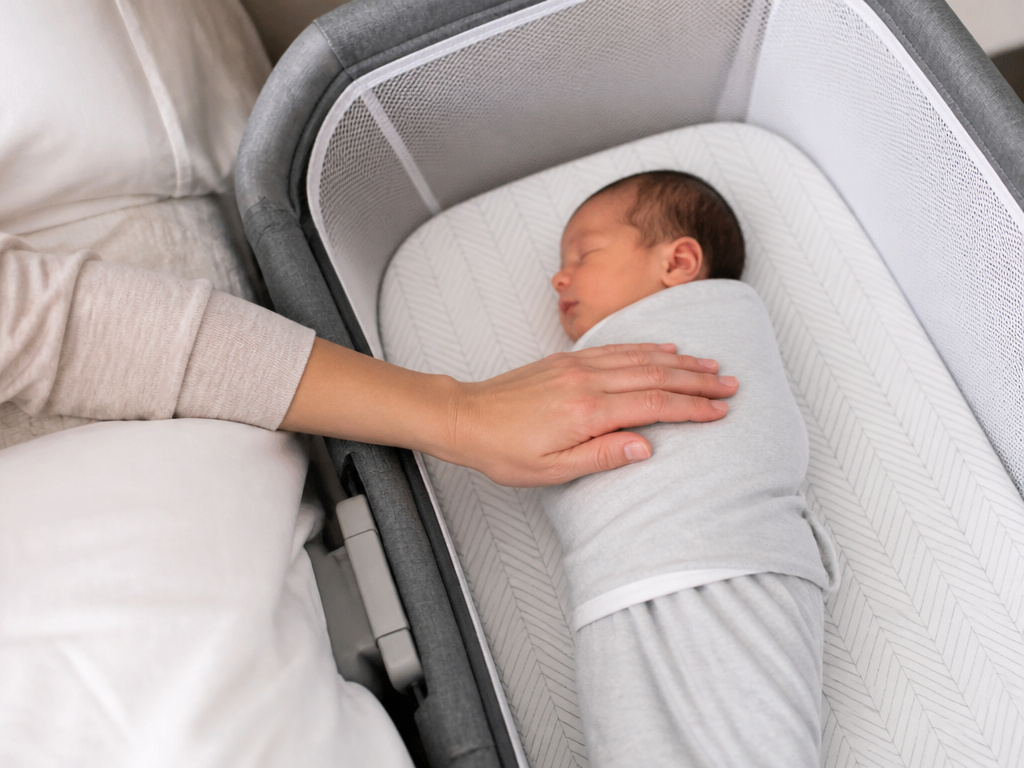
You cannot become a firm, flat mattress. But you can choose products that bring safety and proximity together, satisfying your baby’s need for closeness while adhering to safety standards.
The 3 Tools That Bridge the Gap:
- A Bedside Bassinet (Co-Sleeper): This is your most powerful tool. A certified bedside sleeper attaches securely to your bed frame, giving your baby their own firm, flat surface at arm’s reach. You can place a hand on their chest, they can hear and smell you, but they are safe from adult bedding. The Consumer Product Safety Commission (CPSC) rule mandates that all infant sleep products like these meet strict federal safety standards for bassinets or cribs.
- A Wearable Blanket (Sleep Sack): Ditch loose blankets forever. A wearable blanket provides warmth without the suffocation risk. The slight, even pressure can be comforting, mimicking the feeling of being held. For a newborn, choose one with a snug, secure fit and no loose fabric near the face.
- A Firm Swaddle: For young infants with a strong startle reflex, a well-fitted swaddle for newborns can provide the boundary and security they crave. The key is firmness around the arms to inhibit the Moro reflex, while leaving room at the hips and legs to move. Always transition to a sleep sack once your baby shows signs of rolling.
These products work because they address the sensory gaps. They provide the boundary, the proximity, and the security, removing the hazardous variables of an adult sleep space.
The Transition Playbook: From Chest to Crib
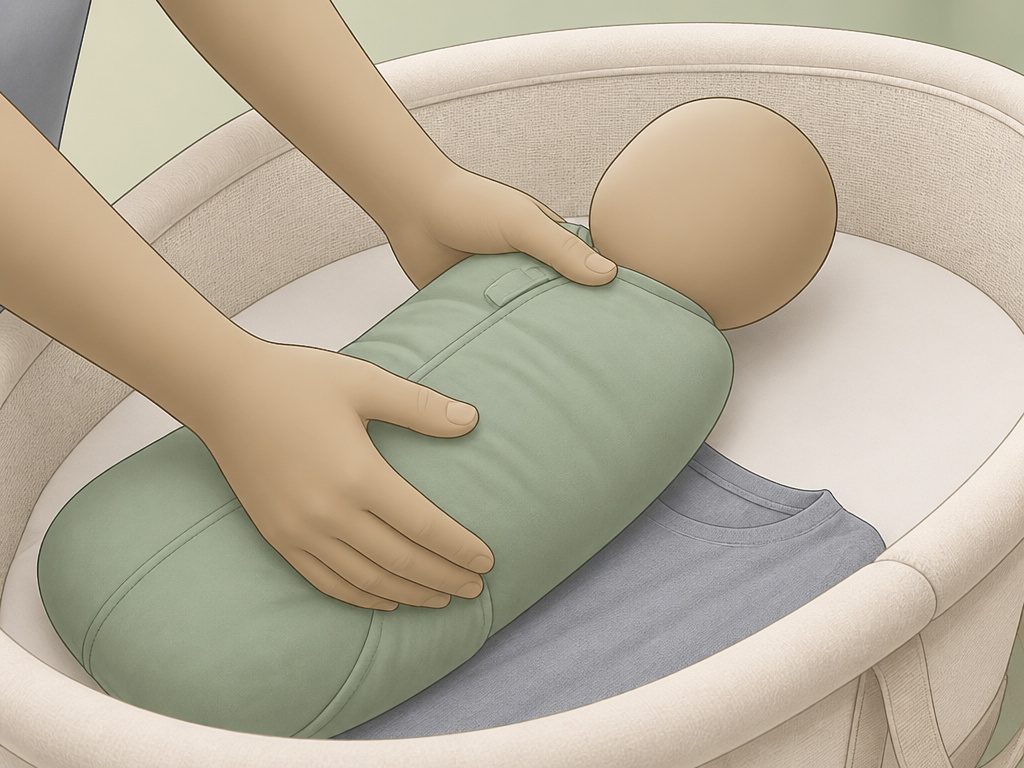
The goal is not to go from “all night on you” to “all night alone in a nursery” in one step. That’s a recipe for failure. The transition is a gradual process of building positive associations with the safe sleep space.
Start With the Easiest Win: The First Nap of the Day.
Baby is well-rested, you are alert, and sunlight provides a natural cue. Begin by wearing the baby in a carrier until they are in a deep sleep, then gently transfer to the pre-warmed bassinet. Place a worn t-shirt (scent-soaked) over the mattress under the fitted sheet, so the familiar smell is present but cannot cover the baby’s face.
Master the Transfer.
Wait for the limp-limb stage of deep sleep. Move slowly, keeping your body in contact with theirs as long as possible. Lower them onto their back, bottom-first, then head. Keep your hands firmly on their chest and tummy for a slow count of thirty after they’re down. This maintains the pressure and connection.
Layer in Other Soothing Tools.
White noise mimics the constant whoosh of your bodily sounds. A safe sleep sack provides that cozy, held feeling. Consider a pacifier at nap and bedtime once breastfeeding is well-established, as its use is associated with a reduced SIDS risk.
What most people get wrong: Trying this for the first time at 2 AM after weeks of chest-sleeping. You’re exhausted, your baby is in their deepest sleep cycle of the night, and the conditions are stacked against you. Practice during the day, under low-stakes conditions, to build skill and confidence for both of you.
When to Seek Help and What to Avoid
This phase is intense but finite. If your baby absolutely cannot be put down even for a daytime nap after 4-5 months, or if you are experiencing dangerous levels of sleep deprivation where you’re falling asleep unsafely with the baby, it’s time to consult your pediatrician. Rule out medical issues like reflux or food sensitivities that can make lying flat painful.
The Absolute “Do Not” List:
- Do not use inclined sleepers, nests, pods, or loungers for unsupervised sleep. These do not meet the CPSC’s safe sleep rule for a firm, flat surface and have been involved in infant deaths.
- Do not add pillows, positioners, crib bumpers, or stuffed animals to the sleep space in an attempt to make it cozier. These are suffocation hazards.
- Do not fall asleep on a sofa or armchair with the baby. The statistics here are unequivocal.
- Do not bed-share if you or your partner smoke, have consumed alcohol, taken medications that cause drowsiness, or are excessively fatigued. The shared sleeping surfaces risks multiply dramatically under these conditions.
Your pediatrician can help you create a personalized plan and may refer you to a pediatric sleep consultant who uses gentle, evidence-based methods.
Frequently Asked Questions
Is it normal for my newborn to hate the bassinet?
Yes, it is biologically normal. The bassinet is a poor substitute for a caregiver’s body from a sensory perspective. Your job is to make it a more appealing, familiar place through scent, sound, and gradual association, not to expect your newborn to prefer it instinctively.
Will I create a bad habit by holding my newborn to sleep?
Not in the first 3-4 months. You are meeting a core developmental need, not instilling a manipulative habit. The concept of “sleep associations” becomes more relevant after the fourth trimester, when you can gently begin to help them learn to connect sleep cycles in their own space.
What’s the difference between co-sleeping and bed-sharing?
“Co-sleeping” is a broad term meaning sleeping in close proximity. Room-sharing (baby in their own infant bed in your room) is the safe practice recommended by the AAP. Bed-sharing (baby in your adult bed) is the practice the AAP advises against due to documented risks. A bedside crib is the hybrid solution that enables safe co-sleeping via room-sharing.
How can I get my newborn to sleep without being held?
Use a layered approach: ensure the sleep space is warm, smells like you (with a safe item like a worn shirt under the sheet), and has continuous white noise. Swaddle firmly or use a wearable blanket. Feed until drowsy but not fully asleep, then transfer with the slow, contact-heavy method. Start with just one nap a day.
Are there any safe products that let my baby sleep on me?
For supervised, awake time, babywearing carriers and slings are excellent. They keep your hands free and satisfy the baby’s need for contact. For sleep, the only safe product is one that places the baby on their back on a firm, flat surface separate from adult bedding, hence the sidecar bassinet is the gold-standard solution.
Before You Go
Your newborn’s need to sleep on you is a sign of a healthy, wired-in survival instinct, not a parenting failure. The conflict between this need and safe sleep guidelines is real and exhausting. The path forward isn’t about choosing one over the other absolutely; it’s about risk minimization.
Prioritize the life-saving practice of room-sharing with a certified bedside bassinet. Use tools like swaddles and sleep sacks to provide security. Start transitions gently during daytime naps. And forgive yourself for the times you feed in bed, just prepare that space as safely as possible first. The goal is progress, not perfection, moving steadily toward the independent sleep that will come as your baby’s own nervous system matures.
