
Why Do Infants Fight Their Sleep? Unpacking Common Causes & Fixes
This post contains affiliate links. As an Amazon Associate we earn from qualifying purchases.
Infants fight sleep primarily because they haven’t learned to fall asleep independently. This is called a sleep-onset association problem. They depend on a specific condition, like being rocked, fed, or held, to transition from awake to asleep. When that condition isn’t present at a nighttime waking, they cannot self-soothe and signal for help, which parents experience as fighting sleep. Most healthy infants are capable of sleeping through the night by 3 months, but 25-50% still wake at 9-12 months because of these associations.
That dependency is a learned skill the infant is missing, not a behavioral flaw. The gap between what puts them to sleep at bedtime and what’s available in the dark at 2 a.m. Is where the fight happens.
What follows: the developmental window when independent sleep becomes possible, the three-part model that explains why problems persist, and the evidence-backed methods that rebuild the skill without leaving anyone in distress.
Key Takeaways
- The 12-week mark is a key developmental window where most infants neurologically mature enough to sleep longer stretches, making it a pivotal time for encouraging independent sleep. Sleep-onset associations, like feeding or rocking to sleep, are the most common engine of sleep fights; the infant is unable to initiate sleep without their specific cue, not resisting it. Sleep problems are rarely about one thing.They involve predisposing factors (like temperament), precipitating factors (like an illness), and perpetuating factors (like inconsistent parental responses).
- Room-sharing without bed-sharing is the only recommended sleep arrangement for the first 6 months, as it facilitates monitoring and feeding while minimizing SIDS risk.
- Effective behavioral interventions like graduated extinction or bedtime fading work by systematically teaching the infant to self-soothe, not by ignoring their needs.
The Developmental Clock: When “Fighting Sleep” Becomes a Pattern
Most infants begin to sleep through the night by approximately 12 weeks of age. Failure to hit this milestone accounts for most infant sleep problems parents report.
This deadline is tied to neurological maturation and circadian rhythm development.
What is the “12-Week Sleep Milestone”?
Healthy infants are capable of sleeping through the night by 3 months of age and no longer require nighttime feedings by 6 months. However, 25%–50% continue to wake up during the night at 9–12 months. The problem isn’t the waking itself, all humans wake briefly between sleep cycles, but the inability to fall back asleep alone.
The “sleeping through” milestone refers to a 5-6 hour stretch, not sunrise. It signals that the infant’s sleep-wake cycle is starting to sync with the day-night rhythm. Before this, their sleep is evenly distributed around the clock. Fighting sleep before 12 weeks is often about pure circadian immaturity, their body literally doesn’t know it’s night.
After 12 weeks, continued fighting usually points to a learned behavior.
The Role of Circadian Rhythms and “Day-Night Confusion”
Newborns have no built-in day-night schedule. The hormone melatonin, which regulates sleepiness, isn’t produced in a reliable daily pattern until around 2-3 months.
You can see this in their sleep logs: equal-length naps and wake windows around the clock. This “confusion” is biologically normal, not a problem to solve. But it sets the stage for later fights if sleep habits aren’t guided as the rhythm emerges.
| Age Range | Sleep Pattern | Common “Fight” Trigger |
|---|---|---|
| 0-8 Weeks | Irregular, 14-17 hours total, day/night reversal possible | Overstimulation, hunger, immature nervous system |
| 2-3 Months | Circadian rhythm begins; longer night stretch possible | Missed sleep window, overtiredness |
| 4-6 Months | Day-night schedule established; 2-3 naps | Sleep-onset associations, separation anxiety |
| 6+ Months | Consolidated night sleep; 1-2 naps | Limit-setting issues, teething, developmental leaps |
The fight often happens at bedtime because the infant is overtired. An immature rhythm means their sleep pressure builds erratically. Miss the brief window when sleep pressure is high and melatonin is rising, and the system floods with cortisol, the alertness hormone. Now you have a wired, screaming baby who desperately needs sleep but physiologically cannot shut down.
The short version: Before 12 weeks, the fight is biology. After 12 weeks, it’s usually biology plus habit.
The Engine of the Fight: Sleep-Onset Associations
This is the core mechanical reason infants fight sleep. They have linked the act of falling asleep with a specific condition. Remove the condition, and the skill disappears.
Sleep-onset associations are negative when the infant depends on parental intervention like rocking or feeding to initiate sleep. Infants unable to self-soothe have prolonged sleep onset and frequent night awakenings because the association isn’t available at each wake-up.
Think of it like a crutch. If you always use a crutch to walk, you never learn to balance on your own legs. The infant who falls asleep nursing learns: “Sleep happens when I taste milk and feel warmth.” At 2 a.m., between sleep cycles, they wake in a dark, silent crib. The milk and warmth are gone. They lack the internal skill to find sleep again, so they cry for the crutch.
This behavior reflects a genuine skill gap, not manipulation.
Common Sleep-Onset Associations That Backfire
- Feeding to sleep (bottle or breast)
- Motion sleep (rocking, car rides, stroller walks)
- Physical contact sleep (holding, lying next to parent)
- Sucking to sleep (pacifier that falls out and isn’t replaced)
The association itself isn’t bad. The dependency is. The goal is to move the association outside the final moment of sleep. Feed, then burp, then read a book, then place in crib drowsy but awake. That breaks the direct link.
Where this goes sideways: Starting a habit during the 4-month sleep regression. This is when sleep cycles mature and nighttime awakenings become more noticeable. A parent starts rocking back to sleep for peace. By night five, the infant’s brain has rewritten the rule: “Waking means I get rocked.” The regression ends; the new habit remains.
The Three-Factor Model: Why Some Babies Fight Harder Than Others
Sleep problems are rarely simple. Experts use a model of predisposing, precipitating, and perpetuating factors to explain why a specific infant fights sleep persistently.
This framework, outlined in the AASM bedtime problems practice parameters, shows why a one-size-fits-all solution fails.
Predisposing factors are the innate vulnerabilities. They don’t cause the problem alone, but they stack the deck. – Temperament: A baby who is intense, sensitive, or less adaptable may react more strongly to sleep transitions. – Maternal anxiety/depression: A parent’s mental health can affect attunement and consistency. – Genetic predisposition: A family history of sleep issues or anxiety can play a role.
Precipitating factors are the triggering events. This is the initial “why now?” – An illness (ear infection, cold) – A developmental leap (learning to roll, sit, crawl) – A change in routine (travel, moving houses) – Teething pain
Perpetuating factors are what keep the problem going long after the trigger is gone. This is usually parental response. – Inconsistent bedtime routines – Alternating between responding and not responding to night wails – Introducing a new sleep crutch (like bringing the baby into bed) to solve a temporary problem
The part nobody mentions: The perpetuating factor often feels like the only solution. When your infant screams for 45 minutes, picking them up works. It stops the crying now. That immediate reinforcement makes the parent more likely to repeat the action next time, accidentally teaching the infant that prolonged protest leads to rescue.
The fight escalates because the infant learns: “Sometimes if I cry long enough, the rocking comes.” That’s an intermittent reinforcement schedule, the most powerful kind for habit formation. It’s why sporadic “giving in” can make the problem worse than never starting an intervention.
The Environment & Safety Factor
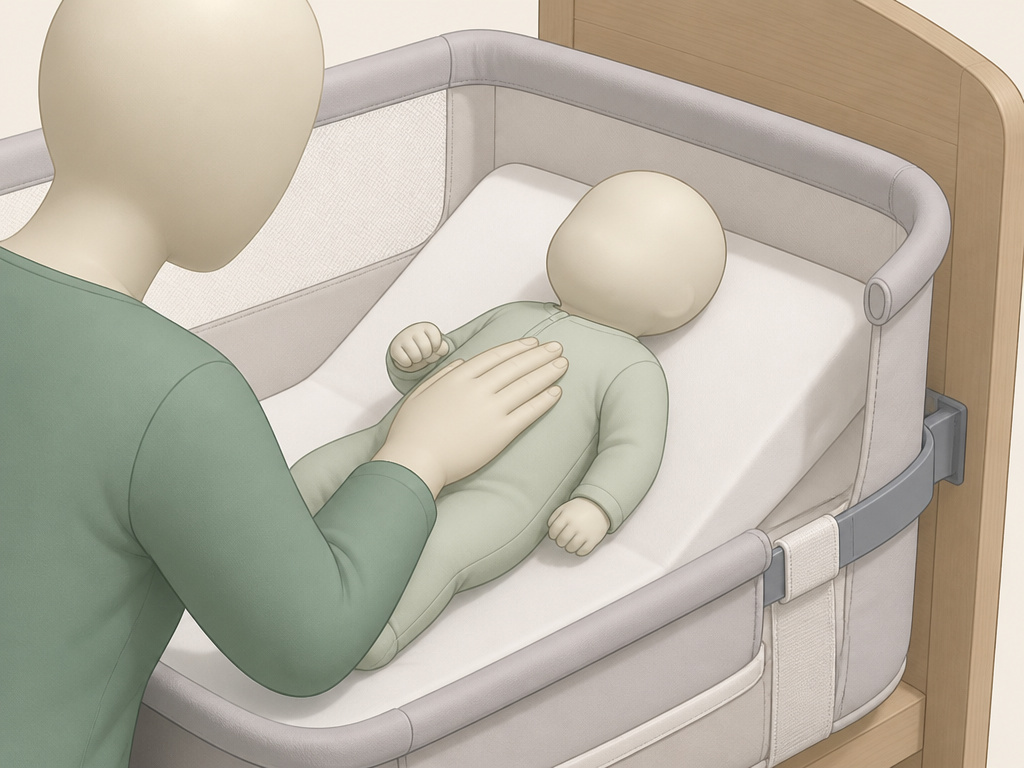
An infant will fight sleep if they are uncomfortable, unsafe, or their environment works against their biology. This isn’t behavioral; it’s physiological.
Supine sleep position is non-negotiable for safety, reducing SIDS risk. Some infants initially fight being placed on their backs, especially if they have reflux. The solution isn’t to abandon the position but to address the comfort, like a slight incline of the crib mattress (if approved by your pediatrician) and a good crib mattress designed for firm, flat support.
Room-sharing without bed-sharing is recommended for the first 6 months. The proximity makes feeding and comforting easier, which can reduce prolonged crying. However, being within hearing distance can also become a perpetuating factor if every grunt receives a full intervention. A bedside bassinets that attaches securely to the parent’s bed maintains the separate, safe sleep surface while keeping the infant close.
Comfort objects are for toddlers, not infants. Loose blankets, pillows, and stuffed animals in the crib are suffocation hazards and can cause overheating. If your infant seems to fight sleep for warmth or comfort, switch to a wearable blankets (sleep sack). It provides the cozy containment of a blanket without the risk.
Temperature and noise matter. An overheated room is a common, silent disruptor. The ideal sleep environment is cool (68-72°F), dark, and with consistent white noise to buffer household sounds. A sudden silence when the noise machine shuts off can trigger a waking.
Evidence-Based Responses: Replacing the Fight with Skill

When the fight is rooted in sleep-onset associations or limit-setting issues, behavioral interventions are the first-line treatment. The clinical guidelines for night wakings rate several methods as effective standards.
These structured, predictable methods teach the infant the new skill of falling asleep independently; they do not involve withholding love.
The Two Most Effective Approaches
1. Graduated Extinction (The “Check-and-Console” Method)
This involves putting your infant down drowsy but awake and allowing them to fuss for progressively longer intervals before you briefly check in. The checks are not to rock or feed back to sleep, but to offer a calm, reassuring touch and voice for 30-60 seconds. – Night 1: Check at 5 minutes, then 10, then 15. – Night 2: Check at 10 minutes, then 15, then 20. – Why it works: It provides reassurance that you’re present while systematically increasing the infant’s tolerance for self-soothing. It breaks the direct link between crying and immediate parental intervention.
2. Bedtime Fading with Positive Routines
This is a gentler, slower approach ideal for infants who become intensely distressed. You temporarily set bedtime to when the infant naturally falls asleep (even if it’s late), ensuring quick, easy sleep onset. Over a week, you move bedtime 15 minutes earlier each night. – Pair it with a positive, consistent routine: Bath, massage with lotion, put on a sleep sacks, read a book, sing a song, into crib. – Why it works: It builds a strong, positive association with the crib and eliminates the prolonged battle that creates anxiety for everyone. The infant succeeds at falling asleep quickly at each step, building confidence.
Common mistake: Starting a method during a precipitating factor like an illness or travel. You’ll set everyone up for failure. Wait for a stable, healthy period of at least two weeks.
What Doesn’t Work (And Makes It Worse)
- Inconsistency. Switching methods night-to-night or responding unpredictably teaches the infant that harder, longer crying might pay off.
- Creating new dependencies. Solving a night waking by bringing the infant into your bed just replaces one sleep association (feeding) with another (parental presence). If you use a co-sleepers, use it from the start of sleep, not as a mid-night rescue.
- Ignoring all cries. No reputable method suggests ignoring an infant in distress. The “extinction” in these names refers to extinguishing the expectation of a specific sleep crutch, not ignoring the child. You always monitor for genuine need.
Tools That Support Better Sleep Habits
Your gear should make safe, independent sleep easier, not harder. The right products support the process.
For Newborns (0-3 months): The focus is on safe containment and mimicking the womb. A tight, secure swaddling blankets can prevent the Moro (startle) reflex from waking them. Stop swaddling as soon as the infant shows signs of rolling.
For Infants (4+ months): Transition to a wearable blankets. It provides warmth and a sleep cue without restriction. Brands like Halo and Kyte Baby make them in various TOGs (warmth ratings) for seasonality.
The Sleep Surface: A firm, flat, certified safe crib mattress is the foundation. There should be no gaps between the mattress and crib walls. A mattress protector is essential, but it must be tight-fitting and waterproof without crinkly noise.
The Routine Anchors: A white noise machine (like the Hatch or a simple portable one) and blackout curtains are not luxuries. They create a consistent, cue-rich environment that signals “sleep time” regardless of what’s happening outside the nursery door.
Frequently Asked Questions
Is it normal for a 6-month-old to still fight sleep?
Yes, but the cause shifts. At 6 months, fighting is less about circadian confusion and more about established sleep-onset associations, separation anxiety, or limit-setting. This is the age where behavioral interventions like bedtime fading are highly effective. It’s also when teething and learning to sit up can be precipitating factors.
Does feeding to sleep cause sleep problems?
It does if it’s the only way your infant knows how to fall asleep. Feeding is a powerful sleep association. The key is to break the direct link by ending the feed before the infant is fully asleep. Move the “last feed” earlier in the bedtime routine, followed by a book or song before placing in the crib.
How long should I let my infant cry?
There is no universal timer. In graduated extinction, you set a predetermined, increasing interval that you can tolerate consistently, starting with 3-5 minutes. The critical part is that your brief check-ins are boring and non-interactive. If the crying is escalating to a panicked, hyperventilating scream, your interval may be too long for your child’s temperament. The goal is manageable fussing, not extreme distress.
Will sleep training harm my infant’s attachment?
No. High-quality studies, including those cited in the NIH behavioral sleep problem review, show no negative effects on attachment, stress hormones, or long-term emotional health when responsive, structured methods are used. Secure attachment is built on responsive caregiving during waking hours, not on never allowing a child to experience frustration as they learn a new skill.
What if my infant is fighting sleep because of reflux or gas?
Address the medical issue first. No behavioral strategy will work if the infant is in pain. Work with your pediatrician to manage reflux (which may involve medication, upright feeding, and a wait time before lying down). For gas, incorporate bicycle legs and burping thoroughly into the pre-sleep routine. Once the physical discomfort is managed, you can address the resulting sleep habits.
Before You Go
Infants fight sleep for logical, often fixable reasons. The battle usually boils down to a missing skill, the ability to self-soothe, magnified by timing, temperament, and environment.
Start by ruling out discomfort and illness. Anchor their world with a safe, consistent sleep space featuring a firm mattress for crib and a wearable blankets. Understand the power of sleep-onset associations; if feeding or rocking to sleep is the norm, that’s the habit to gently change.
Pick one evidence-based method that fits your family’s tolerance for fussing, and apply it with unwavering consistency for at least a week. The goal is an infant who, upon waking in the dark, possesses the quiet confidence to find their way back to sleep on their own.
