
The Reason Babies Sleep With Their Butt Up: A Parent’s Guide
This post contains affiliate links. As an Amazon Associate we earn from qualifying purchases.
Babies sleep with their butt up, knees tucked under their torso, because it mimics the familiar, secure fetal position, aids digestion by relieving gas pressure, supports core muscle development as they learn to roll, and may help regulate breathing by keeping airways open. This position is a natural reflex, not a deliberate choice.
That tucked-up pose is a leftover from the womb. It’s the body’s default setting for the first few months. The shift from that curled security to a flat, back-sleeping posture is where parent anxiety spikes. The official sleep guidelines are clear and non-negotiable for safety, but they don’t always match what you see in the crib at 2 a.m.
What follows breaks down the four physical reasons for the butt-up stance, separates the safe sleep rules from the baby’s natural instincts, and gives you a timeline for when this phase typically passes. You’ll know when the position is a harmless quirk and when it’s a sign the sleep setup needs a change.
Key Takeaways
- The butt-up pose is a vestigial fetal position that provides neurological comfort and helps relieve intestinal gas pressure.
- Back sleeping on a firm, flat surface is the only recommended sleep position to reduce the risk of sleep-related infant death, even if the baby ends up with knees curled.
- The position often fades between 4 and 6 months as core strength increases and the baby gains the ability to roll independently.
- Inclined sleep products, pillows, or soft mattresses that allow the baby to sink into a curled position are unsafe and violate current safety standards.
- Always place your baby on their back to sleep; if they roll to their stomach with their butt up on their own, you generally do not need to reposition them.
The 4 Reasons Babies Assume This Position
That little rear in the air isn’t random. It’s a complex, whole-body response driven by development and physiology. Here are the mechanisms at work.
First, it’s pure habit. For nine months, your baby existed in a compact ball. The curled posture is the only spatial reality their nervous system knows. After birth, assuming that position is neurologically comforting, it signals safety. This is why swaddling, which recreates that contained feeling, is so effective for calming newborns.
Second, digestion plays a major role. A newborn’s gastrointestinal system is immature and inefficient at moving gas. The knees-to-chest position naturally increases intra-abdominal pressure, which can help pass gas or relieve the discomfort of trapped air. It’s a self-soothing, biomechanical response to tummy troubles.
The part nobody mentions: This position can sometimes indicate reflux discomfort. The curl can ease esophageal pressure, but it’s not a fix. The AAP states that elevating “the head of the infant’s crib while the infant is supine is ineffective in reducing gastroesophageal reflux and is not recommended.”
Third, it’s a strength-building exercise. Before a baby can roll or crawl, they need core and hip flexor strength. Tucking the knees is an isometric workout. They’re essentially doing a miniature crunch, engaging the muscles they’ll soon use to move purposefully. You’ll often see this most during active sleep cycles.
Fourth, it may aid breathing. There’s a theory, though less definitively proven, that the slight pelvic tilt and opened diaphragm in this position can make breathing less laborious. The airway stays more aligned compared to a completely flattened, spread-eagle pose.
| Reason for Position | Primary Driver | Typical Age Range |
|---|---|---|
| Neurological Comfort | Vestigial fetal habit | Birth – 3 months |
| Digestive Relief | Immature GI system / gas | 2 weeks – 6 months |
| Muscle Development | Core & hip flexor engagement | 1 – 5 months |
| Breathing Ease | Airway alignment & diaphragm function | Variable |
Safe Sleep Rules vs. Natural Instincts
Your baby’s instinct is to curl. The safe sleep guidelines are to lay them flat on their back. This is the central conflict for parents. Understanding the why behind the rules turns anxiety into actionable protocol.
The American Academy of Pediatrics (AAP) mandate is singular: back to sleep, on a firm, flat surface. This isn’t a gentle suggestion. It’s based on decades of data showing this position drastically reduces the risk of sleep-related infant deaths. The prone or side position increases the risk of rebreathing expired air, leading to hypercapnia and hypoxia. The evidence suggests prone sleeping alters autonomic control of the cardiovascular system around 2 to 3 months of age, a critical window of vulnerability.
So, where does the butt-up pose fit? It’s acceptable only if the baby achieves it while already placed on their back on a firm, flat surface. The safe sleep surface is non-negotiable. The baby’s eventual posture on that surface is secondary.
A firm crib mattress is the cornerstone. It doesn’t conform to the baby’s shape. When a baby tucks their knees on a proper mattress, their pelvis raises, but their face and airway remain in a safe, open plane. A soft mattress or pillow-top pad creates a dangerous cradle, their whole body sinks, potentially curving the spine and neck into an airway-compromising C-shape.
The introduction of unsafe products muddies this. Inclined sleepers, dock-a-tots, and padded loungers allow and even encourage a deep curl. The Consumer Product Safety Commission (CPSC) concluded that products with inclines over 10 degrees are unsafe for infant sleep. Major recalls in 2019 followed reported deaths. The rule is simple: if a product lets your baby sleep in a curled position off a flat mattress, it’s not safe for unsupervised sleep.
Is the Butt-Up Position Safe for Sleep?
 This is the question that keeps you watching the monitor. The direct answer is conditional.
Yes, it is safe when:
- The baby started sleep on their back.
- They are on a certified, firm, flat sleep surface like a safe crib mattress.
- There is no loose bedding, pillows, or stuffed animals in the crib.
- They moved into the position on their own.
No, it is not safe when:
- You initially placed the baby on their side or stomach to achieve the pose.
- They are on an inclined surface (like a car seat, swing, or recalled sleeper).
- They are on a soft adult bed, couch, or pillow that allows them to sink.
- They are swaddled and able to roll into the position, which is a suffocation hazard.
The critical distinction is who initiated the position. You place on the back. They can then move. Once a baby can roll from back to stomach and stomach to back independently, their own muscle control mitigates much of the risk of the prone position. Before that milestone, you must always place them on their back.
The Developmental Timeline: When Do They Stop?
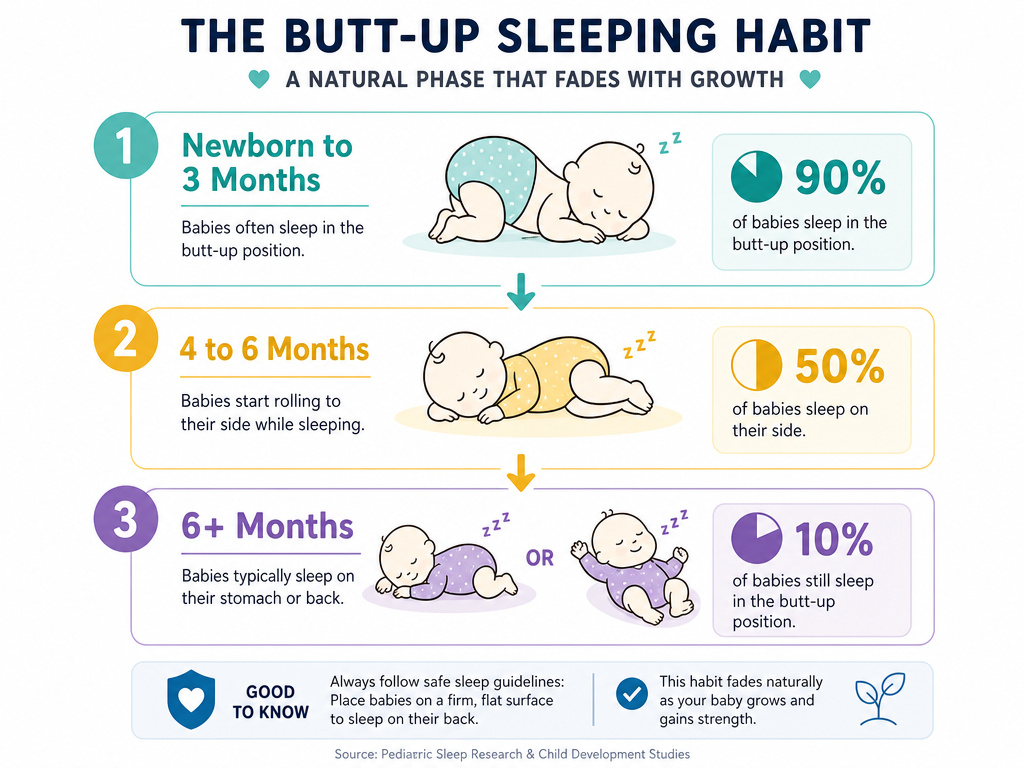 The butt-up sleeping phase has an expiration date. It’s tightly linked to physical milestones.
- Newborn to 3 Months: This is the peak. The fetal reflex is strongest, digestive issues are most prevalent, and core strength is minimal. The position is almost constant during sleep.
- 4 to 6 Months: The fade begins. As babies gain abdominal strength and start rolling, they experiment with new sleep postures, starfish, side-lying, full stomach sleeping. You’ll see the butt-up pose less frequently.
- 6+ Months: For most babies, it’s gone. They now have the motor control to sleep in a variety of positions. If a toddler occasionally assumes this pose, it’s usually during illness or teething for comfort.
If your baby strongly persists in this position exclusively past 6 or 7 months, it’s worth a pediatrician conversation to rule out any underlying muscular or gastrointestinal discomfort. For the vast majority, it’s just a passing, cute habit.
How to Support Safe Sleep in Any Position
Your job isn’t to control your baby’s final sleep posture. Your job is to control the environment so any posture they find is safe. These are the non-negotiable layers of that environment.
- The Surface is Everything. Use a firm, flat baby mattress that meets current safety standards (CPSC 16 CFR Part 1220). The fit in the crib should be snug, no more than two fingers’ width between the mattress and crib side.
- Empty the Crib. No pillows, blankets, stuffed animals, or crib bumpers. Use a wearable sleep sack instead of loose blankets. For bedding, use only a fitted crib sheet designed for that specific mattress.
- Stop Swaddling at the First Sign of Rolling. When your baby shows attempts to roll (often around 8-10 weeks), transition to a sleep sack. A swaddled baby who rolls into a butt-up position on their stomach cannot use their arms to reposition their head.
- Transfer from Sitting Devices. If your baby falls asleep in a car seat, stroller, or swing, move them to their crib as soon as is practical. One study noted infants spend an average of 5.7 hours daily in such devices, but they are not for routine sleep.
- Share a Room, Not a Bed. Place a safe bedside bassinet next to your bed for the first 6-12 months. This allows you to monitor and respond easily without the risks of adult bed-sharing.
Before you start: Never use pillows or positioners to prop your baby into a curled pose. These can shift and block the nose and mouth. Do not place the crib near windows with blind cords. Ensure the mattress is flat, do not elevate the head of the crib to address reflux.
Frequently Asked Questions
Why does my baby sleep with their butt up and face down?
This is a red flag. A face-down position, especially on a soft surface, is a high-risk scenario for suffocation and impaired breathing. If your baby is rolling to this position on a firm crib mattress, it indicates they have strong neck control but you must ensure the mattress is perfectly firm and bare. If they are face-down on a pillow, lounger, or your chest, you need to reposition them immediately.
Is it okay if my baby rolls onto their stomach with their butt up?
Yes, if they roll there on their own. Once a baby can roll from back to front and front to back independently (usually around 5-6 months), you do not need to reposition them all night. Their neuromuscular development allows them to protect their airway. You must still start them on their back and ensure the sleep space is free of hazards.
Does this position mean my baby has gas?
It can, but it’s not a definitive diagnosis. The position helps relieve gas pressure, so a baby with gas may seek it out. However, babies also assume it simply out of habit or for comfort. Look for other signs of gas: fussiness during/after feeding, pulling legs up while crying, a hard belly.
Should I use a special mattress if my baby sleeps like this?
You should use a mattress that meets all safe sleep standards, firm, flat, and well-fitting. A breathable crib mattress can offer an extra layer of reassurance, as it allows air to pass through even if the baby ends up face-close to the surface. The priority is firmness, not special shaping.
Can swaddling help my baby sleep with their butt up?
Swaddling can help a newborn feel secure and may reduce the startle reflex, potentially leading to more settled sleep in whatever position they find. However, it restricts the legs and hips. For a baby who naturally wants to tuck their knees, a swaddle that allows for hip-flexed leg movement (like a sack with a wider bottom) or a transitional sleep sack is a better choice once the startle reflex fades.
When should I be concerned about this sleep position?
Contact your pediatrician if the position is accompanied by: loud, labored breathing; persistent arching of the back and crying (signifying reflux); an inability to be straightened out without significant resistance (which could indicate muscle tone issues); or if your baby seems in pain when their legs are moved.
The Bottom Line
Your baby sleeping with their butt in the air is a normal, transient stage of development rooted in their fetal past and their current physical needs. Your role isn’t to correct the pose but to fortify the stage they’re performing on. That means a bare, firm, flat crib every single time. Trust the guidelines from the American Academy of Pediatrics recommendations, they exist because the alternative carries measurable, documented risk. Provide the safe space, use a trusted mattress for infants, and let your little one find their comfortable tuck. They’ll stretch out on their own schedule, usually just in time for you to miss that tiny, curled-up silhouette.
