
Do I Need a Baby Shaping Pillow? AAP Advice & Safe Options
This post contains affiliate links. As an Amazon Associate we earn from qualifying purchases.
No, you do not need a baby shaping pillow, and you should not use one. The American Academy of Pediatrics (AAP) and the Consumer Product Safety Commission (CPSC) explicitly warn against placing any pillows, cushions, or soft objects in an infant’s sleep space due to the risk of suffocation and Sudden Infant Death Syndrome (SIDS). A 2022 AAP technical report states there is “no clear evidence” these specialty pillows work for flat head syndrome, and the CPSC’s data from 2010-2022 links 154 infant deaths to nursing pillows, which share similar suffocation hazards.
The core of the issue is a product category that promises a solution for a common parental worry—positional plagiocephaly, or flat head syndrome—without delivering proven results, while introducing a measurable, documented risk. The safety standard is not a suggestion; it is a federal regulation born from tragedy.
What follows is a breakdown of the evidence, the new federal rules that reshape the market, and the three things that actually work without putting your baby in danger.
Key Takeaways
- Shaping pillows are ineffective and unsafe. Major health authorities like the AAP and the CPSC advise against any pillows in a baby’s crib due to suffocation risk, and peer-reviewed evidence does not support their use for correcting head shape.
- New federal regulations mandate firmness. For products manufactured after April 23, 2025, nursing pillows and similar items must meet strict firmness tests (requiring over 10.0 Newtons of force to indent) to prevent conforming to an infant’s face.
- Supervised use vs. Sleep is the critical line. A pillow used only when you and the baby are awake, alert, and interacting—like a nursing pillow during feeding—is categorically different from one left in the crib.
- Tummy time and repositioning are the proven, safe first steps. These are the frontline recommendations from pediatricians for managing and preventing flat spots.
- Helmet therapy is a medical intervention. For moderate to severe cases, a custom orthotic helmet like the LOCband can be effective, but it requires a professional diagnosis and fitting.
The Short Answer
You do not need a baby shaping pillow. Full stop.
The question concerns recognizing that the product category itself sits at the intersection of an unproven claim and a known hazard. The AAP’s 2022 safe sleep policy is unambiguous: “It is not safe to place soft materials or objects, such as pillows (including semicircular or other nursing pillows), quilts, comforters, or fur-like materials, even if covered by a sheet, under a sleeping infant.”
The official nursing pillow safety standard (16 CFR Part 1242) now requires a force greater than 10.0 Newtons to indent the pillow by one inch, a test designed to ensure it cannot easily conform to an infant’s face and airway.
This regulation, which took effect in April 2025, exists because softer, conforming products have been involved in infant deaths. The risk is documented in incident reports.
The Evidence Says No
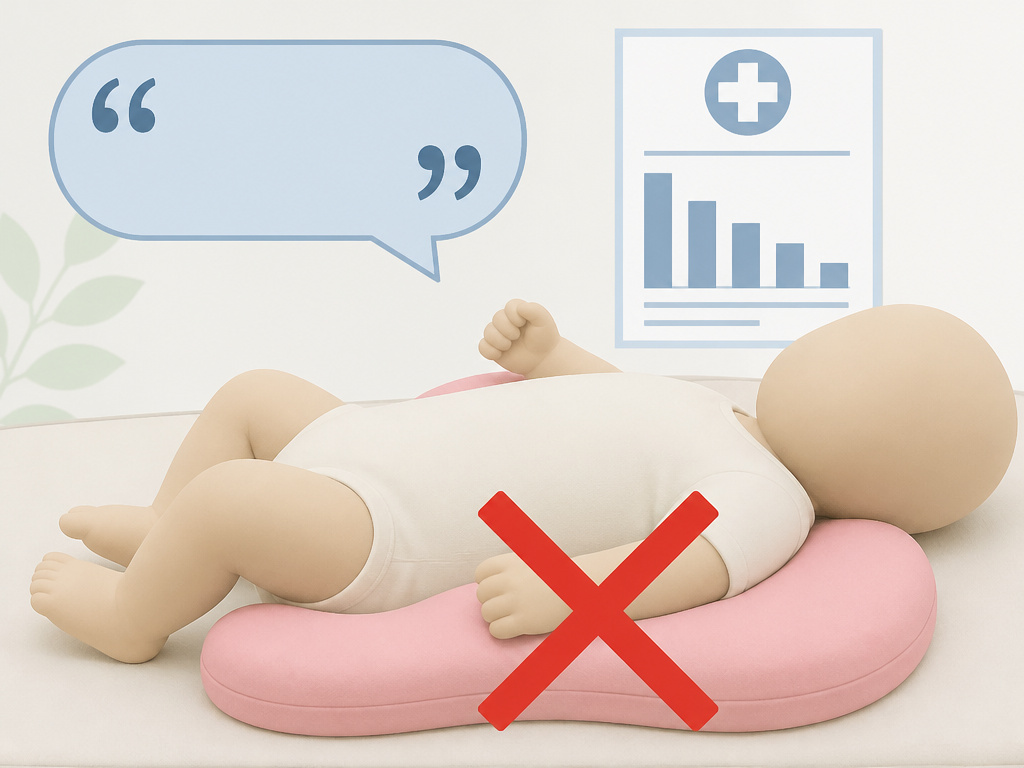
Let’s separate the marketing from the medicine. Flat head syndrome, or positional plagiocephaly, occurs when pressure flattens a spot on a baby’s soft, malleable skull. It became more common after the successful “Back to Sleep” campaign drastically reduced SIDS rates by having babies sleep on their backs.
Companies saw a market. They sold curved pillows, donut pillows, and wedges claiming to cradle the head and promote roundness. The problem is clinical evidence.
Where this goes sideways: Assuming a pillow can gently guide skull growth. The London Orthotics Clinic, which treats the condition, states plainly: “Special pillows are often sold as a way to help with flat head syndrome, but there is no clear evidence that they work.” The skull’s shape is influenced by persistent directional pressure, not a soft cushion meant to offload it.
The AAP’s technical report echoes this, noting the lack of evidence. More critically, these items violate the cardinal rule of safe sleep: a firm, flat, bare surface. Adding any pillow introduces a soft, pliable object that can shift and block an infant’s nose and mouth, especially before they have the neck strength to turn their head away.
The CPSC’s review of incident data from 2010 to 2022 identified 154 fatal incidents linked to nursing pillows. Most victims were under three months old. The cause was typically suffocation or entrapment when the pillow was used for sleep or lounging, not for supervised feeding. This data directly informed the new federal nursing pillow regulation.
What the New Safety Rules Actually Require
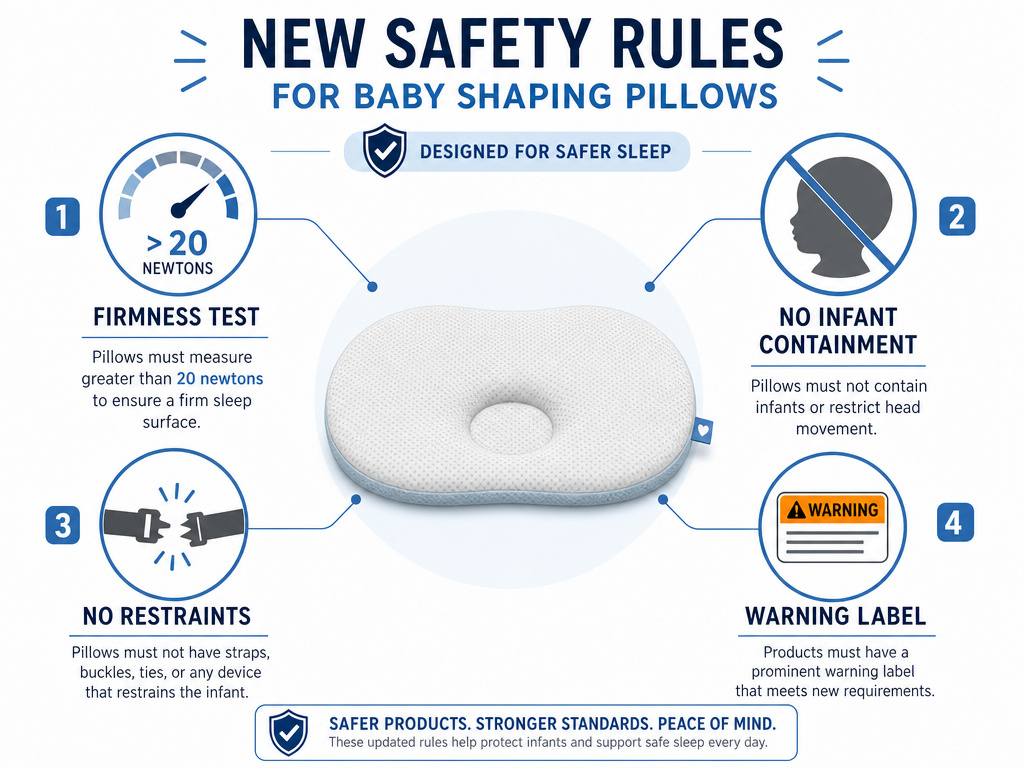
In October 2024, the CPSC published a final rule creating 16 CFR Part 1242, a mandatory safety standard for nursing pillows. This is law for products made after April 23, 2025. The rule aims to eliminate design features that made these products dangerous for sleep.
| Requirement | What It Means | Why It Matters |
|---|---|---|
| Firmness Test | A 3-inch probe must require more than 10.0 N (2.24 lb) of force to indent the pillow 1 inch. | Prevents the pillow from conforming to an infant’s face, reducing suffocation risk if a baby rolls or is placed face-down. |
| Infant Containment | The opening must not contact a 9-inch diameter head probe. | Stops the pillow from creating a snug “nest” that can trap an infant’s head. |
| No Infant Restraints | The pillow “shall not include any infant restraint system.” | Removes straps or harnesses that could encourage leaving a baby unattended in the pillow. |
| Warning Labels | Clear, permanent labels against use for sleep, lounging, or propping. | Directly informs caregivers of the hazard at the point of use. |
This standard also pulls nursing pillows under the umbrella of durable infant products that require a registration card, so companies can contact you if there’s a recall. The parallel ASTM F3669-24 standard covers similar ground for industry testing.
The takeaway for you as a parent is that any pillow sold for infant use should now be visibly firmer and flatter. But even a compliant pillow is not safe for sleep. The labels are there because the hazard remains during unsupervised use.
Safe Alternatives That Actually Work
If a shaping pillow is off the table, what do you do about a flat spot? The protocol is straightforward, incremental, and backed by pediatric consensus.
1. Repositioning and Tummy Time (The First Line)
This is non-negotiable. When your baby is awake and supervised, give them plenty of tummy time to strengthen neck and shoulder muscles. Start with a few minutes a few times a day and build up. Also, alternate the direction your baby’s head faces in the crib each night, and switch which arm you hold them in during feeds.
Common mistake: Keeping the baby in containers (car seats, bouncers, swings) for extended periods when awake. Every minute in a container is a minute not moving freely on a flat surface or building strength during tummy time.
2. Physical Therapy Evaluation
If repositioning isn’t helping by 4-6 months, your pediatrician may refer you to a pediatric physical therapist. They can assess for torticollis (a tight neck muscle that limits head turning) and provide guided exercises. This step addresses the underlying cause of the asymmetry.
3. Orthotic Helmet Therapy (For Moderate/Severe Cases)
For significant deformity that isn’t resolving, a custom-fitted cranial orthosis (helmet) like the LOCband can be effective. The AAP safe sleep evidence base acknowledges this as a treatment option. It works by providing a gentle, continuous guide for growth in the desired direction as the skull expands. This is a medical device, not a retail product, and requires a specialist’s prescription and monitoring.
| Method | How It Works | Best For | Risk If Skipped |
|---|---|---|---|
| Repositioning & Tummy Time | Reduces pressure on flat spot; strengthens muscles. | All infants, especially as prevention. | Flat spot may worsen; can contribute to gross motor delays. |
| Physical Therapy | Stretches tight muscles; improves range of motion. | Babies with torticollis or noticeable preference. | Asymmetry becomes fixed; may require helmet later. |
| Helmet Therapy | Gently directs skull growth into open spaces of the helmet. | Moderate to severe plagiocephaly in infants 4-12 months. | Missed window for correction (skull bones fuse around 18-24 months). |
Nursing Pillows vs. Sleep Pillows: Drawing the Line
This is where confusion leads to danger. A pillow designed for a specific, supervised purpose is not the same as one marketed for sleep.
A nursing pillow is a tool to support a feeding infant and a parent’s arms. The new CPSC rule allows straps for securing it to the parent, not the baby. Its correct use is brief, with the baby actively feeding and the parent fully alert. The moment the baby falls asleep, they must be moved to a safe sleep surface.
A baby sleep pillow or shaping pillow is marketed to be left under the baby’s head in the crib. This is the product the AAP and CPSC warn against. It has no legitimate supervised-use use case that isn’t better served by a firm, flat mattress.
Similarly, a baby lounger pillow is designed for a baby to recline in, often with raised sides. The CPSC now regulates these as “infant support cushions” under a separate rule (16 CFR Part 1243, effective May 2025) because of their high risk when used for unsupervised sleep. They are not safe sleep spaces.
The rule is simple: if a product is in the crib, bassinet, or play yard during sleep, it must be a fitted sheet on a firm, flat mattress. Nothing else.
What About Other Baby Pillows?
The “need” for a pillow is developmental. Infants do not have the cervical spine curvature that makes a pillow comfortable or supportive. They also lack the motor skills to extricate themselves from a soft barrier.
- Newborns to 12+ months: No pillow in the sleep space. This includes so-called pillows for infant sleep.
- Toddlers (18-24 months+): You can introduce a very thin, firm, small pillow for a child’s sleep once they transition to a toddler bed. Prioritize one that doesn’t sink.
- Older Children (4-5 years+): A standard child-sized pillow is appropriate. Look for supportive options among the best pillows for a 5-year-old.
For supervised, awake time, products like tummy time pillows or pillows for flat head syndrome are marketed, but their utility is debatable. A simple rolled towel or blanket under the chest during tummy time often works just as well, and a play mat provides a perfectly adequate firm surface. Spending money on a specialty pillow here is usually unnecessary.
Frequently Asked Questions
Are baby head shaping pillows safe for newborns?
No. They are not safe for newborns or any infant during sleep. The AAP recommends nothing in the crib but the baby on a firm, flat mattress with a fitted sheet. The soft, conforming nature of these pillows presents a suffocation hazard.
What is the best pillow to prevent flat head?
The best “pillow” is no pillow. Prevention is achieved through active measures: supervised tummy time when awake, alternating the baby’s head position during sleep, and limiting time in car seats and bouncers. These methods are free, safe, and effective.
Do pediatricians recommend baby pillows?
Pediatricians, following AAP guidelines, recommend against the use of any pillows, cushions, or soft bedding in an infant’s sleep environment. For flat head concerns, they recommend repositioning and tummy time long before considering any commercial pillow product.
Can I use a nursing pillow for supervised play?
You can, but with extreme caution. The baby must be fully awake, you must be fully alert and hands-on, and the pillow must be on the floor away from edges. It is still a soft surface that could pose a risk if the baby rolls or slumps. A firm play mat is a safer choice.
When is it safe to give my baby a pillow?
Most experts agree it is safe to introduce a small, firm, flat pillow when your child transitions from a crib to a toddler bed, typically around age 2. Before that, there is no physiological need for a pillow, and it only adds risk.
Do baby pillows really help with flat head?
There is no clear clinical evidence that they do. Organizations like the London Orthotics Clinic state they are not proven to work, and they introduce a safety risk. Proven interventions are repositioning, physical therapy, and, in some cases, helmet therapy prescribed by a doctor.
Before You Go
Skip the baby shaping pillow. The evidence isn’t there, but the risk is quantified and real. Your money and energy are far better spent on a good play mat for tummy time and ensuring your baby’s sleep space is boringly bare.
Focus on the three actions that matter: reposition, provide tummy time, and consult your pediatrician early if you’re concerned. For severe cases, a medical path like helmet therapy exists. A pillow sold online is a product that capitalizes on worry while undermining the very sleep safety guidelines that have saved thousands of infant lives. Your baby’s round head isn’t worth that trade.
