
The Reason Babies Move So Much in Their Sleep & What It Means
This post contains affiliate links. As an Amazon Associate we earn from qualifying purchases.
Babies move so much in their sleep primarily because they spend up to 50% of their sleep in active REM sleep, a stage characterized by brain activity, rapid eye movements, and involuntary muscle twitches called myoclonus. These movements are a normal, vital part of sensorimotor development, helping the brain map the body and strengthen neural pathways. The median interval between twitches is less than 30 seconds, with some sessions containing over 500 individual movements.
That intensity of motion isn’t random noise. It’s structured feedback for a brain that’s booting up. Each jerk and stretch sends a signal back to the cortex, building the internal model your baby will use to eventually reach, crawl, and walk.
What follows is a breakdown of the four specific drivers behind the squirms, the timeline for when they peak and fade, and the clear line that separates helpful movement from a disorder that needs a doctor’s attention. You’ll also get actionable tips for setting up a safe sleep space that accommodates this normal activity without compromising safety.
Key Takeaways
- Newborns experience a median of 100 myoclonic twitches per sleep session, with most occurring less than 30 seconds apart, as part of essential brain development.
- A sharp change in movement patterns happens around 2 months, coinciding with the emergence of circadian rhythms and a shift toward more adult-like sleep cycles.
- Sleep-related rhythmic movement disorder (SRRMD), like head banging or body rocking, is distinct from normal twitches and affects up to 67% of infants at 9 months, but usually fades by age 5.
- The safest sleep environment for a moving baby is a firm, flat surface with a fitted crib sheet and no loose blankets, pillows, or soft toys.
- While most movement is benign, consult a pediatrician if movements are rhythmic, forceful, cause injury, or severely disrupt sleep for the child or family.
The 4 Main Reasons for Sleep Movement
The wiggles, startles, and jerks you see have distinct biological jobs. They are not a sign of restless or poor sleep, but of a busy, developing brain.
1. Active Sleep Dominance.
Newborns don’t enter sleep like adults do. We drift off through quiet, deep sleep. Babies plunge directly into active sleep, which is similar to adult REM. This stage makes up about 50% of a newborn’s total sleep. Their brain is highly active, eyes dart under closed lids, and breathing is irregular. The body’s muscle inhibition is incomplete, so brain activity spills over into small movements.
A 2021 study of infant sleep kinematics found movement occurrence is cyclical, with a 1-hour cycle. Peaks in movement were associated with higher acceleration and a higher proportion of bilateral movements.
This cycle is tied to ultradian rhythms, short biological cycles that govern sleep and wakefulness in infants before the 24-hour circadian rhythm matures. You’re seeing the physical signature of each sleep phase.
2. Myoclonic Twitching for Brain Mapping.
The most common movements are myoclonic twitches: sudden, brief jerks of the limbs, face, or torso. Research from the infant myoclonic twitching study shows these are not random. In observed sessions, the median inter-twitch interval was less than 30 seconds, with 85-95% of twitches happening that close together.
These twitches are now understood as fundamental to sensorimotor development. Each twitch generates sensory feedback from the muscles and joints back to the brain. This process is how the brain learns the body’s dimensions, strength, and capabilities, a process called “sensorimotor integration.” It’s the nervous system’s way of self-calibrating.
3. Transitioning Sleep States.
Babies cycle between sleep states every 50-60 minutes, much faster than an adult’s 90-minute cycle. Each transition, from active to quiet sleep, or from one sleep cycle to the next, can be bumpy. You’ll often see a burst of movement, a sigh, or a brief stirring as they shift gears. This is normal and doesn’t usually mean they are waking up.
4. Immature Nervous System.
The neural pathways that suppress voluntary movement during sleep are still under construction. The “brain-to-muscle” signals are more easily activated. As the nervous system matures over the first six months, these movements become less frequent and more subdued.
A Timeline of Normal Sleep Movements
Movement patterns evolve on a predictable schedule. Knowing what to expect and when can turn worry into recognition.
| Age Range | Sleep & Movement Characteristics | What You’ll Likely See |
|---|---|---|
| Newborn (0-2 months) | 16-18 hours of sleep per day. Sleep onset via Active (REM) sleep. No established circadian rhythm. | Frequent myoclonic twitches (median 100/session), startles (Moro reflex), grimaces, and sucking motions. Longest sleep stretch is 2.5-4 hours. |
| 2-4 Months | Circadian rhythms begin. Sleep onset starts with NREM (quiet sleep). REM sleep decreases to ~40%. | Twitching shifts after the 2-month mark. Movements may start to cluster more at sleep onset and during light sleep. More distinct sleep/wake patterns emerge. |
| 5-9 Months | Longer nocturnal sleep stretches (up to 6 hours). Total sleep ~14-15 hours. NREM/REM cycles solidify. | Twitches lessen. More purposeful movements during sleep (rolling, changing position). Rhythmic movements like body rocking may appear at sleep onset in many infants. |
| 10-18 Months | Adult-like sleep architecture. Usually one nap. Well-defined sleep cycles. | Occasional twitches in REM sleep. Sleep is generally more still. Rhythmic movement disorder, if present, peaks in prevalence around 9 months and declines. |
Where this goes sideways: Mistaking the 2-month transition for a sleep problem. When circadian rhythms kick in, sleep patterns change and twitching evolves. Parents often think sleep is getting worse, but the brain is actually maturing. This phase passes in a few weeks.
The data from the normal infant sleep patterns review shows the wide range of normal. Some 6-month-olds sleep 12 hours, others 16. The movement inside that sleep is just as variable. The trend toward consolidation and stillness is what matters, not the absolute number of twitches on any given night.
Normal Movement vs. Sleep-Related Rhythmic Movement Disorder (SRRMD)
This is the critical distinction every parent needs. Normal sleep movement is random, jerky, and small-scale. A disorder is repetitive, stereotyped, and often forceful.
Normal Myoclonic Twitches:
- Pattern: Isolated, jerky, and asynchronous (one arm then a leg, not both together).
- Timing: Occur most during active (REM) sleep, throughout the night.
- Duration: Each twitch lasts a fraction of a second.
- Frequency: Can be very frequent (seconds apart) but irregular.
- Effect on Baby: Does not disturb sleep. The baby remains asleep.
Sleep-Related Rhythmic Movement Disorder (SRRMD):
- Pattern: Repetitive, rhythmic, and stereotyped. Examples include head banging (against crib rail), head rolling (side to side), or body rocking (on hands and knees).
- Timing: Most common at sleep onset or during light NREM sleep (stages 1 & 2). Can occur in all sleep stages.
- Duration: Episodes can last up to 15 minutes. The movements themselves have a frequency of 0.5 to 2.0 Hz (one or two motions per second), as defined by the American Academy of Sleep Medicine.
- Frequency: Episodes may happen nightly.
- Effect on Baby: Can cause injury (bruises, calluses, rarely more severe harm) or significantly disrupt sleep, leading to daytime fatigue. The child is typically unaware of it.
The prevalence of rhythmic head or body movements in normally developing infants is high at 9 months of age (59–67%), decreasing to 33% by 18 months and dropping to 6% by 5 years of age.
Most rhythmic movement is benign and self-limiting. It becomes a clinical disorder. SRRMD, only if it causes injury, major sleep disruption, or daytime impairment. The vast majority of babies who rock or bang will outgrow it without intervention.
Creating a Safe Sleep Space for a Wiggly Baby
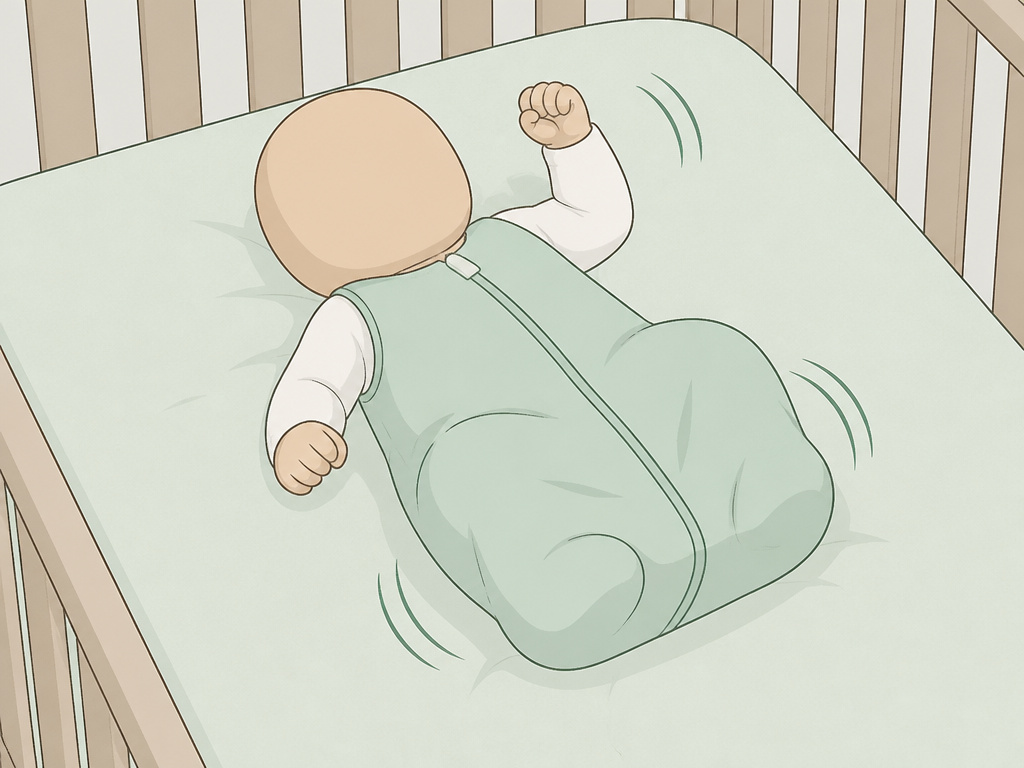 A moving baby needs an environment that protects them without restricting normal activity. Safety is non-negotiable, and it works with their biology, not against it.
Follow these rules for every sleep period (naps and night): 1. Use a Firm, Flat Surface. This is the cornerstone. A firm crib mattress or bassinet mattress resists indentation, preventing airway obstruction if the baby rolls or moves face-down. Soft mattresses are a suffocation risk. 2. Keep the Crib Bare. No pillows, blankets, stuffed animals, crib bumpers, or positioners. These are entanglement and suffocation hazards. For warmth, use a wearable sleep sack or swaddle (if the baby is not yet showing signs of rolling). 3. Employ a Fitted Sheet Only. Use a tight-fitting, breathable crib sheet designed for your specific mattress. Loose sheets can come untucked and pose a risk. 4. Place Baby on Their Back. The “Back to Sleep” position is the single most effective SIDS risk-reducer. Once a baby can roll from back to front and front to back independently, you can leave them in the position they find, but always start them on their back. 5. Consider a Breathable Mattress. For parents particularly concerned about airflow, a breathable mattress can offer an extra layer of reassurance, though it does not replace the other safety rules.
Common mistake: Adding a soft blanket for comfort. A wearable sleep sack is safer. It keeps the baby warm without any loose fabric near their face, which is crucial during periods of active movement.
The goal is to create a “clean runway” for their natural movements. A safe sleep space lets the twitches and rolls happen without danger, giving their developing brain the freedom it needs.
When to Talk to Your Pediatrician
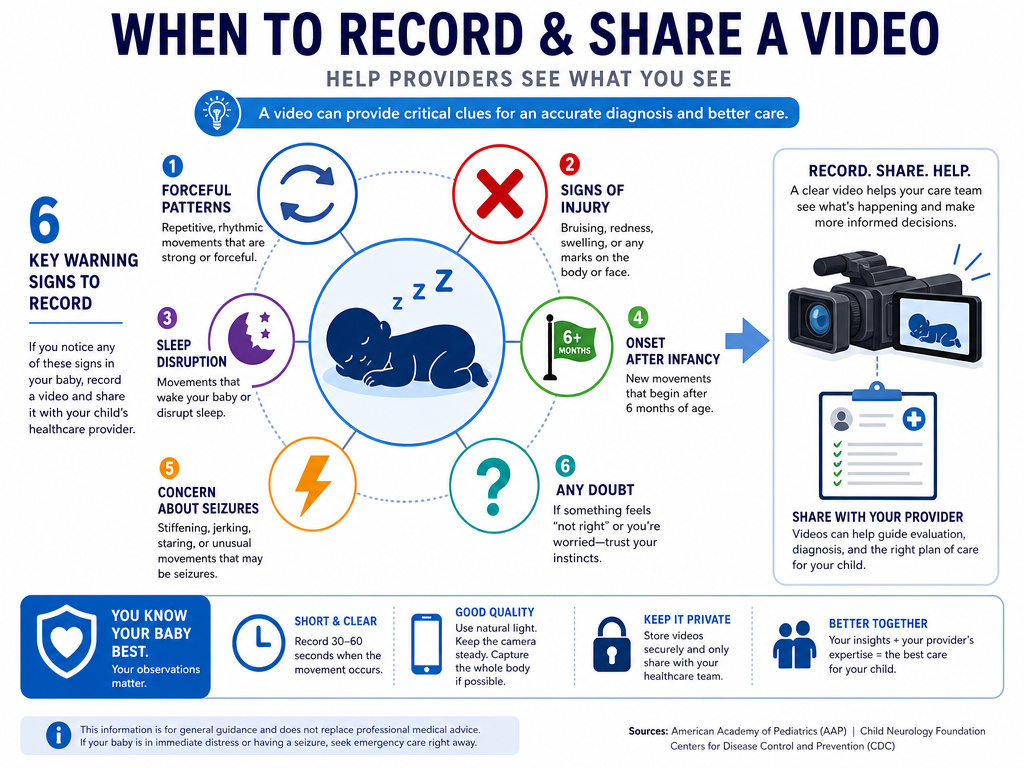 Most sleep movement is a sign of a healthy, developing brain. But a small subset of symptoms warrants a professional opinion.
Consult your doctor if you observe:
- Forceful, Rhythmic Patterns: Repetitive head banging, body rocking, or head rolling that lasts for minutes, especially if it’s loud or violent.
- Signs of Injury: Red marks, bruises, calluses, or hair loss on the forehead or back of the head.
- Sleep Disruption: The movements consistently wake the baby or prevent them from falling asleep, leading to significant daytime fussiness or fatigue.
- Regression or Onset After Infancy: New rhythmic movements appearing in a child over 18 months old.
- Concern About Seizures: Movements that look like jerking spasms, are accompanied by eye deviation or lip smacking, or where the baby is unresponsive during the episode.
- Any Doubt Whatsoever. Parental intuition is powerful. If something feels off, getting it checked provides peace of mind or early intervention.
Your pediatrician will likely ask for a home video of the episode, which is the most helpful diagnostic tool. They may refer you to a sleep specialist for a evaluation or, in rare cases, a polysomnogram (sleep study) to rule out other disorders like sleep apnea or nocturnal seizures.
Frequently Asked Questions
Is it normal for my baby to jerk or twitch while sleeping?
Yes, it is very normal. These are myoclonic twitches, and they are most common in the first few months of life. Studies show babies can have hundreds of these twitches in a single sleep session. They are a positive sign of sensorimotor development.
Why does my baby grunt and squirm so much?
Grunting and squirming are hallmarks of active (REM) sleep, which dominates a newborn’s sleep cycle. The grunting is often due to irregular breathing patterns in this stage, and the squirming is from the incomplete muscle paralysis. It’s also a common sign they are working through gas or a bowel movement, as their digestive system is immature.
Should I swaddle my baby if they move a lot?
Swaddling can be very effective for newborns, as it limits the startle reflex and may promote longer sleep. However, you must stop swaddling as soon as the baby shows any signs of attempting to roll over, usually around 2-3 months. A swaddled baby who rolls onto their stomach is at extreme risk for suffocation. Transition to a wearable sleep sack.
Are sleep movements a sign of a bad dream or nightmare?
No. Nightmares and bad dreams require complex cognitive processing and typically don’t emerge until a child is 2 years old or older. The movements in infancy are purely physiological, not related to dream content.
What is the difference between a sleep startle and a seizure?
Sleep startle (Moro reflex) is a symmetrical jerking of both arms outward, then inward, often in response to a sensation of falling or a loud sound. It’s brief and the baby settles quickly. A seizure may involve asymmetric jerking, rhythmic cycling of the legs, eye deviation, or lip smacking. The baby may be unresponsive and the episode may last longer. If you suspect a seizure, seek immediate medical attention.
Before You Go
Your baby’s nightly dance party is a feature, not a bug. Those twitches and squirms are the visible output of a billion neural connections being wired. They peak in the early months, evolve around the 2-month mark, and gradually subside as sleep matures.
Focus on controlling the environment, not the baby. A firm, bare sleep space with a fitted sheet is the safest stage for their development. Keep a watchful eye for the red flags of rhythmic movement disorder, but know that the vast majority of this activity is a temporary and necessary phase of growth. Trust the process, ensure safety, and when in doubt, your pediatrician is the best resource.
