
Discover What Time Infants Should Go to Sleep & Best Routines
This post contains affiliate links. As an Amazon Associate we earn from qualifying purchases.
Infants 4 to 12 months old should go to sleep between 7:00 PM and 8:00 PM. This window aligns with their natural circadian rhythm, supports the 12-16 hours of total sleep they need, and prevents overtiredness that disrupts nighttime rest. For newborns under 4 months, sleep is erratic and driven by feeding; a consistent bedtime isn’t the goal yet.
That 7-8 PM target is the mechanical outcome of matching their sleep need to the daylight cycle. An infant who naps until 5 PM won’t be ready for bed by 7:30.A baby put down at 9 PM has likely been awake too long, triggering cortisol and making sleep fragmented.
What follows is the breakdown: why that window works, how to adjust it for late naps, the one step in the routine that matters most, and what to do when growth spurts and teething throw the whole schedule out the window.
Key Takeaways
- Aim for a 7:00 PM to 8:00 PM bedtime for infants 4-12 months. This supports their need for 12-16 hours of total sleep.
- For newborns (0-3 months), focus on feeding cues and safe sleep surfaces, not a fixed clock time. Their circadian rhythm isn’t developed yet.
- Protect the last nap of the day. It should end by 5:00 PM to allow a proper wind-down period before the target bedtime.
- A short, consistent 20-30 minute bedtime routine is more powerful than a long, variable one. It cues the brain for sleep.
- Room-sharing for the first 6-12 months is a non-negotiable safety recommendation, not just a convenience.
The Ideal Bedtime Window for Infants (0-12 Months)
The 7-8 PM rule exists because of biology, not tradition. An infant’s internal clock, or circadian rhythm, starts to solidify around 4 months. This rhythm is set by light exposure. Daylight signals wakefulness; darkness triggers melatonin production. Putting a baby down during that natural melatonin rise, which for most infants begins in the early evening, makes falling asleep easier and sleep deeper.
The American Academy of Sleep Medicine states infants 4 to 12 months need 12 to 16 hours of sleep per 24 hours. A bedtime of 7:30 PM, with a 6:30 AM wake-up, provides 11 hours of nighttime sleep. The remaining 1-5 hours come from daytime naps.
Missing this window has a physical cost. An overtired baby produces stress hormones like cortisol. This hormone makes it harder to fall asleep and causes more frequent night wakings. You get a baby who is exhausted but wired.
The part nobody mentions: That 7-8 PM window assumes the last nap ended by 5 PM. If your baby naps from 5:30 to 6:30 PM, a 7:30 bedtime is impossible. They haven’t built up enough sleep pressure. In that case, shift bedtime to 8:30 PM, but protect the 5 PM nap cutoff tomorrow.
| Age Range | Total Sleep Needed (AASM) | Nighttime Sleep Goal | Ideal Bedtime Window | Key Consideration |
|---|---|---|---|---|
| 0-3 Months | No official consensus (highly variable) | 8-9 hours (in segments) | Not applicable | Sleep is driven by hunger; focus on safe sleep position and surface. |
| 4-12 Months | 12-16 hours | 10-12 hours | 7:00 PM – 8:00 PM | Protect the last nap to end by 5:00 PM for a successful bedtime. |
| 12-24 Months | 11-14 hours | 10-11 hours | 7:30 PM – 8:30 PM | Transition to one nap; bedtime may shift slightly later if nap ends late. |
Why Newborn Sleep Is Different (The First 3 Months)
Asking for a newborn’s bedtime is like asking for the sunset time in a cave. They can’t see the sun yet. Their circadian rhythm is undeveloped, and their stomach is tiny. Sleep happens in 30-minute to 3-hour chunks around the clock, punctuated by feeding every 2-4 hours.
The primary goal for newborns isn’t schedule but safety and sustenance. The AAP safe sleep policy guide is clear: always place them on their back on a firm, flat surface free of soft bedding. This means a certified crib mattress in a bedside bassinet or crib in your room.
Where this goes sideways: Trying to force a newborn into a strict 7 PM bedtime. It leads to a frantic, hungry baby and a frustrated parent. For the first 12 weeks, follow their lead. Offer feeds on demand, watch for sleepy cues (glazed eyes, yawning, turning away), and then place them down drowsy but awake in their safe sleep space.
You can, however, start teaching night versus day. During daytime feeds and wakes, open curtains, talk normally, and play. For night feeds, keep lights dim and interaction minimal. This gentle conditioning lays the groundwork for the 4-month shift.
Step-by-Step: Building a Bedtime Routine That Sticks
A routine signals security. It tells a baby’s brain, “Sleep is next.” The magic isn’t in the activities themselves, but in their predictable sequence. Start this routine around 3 months, and by 4 months, it will be a powerful sleep cue.
Keep it short, 20 to 30 minutes max. A marathon routine is exhausting for everyone.
- Feed First. Offer a full feed at the start of the routine, not as the final step. This separates feeding from falling asleep, a crucial skill for self-soothing later. A baby who relies on a bottle or breast to konk out will need it again at every night waking.
- Bath or Wash. Warm water is a natural relaxant. It also serves as a clear “day is over” signal. A quick sponge wash works on nights you skip the full bath.
- Change into Sleep Clothes & Fresh Diaper. This is a tangible transition. A breathable crib mattress with a fitted sheet completes the safe sleep environment.
- Quiet Activity in the Room. Read a short book, sing a lullaby, or give a gentle massage. The key is calm interaction. Avoid tickling or loud play.
- Say Goodnight & Place in Crib. Place your baby in their crib while they are still drowsy but awake. This is the single most important step. It allows them to practice the skill of falling asleep independently. Turn on a white noise machine, offer a final soothing word, and leave the room.
Skip this if: Your baby is already fully asleep in your arms. You miss the “drowsy but awake” practice window. It’s okay sometimes, but making it the habit creates a dependency.
Navigating Naps, Regressions, and Real Life

The perfect 7:30 PM bedtime can be demolished by a day of bad naps or a developmental leap. Here’s how to troubleshoot.
Naps Dictate Night. Think of sleep pressure like a battery. Naps drain it; awake time recharges it. For a 7:30 bedtime, the last nap must end by 5:00 PM. If your baby is on two naps, the second nap often becomes the problem. If it starts too late or runs too long, bedtime shifts. Protect the morning nap to protect the afternoon nap to protect the night.
The 4-Month Sleep Regression. This is a permanent change in sleep architecture. Their brain matures, and sleep cycles become more adult-like, with clear light and deep stages.They now wake briefly between cycles. A baby who doesn’t know how to self-soothe will cry out for help at each wake-up. This is why the “drowsy but awake” practice before the regression hits is critical.
Teething, Illness, and Travel. These are temporary disruptors. During illness or severe teething pain, comfort comes first. Do what you need to do, extra holding, earlier feeds, to get through the night. The goal is to return to the normal routine once the acute issue passes. For travel sleep solutions, consistency is key; bring their lovey, use white noise, and replicate the bedtime steps as closely as possible.
Common mistake: Dropping a nap too early because night sleep is bad. An overtired baby from missed daytime sleep sleeps worse at night, not better. Most babies need three naps until 6-8 months, and two naps until 14-18 months.
Safe Sleep Environment: The Non-Negotiables
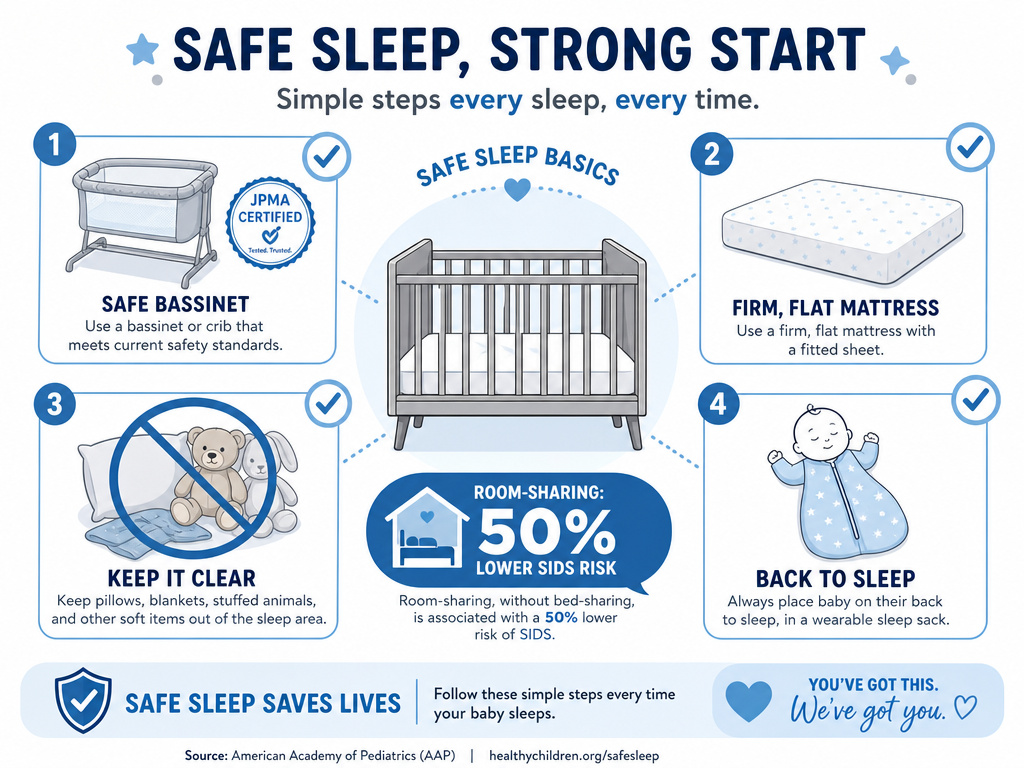
The best bedtime is meaningless without a safe place to sleep. This isn’t about comfort extras; it’s about risk reduction. The evidence is concrete.
Room-sharing for the first 6 months, ideally a year, is associated with a 50% reduction in the risk of SIDS. The baby should be in their own infant bedside sleeper or crib, not in your bed. The 2022 safe infant sleep evidence review reinforces that a firm, flat surface is essential.
Your checklist: * A Certified Sleep Product: Crib, bassinet, or portable cribs must meet current CPSC safety standards (post-June 2021 rule). * A Firm, Flat Mattress: No pillows, no quilts, no padded bumpers. Just a firm infant mattress with a tightly fitted sheet. * Empty Crib: No stuffed animals, loose blankets, or sleep positioners. A wearable sleep sack is safer than a blanket. * Back to Sleep: Always place your baby on their back for every sleep period until they can roll both ways independently.
This environment doesn’t change based on the clock. A safe 7 PM sleep is the same as a safe 11 PM sleep.
Frequently Asked Questions
What if my infant won’t sleep until 9 PM or later?
This is usually a schedule issue, not a preference. A late bedtime often means the last nap is too late or too long, or daytime naps are insufficient, leaving the baby overtired and wired. Try gently waking them from their last nap by 5 PM and moving the entire routine 15 minutes earlier every few days. Consistency with morning wake-up time is also crucial.
How do I know if my baby is overtired?
Signs include rubbing eyes, fussiness, hyperactive silliness, clinginess, and fighting sleep despite obvious exhaustion. An overtired baby often falls asleep quickly but then wakes frequently at night. Preventing overtiredness is easier than fixing it.
Can bedtime be different on weekends?
Try to keep it within a 30-minute window. A drastically later weekend bedtime can trigger a form of “social jet lag” for infants, making Monday mornings rough. Consistency is the bedrock of infant sleep.
What about dream feeds?
Dream feed is a late-night feed (around 10-11 PM) where you gently rouse the baby to feed without fully waking them. It can help some babies link longer sleep stretches in the early part of the night. However, it can also become a habitual waking. It’s a tool, not a requirement, and most babies outgrow the need by 6-9 months.
My baby rolls onto their stomach to sleep. Should I flip them back?
Once a baby can roll from back to stomach and stomach to back on their own, you can leave them in the position they choose. Ensure the sleep surface is still firm and empty. Continue to place them on their back at the start of sleep.
The Bottom Line
The target is 7:00 to 8:00 PM for infants over four months. Hit that by guarding the last nap and following a short, calm routine that ends with them awake in their crib. For newborns, let the clock go and follow their cues, while steadfastly following safe sleep guidelines.
The real goal is a well-rested baby who gets the sleep their growing brain and body require, in an environment that keeps them safe. Start with the 7:30 window, watch your baby’s response, and adjust the dial in 15-minute increments.The routine is your anchor; the exact minute they drift off is just the tide.
