
What Mattress for Newborn? Firmness Rule & Gap Safety Test
This post contains affiliate links. As an Amazon Associate we earn from qualifying purchases.
The right mattress for a newborn is a firm, flat surface that fits a full-size crib with no more than a 3.15-inch gap in any corner and is no more than 6 inches thick. It must meet the federal safety standard ASTM F2933, which bans soft, conforming materials like memory foam. This isn’t about comfort, it’s about preventing suffocation and entrapment.
That gap measurement is specific. Federal testers use a washed cotton sheet pulled tight, then measure from the mattress to a fixed point in the crib’s corner. A mattress that passes in the store can fail at home if it wasn’t fully inflated or recovered for at least 24 hours before the test, a new rule taking effect in 2026.
What follows: the two federal specs that trump every marketing claim, the real difference between foam and innerspring, why after-market and “breathable” mattresses are a minefield, and the one feature worth paying for.
Key Takeaways
- A safe newborn mattress is firm enough that it does not indent under your baby’s head or conform to their face. Memory foam fails this test.
- Federal law (16 CFR § 1241.2) mandates a maximum 3.15-inch corner gap. Test this yourself with a fitted sheet and a tape measure.
- Mattresses sold after August 15, 2022, must pass a firmness test. New 2026 rules require a 24-hour pre-conditioning period before testing to catch underinflated products.
- Avoid after-market mattresses for cribs, bassinets, or play yards unless they are the exact OEM replacement. CPSC data links ill-fitting after-market units to entrapment hazards.
- The only accessory you need is a tight-fitting, waterproof mattress protector. Pads, toppers, and extra bedding increase suffocation risk.
The Two Non-Negotiable Federal Specs
Your first filter is the law. The U.S. Consumer Product Safety Commission (CPSC) enforces a mandatory standard, codified in 16 CFR § 1241.2. This rule incorporates ASTM F2933, the detailed test standard for crib mattresses. Two specs from this document are non-negotiable: size and firmness.
The dimensions of a full-size crib mattress shall measure at least 27 1/4 in. (690 mm) wide and 51 5/8 in. (1310 mm) long. When the mattress with the test mattress sheet is placed against the perimeter and in the corner of the crib, the corner gap shall not exceed 3.15 in. (80.0 mm). Dimensions shall be tested in accordance with 6.2.
That’s the exact language from the federal regulation. The “test mattress sheet” is a 100% cotton fitted sheet, washed and dried twice on hot settings to shrink it. The tester pulls it tight, seats the mattress into the crib’s corner, and measures the shortest distance to a fixed point.
Why the gap matters: An ill-fitting mattress creates a space where an infant can roll and become trapped, leading to positional asphyxiation. Between 2010 and 2021, the CPSC was aware of 494 incident reports involving crib mattresses, including 139 fatalities. Dimensional issues were a cited cause.
Firmness is the second pillar. The AAP states a soft mattress can create an indentation that increases the risk of rebreathing (inhaling carbon dioxide) or suffocation. The 2022 federal rule added a firmness performance test. A key update in the 2026 revision (ASTM F2933-25) extends the pre-conditioning time from 8 hours to at least 24 hours before testing.
Where this goes sideways: A foam mattress shipped compressed in a box might seem firm when you unbox it and test it immediately. If it hasn’t fully expanded for a full day, it could later soften and create a dangerous dip. The new 24-hour rule aims to catch this.
| Federal Requirement | Specification | Why It Exists |
|---|---|---|
| Minimum Size | 27 1/4″ x 51 5/8″ | Ensures mattress fits standard crib interior dimensions (28″ x 52 3/8″). |
| Maximum Corner Gap | 3.15 inches (80 mm) | Prevents entrapment hazard between mattress and crib slats. |
| Firmness Test | Pass/Fail per ASTM F2933 | Eliminates soft, conforming surfaces that pose suffocation risk. |
| Pre-conditioning (2026) | 24 hours minimum | Catches mattresses that soften after full inflation, a documented failure mode. |
Foam vs. Innerspring: The Weight and Wear Trade-Off
You have two main material choices. Both can be safe if they meet the standards above, but their long-term performance differs.
Innerspring crib mattresses use a steel coil unit. They are heavier, usually 15-25 pounds. The weight is a benefit, it keeps the mattress firmly seated on the crib’s support platform without shifting. The coil system is durable and resists permanent sagging far longer than foam. Its main downside is cost; a quality innerspring is a significant investment.
Foam crib mattresses use high-density polyurethane. They are lighter, typically 8-13 pounds, making sheet changes easier. They are also less expensive upfront. The trade-off is material fatigue. All foam compresses over time under constant load. A foam mattress that feels firm for your first child may have lost its structural integrity by the time your second child uses it.
Common mistake: Confusing “high-density foam” with “memory foam.” Memory foam (viscoelastic foam) is designed to conform to body shape and is explicitly warned against by the AAP and CPSC. The Hush Hutting 5″ Memory Foam Crib Mattress was recalled in 2024 for being too thick, too soft, and for failing federal flammability tests.
The why-layer: Foam fatigues through a process called compression set. The cellular structure of the polyurethane collapses permanently under sustained pressure. Innerspring systems distribute weight across hundreds of individual coils; if one area sags, the surrounding coils can still provide support. For a mattress you plan to use for multiple children, innerspring construction typically offers better longevity.
The After-Market and “Breathable” Mattress Minefield
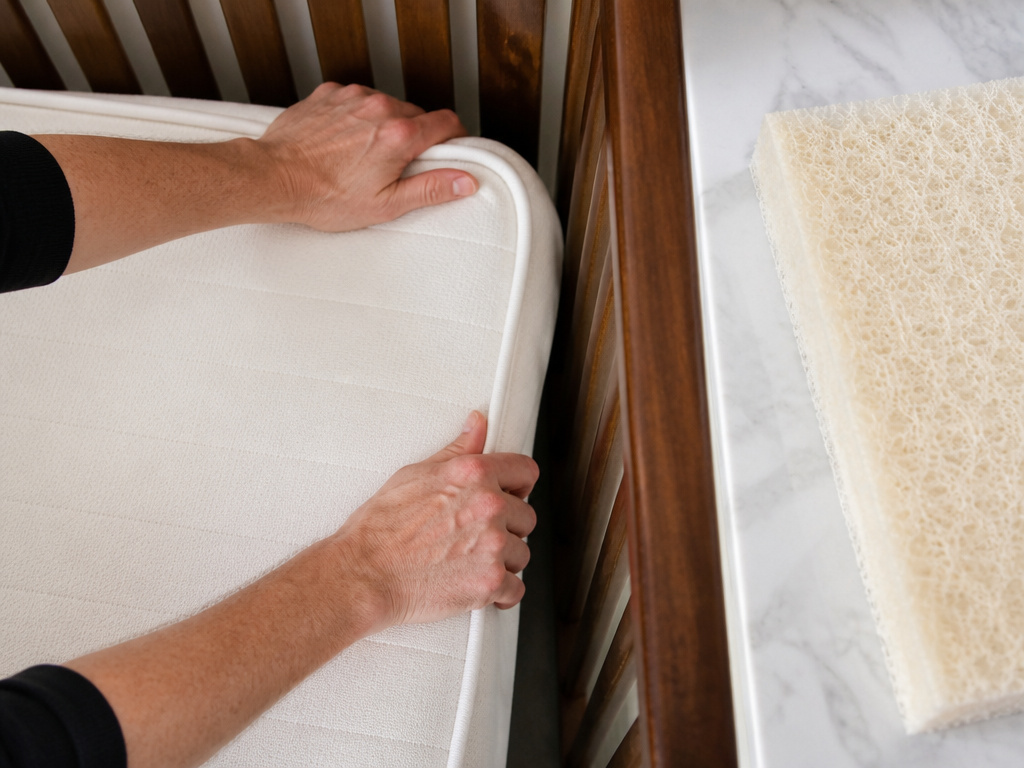
The crib, bassinet, or play yard that comes with a mattress is a tested system. Swapping that OEM mattress for an after-market one voids that certification and introduces risk.
The federal rule has specific, cumbersome requirements for after-market mattresses. They must be tested with every brand and model of product they claim to fit. They must be at least as large and have a support structure at least as thick as the original. Most generic “universal fit” mattresses do not fulfill this. CPSC recall data from 2010-2020 shows approximately 300,000 units were recalled for dimensional issues creating entrapment hazards.
“Breathable” is a marketing term, not a safety standard. These mattresses often have a core of porous foam or a 3D mesh material. The claim is that they reduce rebreathing and overheating.
The evidence is thin. The AAP’s technical report on safe sleep does not endorse “breathable” mattresses as a risk-reduction strategy. Its recommendation is unambiguous: a firm, flat surface with a fitted sheet. Adding complexity, a mesh layer, a topper, a special cover, often introduces more variables than it solves. The safest approach is the simplest one that complies with the known standard.
Skip this if: You’re considering a mattress topper or “double padding” the crib for comfort. The safe bedding guidelines are clear: one firm mattress, one tight-fitting sheet. Nothing else goes in the sleep space.
The One Essential Accessory (And What to Avoid)
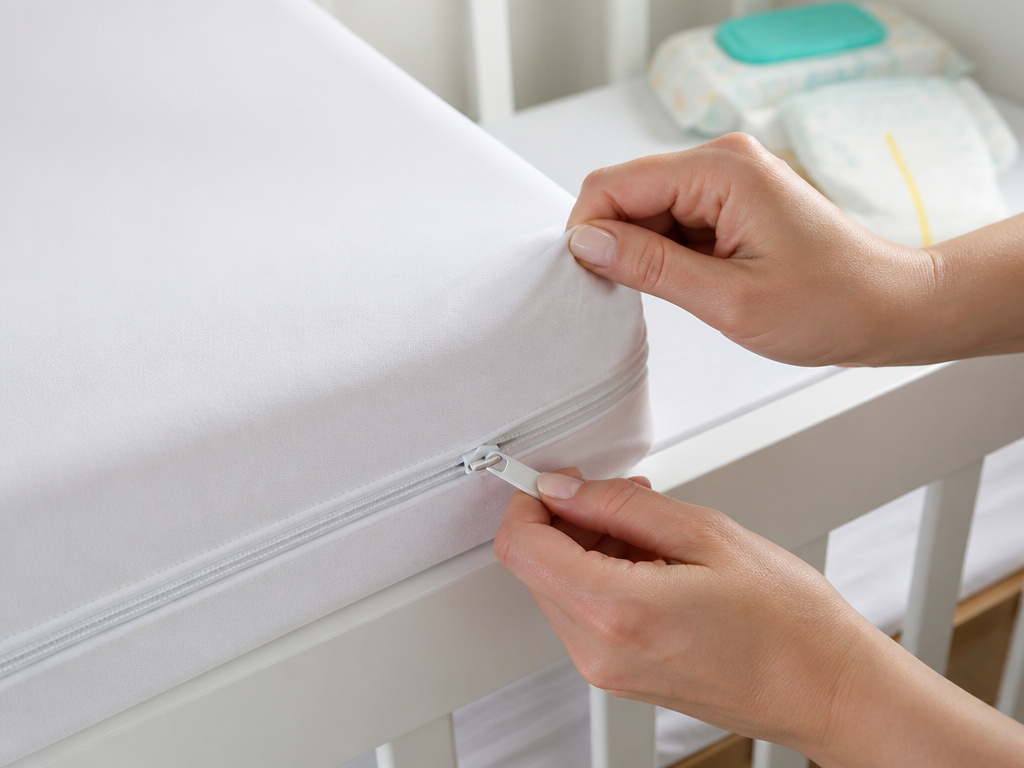
You need a barrier between the mattress and your baby. Spit-up, diaper leaks, and sweat will happen. A waterproof barrier protects the mattress core from moisture, which can lead to mold and mildew inside the foam or innerspring.
The right product is a tight-fitting, waterproof crib mattress protector. It should zip or stretch over the entire mattress like a second skin, with no loose fabric. A good protector is quiet (no loud crinkling) and breathable to some degree, but its primary job is containment.
Avoid “crib mattress pads” that add cushioning. These are essentially thin toppers that can compress, creating a soft, uneven surface. They also can bunch up, creating hazardous gaps at the edges of the crib. A protector is a shield; a pad is a layer. You want the shield.
This is where a quality product pays off. A well-designed protector like a Burlington Baby Ultimate or Naturepedic Organic Protector will lie flat and stay put through countless washes without leaking or losing its shape. It’s the one upgrade that directly preserves the safety and hygiene of your core investment, the mattress itself.
How to Vet a Mattress Before You Buy
Don’t rely on online reviews alone. Use a physical checklist.
- Check the label. It must state “Meets all requirements of 16 CFR § 1241.2 (ASTM F2933).” A manufacture date after August 15, 2022, is best.
- Perform the push test. Press firmly on the center and edges with the palm of your hand. The mattress should spring back immediately with no visible indentation. Your hand should not sink in.
- Ask about pre-conditioning. If buying a foam mattress shipped compressed, ask the retailer how long it needs to fully expand before use. If they don’t know, that’s a red flag.
- Measure for your specific crib. Crib interiors vary slightly. Bring a tape measure to the store if possible, or know your crib’s exact interior dimensions. The mattress should fit with minimal gap.
- Plan for the protector. Factor the cost of a quality waterproof protector into your mattress budget. It’s not optional.
What about bassinets and cribs? The same principles apply, but the standards are different. A bassinet mattress must comply with ASTM F2194. They are often thinner and smaller. Never put a crib mattress in a bassinet or play yard, it will be too tall and thick, creating a fall and suffocation hazard.
Frequently Asked Questions
Can I use a memory foam mattress for my newborn?
No. Memory foam is designed to conform to body shape, which directly contradicts the required firm, non-conforming sleep surface. The AAP warns against them, and the CPSC has issued recalls for memory foam crib mattresses like the Hush Hutting model due to suffocation risk and flammability failures.
How do I know if a mattress is firm enough?
Use the hand test. Press down firmly in the center. The mattress should offer strong resistance and rebound completely when you release. If you can easily compress it or see a deep imprint, it is too soft. The federal firmness test uses a calibrated probe; your hand test is a good real-world proxy.
Is a 6-inch mattress too thin for a newborn?
No. The 6-inch thickness guideline (from Consumer Reports) is a maximum, not a minimum. It exists to prevent overly thick, plush mattresses. A standard 5-inch firm mattress is perfectly safe and often preferable. Thickness does not equal comfort or support for an infant.
What’s the difference between a mattress protector and a pad?
Protector is a thin, waterproof barrier that covers the mattress directly. A pad is a cushioned layer that goes on top of the mattress, often with quilted fabric. Pads can compress and create soft spots, so protectors are the recommended choice for safety and hygiene.
Can I use a used crib mattress?
It depends. You must verify it is still very firm with no sagging or permanent indentations. Check for stains, odors, or tears in the cover that could indicate mold or compromised integrity. If there’s any doubt, buy new. The buying guide for crib mattresses emphasizes that a used mattress’s history is unknown.
Are organic crib mattresses safer?
Organic materials (like organic cotton or latex) address concerns about chemical off-gassing, which is a separate issue from physical safety. An organic mattress must still meet all the same federal size, gap, and firmness requirements. Don’t assume “organic” means “firmer” or “better-fitting.”
Before You Go
The search boils down to three things: a label proving federal compliance, a firmness that doesn’t quit, and a fit that leaves less than three fingers’ width of gap.
Ignore the noise about breathability, dual-firmness, or cooling gels. The regulations, ASTM F2933 and CPSC 16 CFR § 1241.2, are your blueprint. A standard innerspring crib mattress from a reputable brand, paired with a tight waterproof protector, covers the vast majority of families safely. Measure your crib, test for firmness with your own hands, and let the law, not marketing, make the final call.
