
What Is a Toddler Bed | The CPSC Definition & Safety Standard
This post contains affiliate links. As an Amazon Associate we earn from qualifying purchases.
A toddler bed is a bed that accommodates a standard full-size crib mattress (minimum 51⅝ by 27¼ inches) and is intended for a child not less than 15 months old and weighing no more than 50 pounds. This specific definition is a federal safety regulation, not just a suggestion, and every bed sold as a toddler bed in the U.S. Must meet the mandatory performance and labeling requirements of the ASTM F1821 standard.
That definition is the line between a real toddler bed and a small decorative bed. The regulation exists because of documented injuries, mostly falls and entrapments, that led to a mandatory rule in 2011. The standard covers everything from the strength of the slats to the size of openings a child’s head or limbs could get stuck in.
What follows is the breakdown of that legal definition, the specific safety tests a bed must pass, and how to spot a compliant model versus a generic “kid’s bed.” You’ll see why the age and weight limits matter, what the guardrail is actually for, and which features are marketing and which are verified safety.
Key Takeaways
- The official definition is a federal safety standard (ASTM F1821, codified in 16 CFR Part 1217), not a loose guideline. A bed that doesn’t meet it isn’t a certified toddler bed.
- The 15-month age minimum is based on developmental readiness to climb in and out safely; the 50-pound weight limit is tied to the structural testing of the mattress support and guardrails.
- The most common injuries in CPSC data were falls (78% of reported incidents) and limb entrapment, which is why the standard has specific tests for guardrail openings and mattress retention.
- The ASTM F1821-26 standard becomes the mandatory law on August 29, 2026. It clarifies that a toddler bed must be intended for a crib mattress, closing a loophole for larger beds.
- Always verify the bed has a permanent label stating it meets ASTM F1821. This is your guarantee it was tested for scissoring, shearing, pinching, sharp edges, and small parts hazards.
The Official Definition: Size, Age, and Weight
The phrase “toddler bed” isn’t a marketing term. It’s a legally defined product category under U.S. Consumer Product Safety Commission rule 16 CFR Part 1217. The current incorporated standard is ASTM F1821-19ε1, which will be updated to ASTM F1821-26 in late August 2026.
The core of the definition is three non-negotiable specs.
Toddler Bed (per ASTM F1821): “any bed sized to accommodate a full-size crib mattress having minimum dimensions of 51⅝ in. (1310 mm) in length and 27¼ in. (690 mm) in width and is intended to provide free access and egress to a child not less than 15 months of age and who weighs no more than 50 pounds (27.7 kg).”
First, the mattress size. A toddler bed’s interior dimensions must fit a standard crib mattress snugly. The 2026 update changes one word in the standard’s scope, from “sized” to “intended” to accept a crib mattress. This blocks a potential loophole where a larger bed frame could technically hold a crib mattress but leave dangerous gaps. The test mattress used in all compliance checks is a full-size crib mattress.
Second, the 15-month age floor. This isn’t about when a child outgrows a crib. It’s about the developmental milestone of being able to get in and out of a low, open bed without a contained rail. A child younger than 15 months lacks the coordination and judgment for that free access, increasing fall risk dramatically.
Third, the 50-pound weight limit. This number comes directly from the standard’s performance tests. The mattress support system and side rails are tested with static loads and impact forces calibrated for a 50-pound child. Exceeding that weight voids the engineering assumptions behind the bed’s safety.
Why the Federal Standard Exists
The government didn’t create a rule for toddler beds on a whim. The regulation followed years of incident data showing consistent, preventable injuries.
Between 2005 and 2009, CPSC staff reviewed data on 4 fatalities and 81 nonfatal incidents. A later review of 41 incidents from 2009 to 2010 provided a clearer breakdown of what was going wrong in homes.
| Reported Hazard (2009-2010 Data) | Number of Incidents | Injuries Reported |
|---|---|---|
| Broken, loose, or detached components (guardrail, hardware) | 14 | 3 |
| Entrapment (mostly of a limb) | 10 | 8 (fractures, sprains, bruises) |
| Mattress support integrity failure | 4 | 1 (finger injury) |
| Inadequate mattress fit | 3 | 0 |
| Miscellaneous (sharp edges, lead paint, etc.) | 9 | 4 |
Where this goes sideways: Assuming a bed is safe because it’s low to the ground. The CPSC data shows entrapment caused injuries in 80% of reported cases, often from limbs getting caught in openings between the guardrail and mattress or in poorly designed side rails.
The data forced a focus on physical integrity and geometry. Falls were the leading hazard (78% of NEISS-reported injuries), but entrapments were more likely to cause specific injuries like fractures. This is why the ASTM F1821 safety specification includes a battery of tests that go far beyond just making sure the wood doesn’t splinter.
What Makes a Bed Compliant: The F1821 Safety Tests

When a manufacturer claims a bed meets ASTM F1821, they are stating it passed a series of specific performance tests. These are the hidden engineering checks that separate a compliant toddler bed from a decorative piece of furniture.
The standard references other CPSC rules for baseline hazards: lead in paint, sharp points and edges, and the use and abuse tests that simulate a child jumping on or kicking the bed. On top of that, F1821 adds its own targeted tests.
Mattress Retention. The bed must have a system to keep the mattress from shifting horizontally. Why? If the mattress moves, it can create a gap between the mattress and the guardrail or footboard. That gap is a partial-body entrapment risk. The test uses a special wedge-shaped block to ensure no dangerous opening is created.
Guardrail and Opening Requirements. The guardrail isn’t just a cute mini-fence. Its height, strength, and the size of any openings in it are strictly regulated. * Openings must be small enough to prevent a child’s head from getting trapped but large enough to prevent finger entrapment. * The guardrail itself must withstand a static load test, a simulation of a child leaning or pulling on it. * The distance between the guardrail and the mattress surface, and between the mattress and the footboard, is checked with probe blocks to prevent torso or limb wedging.
Corner Post Extensions. Posts at the corners of the bed cannot extend more than a specified height above the side rails. This is an anti- entanglement and strangulation measure, preventing cords or clothing from catching.
Labeling Permanency. Every warning label and compliance statement must be permanently affixed to the bed. You shouldn’t be able to peel it off with your fingernail. If you can, the bed fails this part of the standard.
The part nobody mentions: The “use and abuse” tests (16 CFR 1500.50-53) that are referenced include a 100-pound impactor dropped onto the mattress support from 3 inches, and a 25-pound weight slammed into the side rails. A bed that passes has survived simulated years of toddler treatment.
Toddler Bed vs. Other Kids’ Beds
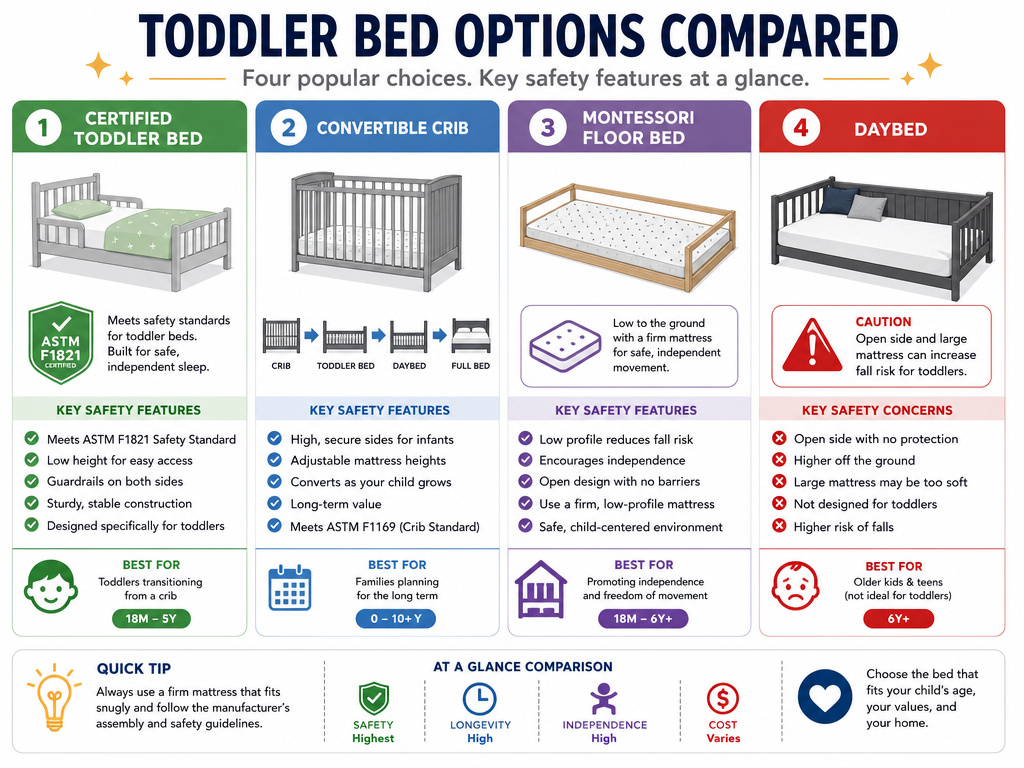
It’s easy to see a low bed and call it a toddler bed. The difference is certification. Here’s how it stacks up against common alternatives.
| Bed Type | Defining Feature | Key Safety Difference from a Toddler Bed |
|---|---|---|
| Certified Toddler Bed | Meets ASTM F1821 standard. | Tested for entrapment, structural integrity, mattress retention, and labeled with age/weight limits. |
| Crib with Convertible Kit | Crib that converts using manufacturer kit. | When properly converted per instructions, it becomes a toddler bed and should meet the standard. |
| Montessori Floor Bed | Mattress on floor or low platform. | No standard exists. No guardrail, no mattress retention system, no tested openings. It’s a mattress on the floor. |
| Daybed / Twin Bed | Standard twin-size frame. | Openings are not tested to toddler entrapment probes. Mattress is larger, creating height and gap risks. |
A convertible crib is the most common path. When you use the official conversion kit to remove the front rail, the resulting bed is considered a toddler bed if the kit is designed to bring the crib into compliance with F1821. Not all are. Check the manual.
A toddler floor bed is a philosophy, not a regulated product. Its safety relies entirely on the child’s environment, a bare room with no fall risk. It lacks the engineered entrapment protections of a standard toddler bed.
The choice between a dedicated toddler bed and a convertible crib often comes down to long-term planning and space. A dedicated bed is simpler. A convertible crib is a longer-term investment, guiding the transition from crib to toddler bed within the same footprint.
How to Choose a Safe Toddler Bed
You have the definition and the standard. Applying it means looking past the cartoon characters and paint color.
- Check for the Permanent Label. Before anything else, find the label on the bed frame. It must state it meets ASTM F1821. It should also include the manufacturer’s name, model number, and date of manufacture. No label, no sale.
- Measure the Mattress Gap. If you can, test the fit. A standard crib mattress should fit snugly within the frame. Run your hand between the mattress and the guardrail or footboard. If you can easily wedge your fingers sideways into a gap, it’s a potential entrapment zone.
- Inspect the Guardrail. It should feel solid, with no wobble. Look at the openings or spindles. They should be too small for a soda can to pass through (this is a common test proxy for head entrapment).
- Look for Rounded, Smooth Edges. Every corner and edge should be sanded smooth or rounded over. This is a basic requirement from the referenced sharp edges standard.
- Verify Hardware is Secured and Covered. All bolts and screws should be tight, with no sharp protrusions. Any plastic caps or covers over hardware should require significant force to remove, a child shouldn’t be able to pop them off and create a small parts choking hazard.
Worth knowing before you start: The toddler bed safety rails sold separately are not part of the original certification. If you add one, you are modifying the bed and potentially creating new entrapment openings. Use only rails specifically designed for your bed model.
Your toddler mattress choice is part of the system. A standard, firm crib mattress is the tested condition. A softer, thinner, or non-standard mattress can change the safety geometry, altering guardrail clearances and mattress retention.
Frequently Asked Questions
What is the difference between a toddler bed and a crib?
Crib has high, contained sides to restrict a child’s movement. A toddler bed is low, with a partial guardrail and open sides, intended for a child who can get in and out independently. The toddler bed uses the same size mattress but is governed by a different safety standard (ASTM F1821 vs. ASTM F1169 for cribs).
When should I move my child to a toddler bed?
The standard says not before 15 months. In practice, most parents transition between 18 months and 3 years. The signs are less about age and more about behavior: your child is consistently attempting to climb out of the crib (a major fall hazard), is potty training and needs nighttime access, or simply asks for a “big kid bed.”
Can I use a twin mattress on a toddler bed?
No. A toddler bed is dimensionally designed for a full-size crib mattress only. A twin mattress will not fit correctly, leaving large, dangerous gaps between the mattress and the bed frame. These gaps are prime entrapment hazards and void any safety certification.
Are toddler beds necessary, or can I just use a twin bed?
Regulated toddler bed is safer for a child under 50 pounds than a standard twin bed. Twin beds are taller, increasing fall height and injury severity. Their railings and openings are not tested to the stringent entrapment probes required by the toddler bed standard. For a young toddler, the defined bed options for children start with a certified toddler bed.
What is the weight limit for most toddler beds?
The federal standard sets a maximum weight limit of 50 pounds (27.7 kg). This is not a suggestion; it’s the limit for which the bed’s structure has been tested. Exceeding it risks failure of the mattress support or guardrails.
Do I need a bed rail for a toddler bed?
Compliant toddler bed comes with an integrated guardrail. You do not need an additional bed rail. In fact, adding a non-integrated rail can create unsafe gaps. If your child is a very active sleeper, ensure the included guardrail is on the side where they most often roll.
Before You Go
A toddler bed is a piece of safety equipment disguised as furniture. Its definition, the mattress size, the age, the weight, is a legal boundary drawn from real injury data. The ASTM F1821 standard is the blueprint that enforces it, testing for the hidden risks of entrapment and structural failure.
Your checklist is short but non-negotiable: find the permanent ASTM F1821 label, ensure a snug crib mattress fit, and feel for solid construction without sharp edges or loose parts. Skip the decorative beds that ignore the standard. The right bed is the one that passed the tests your child shouldn’t have to.
