
Good Dimensions for a Baby Blanket: A Complete Size Guide
This post contains affiliate links. As an Amazon Associate we earn from qualifying purchases.
Good dimensions for a baby blanket are defined by its use, not a single number. A safe swaddle is a 40-inch square. A receiving blanket works at 30×40 inches. A crib blanket for a toddler fits a standard crib mattress at roughly 40×60 inches. For infants under 12 months, a loose blanket in the crib is not safe for sleep regardless of size.
That last point is the one most sizing charts bury in the footnotes. The American Academy of Pediatrics is clear: no loose bedding, including blankets, for babies under one year in a crib. So a “crib blanket” dimension is irrelevant for safe sleep until your child is a toddler. The useful sizes are for supervised swaddling, play, stroller trips, and eventual toddler-bed use.
What follows is a breakdown of dimensions by purpose, the historical standards that still shape them, and how to measure what you already own. You’ll know which size to buy for tomorrow’s park trip and which one to avoid for tonight’s bedtime.
Key Takeaways
- Safety overrules size for infants. No loose blanket is safe in a crib for a baby under 12 months. Use a wearable sleep sack instead.
- Match the blanket to the task. A 40″ square is for swaddling; a 30″x40″ rectangle is for receiving and play; a 40″x60″ rectangle is for a toddler’s crib.
- Manufacturer labels can be misleading. A product called a “crib blanket” is often marketed for decoration, not safe sleep. Always check the intended age.
- Measure on a flat, conditioned surface. Fabric relaxes and dimensions change. For a true measurement, lay the blanket flat, smooth it by hand, and let it sit for a day outside its package.
- The 45×60 inch standard has a 78-year history. The 1946 NIST Commercial Standard CS136-46 set this minimum for hospital crib blankets, a spec that still echoes in today’s products.
The Standard Baby Blanket Size Chart (By Use)
Forget finding one perfect size. You need a small wardrobe of blankets, each with a job. The chart below locks in the dimensions you’ll see again and again, and more importantly, tells you when to use each one.
| Blanket Type | Typical Dimensions | Primary Use | Safety & Fit Notes |
|---|---|---|---|
| Swaddle | 40 x 40 inches (square) | Snug wrapping for newborns (0-3 mos) | Must be thin, stretchy fabric. Too large is unwieldy; too small won’t wrap securely. Always place swaddled baby on back. |
| Receiving | 30 x 30 to 30 x 40 inches | Multi-purpose: burp cloth, tummy time mat, light cover | The workhorse blanket. Compact size makes it easy to carry and layer. |
| Crib / Toddler | 40 x 60 inches | Cover for a toddler in a standard crib | Not for infants under 12 months. This size is designed to cover a 28″ x 52″ crib mattress with overhang. |
| Stroller | 30 x 40 inches | Warmth on walks, in the car seat | Often has ties or snaps. Its narrow width fits stroller harness slots without bulk. |
| Security (Lovey) | 12 x 12 inches | Comfort object for toddlers | Small enough to clutch and carry. Introduced after 12 months when SIDS risk drops. |
Where this goes sideways: Using a crib blanket for an infant under 12 months. The dimension fits the mattress, but the safety risk doesn’t fit the child. That mismatch is how preventable accidents happen.
The 40×60 inch crib blanket size isn’t a modern invention. It’s a direct descendant of the 45×60 inch minimum specified for “crib, infant and child” blankets in the 1946 U.S. Commercial Standard CS136-46 for hospital blankets. Manufacturers have simply trimmed a few inches from the hospital standard for the home market. When you see that familiar rectangle, you’re looking at eight decades of standardized bedding.
Why “Crib Blanket” is a Misleading Label for Infants
This is the most critical non-negotiable in baby bedding. The phrase “crib blanket” implies it belongs in a crib. For a newborn or young infant, that is dangerously false.
The Sleep Foundation blanket size guide states it plainly: “When used for sleeping, crib blankets are designed for children who are at least 12 months old.” A blanket sized for a crib mattress is a toddler blanket. Full stop.
The mechanism is about mobility and airway obstruction. A young infant cannot reliably roll over or push fabric away from their face. A loose blanket, even a perfectly sized one, can cover their nose and mouth during sleep. The risk is suffocation and Sudden Infant Death Syndrome (SIDS). This is why the AAP’s safe sleep guidelines mandate a bare crib—just a firm mattress and a fitted sheet—for the first year.
So what do you do with a beautiful 40×60 inch blanket before your child’s first birthday? – Use it as a play mat on the floor. – Drape it over the rocking chair for your own comfort during feeds. – Keep it in the stroller for an extra layer on cold days. – Put it away until the first birthday party.
Your best baby bedding setup for an infant centers on sleep sacks, not loose blankets. The dimensions that matter are those of the wearable blanket, which cannot ride up over the face.
Choosing Dimensions by Age and Stage
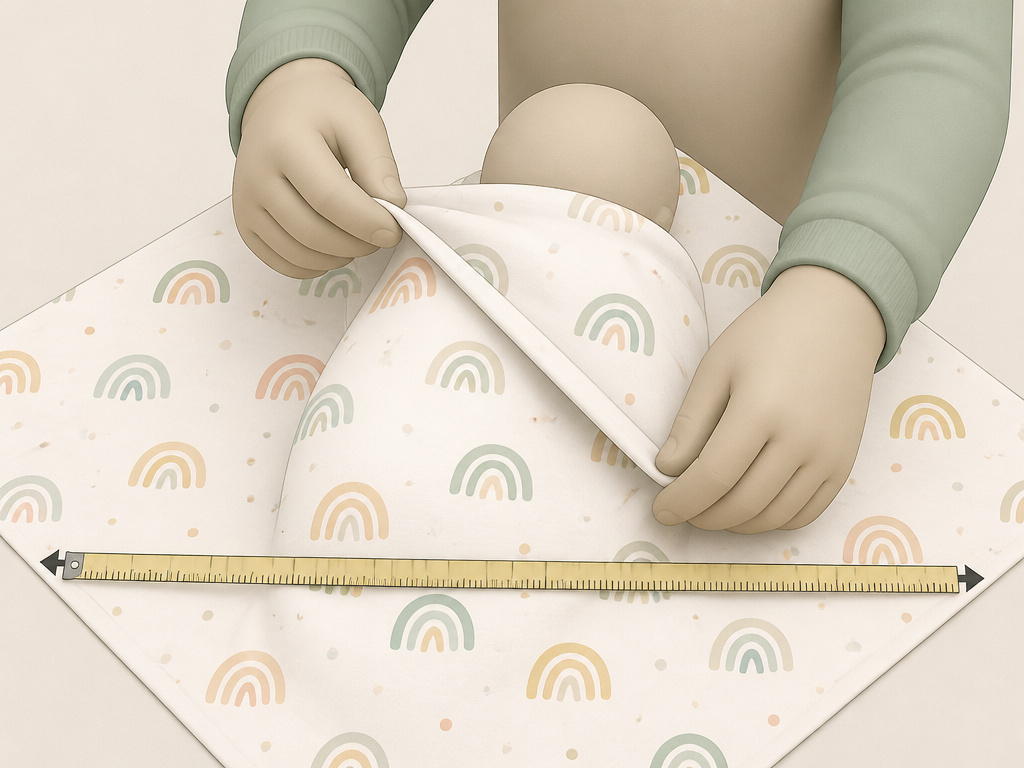
Your baby’s size and abilities change fast. The blanket that worked last month is now a tripping hazard or a safety risk. Follow this progression.
Newborn (0-3 Months): The Swaddle & Receive Phase
At this stage, blankets are tools for you, not comfort objects for them. You need two types: 1. Swaddle Blankets: Aim for the 40-inch square. This size gives you enough fabric to create a secure, snug wrap without excessive bulk. Popular brands like Aden + Anais use this dimension. A larger swaddle (47-inch square) can be easier for beginners but may be too much fabric for a tiny newborn. 2. Receiving Blankets: The 30×40 inch rectangle is perfect. It’s a burp cloth, a changing pad liner, a sun shield, and a light layer for supervised skin-to-skin contact. It’s the most versatile piece in your early parenting kit.
Our picks for best swaddle blankets and best receiving blankets focus on these exact dimensions in breathable fabrics.
Infant (3-12 Months): The Play & Layer Phase
Swaddling stops once your baby shows signs of rolling. Now, blankets shift to awake-time use. – Tummy Time & Play Mats: A larger, soft blanket like a 40×60 inch crib blanket is excellent for creating a clean, cushioned play space on the floor. – Stroller & Car Seat Coverage: This is the prime time for a dedicated stroller blanket. The 30×40 inch size is ideal because it’s long enough to cover the body but narrow enough to tuck around the harness without interfering.
Toddler (12+ Months): The Safe Sleep & Comfort Phase
After the first birthday, you can safely introduce a loose blanket in the crib. The standard 40×60 inch crib blanket is designed for this. It’s wide enough to tuck in slightly at the sides (below the armpits) and long enough to cover a wiggly sleeper. This is also when a small security blanket (12-inch square) can be introduced for comfort.
How to Measure a Baby Blanket (The Right Way)
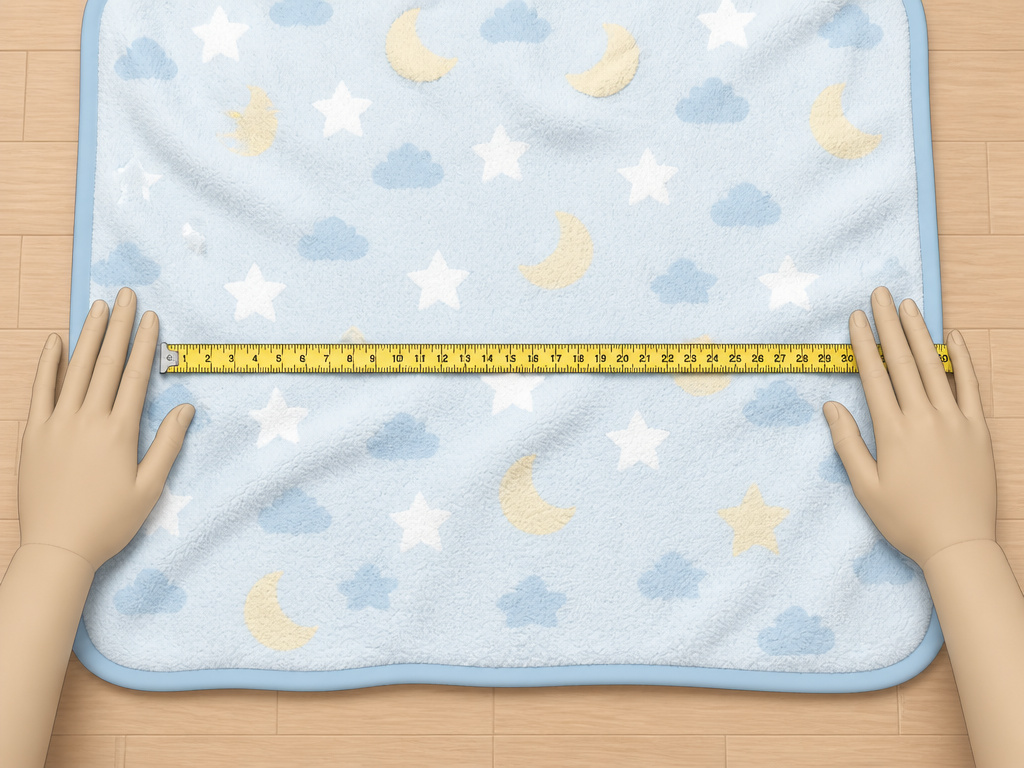
You found a blanket without a tag. Or the tag says “approximately 30×40.” How do you know what you really have? The official method from the 1946 NIST standard is still correct.
Lay the part of the blanket being measured on a flat surface and smooth it out by hand. Take five measurements across the width at intervals down its length, and five measurements along the length at intervals across its width, to the nearest half-inch. The averages of each set of five are the true width and length.
Why five measurements? Because fabric stretches, relaxes, and may be cut or woven slightly irregularly. One measurement can lie. This is especially true for knit or gauze blankets. The humanitarian aid standard for synthetic blankets adds another step: condition the blanket flat for 24 hours at room temperature before measuring. Fabric just out of a tight package or bale needs time to relax to its true size.
For a quick, practical check at home: 1. Clear a space on a hardwood or tile floor. 2. Lay the blanket completely flat, smoothing out wrinkles and curls by hand. 3. Measure from edge to edge in the middle of the blanket, not at the stretched corners. 4. Round to the nearest inch.
If your measurement is within an inch or two of the standard sizes in the chart, it fits that category. A blanket measuring 38×58 inches is functionally a crib blanket. One at 29×38 inches is a receiving blanket.
Material and Make: Why Fabric Choice Changes the Game
Dimensions tell you the footprint. The fabric tells you how the blanket will behave in use. A 40-inch square in thick wool is not a swaddle blanket—it’s a suffocation hazard. A 40-inch square in muslin or stretch-cotton jersey is perfect.
The best blanket fabrics for babies are breathable, lightweight, and get softer with washing. Here’s how material interacts with size: – Muslin/Cotton Gauze: Light and breathable. A 40-inch muslin square is a classic swaddle. It drapes easily and allows heat to escape. – Stretch Cotton Jersey: Clings and conforms. Excellent for a secure swaddle. The stretch compensates if your measurement or wrapping technique is slightly off. – Flannel/Cotton Velour: Warmer and heavier. Best for receiving or stroller blankets in cooler climates. The heft means a 30×40 inch flannel blanket feels substantial. – Fleece/Synthetic Pile: Very warm, not breathable. Use only for supervised outdoor stroller use. Never for sleep or swaddling, as it can cause overheating.
A brand like In2Green uses recycled cotton for its recommended baby blankets, offering a soft, eco-conscious option that meets these size and safety parameters.
Regulatory Shadows and Why They Matter
The blanket industry isn’t wildly unregulated. It operates in the shadow of old standards and new vigilance. The CPSC infant blanket safety notice from Spring 2024 signals ongoing work with ASTM to update safety standards. This isn’t a recall notice; it’s a sign that regulators are actively reviewing the rules that govern these products.
The old NIST standard set physical minimums. Modern regulatory work focuses on safety labeling, suffocation risk warnings, and flammability. When you choose a blanket, you’re relying on a chain of compliance that stretches from a 1946 size rule to a 2024 ASTM committee meeting. That’s why buying from reputable brands that adhere to safety certifications matters more than a perfect half-inch.
Frequently Asked Questions
What is the most versatile baby blanket size?
The 30 by 40 inch receiving blanket is the most versatile. It’s small enough to stash in a diaper bag, large enough for tummy time, and the right proportion for a car seat or stroller cover. It’s the one size you can buy multiple of without regret.
Can a baby blanket be too big?
Yes, especially for sleep. An overly large blanket increases the risk of entanglement and face-covering for a mobile infant or toddler. For swaddling, too much fabric is difficult to wrap securely and can become a loose hazard if the wrap comes undone. Stick to the standard size ranges.
How many blankets do I really need for a newborn?
Start with 4-6 swaddle blankets and 6-8 receiving blankets. Spit-ups, blowouts, and laundry delays make this number practical. You can always add more newborn blankets later, but running out at 2 a.m. Is a real problem.
Are handmade baby blankets safe?
They can be, if the maker follows key rules. Use breathable, washable yarn or fabric (like cotton). Avoid loose threads, buttons, or ribbons that could detach. Ensure the dimensions match a standard use (e.g., 40-inch square for a swaddle). Most importantly, attach a clear label stating it is not for unsupervised sleep for infants under 12 months.
When can my baby have a lovey blanket in the crib?
The safest time to introduce a small lovey blanket is after your child’s first birthday, when the SIDS risk drops significantly. Even then, keep it small (under 12×12 inches) and without removable parts. Before one year, a lovey is for awake, supervised comfort only.
Before You Go
Good dimensions are a starting point, not the finish line. A 40×60 inch blanket is the right size for a toddler’s crib, but only if the toddler is over a year old. A 40-inch square is perfect for swaddling, but only if the fabric is breathable and the baby is placed on their back.
Measure what you have. Match new purchases to a specific job—swaddling, playing, strolling, or toddler sleeping. And let the first-year crib be a blanket-free zone. The right size at the wrong time is still the wrong choice. Your guide isn’t the tag on the blanket; it’s the age and ability of the child in your care.
