
The 67x Risk: Should Kids Sleep With Parents? Safety Guide
This post contains affiliate links. As an Amazon Associate we earn from qualifying purchases.
Should kids sleep with parents in the same bed? No. The American Academy of Pediatrics advises against bed-sharing under any circumstances for infants 0-12 months, citing a dramatically increased risk of SIDS and suffocation. The safe, recommended practice is room-sharing, placing the baby’s crib, bassinet, or play yard in your room for at least the first six months, ideally up to a year.
That gap between bed-sharing and room-sharing is the whole conversation. One is a documented hazard; the other is a protective measure backed by the same research. This isn’t about judging parental choices. It’s about a specific, physical risk that multiplies under predictable conditions.
What follows: the official guidance broken down, the exact risk multipliers you won’t find in most articles, the mechanics of why suffocation happens, and a clear path to setting up a safe sleep space that keeps your baby close without the danger.
Key Takeaways
- Bed-sharing is not recommended. The AAP states it should be avoided under any circumstances for infants 0-12 months due to increased risks of SIDS, suffocation, and entrapment.
- Room-sharing is the safe standard. Place your baby’s own safety-approved sleep surface (crib, bassinet) in your room for at least the first 6 months, this can lower SIDS risk by up to 50%.
- Risk isn’t uniform. Sharing a couch or armchair for sleep increases the risk of infant death up to 67 times. Risk is also 10x higher if the adult is impaired by fatigue, alcohol, or sedating medication.
- The “why” is mechanical. Adult beds have soft bedding, gaps, and pillows that can block an infant’s airway or cause overheating, which their immature systems can’t always correct.
- Have a plan for exhaustion. If you might fall asleep while feeding, prepare the adult bed by removing all pillows and loose bedding first, and place the baby back in their own sleep space immediately upon waking.
The Official Stance: Room-Sharing vs. Bed-Sharing
The recommendations are precise for a reason. Room-sharing means your baby sleeps in your room, on their own separate, safety-approved surface. Bed-sharing means your baby sleeps on the same surface as you, whether that’s an adult bed, couch, or armchair. The first is the cornerstone of modern safe sleep advice. The second is what the guidance warns against.
Room-sharing without bed-sharing allows for close proximity to the infant for feeding and comforting, is safer than bed-sharing, and is associated with a decreased risk of SUID and SIDS. For these reasons, room-sharing without bed-sharing is the only recommended sleeping arrangement for parents and infants in the first 6 months of life.
This comes directly from the MSD Manual Professional edition, referencing the AAP’s 2022 technical report. The logic is twofold: proximity makes feeding and monitoring easier, while a separate surface eliminates the risks of overlay, entrapment, and soft bedding.
The Consumer Product Safety Commission (CPSC) rule from June 2021 is the baseline. Any product marketed for infant sleep, a crib, bassinet, play yard, or bedside sleeper, must meet strict federal safety standards for slat spacing, mattress firmness, and structural integrity. Your adult mattress, even if firm, does not meet these standards. That’s not a minor detail. It’s the difference between a regulated safety device and a household furnishing.
The 67x Risk Factor: When Bed-Sharing Becomes Most Dangerous
General warnings don’t stick. Specific numbers do. The AAP’s 2022 update didn’t just say bed-sharing is risky. It attached multipliers to specific, common scenarios.
| Sleep Scenario | Risk Multiplier | Primary Hazard |
|---|---|---|
| Sharing a couch, sofa, or armchair | Up to 67 times higher | Suffocation from cushions, entrapment in gaps |
| Adult is impaired (alcohol, drugs, extreme fatigue) | 10 times higher | Reduced arousal, inability to sense the infant |
| Infant is under 4 months old | 5-10 times higher | Immature motor skills and airway control |
| Infant was preterm or low birthweight | 5-10 times higher | Underlying physiological vulnerabilities |
| Sharing with someone other than a parent | 5-10 times higher | Unfamiliar sleep patterns and awareness |
These aren’t theoretical odds. They are derived from analyses of sleep-related infant deaths, which are tracked under specific ICD-10 codes: R95 (Sudden Infant Death Syndrome), R99 (Ill-defined deaths), and W75 (Accidental suffocation and strangulation in bed). The 67x figure for couches is the standout. It turns a moment of convenience on the sofa into the single most dangerous sleep environment in the house.
Where this goes sideways: Bringing a fussy baby into your bed “just this once” because you’re exhausted. Fatigue alone raises your risk factor tenfold. You fall into a deeper sleep, your body doesn’t register the baby rolling into a crevice or against a pillow, and the unthinkable becomes statistically predictable.
The other critical number is six months. The risk of SIDS peaks between 1 and 4 months and remains significant through the first half-year. This is precisely why the room-sharing recommendation targets the first 6 months as an absolute minimum. The Texas DSHS room sharing guide phrases it clearly: “Room sharing is recommended for at least the first six months of baby’s life and up to one year of age.”
Why the Adult Bed is a Hazard: The Mechanical Reasons
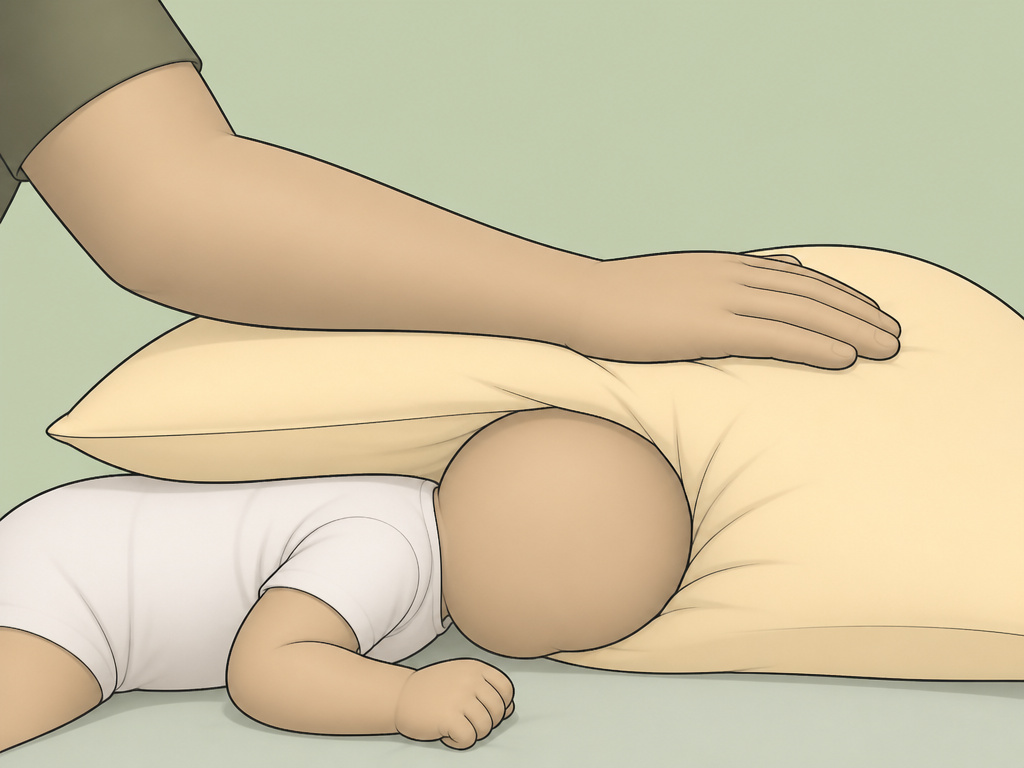
A baby doesn’t just “stop breathing.” There’s a physical sequence. Understanding it makes the rules feel less arbitrary.
- Suffocation by Soft Surface: An adult mattress, pillow, or down comforter is compressible. An infant’s nose and mouth can press into it, creating a seal. Their neck muscles aren’t strong enough to consistently lift and turn their head to clear an airway.
- Entrapment: The gap between a mattress and headboard, wall, or footboard can be just wide enough for a baby to slip into, but not wide enough for them to extricate themselves. This is also a danger with some bedside sleeper designs that aren’t CPSC-compliant.
- Overheating: Sharing a sleep space with an adult significantly raises the local temperature. Overheating is a known risk factor for SIDS, as an infant’s ability to regulate body temperature is still developing.
- Overlay: This is when an adult rolls onto the infant during sleep. It’s more common than most believe, especially in the context of the impaired sleep (from exhaustion or otherwise) that defines life with a newborn.
This is why a children’s mattress in a regulated crib is engineered differently. It’s firm to the point of feeling uncomfortably hard to an adult hand. There are no gaps, no pillows, no loose blankets. It’s a controlled environment designed for a body that can’t yet fend for itself.
How to Set Up a Safe Room-Sharing Space
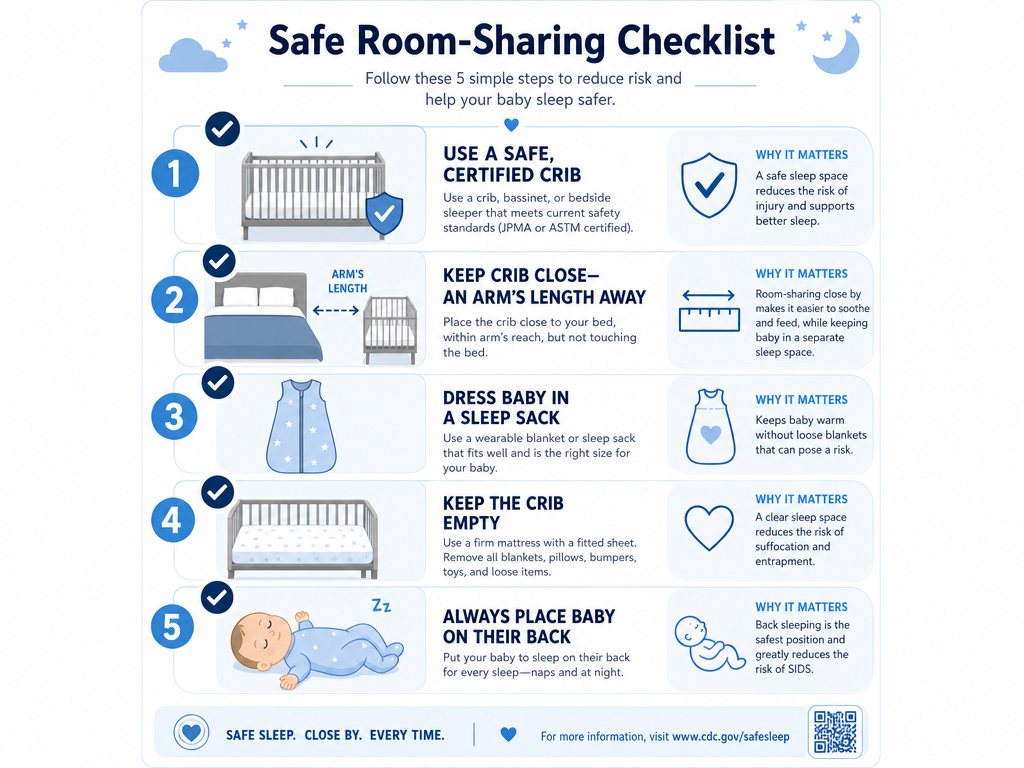
Safety is a setup, not a hope. Here is the actionable checklist for creating a protective room-sharing environment.
- Choose the Right Sleep Surface. This is non-negotiable. You need a crib, bassinet, or play yard that meets current CPSC safety standards. Look for the certification. A hand-me-down that’s more than 10 years old may not comply with modern slat-spacing rules and should be retired.
- Position It Strategically. Place the crib or bassinet within arm’s reach of your bed, but not touching it. This prevents the adult bedding from accidentally falling into the baby’s space and eliminates any potential entrapment gap between the two furniture pieces.
- Dress the Baby, Not the Bed. Use a wearable sleep sack or swaddle (if the baby is not yet rolling) instead of loose blankets. The room should be comfortable for a lightly clothed adult, around 68-72°F (20-22°C).
- Keep the Crib Bare. No pillows, stuffed animals, bumper pads, or loose sheets. A fitted sheet over the firm mattress is the only thing that should be in there with the baby. This is the single most effective visual check you can do every time you lay them down.
- Always Back to Sleep. Every sleep, every time. The supine position is the safest. Once a baby can roll from back to front and front to back independently, you can leave them in the position they find, but always start them on their back.
This setup gives you the closeness that drives many parents to consider bed-sharing, you can hear every sigh, reach over to soothe, and feed easily, but within the safety framework of a kids bed designed for the purpose.
If You Do Fall Asleep: The Damage-Control Plan
Exhaustion is a real policy. The AAP and every sane guide acknowledges that parents will sometimes fall asleep while feeding or comforting a baby in an adult bed. The goal is harm reduction, not perfection.
Before you start a feeding session in bed:
- Strip the adult bed completely. Remove all pillows, comforters, loose blankets, and stuffed animals.
- Move the bed away from the wall to eliminate a trapping gap.
- Consider setting a timer on your phone for 15 minutes to prompt you if you start to drift.
- Have another adult stay awake with you if possible.
The part nobody mentions: If you wake up and find the baby asleep in your bed, don’t panic and leave them there because you don’t want to wake them. Move them immediately. The risk accumulates with time. Gently place them on their back in their own twin mattress or bassinet. A brief stir is a negligible price.
This plan is explicitly outlined in public health materials because pretending it won’t happen is useless. Preparing for it saves lives.
The Cultural and Personal Pull of Bed-Sharing
The evidence is clear, yet the practice persists. Why? The ISPID safe sleep recommendations note that adult-infant bed-sharing is a common infant care practice that varies across cultures. The MSD Manual lists the reasons parents choose it: convenience for feeding, a desire for bonding, a belief that their own vigilance is the only way to keep the infant safe, and a belief that they can maintain that vigilance even while sleeping.
These are powerful, valid feelings. They are also, in the cold light of the data, often at odds with the physiological reality of infant sleep safety. The vigilance argument is particularly fragile, the deepest, most dangerous sleep for parents often comes in the early morning hours after repeated night wakings, which is exactly when vigilance fails.
The conversation isn’t served by dismissing these reasons. It’s served by acknowledging them and then providing a safer, equally close alternative: a firm toddler bed or crib three feet from your own, in a room that’s quiet, dark, and cool.
Frequently Asked Questions
What’s the difference between co-sleeping and bed-sharing?
This is a critical terminology fix. “Co-sleeping” is an umbrella term that can mean either sleeping in close proximity (room-sharing) or on the same surface (bed-sharing). Because it’s ambiguous, leading health guides now advise dropping the term. Use room-sharing (safe, recommended) to mean baby in your room on their own surface, and bed-sharing (not recommended) to mean baby on the same sleep surface as you.
Is it ever safe for a toddler to sleep in your bed?
The AAP’s strict “under any circumstances” recommendation applies to infants 0-12 months. For older toddlers, the mechanical risks of suffocation and entrapment are much lower because they can move purposefully, roll over, and call out. However, new risks emerge, like falls from an adult-height bed. If you choose to bed-share with a toddler, use guardrails and ensure the mattress is on the floor or in a low frame. The transition from a full size mattress in their own room is often a healthier long-term sleep habit.
Does breastfeeding change the bed-sharing risk?
Breastfeeding is protective against SIDS, and the convenience of feeding while lying down is a major reason parents bed-share. However, the AAP’s stance remains: the risks of bed-sharing still outweigh the benefits, even in a breastfeeding dyad. The safe alternative is to feed the baby in bed (following the damage-control plan above), then immediately return them to their separate sleep surface. Room-sharing facilitates this while maintaining safety.
What about products like in-bed sleepers or pods?
The CPSC’s Safe Sleep for Babies Act banned inclined sleepers, in-bed sleepers, and similar products because they do not provide a firm, flat, separate surface and have been linked to infant deaths. Any product that places the baby on an adult bed, even with raised sides, carries the risks of that soft, unregulated adult sleep environment. A standalone bassinet that meets CPSC standards is the only safe choice for a separate surface in your room.
How do I transition from room-sharing to their own room?
There’s no magic age. After the first 6-12 months, when SIDS risk has dropped significantly, you can begin the transition. Start with naps in their own room in their crib or bunk bed (if they’re older). Then move the first part of the night there, bringing them to your room after their first wake-up. Gradually extend the time. Consistency and a comforting bedtime routine are key. The goal is a child who feels secure in their own safe sleep space.
Before You Go
The question isn’t about keeping your child distant. It’s about keeping them safe in the most vulnerable period of their life. Room-sharing delivers the closeness, the monitoring, and the bonding opportunity that parents rightly seek. Bed-sharing introduces a set of physical hazards that a newborn’s body is ill-equipped to handle.
The numbers, 67 times, 10 times, 5 times, tell a story that anecdotes can’t contradict. Set up a safe sleep surface in your room. Use it for every sleep. And when exhaustion wins, have a plan that strips the adult bed bare first. That’s how you close the gap between love and safety. They don’t have to be different things.
