
Evaluating If a Fibre Mattress Is Good for Your Baby’s Safety
This post contains affiliate links. As an Amazon Associate we earn from qualifying purchases.
A fibre mattress is good for a baby if it is new, meets the mandatory firmness and flammability standards (ASTM F2933, 16 CFR § 1241.2), and fits the crib with a gap under 3.15 inches. The core must not indent under pressure. Fibre allows better air circulation than solid foam, but it wears out faster than an innerspring unit and offers no proven SIDS reduction.
That last point is critical. “Breathable” is a marketing term, not a safety certification. The American Academy of Pediatrics states there is no epidemiological evidence these mattresses protect from SIDS. Your choice hinges on verified firmness and fit, not airflow claims.
What follows: the CPSC data on why softness fails, the exact standards a label must cite, a head-to-head comparison with other core types, and the one material upgrade actually worth the cost.
Key Takeaways
- A safe fibre mattress must carry a compliance label for ASTM F2933-25 and the federal crib mattress flammability standard. The label is non-negotiable.
- 26% of nonfatal crib mattress incidents reported to the CPSC involved fit issues; 15% involved mattresses too soft. Firmness isn’t a preference—it’s a documented hazard.
- “Natural fibre” (coconut, wool) costs more but handles moisture better. Standard synthetic fibre is a budget entry point but compresses faster.
- Never use a second-hand fibre mattress. The core loses resiliency, and hidden bacteria or dust mites are a documented concern.
- For longevity, a pocket sprung mattress lasts about 15% longer than a standard fibre core. Choose fibre for a first crib, but plan to replace it sooner.
What Exactly is a “Fibre Mattress” for a Crib?
The term is a category, not a single material. It describes a core of layered, non-coil filling—usually polyester—wrapped in a quilted cotton or waterproof cover. Think of it as a dense, firm pillow. A natural fibre mattress swaps that polyester for materials like coconut coir, cashmere, or lambswool. That distinction changes the price, feel, and performance.
The construction creates tiny air pockets. This allows some passive air movement, which is where the “breathable” claim originates. It does not mean the mattress actively ventilates or reduces carbon dioxide rebreathing. No study has proven that claim lowers SIDS risk. The AAP is clear: the evidence isn’t there.
Your primary job is to verify the mattress meets the ASTM F2933 safety specification. This standard includes a firmness test. After August 15, 2022, all crib mattresses sold in the U.S. Must comply. The label should also cite compliance with 16 CFR § 1241.2, the federal rule incorporating that standard. If the tag lacks these, walk away.
A crib mattress must be at least 27 1/4 inches wide and 51 5/8 inches long. When placed in the crib corner with a test sheet, the corner gap cannot exceed 3.15 inches (80 mm). These dimensions are part of the ASTM F2933-25 standard referenced in federal law.
The Safety Benchmarks: What “Good” Actually Means
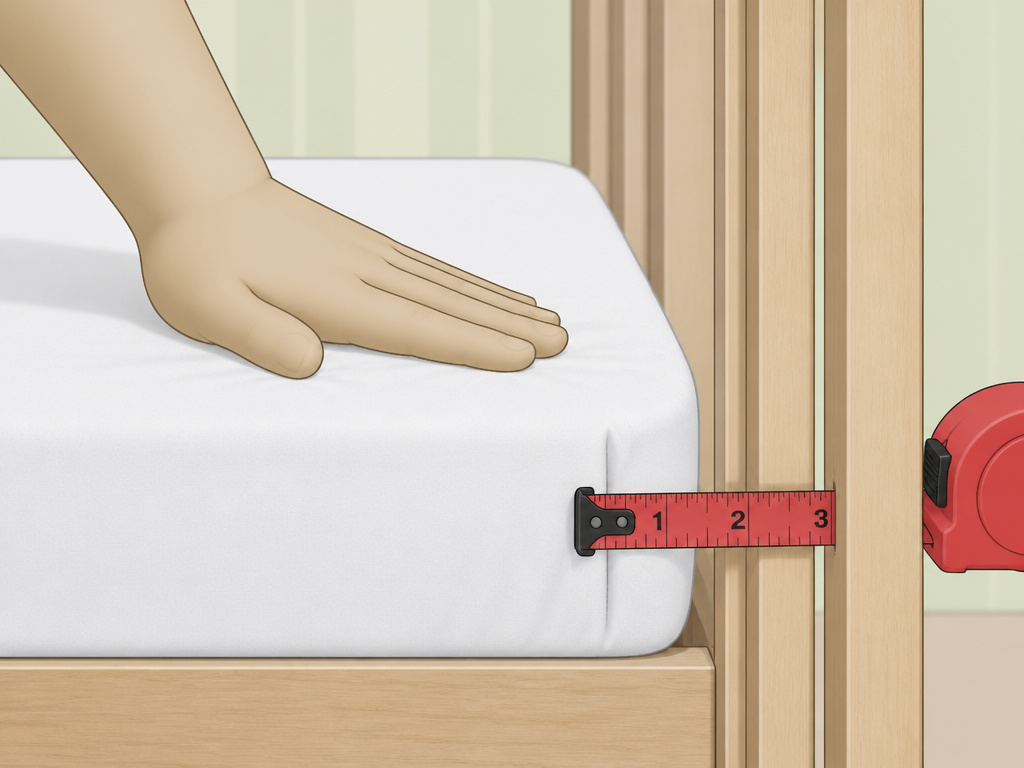 A good baby mattress is defined by three measurable traits: firmness, fit, and fire resistance. Marketing about organic materials or breathability comes after these are satisfied.
Firmness is a Test, Not a Feeling
Your hand test means nothing. The standard requires a specific compression test. In plain terms: the surface should not conform to your baby’s head or body. If you press on the center and see a lasting dent, it’s too soft.
The CPSC’s analysis of incident data from 2010-2020 is blunt. 15% of nonfatal incidents involved a mattress reported as too soft. These mattresses can create a pocket, increasing rebreathing or suffocation risk if an infant rolls prone. Memory foam or adjustable-firmness mattresses are dangerous for this exact reason. They are designed to conform.
Where this goes sideways: Assuming a mattress is firm enough because it feels solid to an adult. The test sheet compresses the surface. A sheet can cause a fibre core to bow, creating a dangerous side gap. Always check the fit with the sheet on.
The Snug Fit Rule and the 3.15-Inch Gap
A proper fit prevents limb entrapment and keeps the baby away from the crib sides. The federal rule specifies the test: you must use a washed 100% cotton fitted sheet. With that sheet on, you push the mattress into one corner of the crib. The gap at the opposite corner cannot be larger than 3.15 inches.
For a full-size crib, the interior width is 28 inches ± 5/8. Your mattress must be at least 27 1/4 inches wide. That leaves a maximum potential side gap of 1 3/8 inches when new. As a fibre core compresses with use, that gap can grow. Measure it every few months.
This is why an after-market mattress for a play yard or mini-crib is risky. If it’s thicker than the original, the flexible sides bow inward, creating a larger, unsafe gap at the mattress edge. The CPSC crib mattress safety guidance explicitly warns against this.
Fire Resistance is Law
All crib mattresses must meet a mandatory federal flammability standard. This is separate from the ASTM safety spec. The label should indicate compliance with the US CFR crib mattress requirements for flammability (16 CFR § 1633 or similar). This is not optional. It’s why you should never attempt to re-cover or modify an old mattress.
Fibre vs. Innerspring vs. Pocket Sprung: The Durability Trade-Off
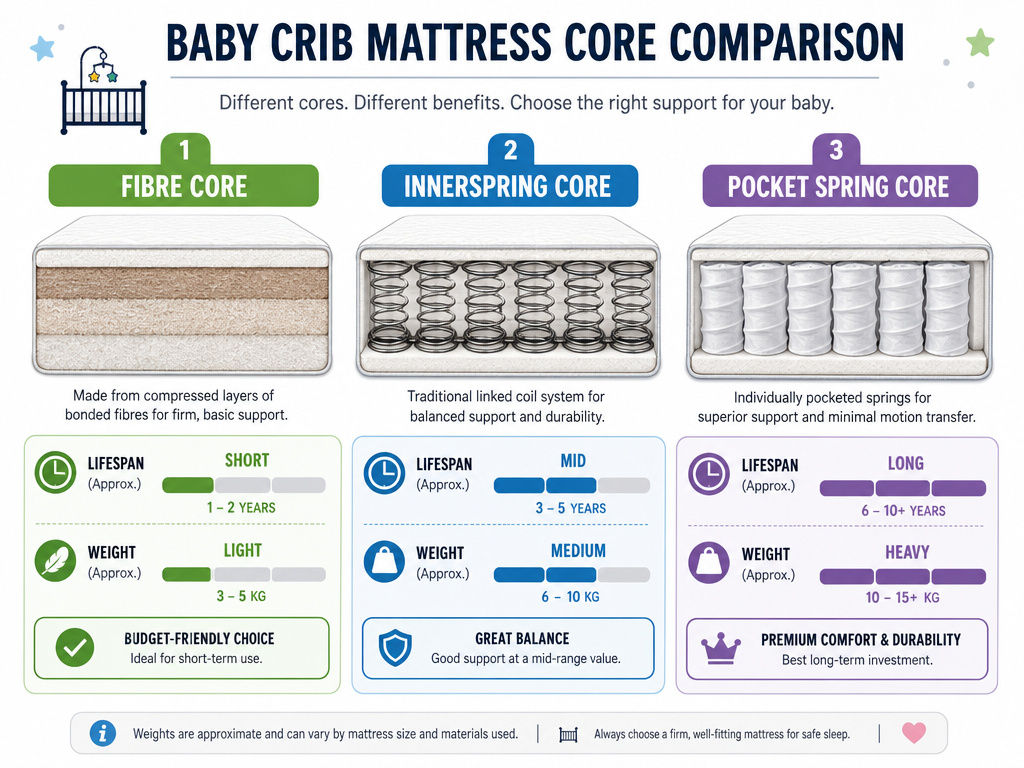 Fibre is the budget-friendly, lightweight option. The others cost more but last longer. Your choice depends on whether this mattress will be used for one child or passed down.
| Core Type | Best For | Weight & Ease | Lifespan & Cost | Risk If Compromised |
|---|---|---|---|---|
| Fibre | First-time parents, tight budgets, lightweight needs. | Lightest (8-13 lbs). Easy to lift for sheet changes. | Shortest. Compresses over 12-18 months of use. Lowest cost. | Core compresses, creating uneven surface and larger crib gaps. Loses firmness. |
| Innerspring | Families wanting a traditional, durable feel. | Heavy (10-20 lbs). Harder to maneuver alone. | Long. Steel coils resist permanent compression. Mid-range cost. | If coils fail, can create sharp depressions. Must be checked for sagging. |
| Pocket Sprung | Long-term use, multiple children, premium support. | Heaviest. Requires careful handling. | Longest. Lasts about 15% longer than standard fibre. Highest cost. | Same as innerspring. Premium price, but the best durability you can buy. |
A pocket sprung mattress is the durability king. Each spring is in its own fabric pocket, so it adapts without transferring motion. It’s the choice if this will be your only nursery mattress for years. For a single child, a high-quality organic crib mattress with a fibre core may suffice, but know you might replace it sooner.
The “breathability” edge of fibre is real but minor. The air pockets help dissipate heat slightly better than a solid foam block. For a baby who runs hot, it’s a point in fibre’s favor. For all babies, the essential crib mattress for newborns is firm and fits—regardless of core type.
How to Vet a Specific Fibre Mattress Before You Buy
Don’t trust the product description alone. Follow this checklist.
- Find the Compliance Label. Look on the mattress itself or the product spec sheet for “Conforms to ASTM F2933” and “Meets CFR 16 Part 1241.2” or similar. No label, no sale.
- Check the Dimensions. Know your crib’s exact interior measurement. The mattress must be within a half-inch of that length and width. For a mini crib mattress or a cot mattress, this is even more critical—order the manufacturer’s recommended size.
- Identify the Core Material. Is it standard polyester fibre or a natural blend? Coconut fibre adds firmness and moisture resistance. Wool is temperature-regulating but often requires special care.
- Read the Warranty. A 5-year warranty suggests the manufacturer trusts the core won’t compress significantly. A 1-year warranty is a red flag.
- Plan for the Cover. You will need a waterproof mattress protector. Ensure the mattress cover is removable and washable. The best ones are quiet (not crinkly) and truly waterproof.
Common mistake: Prioritizing a “breathable crib mattress” over verified firmness. The AAP notes no evidence these reduce SIDS risk. A firm, well-fitting standard mattress is safer than a “breathable” one that’s even slightly soft.
When a Fibre Mattress is a Bad Idea
There are clear scenarios where you should pick a different type.
- For a Second or Subsequent Child. A used fibre mattress has likely compressed. Its support is uneven, and it may not fit the crib as tightly. The CPSC incident data includes reports of depressions and “bunching up.” Start fresh.
- If You Need a Mattress for a Bassinet or Cradle. The thickness is different. A standard 6-inch crib mattress is too tall. You need a specific bassinet mattress or cradle mattress designed for that product’s shallow depth and smaller dimensions.
- When Allergies are a Severe Concern. While new fibre mattresses are hypoallergenic, older ones can harbor dust mites. If your child has severe asthma or allergies, a new mattress with an allergen-barrier cover is mandatory. Some natural fibres like wool are naturally dust-mite resistant.
- If You Want a “Green” Option. Standard polyester fibre is a petroleum product. For an eco-conscious choice, look for a certified organic crib mattress with GOTS-certified cotton and natural latex or coconut fibre.
Your safest path is to buy a new mattress designed for the specific sleep product. The AAP recommends this to ensure fit. An after-market mattress for a play yard must meet the same ASTM crib mattress standard as a crib mattress and be tested with that specific model.
Frequently Asked Questions
Are natural fibre mattresses safer than synthetic?
They are not inherently safer from a suffocation or entrapment standpoint. Both must pass the same firmness and fit tests. Natural fibres like coconut or wool can better manage moisture and heat, which may improve comfort. Their main advantage is material origin, not safety performance.
How often should I replace a fibre crib mattress?
Replace it if you see any permanent indentation, if it feels less firm, or if it no longer fits the crib snugly. For a single child, a quality fibre mattress should last through the crib years (2-3 years). If it will be used for a second child, inspect it rigorously for sagging. Many experts recommend a new mattress for each child.
Can I use a mattress topper to make it softer?
No. Never add a topper, pad, or additional padding to a crib mattress. It creates a soft, pliable surface that increases the risk of suffocation and overheating. The mattress must be used exactly as sold, with only a fitted sheet and a protective cover for a crib mattress.
Is a fibre mattress okay for a toddler bed?
Once a child transitions to a toddler bed (around age 2-3), the suffocation risk diminishes greatly. A fibre mattress from the crib can be used if it’s still structurally sound and fits the toddler bed frame securely. However, if it’s compressed, investing in a new, supportive mattress is better for their growing spine.
Do I need a special sheet for a fibre mattress?
You need a well-fitting crib sheet, preferably 100% cotton. The sheet must be tight enough not to come loose, as loose bedding is a hazard. The sheet’s tension can also affect mattress fit, which is why the ISO safety and test methods specify testing with a washed cotton sheet.
Before You Go
A fibre mattress is a valid, safe choice if you buy a new, certified model and commit to checking its firmness and fit every few months. Its pros are light weight and cost. Its con is shorter lifespan.
Skip the marketing hype about breathability. Focus on the label: ASTM F2933-25. Pair it with a high-quality waterproof protector. For a single baby in a standard crib, a good fibre mattress does the job. For a long-term investment across multiple children, the added cost of a pocket sprung model pays off in durability. The goal is a flat, firm, unchanging surface. Everything else is secondary.
