
How to Use Baby Travel Pillow: The Complete Safety Guide
This post contains affiliate links. As an Amazon Associate we earn from qualifying purchases.
Use a baby travel pillow only for comfort and support during travel for children over 12 months, and never in an unsupervised sleep space. For infants under 12 months, official safety guidance from bodies like the UK Department for Education prohibits adding any pillows, toys, or loose bedding to cots, travel cots, or bassinets due to suffocation risks. The only sanctioned use is with specific car seat accessories, like the head and back pillows in the Maxi-Cosi Pria All-in-One, which the manual states are only for rear-facing mode and must be used together.
That distinction, between a travel comfort aid and a sleep space addition, is where the real risk lives. A pillow that keeps a toddler’s head from bobbing on a road trip is one thing. Placing that same pillow in a bassinet for an infant is a documented hazard with a clear timeline to failure.
What follows is not a list of product recommendations. It’s a breakdown of three proven safety frameworks: the manufacturer-specific rules printed in car seat manuals, the blanket prohibitions from public health authorities, and the narrow window where a travel-specific pillow like the Trtl Pillow Junior fits for older children. By the last section, you’ll be able to read any product manual and spot the single sentence that decides whether a pillow is safe or a violation.
Key Takeaways
- Car seat pillows like those in the Maxi-Cosi Pria are accessories with strict mode rules, they are only for rear-facing use and often must be used in pairs, per the manual.
- For any sleep space (cot, bassinet, travel cot), official guidance for infants under 12 months mandates a clear, flat, firm surface with no added pillows, padding, or soft bedding.
- If an infant under 12 months falls asleep in a car seat, the UK Department for Education states they must be transferred to a safe sleep space upon return, even if it means waking them.
- Travel pillows like the Trtl Pillow Junior are designed for awake or supervised travel comfort for children roughly 8 and up, not for unattended sleep.
- Always verify that travel sleep products like the Silver Cross Sleep&Go comply with current safety standards like ASTM F2194-22e1 or BS EN 716-1:2017.
The One Rule Every Car Seat Manual Repeats
Head to the accessories section of any convertible car seat manual. The language is never casual. For the Maxi-Cosi Pria All-in-One, the manual dated May 2015 states its small infant positioning pillow, head pillow, and back pillow are “Only For Use in Rear-Facing Mode.” It goes further: the head and back pillows “MUST be used together.”
The Maxi-Cosi Pria All-in-One car seat manual specifies that its head pillow, back pillow, and small infant positioning pillow are only for use in rear-facing mode. The head and back pillows must be used as a pair. The small infant pillow should be removed once the harness slots are at or below the infant’s shoulders and a snug fit is achievable without it.
This isn’t a suggestion. It’s a condition of safe use tied to the seat’s crash-test certification. These pillows are part of the seat’s system to position a smaller infant correctly so the harness rests at or below the shoulders. Using them in forward-facing mode, or using one without the other, changes the geometry the seat was tested under.
The manual includes a 10-year expiration from the date of manufacture for the seat itself. The accessory rules have the same weight. Ignoring them voids the safety premise.
What the Official Sleep Safety Guidance Says
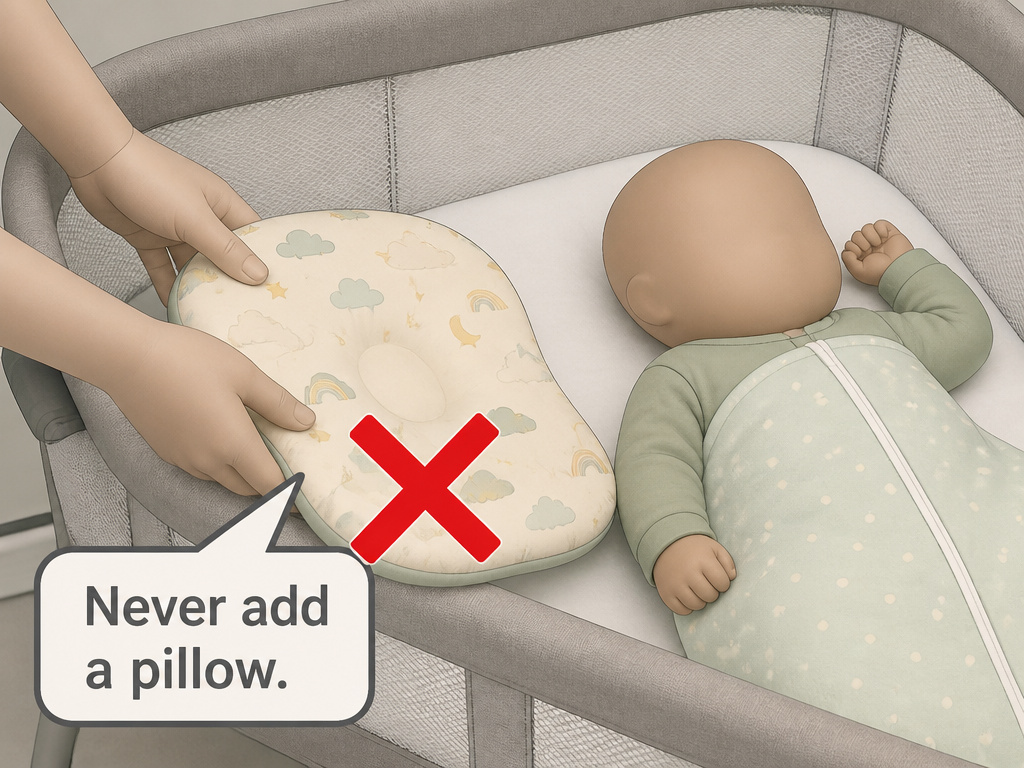 For sleep, actual, unattended sleep, the guidance from health authorities is unanimous and absolute. The UK Department for Education, in collaboration with The Lullaby Trust, publishes direct safer sleep recommendations for providers. It states that for babies aged 12 months and under, sleep spaces “must not contain extra items such as toys, pillows, loose bedding, bumpers, wedges or straps.”
The Chicco LullaGo Anywhere SE bassinet manual echoes this with a stark warning: “Use ONLY the pad provided by Chicco. Never add a pillow, comforter, or another mattress for padding.”
| Sleep Space Type | Official Rule for Infants (<12 months) | Consequence of Adding a Pillow |
|---|---|---|
| Cot / Travel Cot | Must be clear; only a firm mattress and lightweight bedding. | Increases risk of suffocation and head covering. |
| Bassinet / Moses Basket | Use only the manufacturer-provided pad. | Creates gaps between padding and sides; infant can roll into space and suffocate. |
| Car Seat (for sleeping) | Not a recommended sleep space; infant must be transferred. | Risk of positional asphyxia; head can slump forward, blocking airway. |
The mechanism is physical. An infant lacks the neck strength and motor control to reposition themselves if their face presses into soft padding or if they roll into a gap created by an added mattress or pillow. Suffocation is silent and can happen in minutes.
Where this goes sideways: Assuming a “travel pillow” is safe for naptime in a stroller or bassinet. The prohibition isn’t about the pillow’s quality, it’s about any soft item in the sleep environment for a child under one.
TL;DR: For sleep, under one year, the rule is zero added soft items. A travel pillow does not get an exemption.
The Critical Transfer Rule for Sleeping Infants
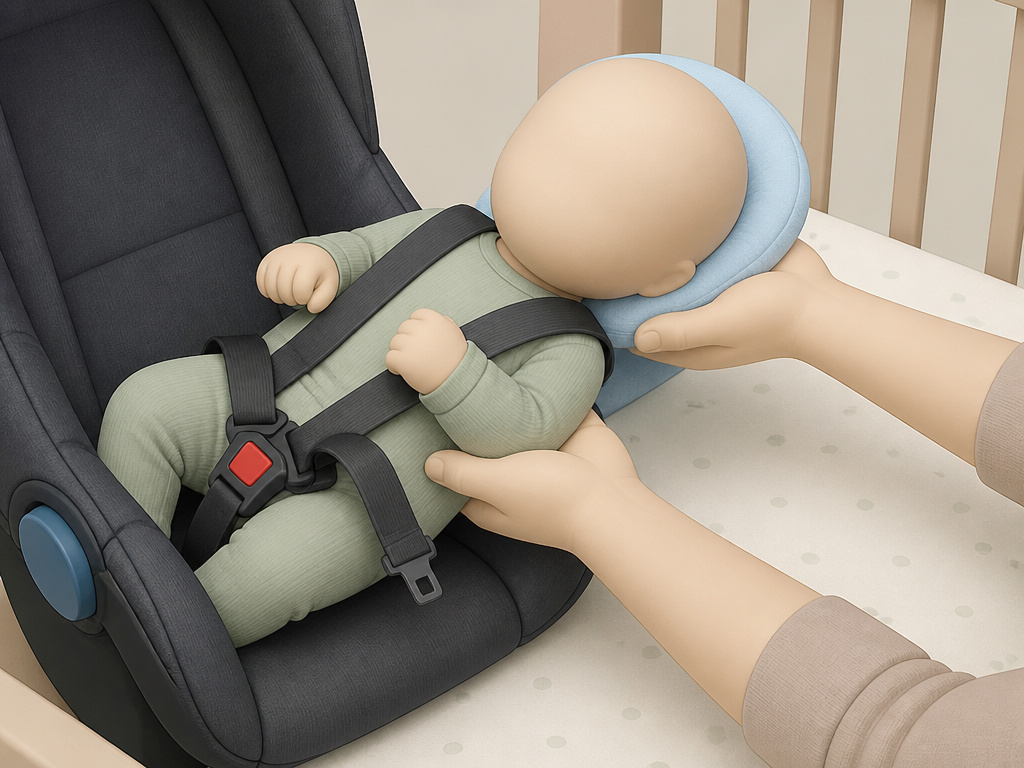 This is the procedural step most parents hope to avoid but is non-negotiable. The same UK government guidance states: “Babies aged 12 months and under that fall asleep whilst travelling must be transferred to their cot once they return to the setting.” It adds that NHS guidance advises removing hats and extra clothing upon entering a vehicle or indoors, “even if it means waking the baby.”
Why is this so firm? A car seat is a seated, semi-reclined position. An infant’s heavy head can slump forward, chin-to-chest, potentially obstructing their airway, a condition called positional asphyxia. This risk is present even with proper harness fit and is why car seats are for travel, not for primary sleep.
The guidance for children over 12 months is slightly relaxed but still clear: they should be transitioned to a separate sleep space on a clear, flat, firm surface. A lie-flat pram is not considered a main separate sleep space.
When Are Travel Pillows for Kids Actually Meant for Use?
The market for travel pillows for kids and neck pillows for kids exists for a reason. They are designed for comfort during awake travel or supervised rest for children who are well past the infant suffocation risk window.
Take the Trtl Pillow Junior. Its specs are for kids and teens 8-18 years and petite adults. It’s 18 x 22 x 9 cm and uses a 10 mm foam support structure. It is not marketed for sleep in a crib. It’s for a child who can sit upright, communicate, and reposition themselves on a long flight or car ride. The same logic applies to looking for the best pillows for children for their bed at home, these are for older children who have moved out of a crib entirely.
| Product Type | Intended User Age | Primary Use Case | Safe for Unattended Sleep? |
|---|---|---|---|
| Trtl Pillow Junior | 8 years and up | Neck support during seated travel (car, plane) | No |
| Car Seat Head Pillow (e.g., Maxi-Cosi) | Per car seat manual (rear-facing infants) | Positioning as part of car seat system | Only during travel in the correctly installed seat |
| Standard Bed Pillow | Toddler+ in a toddler bed | Sleep in a safe, flat bed | Yes, for the appropriate age |
The line is functional independence. If a child cannot reliably roll over, push up, and clear their own airway, they should not have any pillow in their sleep space. Full stop.
How to Choose and Use a Support Pillow for Travel
If you’re considering a support pillow for an older child’s travel comfort, your checklist changes from “is it safe for sleep?” to “does it fit the scenario?”
- Match the product to the child’s size and age. The Trtl Pillow Junior is sized for smaller frames. An adult-sized travel pillow will not provide proper support for a young child and could push their head into an awkward position.
- Follow the manufacturer’s washing instructions. All Trtl travel pillows are machine washable on a cold setting after removing the internal support. Hygiene is part of safety.
- Use it only in the seated, supervised travel context for which it was designed. Do not let it migrate into the child’s bed or nap space unless they are of an age where a regular bed pillow is already appropriate.
- For infants, only use car seat accessories that came with the seat or are approved by the manufacturer. And only as the manual dictates. Never add an aftermarket head support pillow that wasn’t tested with your specific seat model.
For other types of infant support, like during feeding or play, parents often look at dedicated nursing pillows or tummy time pillows for newborns. These are for fully supervised, awake activities and should be put away immediately after use.
Standards and Certifications to Look For
When evaluating any product meant for a child to rest in, the certification is your guardrail. For a travel cot or portable bassinet, look for compliance with a recognized standard. The Silver Cross Sleep&Go manual states it complies with ASTM F2194-22e1 (for bassinets) and ASTM F406-22 (for play yards). In the UK, the relevant British Standards are BS EN 716-1:2017 for cots and BS EN 1466:2014/2023 for carrycots.
These standards dictate everything from the firmness of the mattress and the height of the sides to the strength of the locking mechanisms. They are why a product manual screams “NEVER ADD A MATTRESS, PILLOW, COMFORTER, OR PADDING.” Adding anything changes the dimensions and safety features the product was certified to meet.
Common mistake: Using a travel cot without the specific mattress pad it came with, or adding a softer topper. This creates the exact “gaps between extra padding and side” that the Chicco manual warns can lead to suffocation.
If you’re considering a baby lounger pillow, understand its intended use is for supervised, awake lounging on the floor, not for sleep, and never in an elevated or enclosed space.
Frequently Asked Questions
Can a newborn use a travel pillow?
No. Newborns should not use any pillow in any context other than a specific car seat positioning pillow that is part of the seat’s certified system and used exactly as the manual instructs. For sleep, the guidance for safe pillows for newborns is clear: none until at least 12 months, and often longer.
Are there safe baby travel pillows for airplanes?
For infants under one, the safest option is no pillow. For older toddlers and children, a travel pillow like the Trtl Pillow Junior can provide neck support while they are awake or napping in an upright seat under your direct supervision. It is not for unattended sleep.
How do I know if my car seat pillow is safe?
Check your car seat manual. It will specify if the included pillows are approved for use, which modes (rear-facing only), and if they must be used in combination. Never use an aftermarket head support that wraps around the child’s head or neck, as it can interfere with harness fit.
What should I use instead of a pillow for infant travel comfort?
For car travel, ensure the harness is properly adjusted and the child is dressed comfortably. For sleep on the go, use a product designed for safe infant sleep, like a travel cot that meets safety standards, and always use only the mattress pad it comes with.
Before You Go
Using a baby travel pillow correctly boils down to three questions. Is it a manufacturer-mandated part of a car seat system? Is your child over 12 months and using it only for awake travel comfort? Are you following the absolute rule of a clear, flat, firm sleep space for any infant under one? The manuals from Maxi-Cosi and Chicco, and the guidance from the UK Department for Education, give you the answers. They are specific, they are strict, and they are what stand between a comfortable journey and a preventable risk. Your job is to read them and follow them to the letter.
