
How to Safely Co Sleep with Baby: Essential Safety Guidelines
This post contains affiliate links. As an Amazon Associate we earn from qualifying purchases.
To safely co sleep with a baby, you must control three things: the sleep surface (a firm, flat adult mattress, never a sofa), the sleep environment (no pillows/loose bedding near baby, baby on back), and the condition of the adults (sober, non-smoking, and alert). The highest risk comes from sofa co-sleeping, which increases SIDS risk by up to 50 times according to high-quality case-control studies.
This isn’t about eliminating risk, that’s only possible with a separate crib in your room. It’s about minimizing it to the absolute lowest level if you choose to share a bed. The difference between a prepared adult bed and a sofa isn’t just comfort; it’s a documented, quantifiable chasm in safety outcomes.
What follows is the breakdown of those three pillars, the specific scenarios where bed sharing becomes dangerously unsafe, and the one sleep setup that offers protection without the same hazards.
Key Takeaways
- Sofa or armchair co-sleeping increases the risk of SIDS by up to 50 times. It is the single most dangerous common sleep practice.
- The firmness of your mattress is non-negotiable. A pooled analysis of case-control studies shows a clinically important increase in SUDI risk on soft surfaces because a baby’s head sinking in raises their thermal environment.
- Adult impairment is a direct hazard. The strongest predictor of SUDI in shared sleep is the combination of recent maternal alcohol consumption and a soft shared surface.
- Room sharing, where baby sleeps in a separate crib or bassinet next to your bed, is universally protective and cuts SIDS risk by up to 50% without the risks of surface sharing.
- One specific study found no increased SUDI risk from a pillow in the adult bed, but expert committees still advise against it based on broader infant sleep evidence.
The 3 Pillars of Safe Surface Sharing
If you are going to share a sleep surface, your entire setup must pass these three checks. Fail one, and the risk profile changes dramatically.
1. The Right Surface: Firm, Flat, and Clear
Your mattress must be firm. Not “pretty firm” or “comfortable for you.” It must be firm enough that your baby’s head does not sink in when placed on their back.
When a baby’s head sinks deeper into a soft mattress, it can increase the thermal environment around them, which may increase the risk of sudden unexpected death of an infant. This is the mechanism identified in the evidence review.
This isn’t theoretical. A high-quality case-control study (195 cases, 194 controls) showed a clinically important increase in SUDI risk when bed sharing on a soft mattress versus a firm one. Your memory foam topper, pillow-top, or old sagging mattress is a soft surface.
The bed must also be clear of hazards for the baby: * No gaps: The mattress must fit snugly against the headboard and walls. A baby can become trapped in a gap as small as two fingers wide. * No loose bedding: Keep adult pillows, duvets, comforters, and blankets well away from the baby. Use a wearable sleep sack or blanket on yourself that cannot cover the baby’s head. * Position: Always place the baby on their back, on a flat surface. Never allow them to sleep on their side or tummy in your bed.
2. The Right Environment: Baby-Centric and Simple
You are adapting an adult space for an infant. The baby’s needs override your comfort.
The Pillow Paradox
Here’s where the data gets specific. One case-control study found no greater risk of SUDI when bed sharing with a pillow compared to without one. But the expert committee reviewing that same evidence still advised against pillows near the baby. Why? Their recommendation was based on broader infant sleep evidence not specific to co-sleeping. The conservative, safest path is to keep all pillows far from the baby’s sleep space.
Temperature and Clothing
Overheating is a known risk factor. Dress the baby lightly, a onesie or sleep sack is usually sufficient. If you are using a blanket for yourself, it should be lightweight (like a cellular blanket) and securely tucked under your arms so it cannot ride up.
The “No Others” Rule
The bed is for you and the baby only. One study indicated a clinically important increase in risk when bed sharing with others (like other children or pets) compared to just the mother or mother and father. Your toddler or dog does not belong in the bed during infant co-sleeping.
3. The Right Condition: Sober, Alert, and Aware
This is the most personal and critical pillar. Your physical state directly impacts your baby’s safety.
Where this goes sideways: Sharing a bed after even two units of alcohol. High-quality evidence shows this creates a clinically important increase in SUDI risk, likely due to impaired parental arousal and responsiveness.
The strongest predictor identified in the research is the combination of recent maternal alcohol consumption and sleeping together on a soft surface. The same absolute prohibition applies if you or your partner: * Have taken any medication that causes drowsiness (e.g., certain cold medicines, sleep aids, pain relievers). * Have used recreational drugs. * Are a smoker (smoking itself reduces arousal, and the risk is present even if you don’t smoke in bed). * Are excessively fatigued to the point of impaired awareness.
If any of these conditions apply, the only safe option is a separate sleep space like a bedside sleeper or bedside bassinet.
When You Must Avoid Bed Sharing Entirely
Some risks are so well-documented that the advice is categorical: do not share a sleep surface. This isn’t scare talk; it’s the consistent finding of multiple peer-reviewed studies.
| Scenario | Documented Risk | Safer Alternative |
|---|---|---|
| On a Sofa or Armchair | Increases SIDS risk by up to 50 times. Baby can become trapped or overheat. | Place baby in their safe sleep space immediately if you feel sleepy. |
| Adult Impairment (Alcohol/Drugs) | Strongest predictor of SUDI on a shared surface. | Use a separate infant bed next to you. |
| Parental Smoking | Smokers have reduced arousal; multiple studies show increased risk. | Room share with baby in a separate bassinet. |
| Baby Born Preterm or Low Birth Weight | These infants are at higher baseline vulnerability. | A co-sleeping bassinet provides proximity without risk. |
| Extreme Fatigue | Impairs awareness and responsiveness similar to substances. | Put baby in their crib before you become too tired. |
The Sofa is Not a Bed
This point cannot be overstated. High-quality evidence from a pooled analysis of two case-control studies shows a clinically important increase in SUDI risk when co-sleeping on a sofa versus in a bed. The cushions create a suffocation hazard, and the angles can trap a baby. If you feed your baby on a sofa at night, have a plan to move them to a bedside crib the moment you feel drowsy.
Room Sharing: The Gold Standard of Proximity
There is a way to get the protective benefits of closeness without the risks of surface sharing. Researchers concur that room sharing, where the baby sleeps in their own cot or bassinet in the same room as the parents, is protective against SIDS and should be encouraged.
It can reduce the risk of SIDS by as much as 50%. This setup allows you to hear and respond to your baby easily, supports breastfeeding, and provides all the reassurance of proximity while giving your baby a dedicated, safe surface.
This is why products designed for safe proximity exist. A quality bedside sleeper bassinet attaches securely to your bed frame, giving your baby their own firm, flat space with a breathable surround. It’s the compromise that satisfies the biological urge for closeness and the evidence-based need for a separate sleep space.
Choosing and Preparing Your Sleep Space
 Your gear matters. Whether it’s your adult bed or the baby’s own sleep product, it must meet specific safety standards.
If Using Your Bed:
- Mattress: It must be firm. If you’re unsure, invest in a high-quality, firm baby mattress and place it on the floor in a safely prepared room (no cords, gaps, or hazards). A floor bed is safer than a soft adult mattress on a frame.
- Bedding: Use a tight-fitting sheet on your mattress. Your pillows and duvet stay on your side, away from the baby.
If Using a Separate Sleeper:
- Certifications: Look for products that meet recognized safety standards like the British BSEN716 (which specifies slats no more than 6.5cm apart) or the Australian AS/NZS2172-2010 for cots.
- Firmness: The included mattress must be very firm. Many breathable mattress options are designed for this exact purpose, firm support with enhanced airflow.
- Installation: Follow the manufacturer’s instructions exactly. Ensure any bedside sleeper products are securely attached with no dangerous gaps between the adult bed and the infant unit.
The NCBI Bookshelf on co-sleeping risks details how environmental factors like surface softness translate into physiological risk. Your equipment is your first line of defense.
The Reality of Unplanned Co-Sleeping
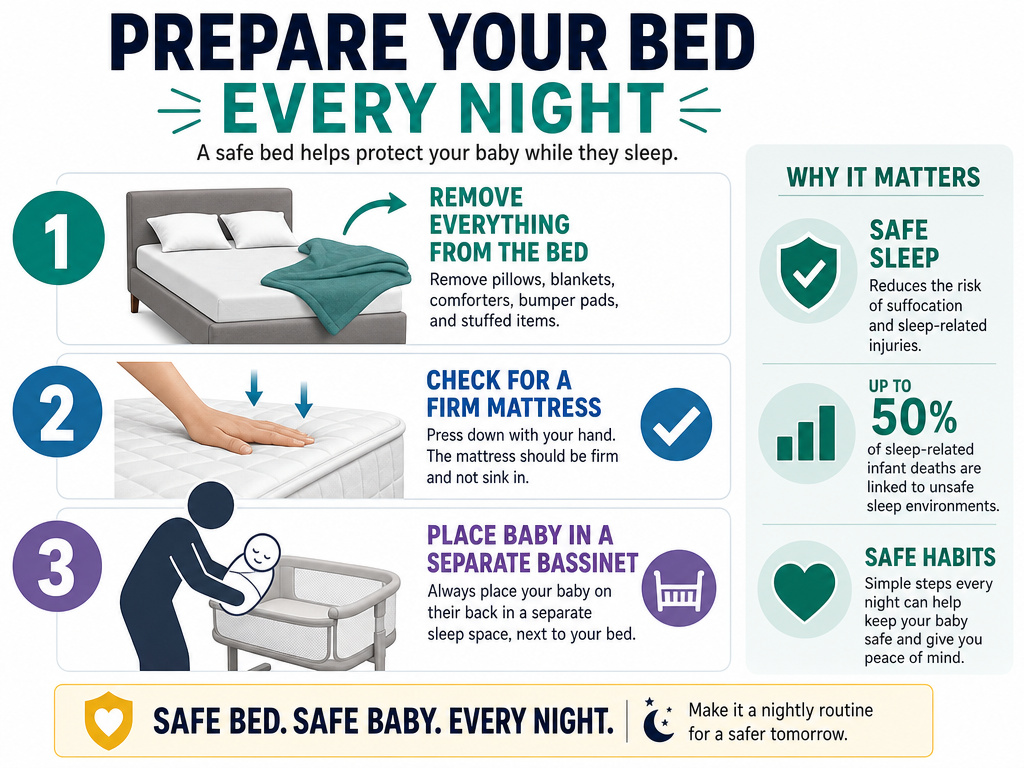 Many parents fall asleep with their baby unintentionally, often during a night feed. Since this is so common, the safest approach is to prepare your bed every night as if you might co-sleep, even if you don’t plan to.
Make it a habit: 1. Strip the bed of excess pillows and heavy blankets before you start the feed. 2. Ensure the mattress is firm and there are no gaps. 3. If you feel sleepy while feeding in bed, place the baby in their own space immediately. If you’re on a sofa, get up and move.
This “prepare for the unexpected” strategy is more practical than relying on perfect vigilance at 3 a.m. The NCBI shared sleeping surfaces report emphasizes that risk is about circumstances, not just intent.
Frequently Asked Questions
Is it safe to co-sleep with a newborn?
The same safety pillars apply regardless of age. However, newborns are especially vulnerable due to their limited mobility and strength. The safest arrangement for a newborn is room sharing in their own safe bedside bassinet. If bed sharing, you must be hyper-vigilant about mattress firmness, bedding, and your own alertness.
Can I co-sleep if I breastfeed?
Breastfeeding is protective against SIDS and often makes co-sleeping more likely due to frequent night feeds. The key is to follow the safe sleep pillars strictly. Prepare your bed, and if you are impaired by fatigue or anything else, use a sidecar bassinet for feeding and then place the baby back.
What is the difference between co-sleeping and bed sharing?
Co-sleeping is the broad term for a baby and caregiver sleeping in close proximity. Bed sharing is a subset, meaning sharing the same sleep surface (like a bed). Room sharing, where the baby is in a separate crib in the same room, is also a form of co-sleeping and is the safest recommended option.
Are there any products that make bed sharing safe?
No product can make an unsafe sleep surface (like a soft mattress or sofa) safe, or counteract parental impairment. Products like bedside sleepers are designed to provide a separate, safe surface that attaches to your bed, which is room sharing, not bed sharing.
How long is co-sleeping recommended?
There is no official recommended duration for bed sharing. Room sharing is recommended for at least the first six months. As your baby becomes more mobile (around 4-6 months), the risks in an adult bed can change, as they may move into unsafe positions. Many families transition to a standalone crib in the parent’s room as mobility increases.
Before You Go
Safe co-sleeping isn’t a single rule. It’s a system built on a firm surface, a clear environment, and alert caregivers. The data is clear: a sofa is in a different danger category altogether, and adult impairment turns a calculated risk into a reckless one.
Your safest path is always room sharing with a dedicated crib or bassinet. If you choose to share your bed, let that choice be informed, deliberate, and rigidly adherent to the three pillars. Your vigilance is the final, most important piece of safety equipment.
